
As an Amazon Associate, we earn from qualifying purchases. This helps support our site at no extra cost to you.
If your golf cart won't charge, do not buy a new charger yet. Sometimes the charger is bad. A lot of the time the real problem sits on the cart itself: a loose charge receptacle, corroded contacts, a heat-damaged plug, a failed reed switch, or a battery pack so low the charger never wakes up.
That is what makes charging-port problems frustrating. The symptoms overlap. A bad port can look like a bad charger. A dead battery can look like a bad port. A stuck interlock can make the cart refuse to move even after you unplug it, which sends owners down the wrong path entirely.
This guide is the practical fix path for an electric golf cart that won't charge, Club Car charging problems, EZGO charging port problems, hot plugs, bad receptacles, and even the separate "Club Car USB port not working" issue that owners often confuse with the main charge port. If you are still trying to identify the connector family itself, use our newer golf cart charger plug compatibility guide first. If the connector is correct and the bigger question is charger quality or normal charge length, pair this page with our best golf cart chargers guide and golf cart charge-time guide.
Stop charging If the plug or receptacle becomes unusually hot
Match first Cart model, voltage, connector, and part number
Test first Outlet power and total pack voltage
12V circuit Club Car USB is separate from the main charge port
Golf Cart Won't Charge: Quick Diagnosis
| Symptom | Most Likely Cause | First Check |
|---|---|---|
| Golf cart won't charge at all | Low pack voltage, dead outlet, bad charger, or open charge circuit | Test outlet power and total pack voltage first |
| Electric golf cart won't charge after storage | Battery pack below charger wake-up voltage | Measure pack voltage and each battery |
| Charger only works when you wiggle the plug | Loose, worn, or corroded charging port | Inspect receptacle pins, plastic housing, and charger handle fit |
| Charger plug gets hot | High resistance at the port, plug, outlet, or extension cord | Stop charging and inspect for corrosion, heat damage, and loose contacts |
| Club Car charging problems | Receptacle/fuse issue, OBC fault, ERIC compatibility issue, or wrong lithium profile | Identify PowerDrive/OBC vs ERIC-era charging system |
| Club Car USB port not working | 12V accessory fuse, reducer, key-switch feed, or USB socket issue | Check fuse, voltage reducer output, and dash wiring |
| EZGO charging port issue | PowerWise D wear, reed switch fault, triangle-plug damage, or Delta-Q receptacle issue | Identify TXT/RXV connector type before ordering parts |
EZGO Charging Port Replacement vs Club Car USB Replacement
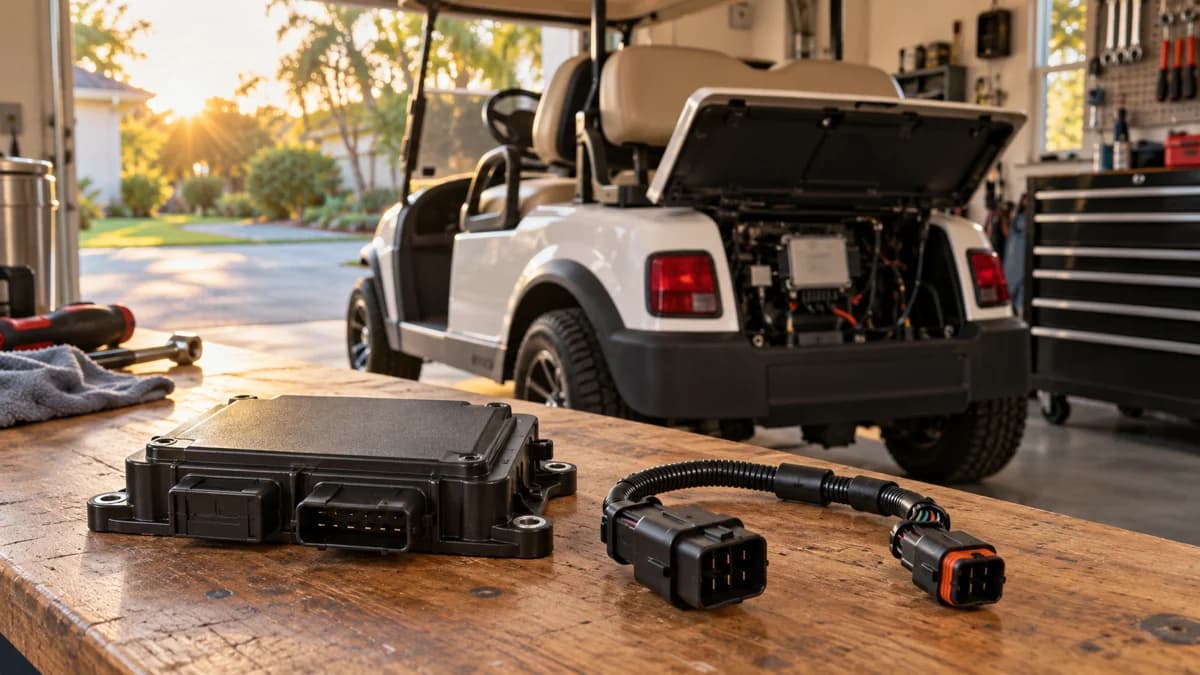
These are different repairs. For an EZGO charging port replacement, match the cart model, year range, pack voltage, connector shape, and OEM part number. Inspect the charger handle too, because a heat-damaged handle can quickly damage a new receptacle. Do not bypass a run-disable circuit or interlock without the model-specific wiring diagram.
A Club Car USB port not working usually belongs to the 12V accessory circuit, not the high-voltage battery charging circuit. Check the accessory fuse, voltage reducer output, key-switch feed, ground, and USB socket. Replace the USB socket only after confirming it receives the voltage specified for that accessory. Disconnect pack power and follow the cart service procedure before opening either circuit.
What a golf cart charging port actually does
The charging port, also called the charge receptacle, is the female connector mounted on the cart. It does more than hold the charger handle.
On a basic level, the port is the entry point for charging current. On some cart models, it is also tied into other logic:
- the charger has to see a clean electrical path through the receptacle
- some systems use a fuse or harness at the port
- some older EZGO setups use a reed switch in the receptacle as part of a run-disable circuit
- some Club Car systems involve the On-Board Computer in the overall charging path
That is why a bad port can create more than one symptom. The cart might fail to charge, charge intermittently, stop charging too early, or even refuse to move after unplugging.
Because this wiring varies by model, use the cart's service manual or an authorized dealer to confirm whether the receptacle contains a reed switch, fuse, or other run-disable circuit. Do not use a generic bypass as a diagnostic shortcut.
Electric Golf Cart Won't Charge: Start Here
When an electric golf cart won't charge, use the cheapest checks first. A charging-port problem is common, but it is only one part of the no-charge chain.
- Confirm AC power: Try another outlet and remove questionable extension cords. If you must use a cord, follow the charger extension cord safety guide.
- Match the charger to the cart: Voltage, connector, and lithium vs lead-acid profile all matter. If the plug or profile is wrong, use the charger plug compatibility guide.
- Read the charger lights: Charger fault lights can point to bad batteries, a timeout, polarity, or no pack connection. Use the charger light codes guide before guessing.
- Measure pack voltage: A smart charger may not wake up if the pack is deeply discharged. Check the battery voltage chart and test each battery.
- Inspect the charging port: Look for heat damage, corrosion, loose pins, cracked plastic, and a handle that does not seat firmly.
- Check brand-specific interlocks: Older EZGO PowerWise carts may involve a reed switch. Older Club Car 48V carts may involve OBC logic. Newer lithium conversions may involve BMS sleep or charger-profile mismatch.
If the cart is lithium and the charger looks dead, go straight to the lithium battery not charging guide after the basic port inspection.
The most common golf cart charging port problems
The charger handle gets hot
This is one of the clearest warning signs.
If the plug or receptacle feels unusually hot during charging, resistance is building somewhere at the connection. That resistance usually comes from:
- loose contacts
- corrosion on the pins
- worn receptacle tension
- arcing damage
- partially melted plastic that no longer holds the handle squarely
Heat is not something to monitor casually. It is something to fix. Golf Cart Garage's charger safety literature specifically warns that a plug and receptacle feeling hotter than normal during charge is a fault condition worth stopping for. If you keep using a hot connection, you can damage both the charger handle and the cart-side receptacle.
If the heat only appears when you use a cord, check our golf cart charger extension cord safety guide before blaming the cart-side port.
The charger only works when you wiggle the plug
This is the classic worn-port symptom. The charger may click on, drop out, then come back if the handle is repositioned. That usually means the port has lost a reliable physical connection.
At that point, cleaning may help only if the issue is light corrosion. If the handle needs pressure or the cart charges only at certain angles, replacement is usually the real answer.
The charger never wakes up
Owners often assume the port is dead here, but the battery pack matters just as much. Many smart chargers need to see minimum pack voltage before they start. If the pack sat through winter or one battery failed badly, the charger may never click on at all.
This is why low-voltage battery problems and charging-port problems get confused so often. Our battery voltage chart guide and how long to charge a golf cart guide explain the battery side. This post stays focused on what the port adds to the problem.
For lithium carts specifically, our lithium battery not charging guide walks through BMS sleep mode, cold-charge lockout, and charger profile checks.
The cart will not move after unplugging
This is where the reed switch or charge interlock becomes the lead suspect.
Buggies Unlimited describes the reed switch on older EZGO PowerWise systems as part of the safety chain that prevents the cart from operating while plugged in. If that switch sticks in the charge state, the cart may stay disabled. On the driver side, that feels like a cart that suddenly has an electrical no-go problem for no obvious reason.
The charger cycles on and off
Intermittent cycling is often caused by:
- poor contact at the receptacle
- cracked or heat-damaged plug housing
- bad wiring at the port
- a weak battery pack that keeps falling out of the normal charging window
You need to inspect both sides, but the port is high on the list if the charger handle or cart-side connector shows visible wear.
How to tell whether the port or the batteries are at fault
This is the main decision tree that matters.
Signs the charging port is the main problem
- the handle gets hot fast
- the plug feels loose in the receptacle
- charging starts only when the plug is held a certain way
- you see green corrosion, black arcing marks, or melted plastic
- the cart will not move after charging and you suspect the interlock is stuck
Signs the batteries are more likely the main problem
- the port looks clean and tight
- the charger never wakes up after long storage
- total pack voltage is well below normal
- one battery is much lower than the rest
- the cart charges but range is still poor and lights sag under load
When both are likely bad
Older carts often give you both problems at once. A worn receptacle increases resistance and charging loss. A weak pack then spends more time trying to recover, which creates more heat and wear at the port. That cycle ends with owners replacing the charger, then the port, then the batteries, often in the wrong order.
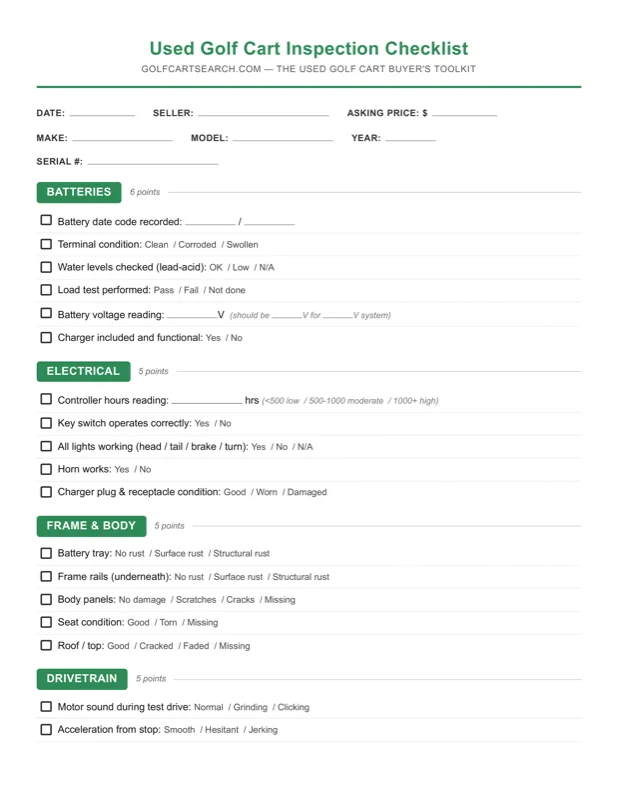
If you are facing all three costs at once, compare the repair total against a current golf cart value calculator estimate, our used buying guide, and local listings on our for sale directory.
Brand-specific charging port failures
EZGO charging port problems
EZGO gives you the widest range of charge-port confusion because the platform spans old SB50 connectors, 36V PowerWise D ports, 48V triangle-plug setups, and later Delta-Q style hardware.
The high-frequency EZGO charging-port issues are:
- dirty or corroded PowerWise D receptacles on older TXT and Medalist carts
- failed or marginal reed switches on PowerWise systems
- low pack voltage that makes a good charger look dead
- incorrect assumptions about whether the cart is still stock
Current pricing gives you a useful repair benchmark:
- Golf Cart Garage lists the RHOX EZGO TXT 36V PowerWise D receptacle at $87.99
- the full EZGO PowerWise receptacle assembly is listed around $107.99
- Buggies Unlimited lists the EZGO PowerWise receptacle reed switch at $67.99
- 3 Guys Golf Carts lists the EZGO 48V Delta-Q receptacle at $149.99 for 2010-2022 models, and Golf Cart Garage shows similar later Delta-Q TXT hardware around $260.99
That spread matters. A simple older 36V EZGO port issue can be a fairly cheap fix. A newer 48V Delta-Q port problem gets expensive quickly.
For the exact "EZGO charging port" question, do not order by brand alone. Match TXT vs RXV, year range, pack voltage, and plug family first. A 36V TXT PowerWise D receptacle, a 48V TXT triangle-style or Delta-Q receptacle, and an RXV receptacle are different repair paths.
If your EZGO is a TXT and you also need charger fitment help, use the dedicated EZGO TXT charger guide. If the question is connector families across brands, the charger plug compatibility guide is the better first stop.
If the plate is missing or the seller is unsure of the year, use the free golf cart VIN decoder before ordering a receptacle, charger, or reed-switch part by model year.
Club Car charging port problems
Club Car charging complaints often sound like charger failures because the On-Board Computer can muddy the picture.
On a typical 48V Club Car:
- the round 3-pin receptacle has to make a clean connection
- the fuse kit at the receptacle matters
- the OBC can prevent normal charging behavior even when the port physically looks fine
Buggies Unlimited currently lists a 1995-up Club Car 48V receptacle and fuse kit at $70.99, which is actually cheaper than many EZGO or newer Delta-Q receptacle parts. That means the part itself is not the expensive part of the Club Car diagnosis. The expensive part is the time lost if you replace the charger when the cart-side electronics were the real issue.
If the receptacle looks sound but the charger still acts wrong, do not ignore the possibility of an OBC-related fault. Our Club Car review, troubleshooting guide, and electric repair directory are the best next stops there.
If testing points to the onboard computer, our Club Car OBC bypass guide compares bypass and replacement costs and links to the DS and Precedent kit diagrams.
Club Car USB port not working
A Club Car USB port not working is usually a 12V accessory problem, not a main charging-port problem. The big charging receptacle feeds the traction battery pack. A dash USB charger should be on a separate accessory circuit that steps battery-pack voltage down to 12V.
Check this path:
- USB fuse: Look for a small inline fuse behind the dash or near the accessory harness.
- Voltage reducer output: Electric Club Car carts need a DC-to-DC converter. If the reducer has no 12V output, the USB port will be dead even if the main cart charges normally.
- Key-switch feed: Some USB ports are wired to work only when the key is on.
- Loose dash wiring: Spade connectors and ring terminals behind the dash shake loose on rough neighborhood roads.
- Corroded USB socket: A cheap USB insert can fail after rain, washing, or coastal storage.
Do not tap one or two batteries to power a USB port on a 36V or 48V cart. That creates pack imbalance and can make real charging problems worse. Use the voltage reducer wiring guide, fuse box guide, and dashboard tech upgrades guide for the accessory side.
Yamaha charging port problems
Yamaha has fewer interlock headaches than older EZGO PowerWise setups, but the connector families still vary enough to cause ordering mistakes. Golf Cart Garage currently lists:
- Yamaha 48V 2-pin receptacle around $95.99
- Yamaha Drive 48V 3-pin receptacle (2007-2010) around $138.99
- Yamaha Drive 48V receptacle (2010+) around $186.99
- premium Yamaha 2-pin chargers much higher than basic receptacle parts
That usually means Yamaha owners should verify the exact receptacle before ordering anything. The part is not always cheap enough to guess on, especially with the newer Drive family.
The reed switch problem most owners miss
The reed switch deserves its own section because it creates a failure pattern most owners do not understand the first time they see it.
On older EZGO PowerWise systems, the reed switch sits in the receptacle as part of the charging interlock. The charger or receptacle contains the magnetic trigger. Plug the charger in and the cart is supposed to know it is charging. Unplug it and the cart is supposed to return to normal drive mode.
When the reed switch fails, you can see one or more of these:
- cart will not move after unplugging
- cart moves only if the charge handle is wiggled or removed just right
- charger behavior becomes erratic
- the main solenoid does not engage even though the batteries are present
The Tara guide notes that the charger plug or receptacle typically contains the magnet that actuates the switch. That is useful because it explains why a bent or damaged port can cause interlock issues even when the switch itself is not electrically dead.
If you are troubleshooting an EZGO with a no-go symptom after charging, do not skip the reed switch.
What to try before replacing parts
Step 1: Inspect the port visually
Look for:
- green corrosion
- black soot or arc marks
- melted plastic
- loose movement in the receptacle
- cracked housing
- terminals pushed back out of position
Step 2: Clean light corrosion
If the port is only dirty or lightly corroded, start with cleaning.
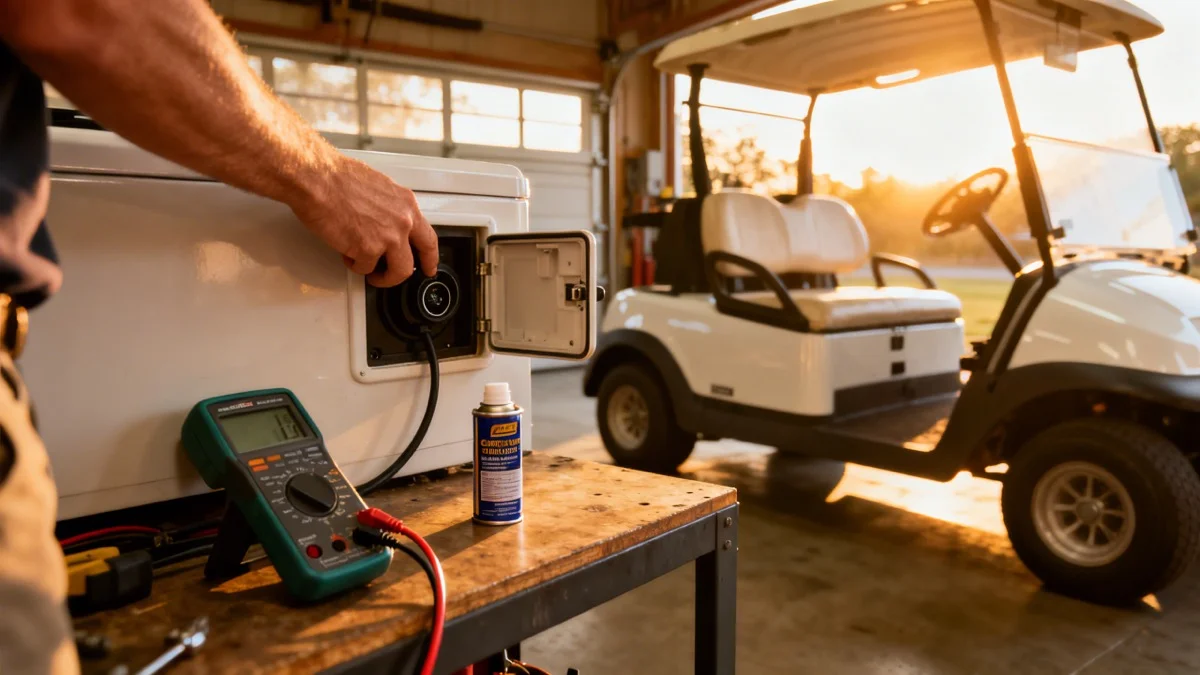
Spray the cleaner, let it flash off, and clean the contacts gently. If the pins are pitted or the housing is heat-damaged, skip the fantasy of “maintenance” and replace the part.
Step 3: Check pack voltage
Use a multimeter before blaming the receptacle.
Check Price on AmazonIf the port is clean but the charger never wakes up, low pack voltage may be the real problem. That is especially common after storage. Our spring checklist, winterization guide, and battery guide explain that side in more detail.
Step 4: Protect the connection after cleanup
If you caught the corrosion early and the port is still structurally good, add a corrosion barrier after cleaning.
CRC Battery Terminal ProtectorThis is not a fix for a burnt or loose port. It is only a prevention step once the connection is clean and stable.
Step 5: Replace the charger only after the port checks out
A new charger makes sense only once you know the port is solid and the pack is not obviously collapsed.
For common replacement scenarios:
If you are still unsure whether your problem is the charger, the port, or the batteries, do not just keep ordering parts. Use our electric golf cart repair shops near you directory to find a shop that can bench-test the charger and load-test the pack, or compare ranked golf cart repair shops by state if you want a review-based shortlist first.
When replacement is the right move
Replace the receptacle when
- the port is visibly melted
- the pins are loose or pushed back
- the charger handle does not stay engaged
- the port only works when you wiggle it
- repeated cleaning did not stop the heat or intermittent charging
Replace the reed switch when
- the cart acts like the charger is still plugged in
- the interlock behavior is erratic
- the receptacle body is fine but the switch is the weak link
- you have confirmed the issue on an older EZGO PowerWise setup
Replace the charger when
- the port is clean, tight, and undamaged
- the pack voltage is still within a reasonable operating range
- another known-good charger works on the cart but yours does not
- your current charger is old enough that a smart upgrade is worth it anyway
Replace or service the batteries when
- total pack voltage is too low to wake the charger
- one battery is far below the others
- charging looks normal but range is still collapsing
- the cart sat discharged for a long time
At that point, stop thinking “charging port problem” and start thinking full charging-system problem.
Golf cart charging port FAQ
Why won't my golf cart charge?
If your golf cart won't charge, start with the outlet, charger plug fit, total battery-pack voltage, visible charging-port damage, and charger light codes. A dead-looking charger is often caused by low pack voltage, a loose receptacle, corrosion, a bad fuse, or a cart-side charge interlock.
Why won't my electric golf cart charge?
An electric golf cart won't charge when the charger cannot see the pack, pack voltage is too low, the charger profile is wrong, the charge receptacle has poor contact, or the cart has a failed interlock such as an EZGO reed switch or Club Car charging-system fault.
What are the most common Club Car charging problems?
Common Club Car charging problems include a worn round 3-pin receptacle, a bad receptacle fuse, low battery-pack voltage, OBC-related faults on older 48V carts, ERIC charger compatibility issues on newer carts, and lithium conversions using the wrong charger profile.
Why is my Club Car USB port not working?
A Club Car USB port not working is usually a 12V accessory issue, not a main charging-port issue. Check the inline fuse, voltage reducer output, key-switch feed, loose dash wiring, corroded USB socket, and whether the cart has a proper 12V reducer instead of a battery tap.
What should I check on an EZGO charging port?
On an EZGO charging port, identify the connector first: SB50, PowerWise D, triangle, RXV, or Delta-Q style. Then inspect for loose pins, corrosion, heat damage, poor handle fit, wiring damage, and reed-switch or charge-interlock problems on older PowerWise setups.
What are the most common golf cart charging port problems?
Loose contacts, corrosion, melted plastic, low-voltage no-start conditions, and failed interlock parts such as a reed switch are the most common.
Why does my golf cart charger plug get hot?
Heat usually means resistance from loose, corroded, or worn contacts. Stop using the connection until the port is inspected.
Why will my golf cart not charge even though the charger looks fine?
Because the charger is only one part of the system. Low pack voltage, a damaged receptacle, a bad fuse, or a failed reed switch can all stop charging.
Can a bad charging port stop the cart from moving?
Yes. On carts with a charging interlock, especially older EZGO systems, a stuck reed switch or damaged receptacle can leave the cart disabled.
How much does a charge receptacle cost in 2026?
Common parts currently run from about $70.99 for a Club Car receptacle and fuse kit to about $87.99 for an EZGO TXT PowerWise D receptacle. Newer Delta-Q EZGO ports can run about $149.99 to $260.99.
How much does an EZGO reed switch cost?
A common Buggies Unlimited EZGO PowerWise reed switch is currently listed at about $67.99.
Should I clean the charging port or replace it?
Clean it first if the problem is light corrosion and the housing is still tight. Replace it if the pins are loose, the plastic is damaged, or the charger only works when wiggled.
Should I replace the charger before the port?
Only if the port and batteries already test well. Many owners replace the charger first and find out later that the receptacle or the pack was the real fault.
How do I know if my batteries are too low for the charger to wake up?
Measure total pack voltage and check each battery individually. If the pack is deeply discharged or one battery is far lower than the others, the charger may not start.
What if I am not sure which port or charger I have?
Use our golf cart charger plug compatibility guide to identify the connector family first, then come back here for the symptom-based repair path. If you need a replacement charger too, compare the current options in our best golf cart chargers guide.
Golf Cart Search
Find the Best Golf Carts of 2026
Compare top-rated models, read expert reviews, and find the perfect cart for your needs.