
As an Amazon Associate, we earn from qualifying purchases. This helps support our site at no extra cost to you.
If you buy the wrong golf cart charger, the problem usually starts with the plug. Owners blame a dead charger, a weak battery set, or a bad cart, when the real issue is simpler: the connector on the charger does not match the receptacle on the cart, the pack voltage is wrong, or the cart was converted and no longer uses the stock charging setup.
That is why this guide focuses on golf cart charger plugs and compatibility first, not just brand names. Club Car, EZGO, and Yamaha have all changed connector styles over the years. Add lithium conversions, older fleet carts, replacement receptacles, and aftermarket adapters, and it gets expensive fast if you guess.
This page shows you the common charger plug families, how to identify your cart in a few minutes, which chargers fit the most common connector types, and when a hot or corroded charge port is the bigger problem than the charger itself. If you need brand-specific deep dives after this, jump to our broader golf cart charger guide, the dedicated EZGO TXT charger guide, our battery voltage chart and test guide, or our golf cart charge-time guide.
8 common plug families Club Car, EZGO, Yamaha, and older legacy handles
$91.99 to $104.99 Typical replacement receptacle part pricing
18 amps Max DC output on the 48V Delta-Q QuiQ 1000
5 minute ID check Voltage, plug shape, chemistry, conversion status
Golf cart charger plug chart
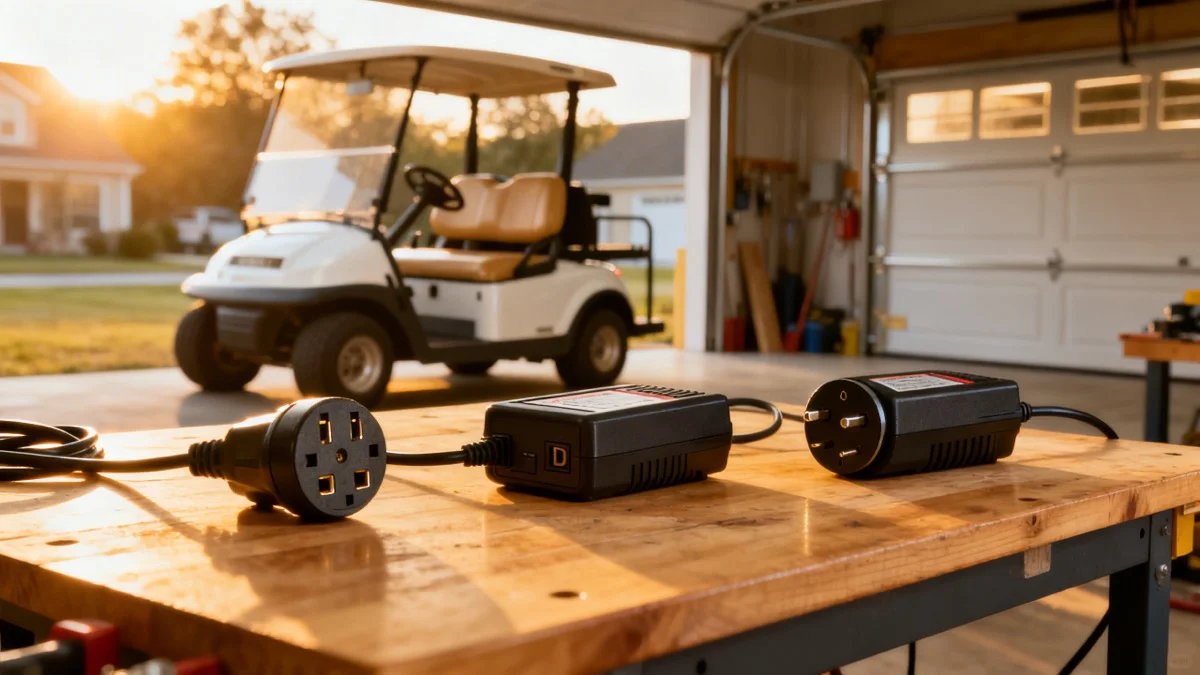
Most charger confusion comes from the fact that owners search by brand when they should search by plug family plus voltage. A useful reference from Golf Cart Hot Rod breaks the common handles into eight families, and that list lines up well with what buyers still see on used carts, chargers, and replacement parts today.
| Plug family | Common brand / use | Common voltage | Where you usually see it |
|---|---|---|---|
| Crowfoot | Older Club Car, some legacy carts | 36V, some 48V legacy use | Older DS and utility carts |
| 3-pin round | Club Car | 48V | DS, Precedent, Tempo, Onward style carts |
| SB50 | Older EZGO | 36V or 48V depending on cart | Marathon and older rebuilt carts |
| PowerWise D | EZGO | 36V | TXT and Medalist 1996 and newer |
| PowerWise slotted | EZGO | 48V | Older 48V PowerWise setups |
| 3-pin triangle | EZGO | 48V | Many later TXT, RXV, and aftermarket 48V chargers |
| 3-pin leaf | Yamaha | Common 48V lead-acid use | G29 Drive and Drive2 replacement fitment; confirm the port |
| Nabson / 2-pin round | Yamaha | Model-specific | Some replacements, legacy carts, and converted receptacles |
The table is the starting point, not the final answer. Many carts on the used market no longer have their factory charging hardware. That is especially true if the cart went through fleet service, sat in storage for years, or got a lithium conversion.
How to identify the right charger in 4 steps
1. Count the batteries and confirm the pack voltage
You need the pack voltage before the plug type matters.
| Battery layout | Pack voltage | What it usually means |
|---|---|---|
| 6 x 6V | 36V | Common older Club Car and EZGO setups |
| 6 x 8V | 48V | Common 48V lead-acid setup |
| 8 x 6V | 48V | Common on some 48V carts |
| 4 x 12V | 48V | Often replacement or aftermarket pack |
| 1 lithium pack | 36V or 48V | Use the battery maker's charge spec |
If you inherited the cart, check the battery labels, not the seller's memory. When you are deciding whether a used cart is worth sorting out, compare the repair bill with current used golf cart buying guidance, the latest golf cart pricing guide, and our golf cart value guide.
Once you know the plug family, use the golf cart chargers parts finder to compare charger and port options by voltage, brand, and battery chemistry.
2. Match the receptacle on the cart, not just the charger label
The charger plug has to fit the receptacle on the cart, and that receptacle can be replaced independently of the rest of the cart. Matching the port on the cart first is still the safest way to avoid ordering the wrong connector.
The fastest way to identify the correct family is visual:
- Round 3-pin plug usually points you toward Club Car 48V hardware.
- Flat D-shaped EZGO plug usually points you toward EZGO 36V TXT or Medalist hardware.
- Triangular 3-pin layout usually points to 48V EZGO TXT or RXV style fitment.
- A 3-pin leaf or round 2-pin/MAC plug can point to Yamaha, but the cart and battery system must confirm the fit.
- Oversized rectangular SB50 handle usually points to older EZGO or a cart that has been rebuilt around older connector hardware.
If the charger plug on the cart side looks newer than the cart itself, assume it may have been changed.
3. Check whether the cart still uses factory charging electronics
Many owners skip this step.
Club Car carts often bring the On-Board Computer, or OBC, into the conversation. A charger may physically fit the cart and still not behave the way you expect if the OBC is bad, bypassed, or not part of the system anymore. That is why the same Club Car can take a stock-style charger, an OBC-bypass charger, or a completely different setup after a conversion.
EZGO carts add a different kind of confusion. A 48V TXT or RXV may look stock but have a different replacement receptacle or charger algorithm than the original PowerWise hardware.
4. Separate lead-acid from lithium before you spend money
This is where charger mistakes get expensive.
Lead-acid and lithium chargers do not just use different labels. They use different charging profiles. Delta-Q notes in its lithium algorithm guidance that different lithium configurations can require different target voltages even within the same nominal pack family.
For many residential golf carts:
- 48V lead-acid chargers are usually selected around the original lead-acid profile
- 48V LiFePO4 conversions often want about 58.4V
- 36V LiFePO4 conversions often want about 43.8V
If the cart was converted, shop by the battery maker spec first. If you are unsure which battery you have, our battery guide and troubleshooting guide will get you pointed in the right direction.
Brand-by-brand charger plug compatibility
Club Car charger plugs
For most modern personal-use Club Cars, the common answer is simple: 3-pin round, 48V.
That covers many DS, Precedent, Tempo, and Onward style carts. Older 36V Club Car DS carts often send you back to the crowfoot family instead. The catch is the OBC. A physically correct charger is not always enough if the cart's charging electronics are the real failure point.
If the cart is a Club Car and you need the full OBC vs ERIC vs lithium charger breakdown, see our best Club Car chargers guide.
If you want model context before buying parts, use our Club Car review, best golf cart brands, and best golf carts pages to decide whether the cart is worth further investment.
EZGO charger plugs
EZGO is where charger plug confusion is worst because three different families show up all the time:
- PowerWise D for many 36V TXT and Medalist carts
- SB50 for older Marathon and legacy setups
- 3-pin triangle for many later 48V TXT and RXV style chargers
We split the model-specific advice into a dedicated EZGO TXT charger guide. If your cart is a used TXT with unclear history, this is also a good point to compare the cost of parts against browsing cleaner local carts on our for sale directory.
Yamaha charger plugs
Yamaha connector descriptions are inconsistent across marketplace listings:
- 3-pin leaf appears on many 48V lead-acid G29 Drive and Drive2 replacement chargers
- 2-pin round Nabson or MAC style appears on some replacement, legacy, and converted setups
The easiest way to get in trouble with Yamaha is assuming every round connector is the same. It is not. Verify the exact receptacle and, if possible, the part listing against the model generation.
Best charger picks by plug type
This is not meant to replace our main charger buyer's guide. It is the short list of the chargers that make the most sense once you already know the plug family you need.
| Plug type | Best pick | Typical price | Why it fits |
|---|---|---|---|
| Club Car 3-pin round | EPOWREY 48V 15A | About $100 | Lead-acid value pick after checking OBC status |
| EZGO PowerWise D | FORM 36V 18A | About $180 | Strong 36V TXT and Medalist fit when the D-style plug matches |
| EZGO 3-pin triangle | EPOWREY 48V 15A | About $110 to $140 | Clean value play for 48V TXT and RXV style carts |
| Yamaha 3-pin leaf | FORM 48V 15A | About $200 to $260 | G29 Drive and Drive2 lead-acid pick when the port matches |
| Premium programmable | Delta-Q QuiQ 1000 | About $500 to $600 | 18A max output, sealed build, strong OEM reputation |
Best Club Car 3-pin round charger
If your cart uses the common 48V Club Car round 3-pin plug, the roughly $100 EPOWREY 48V 15A charger is a value-first option for lead-acid batteries. Plug shape alone is not enough: confirm whether the cart uses a functioning OBC or a non-OBC setup and check the seller's current compatibility guidance.
It fits Precedent, Tempo, and many DS owners who want smart charging without paying premium Delta-Q money.
Check Price on AmazonBest EZGO PowerWise D charger
For 36V TXT and Medalist carts that still use the D-style receptacle, the FORM 36V charger is the safest current recommendation. It is built around the D-style EZGO plug and uses smart charging behavior for compatible 36V battery packs.
This is the charger I would point most 36V EZGO owners to before telling them to gamble on a generic replacement.
Check Price on AmazonBest EZGO 3-pin triangle charger
If you have a later 48V EZGO setup with the triangular plug, the EPOWREY 48V 15A charger is the value pick. It lands around $110 to $140, which is easier to justify on an older TXT or RXV than a premium fleet charger.
The key is still fitment. Buy it because the cart has the right triangular receptacle and the pack is still lead-acid, not because the seller just called the cart an EZGO.
Check Price on AmazonBest Yamaha 3-pin leaf charger
For Yamaha owners, the FORM 48V 15A charger is our current replacement pick for G29 Drive and Drive2 lead-acid setups with the matching 3-pin leaf receptacle. Confirm the actual port and battery chemistry because Yamaha connector descriptions vary across listings and converted carts.
Check Price on AmazonBest premium charger if you want OEM-grade hardware
The Delta-Q QuiQ 1000 is still the premium benchmark. Delta-Q lists the 48V QuiQ 1000 at 1000W max DC output power, 18A max output current, IP66 protection, and 93% peak efficiency on its QuiQ series spec page. If you manage multiple carts, run a fleet, or simply want the premium answer once the connector type is known, this is the charger to compare everything else against.
Check Price on AmazonCharge port problems that look like bad chargers
Hot plug or melted plastic
Heat at the charge port means resistance. Resistance means lost power, arcing, and eventually melted plastic.
Golf Cart Garage currently lists a common EZGO PowerWise D receptacle assembly at $91.99 and the broader listing for the same family shows $104.99 for the RHOX EZGO assembly. Use that as a practical parts-only baseline before labor. If the charger handle or the receptacle is already heat-damaged, stop using it until the port is fixed.
Green corrosion or black arcing marks
Corrosion at the receptacle is especially common in humid climates, beach towns, and carts that sit in carports. The charger may click on, cycle on and off, or fail to make a solid connection.
This is one of the cheapest fixes on the page if you catch it early. Start with contact cleanup before ordering a new charger:
If the pins are loose, pitted, or heat-stressed, replace the receptacle instead of trying to nurse it along.
The charger will not wake up after storage
A smart charger needs to see enough pack voltage to start. If the cart sat all winter, the batteries may be too far down for the charger to wake up. That is why "my charger died" and "my cart sat for four months" often show up together.
Before buying a new charger:
- Check total pack voltage.
- Verify the outlet and cord.
- Inspect the receptacle for corrosion or heat.
- Review your winter storage routine.
- Use our battery test guide if one battery is dragging the whole pack down.
Club Car OBC confusion
A Club Car can absolutely make a good charger look bad. If the charger physically fits but charging behavior is erratic, the OBC or related wiring may be the real issue. That is why many Club Car charging complaints end up in our won't-start guide, maintenance guide, and repair directory before the diagnosis is done.
E-Z-GO PowerWise 48 red flashes
The official E-Z-GO TXT 48 owner's guide gives some of the most useful charger fault clues on the page:
- 1 red flash: poor battery contact or charger temperature fault
- 2 red flashes: battery pack voltage fault
- 3 red flashes: charge timeout
- 4 red flashes: battery fault
- 6 red flashes: internal charger fault
If the charger is showing a different LED pattern or you need Club Car, Yamaha, Delta-Q, and Lester codes too, use our golf cart charger light codes guide.
That is useful because it tells you whether to keep diagnosing the batteries, the pack wiring, or the charger itself. If you are on the fence between repair and replacement, compare the total cart condition with current listings on Golf Cart Search before you pile more parts into a worn-out fleet turn-in.
When to replace the charger, the receptacle, or the batteries
Replace the charger when
- the plug type and voltage are confirmed
- the receptacle is clean and tight
- the battery pack tests reasonably healthy
- the charger still will not start, finish, or charge normally
Replace the receptacle when
- the port is loose
- the plastic is melted or discolored
- the pins show pitting or arcing
- the charger only works if you wiggle the handle
Replace or test the batteries first when
- the cart sat for months and the charger never wakes up
- one battery is clearly lower than the rest
- range has collapsed even after "successful" charging
- the charger keeps timing out or running forever
That last scenario is where owners misdiagnose the problem most often. If the pack is tired, a new charger may only make the failure easier to see. Our golf cart batteries guide and how long to charge a golf cart guide explain the difference between normal long lead-acid charge cycles and real battery decline.
If the plug family is correct but the handle gets hot, only works when wiggled, or leaves the cart stuck in charge mode, use our golf cart charging port problems guide to diagnose the receptacle, reed switch, and cart-side wiring.
Golf cart charger plug FAQ
Are golf cart charger plugs universal?
No. Even within the same brand, plug families change across generations. The correct answer is always connector shape, pack voltage, and battery chemistry together.
What plug does Club Car usually use?
Most 48V Club Car personal carts use the 3-pin round connector. Older 36V DS carts often use the crowfoot family instead.
What plug does EZGO usually use?
Many 36V TXT and Medalist carts use the D-style PowerWise plug. Older EZGO carts often use SB50. Many 48V TXT and RXV carts use the triangular 3-pin family.
What plug does Yamaha usually use?
Many 48V lead-acid Yamaha Drive and Drive2 replacement chargers use the 3-pin leaf connector. Two-pin round/MAC arrangements also appear in replacement, legacy, and converted setups, so identify the receptacle on the cart instead of ordering by model name alone.
How do I tell if my cart is 36V or 48V?
Count the batteries and read the labels. Six 6-volt batteries means 36V. Six 8-volt batteries, eight 6-volt batteries, or four 12-volt batteries means 48V.
Can I use a lead-acid charger on a lithium-converted cart?
Usually no. Most lithium packs want a different voltage target and a different charge profile. Use the battery maker's spec, not the original charger label.
Why is my charge receptacle getting hot?
Heat means resistance, usually from corrosion, loose pins, worn contacts, or damaged plastic. Stop using the charger until the receptacle is repaired or replaced.
How much does charge port replacement usually cost?
A common receptacle part is usually about $90 to $105. Installed cost is often about $150 to $300 once labor and any wiring cleanup are included.
What do the E-Z-GO PowerWise 48 red flashes mean?
One flash usually points to poor contact or temperature, two to pack voltage, three to timeout, four to battery fault, and six to internal charger fault.
Which charger should I buy if I am still unsure?
Do not guess. Identify the plug family first, then buy the charger. If the cart is modified, use the battery or conversion kit spec instead of shopping by model name alone.
Golf Cart Search
Find the Best Golf Carts of 2026
Compare top-rated models, read expert reviews, and find the perfect cart for your needs.