As an Amazon Associate, we earn from qualifying purchases. This helps support our site at no extra cost to you.
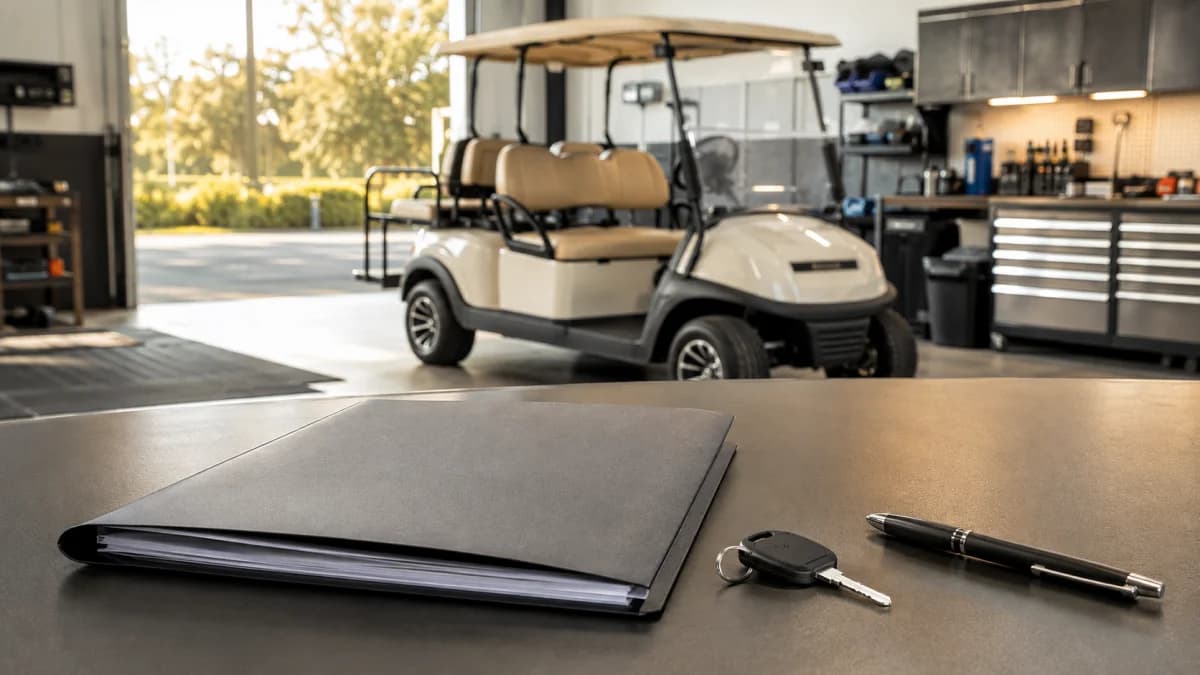
The right golf cart garage size starts with three numbers: the cart's total length, widest installed point, and tallest installed point. Then add room to steer through the door, reach the charging port, open the seat for service, and walk around the cart.
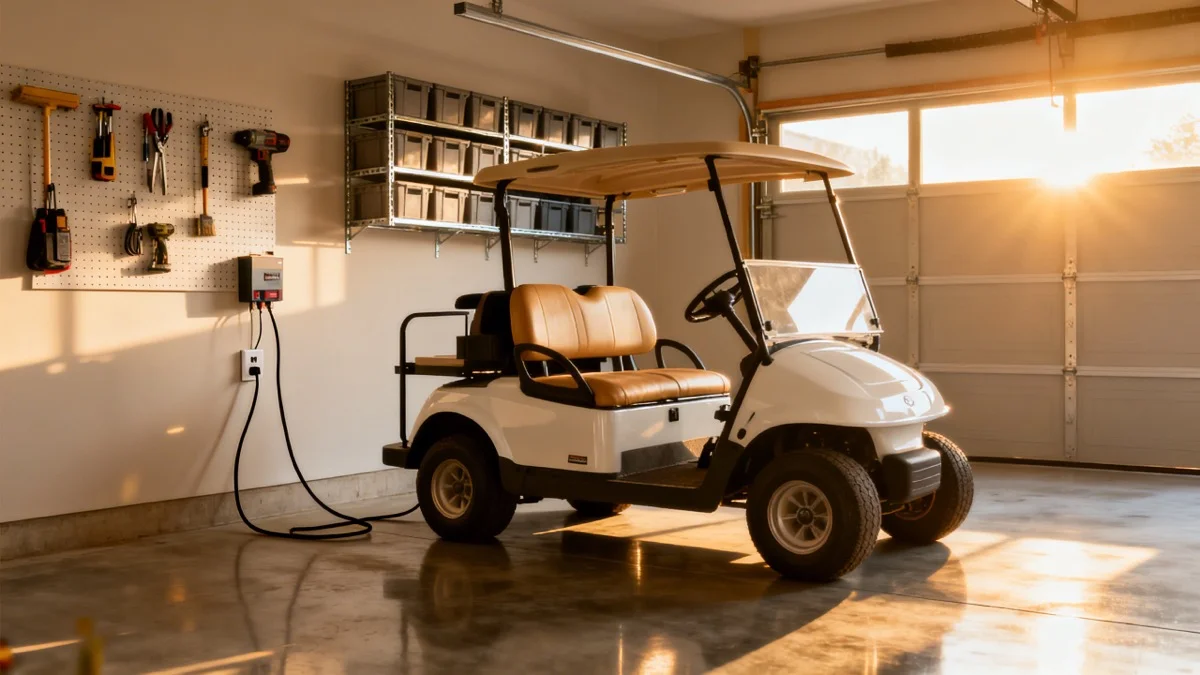
But a good garage setup goes beyond just pulling the cart inside and closing the door. The right space needs proper dimensions for your cart, a safe charging station, adequate ventilation (especially for lead-acid batteries), and smart organization so your tools and accessories are not scattered across the floor.
This guide uses model measurements already maintained in our golf cart dimensions checker, then covers door clearance, charging setup, ventilation safety, storage organization, and outdoor alternatives.
Average Cart Size 47-49 in x 91-96 in
Minimum Garage Cart size + access clearance
Garage Cost Range $200 - $15,000
Door Target Cart width + 12 in
Golf Cart Dimensions: Know Your Cart First
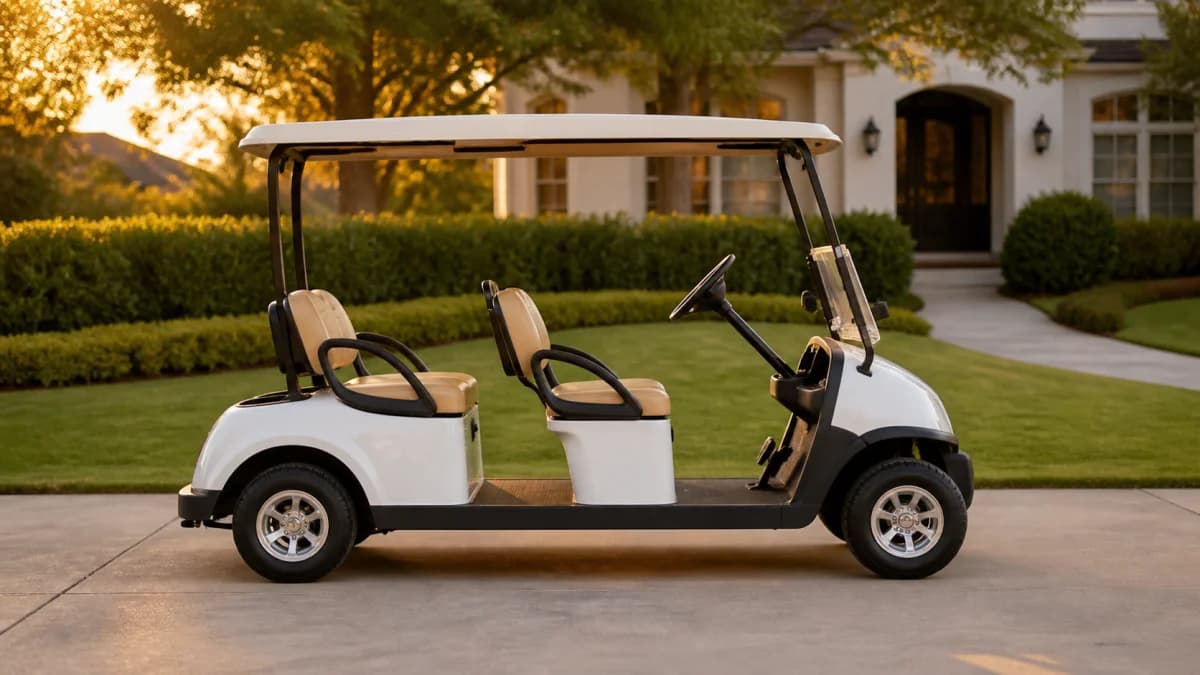
Before planning your garage, you need to know how much space your cart actually takes up. Dimensions vary significantly by seating capacity and whether you have a lifted cart or stock height.
| Cart Type | Length | Width | Height | Garage Constraint |
|---|---|---|---|---|
| 2-passenger stock cart | 91-96 in | 47-49 in | 70-72 in | Usually door width and walking clearance |
| 4-passenger stock cart | 106-128 in | 46-49 in | 71-76 in | Rear-seat length and room behind the cart |
| 6-passenger stock cart | 134-161 in | 47-51 in | 74.5-78 in | Garage depth |
| Lifted 4- or 6-passenger cart | 108-149 in | 49-53 in | 80-82 in | Door height, mirrors, tires, and roof accessories |
These ranges come from the model records behind our dimensions tool, including examples from Club Car, EZGO, Yamaha, and ICON. They are planning ranges, not substitutes for measuring your exact cart. For example, our dataset lists the compact Club Car Onward 2 Passenger at 91.5 inches long, while the Yamaha Drive2 Concierge 6 reaches 161.4 inches.
Measure bumper to bumper, then measure the widest installed point and the tallest fixed accessory. Fold mirrors only if you are willing to do it every time you park. For a deeper dive into golf cart weight and how it affects floors and ramps, see our dedicated guide.
For current model-by-model width, length, and height numbers, use the golf cart dimensions fit checker, then read our golf cart dimensions by brand guide for more model context.
Minimum Garage Size Requirements
Single Cart: Calculate the Space From Your Cart
Instead of treating 8 by 12 feet or 10 by 14 feet as universal, start with the vehicle envelope:
- Add at least 24 inches to total cart width for basic access, or 36 to 48 inches if you need comfortable service access on both sides.
- Add at least 36 inches to cart length so the door can close and you can reach the rear seat or cargo area.
- Reserve the space required to lift the seat or battery-compartment cover.
- Add separate wall depth for shelving, a workbench, or a wall-mounted charger.
A stock two-passenger cart around 48 by 94 inches can fit in a compact bay, while a 161-inch six-passenger cart needs more than 13 feet just for the vehicle. Tape the proposed footprint on the floor before building or ordering a shed.
Two Carts: Add Both Vehicle Envelopes
Add the measured widths of both carts, then add the side and center access you need. Two 49-inch carts already occupy 98 inches before mirrors, wall clearance, or a walking aisle. For depth, plan around the longer cart rather than averaging the pair.
Ceiling Height
Our stock-cart records reach roughly 78 inches high, and lifted examples reach 80 to 82 inches before owner-installed light bars or roof accessories. Measure both the ceiling and the lowest obstruction, including the raised garage door, opener rail, lights, and overhead storage.
Door Width and Height
Measure the finished clear opening with the door, tracks, trim, and weather seal installed. As a practical target, make the opening at least 12 inches wider and 6 inches taller than the cart's widest and tallest fixed points. A 49-inch-wide stock cart therefore benefits from at least a 61-inch clear opening; a 72-inch opening gives more steering margin. A lifted cart that measures 82 inches tall does not fit through a nominal 7-foot opening if trim or the raised door reduces the clearance.
If you are building new, bring the cart measurements to the door supplier and have the finished clear width and height written into the quote.
Garage Floor Setup
Your garage floor takes a beating from tire marks, battery acid drips, grease, and dirt tracked in from the course or neighborhood. Setting it up correctly protects both the floor and your cart.
Sealed Concrete Is the Best Surface
A sealed or epoxy-coated concrete floor resists battery acid, oil, and moisture while being easy to sweep and mop. If your garage has bare concrete, apply a concrete sealer ($30 to $50 for a single-cart area) or an epoxy floor coating ($100 to $300 DIY, $500 to $1,500 professional).
Avoid parking on bare wood, unsealed concrete, or dirt. Battery acid from lead-acid systems will stain and erode unsealed surfaces. Even lithium battery carts drip water and track in debris that damages unprotected floors.
Golf Cart Parking Mats
A dedicated parking mat protects the floor from tire marks, fluid drips, and battery acid. The Roykaw golf cart parking mat is sized specifically for golf carts at 9.2 by 4.9 feet, uses oil-absorbent material with a waterproof backing, and resists petroleum products and battery acid. At $50 to $70, it is a cheap insurance policy for your garage floor.
Check Price on AmazonWheel Guides and Parking Stops
Install simple rubber wheel stops or floor-mounted parking guides so you pull in to the same spot every time. This prevents bumping the back wall, keeps the cart aligned with the charger outlet, and makes the space feel larger because you are using it consistently. Rubber wheel stops cost $15 to $30 per pair on Amazon.
Charging Station Setup
A well-designed charging station is the centerpiece of any golf cart garage. Get the electrical right and charging becomes effortless. Get it wrong and you risk tripped breakers, damaged chargers, or worse.
Electrical Requirements
Read the charger's input label and manual before choosing the circuit. Battery-pack voltage does not tell you the wall-current requirement by itself.
| Check | What to confirm |
|---|---|
| Supply voltage and frequency | Must match the charger's input label |
| Branch-circuit rating | Must support the charger's rated input and other loads on that circuit |
| Grounding | Use the grounded receptacle and plug specified by the manufacturer |
| GFCI protection | Follow current local code for garage receptacles |
| Extension cord | Avoid it unless the charger manual permits one and specifies gauge and length |
For example, EZGO's current customer guidance says its World Chargers use a traditional three-prong household receptacle and require at least a 10-amp circuit. A Club Car owner manual instructs users to connect to a properly installed and grounded receptacle, avoid extension cords, and provide charger ventilation. Those examples show why the correct answer comes from the exact charger manual, not a universal "48V equals 20 amps" rule.
Have an electrician evaluate a shared, damaged, ungrounded, or unknown garage circuit. Local code and the installed charger determine whether a dedicated circuit or GFCI protection is required.
If you are tempted to bridge the gap with a cord, read our golf cart charger extension cord safety guide before making that a routine charging setup.
Charger Placement
Mount or position the charger where the cord reaches the cart's charging port without stretching or creating a trip hazard. Wall-mounting the charger (rather than leaving it on the floor) keeps it off the ground, away from moisture, and easy to access.
For compatible 48V lead-acid Club Car carts, the EPOWREY 15A charger uses the round 3-pin plug and provides automatic shutoff/trickle behavior. Confirm the cart's OBC status and current seller compatibility guidance before ordering; charge time depends on pack capacity and depth of discharge.
Check Price on Amazon (Club Car 48V)For EZGO TXT owners running a 36V system, the FORM 36V charger is the equivalent option with the same wall-mount capability and auto-shutoff.
Check Price on Amazon (EZGO 36V)For a full comparison of chargers by voltage and brand, see our complete charger guide.
Cable Management
A charging cable draped across the floor is a trip hazard and gets run over. Use wall-mounted hooks, a retractable cord reel, or a simple cable wrap to keep the cord off the ground when not in use. Position the outlet so the cable path runs along the wall rather than across the walking area.
Ventilation and Safety
This section is critical, especially for lead-acid battery carts. Skipping it can be dangerous.
Hydrogen Gas from Lead-Acid Batteries
Flooded lead-acid batteries can release hydrogen during charging. Hydrogen is colorless, odorless, lighter than air, and flammable when it accumulates. OSHA battery-charging guidance requires adequate ventilation in covered workplace settings and warns against smoking, flames, sparks, and electrical arcs near charging batteries. Homeowners should follow the same hazard-control principles plus the vehicle and battery manuals.
How to stay safe:
- Never charge flooded batteries in a sealed space. Provide ventilation that follows the battery and vehicle manuals
- Use a purpose-designed ventilation plan. Do not assume a cracked door or an ordinary bathroom fan provides a specific safe airflow
- Do not smoke, weld, or use open flames near a charging golf cart
- Keep charger vents clear and place the charger only as its manual directs
- Inspect battery vent caps, cables, plugs, and receptacles before charging
Lithium Battery Safety
Lithium batteries do not have the same hydrogen-gassing behavior as flooded lead-acid packs, but they introduce different risks. Use only the specified charger, do not charge a damaged or swollen pack, keep the battery management system and temperature protections intact, and follow the manufacturer's charging-temperature limits. If a pack has been submerged, crashed, modified, or produces heat, odor, smoke, or unusual sounds, stop using it and contact the manufacturer or a qualified technician.
Gas Cart Exhaust
If you have a gas-powered golf cart, never run the engine inside a closed garage. Carbon monoxide is odorless and lethal. Drive the cart in and out quickly, and install a carbon monoxide detector if you store a gas cart inside.
Turn off the fuel valve when storing the cart for more than a few days to prevent fuel vapor buildup.
Fire Safety Essentials
Every golf cart garage should have:
- A fire extinguisher rated ABC (covers electrical, gasoline, and general fires) mounted near the door
- A smoke detector on the ceiling
- A carbon monoxide detector if you store a gas cart
- No flammable liquids stored directly next to the cart or charger
For more golf cart safety practices, see our complete safety guide.
Storage and Organization
A well-organized garage makes maintenance easier and keeps accessories from getting damaged. Here are the systems that work best for golf cart garages.
Wall-Mounted Systems
Pegboard, slatwall panels, or track systems (like the French cleat style) turn your walls into functional storage. Mount them on the wall opposite the cart or along the sides above cart height.
What to hang:
- Charger cable and extension cords
- Tool kit (wrenches, socket set, tire pressure gauge)
- Cleaning supplies (microfiber towels, spray bottles)
- Keys, registration documents, insurance card
Pegboard is the cheapest option ($15 to $30 per 4x8 sheet). Slatwall is more durable and polished ($40 to $80 per 4x8 panel). Both work well for golf cart garages.
Overhead Storage
The space above the cart is often wasted. Install overhead racks or ceiling-mounted shelves to store seasonal items like golf cart covers, enclosures, and items you do not need daily.
Overhead storage works best for light items in sealed bins. Do not store heavy items above the cart where they could fall and cause damage.
Shelving for Maintenance Supplies
A narrow shelf (12 to 18 inches deep) along one wall holds maintenance essentials:
- Distilled water (for lead-acid battery maintenance)
- Terminal cleaner and corrosion spray
- Tire pressure gauge and inflator
- Touch-up paint and rust preventive spray
- Brake fluid and lubricants
- Microfiber towels and cleaning supplies
Keep battery acid neutralizer (baking soda) within reach if you run lead-acid batteries. Spills happen, and neutralizing acid immediately prevents floor damage.
Accessory Storage
If you run seasonal accessories like windshields, tops, or seat covers, store them flat or hanging to prevent creasing. A dedicated wall hook or shelf keeps them organized and ready to swap with the seasons.
Climate Control and Battery Protection
Batteries are the most expensive component in your golf cart, and temperature is their biggest enemy. A garage that manages temperature extends battery life significantly.
Temperature Effects on Batteries
| Temperature | Effect on Lead-Acid | Effect on Lithium |
|---|---|---|
| Below 32°F (0°C) | Can freeze and crack cells permanently | Reduced capacity, no permanent damage |
| 32-50°F (0-10°C) | Reduced capacity, slower charging | Slightly reduced capacity |
| 50-80°F (10-27°C) | Optimal range | Optimal range |
| 80-100°F (27-38°C) | Acceptable | Acceptable |
| Above 100°F (38°C) | Accelerated degradation | Accelerated degradation, risk increases |
Cold Climate Protection
In regions with freezing winters, an insulated garage prevents the most destructive scenario: a fully discharged lead-acid battery freezing and cracking. A fully charged lead-acid battery will not freeze until about minus 75 degrees, but a depleted one can freeze at 20 degrees. Keep batteries charged and the garage above freezing.
For detailed seasonal storage steps, see our winterization guide.
Hot Climate Protection
In Arizona, Texas, Florida, and other hot-climate states where golf carts are most popular, garage temperatures can exceed 120 degrees in summer. Insulation, a light-colored roof, and ventilation (even a simple vent fan on a thermostat) keep interior temps closer to outdoor shade temperatures.
Never leave a cart charging in direct sun. The combination of charger heat and solar heat can push battery temperatures into the danger zone.
Humidity and Rust Prevention
Coastal and humid climates accelerate corrosion on steel-frame carts from EZGO, Yamaha, ICON, and other steel-frame brands. Club Car's aluminum frame is immune to rust, which is one reason it holds its value so well.
For steel-frame carts, keep garage humidity below 50% with a dehumidifier ($30 to $150 depending on capacity). Apply a rust preventive coating to exposed steel components annually, especially in coastal areas.
Outdoor Storage Alternatives
Not everyone has a garage. Here are the best options for outdoor golf cart storage, ranked by protection level.
Portable Carports and Shelters
A portable carport provides full rain and sun protection with airflow that prevents moisture buildup. A 12x20-foot carport fits a golf cart with room to spare, and most set up in a few hours without permanent foundation.
The ADVANCE OUTDOOR 12x20 Heavy Duty Carport uses an 8-leg frame of 1.5-inch galvanized steel poles with reinforced triangular bracing, a heat-sealed triple-layer polyethylene canopy that is waterproof and UV resistant, and four adjustable height settings with a peak of 9.8 to 11.3 feet. Setup is tool-free. It is also one of the most reviewed carports on Amazon, at 4.3 stars across more than 2,500 ratings. Note that it is an open canopy: it keeps rain and sun off, but it has no sidewalls.
Check Price on AmazonStorage Sheds
A prefab metal or resin shed (10x12 or 10x14 feet) provides full enclosure with a lockable door. Costs run $500 to $3,000 depending on size and material. If you go this route, add ventilation (a gable vent or small exhaust fan) and an electrical outlet for charging.
Golf Cart Covers
A quality waterproof cover is the minimum protection for any outdoor-stored cart. Covers run $30 to $80 and protect against rain, UV, dust, and bird droppings. They do not protect against temperature extremes or wind-blown debris the way an enclosed structure does.
For detailed cover recommendations by cart size and brand, see our complete golf cart covers guide.
Clamshell Shelters
Clamshell-style shelters open from the front and provide drive-in/drive-out convenience. They are popular with snowbirds and RV parks because they fold flat for transport. Expect $300 to $600 for a golf cart sized unit.
Seasonal Storage Prep
Preparing for Winter
If you live in a region where your cart sits idle for 3 or more months, proper winterization prevents battery damage, flat-spotted tires, and critter nests in the engine compartment. The key steps: fully charge the batteries, disconnect the negative terminal (lead-acid) or set a maintenance charge schedule (lithium), inflate tires to max PSI, and cover the cart.
Our complete winterization guide walks through every step with a printable checklist.
Spring Startup
When cart season returns, do not just turn the key and go. Check tire pressure, inspect battery terminals for corrosion, test the brakes, clean the cart, and do a slow first charge. Our spring maintenance checklist covers the full startup routine.
Year-round maintenance keeps everything running smoothly between seasons. See our complete maintenance guide for monthly, quarterly, and annual tasks.
Cost Breakdown: Budget to Premium
Here is what a golf cart garage setup costs at three budget levels:
Budget Setup ($100 - $300)
- Parking mat: $50 to $70
- Charger wall hooks and cable management: $15 to $25
- Wheel stops: $15 to $30
- Pegboard wall organizer: $20 to $40
- Fire extinguisher: $20 to $35
- Smoke detector: $10 to $20
This covers the essentials for a cart stored in an existing garage or carport. Total: roughly $130 to $220.
Mid-Range Setup ($500 - $2,000)
Everything in budget, plus:
- Portable carport shelter: $250 to $500
- Electrical work if the charger or local code requires it: get an electrician quote
- Replacement charger with wall mount: $150 to $250
- Slatwall panels and hooks: $60 to $120
- Overhead storage rack: $80 to $150
- Concrete sealer or epoxy coating: $50 to $300
- Dehumidifier (coastal areas): $50 to $150
For those building a covered space or upgrading an existing garage with proper electrical and organization. Total: roughly $900 to $1,970.
Premium Setup ($3,000 - $15,000)
Everything in mid-range, plus:
- Dedicated built garage or shed: $3,000 to $10,000
- Golf cart garage door (5x6 or 6x7): $300 to $800
- Insulation and climate control: $500 to $1,500
- Epoxy floor coating (professional): $500 to $1,500
- Built-in cabinetry and workbench: $300 to $1,000
For those building a purpose-built golf cart garage from scratch, especially in golf cart communities where dedicated cart garages are common. Total: roughly $4,600 to $14,800.
Whatever your budget, the parking mat, proper charging setup, and fire extinguisher are non-negotiable. Everything else scales to your needs and space.
Frequently Asked Questions
Can I store two golf carts in a standard 2-car garage?
Yes. A standard 2-car garage (20 by 20 feet) can fit two golf carts comfortably with room for storage along the walls. Two golf carts side by side take about 9 to 10 feet of width, leaving roughly half the garage open. You can also fit a car and a golf cart side by side in most 2-car garages.
How do I prevent tire flat spots during storage?
Inflate tires to their maximum rated PSI before storage. For storage lasting more than 2 months, place the cart on jack stands to take weight off the tires completely. Moving the cart a few feet forward or backward every 2 to 4 weeks also prevents flat-spotting. See our tire guide for more on tire maintenance.
Do I need a building permit for a golf cart garage?
Permit requirements vary by municipality. Generally, permanent structures (stick-built garages, concrete slabs) require permits, while portable shelters and temporary carports do not. Many golf cart communities have HOA guidelines for cart garages including size limits, setback requirements, and approved materials. Check local codes before building.
What is the best way to secure a golf cart in a garage?
Use a key switch in the off position, a steering wheel lock, or a wheel boot for physical security. A lockable garage door provides the primary barrier. For higher security, a GPS tracker (see our GPS tracker guide) alerts you if the cart moves. Golf cart insurance covers theft, and many policies require proof of secured storage for coverage.
Should I leave my golf cart plugged in all the time?
Only if the vehicle, battery, and approved charger manuals explicitly support that storage mode. Charging logic differs across lead-acid, lithium, onboard, and portable systems. Follow the documented state-of-charge, tow/run switch, disconnect, and inspection procedure for your exact cart. See our battery guide for the questions to check.
How do I run electricity to a detached golf cart shed?
Ask a licensed electrician to size the feeder or branch circuit from the charger's input requirements, the run length, other planned loads, and local code. The electrician should also determine grounding, burial, disconnect, weather protection, and GFCI requirements. Do not treat an extension cord as permanent building wiring; use one only when the charger manual and local rules permit the exact cord type, gauge, and length.
Can I convert part of my regular garage into a golf cart space?
Yes, and this is the most common approach. Partition 8 to 10 feet of width from your existing garage using the wall opposite the garage door. Add a charger outlet, a parking mat, and wall storage. A simple curtain or partial wall separates the cart space from the rest of the garage. This works well in 2-car garages where you want to keep one bay for a car.
Golf Cart Search
Find the Best Golf Carts of 2026
Compare top-rated models, read expert reviews, and find the perfect cart for your needs.