
As an Amazon Associate, we earn from qualifying purchases. This helps support our site at no extra cost to you.
Best EZGO TXT Charger: 36V, 48V & Lithium Picks
Quick Answer: Which EZGO TXT Charger Do You Need?
Match the charger to your pack voltage, charge-port shape, and battery chemistry. Most older 36V EZGO TXT carts use a D-style plug, many later 48V TXT carts use a 3-pin triangle plug, and lithium-converted carts need the battery maker's lithium profile instead of a generic lead-acid charger. For most 36V D-plug carts, start with the FORM 36V pick. For most 48V triangle-plug lead-acid carts, start with a 15A smart charger. For 48V LiFePO4 swaps, confirm whether the battery calls for a 58.4V lithium charger.
The best EZGO TXT charger for your cart depends on three things: pack voltage, plug shape, and battery chemistry. Get any of those wrong and you can end up with a charger that never starts, a pack that never finishes, or in the worst case, damaged batteries.
That is why this guide stays narrow. Instead of covering every golf cart charger on the market like our broader 36V and 48V charger guide, this one focuses on the real-world EZGO TXT question owners keep asking: do I need the 36V D-style charger, the 48V triangle-plug charger, or a lithium-specific replacement?
If you own an older EZGO, are shopping a used TXT on our dealer directory, or are trying to decide whether to fix your current cart or replace it, this breakdown will save you money. We also cover the most common charging failures, the PowerWise 48 flash codes, and which charger actually makes sense for a daily neighborhood cart versus a seasonal garage queen.
Top 36V Pick FORM 36V, about $180
Value 48V Pick $110 to $140
Premium OEM Option Delta-Q, $500 to $600
First Check Plug shape + pack voltage
EZGO TXT Charger Quick Match
If you are standing in the garage trying to buy the right charger, use this order: battery layout first, charge port second, chemistry third. Do not buy from the model name alone.
| Your EZGO TXT setup | Common port | Charger to shop for | Best starting point |
|---|---|---|---|
| Older 36V lead-acid TXT | D-style / PowerWise-style plug | 36V smart charger with D-style plug | FORM 36V or MODZ Max36 |
| Later 48V lead-acid TXT | 3-pin triangle plug | 48V 15A smart charger with triangle plug | Value 48V 15A pick, Delta-Q for premium use |
| 36V lithium conversion | Varies by kit | Lithium charger matched to battery spec | Battery maker spec, not old TXT charger |
| 48V lithium conversion | Varies by kit | Usually 58.4V LiFePO4 charger if the battery calls for it | LiTime-style 58.4V charger when compatible |
| Unknown or rebuilt cart | Any replaced port | Confirm pack voltage and receptacle before buying | Inspect batteries and port photos first |
The fastest way to waste money is buying a "TXT charger" that has the wrong plug or wrong charge profile. A charger can look correct in the product photo and still be wrong for a rebuilt, converted, or lithium-swapped cart.
Which EZGO TXT charger fits your cart?
Start with the plug, not the brand name. "EZGO TXT" covers a long run of carts, and that label alone is not enough to buy the right charger.
Confirm the battery pack voltage first
The quickest check is the battery layout under the seat:
| Battery setup | Pack voltage | What it usually means |
|---|---|---|
| 6 x 6V batteries | 36V | Common older TXT and Medalist setup |
| 6 x 8V batteries | 48V | Common later TXT 48 setup |
| 4 x 12V batteries | 48V | Usually an aftermarket replacement pack |
| 1 lithium pack | 36V or 48V | Buy by battery maker spec, not by old charger |
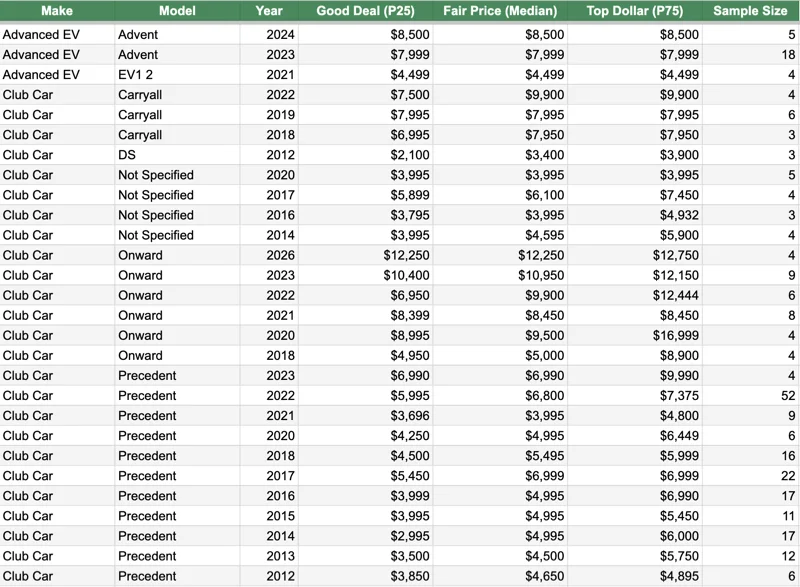
If you are not sure whether the cart is still worth investing in, compare replacement-part costs against our golf cart pricing guide, current used values, and the latest best golf carts before ordering batteries and a charger at the same time. For the broader buying decision, our 36V vs 48V golf cart guide explains when an older 36V TXT is still worth keeping.
Still deciding whether the cart is a TXT worth fixing or an RXV worth upgrading? Our EZGO TXT vs RXV comparison covers used prices, model clues, and buyer risks, and the E-Z-GO parts fitment guide covers broader TXT, RXV, Marathon, Medalist, Valor, Express, and Liberty parts checks.
For charger-only shopping, the golf cart chargers parts finder groups 36V D-style, 48V triangle, lithium, port, and diagnostic options in one place.
Match the charge receptacle before you order
Once you know the voltage, look at the actual charge port on the cart. For EZGO TXT owners, this is usually the deciding factor:
| What you see on the cart | Common setup | Buy this charger type |
|---|---|---|
| D-style receptacle | Many 36V TXT / Medalist carts | 36V charger with D-style plug |
| 3-pin triangular receptacle | Many 48V TXT / RXV carts | 48V charger with triangle plug |
| Stock port plus lithium adapter harness | Lithium conversion | Charger matched to lithium battery maker |
| Aftermarket Anderson or other custom plug | Modified cart | Use the charger spec from the conversion kit |
If you need a broader chart that also covers Club Car, Yamaha, SB50, crowfoot, and other charger families, see our golf cart charger plug compatibility guide.
Separate lead-acid from lithium before comparing chargers
If the cart still runs flooded lead-acid batteries, most smart aftermarket chargers in this guide will work fine as long as voltage and plug style match. If the cart has had a lithium conversion, buy by battery spec first and golf cart model second.
A 48V lithium pack usually wants a 58.4V LiFePO4 charger. A 36V lithium pack usually wants about 43.8V. That is different from the charging profile used on lead-acid batteries, and it is why many "my EZGO TXT charger will not work after lithium" threads really come down to a chemistry mismatch rather than a bad cart. Our full battery guide explains what changed if you inherited a converted cart.
Best EZGO TXT chargers for 2026
These are the picks that make the most sense right now for real TXT owners, not just the cheapest listings online. I prioritized fitment clarity, smart charging behavior, weather resistance, and whether the charger is easy to recommend for a cart that might sit a week or a month between drives.
| Charger | Voltage | Plug | Battery type | Best for | Typical price |
|---|---|---|---|---|---|
| FORM 36V | 36V | D-style | Lead-acid, many lithium-ready setups | Best overall 36V TXT pick | About $180 |
| MODZ Max36 | 36V | D-style | Lead-acid | Best premium 36V upgrade | About $275 |
| EPOWREY 48V 15A | 48V | Triangle | Lead-acid | Best value 48V TXT pick | About $110 to $140 |
| Delta-Q QuiQ 1000 | 48V | Triangle / configurable | Lead-acid and OEM-style fleets | Best premium 48V option | About $500 to $600 |
| LiTime 58.4V 10A | 48V | Lithium-specific | LiFePO4 | Best for 48V lithium swaps | About $135 to $150 |
Best overall 36V pick: FORM 36V Charger for EZGO TXT
For most 36V TXT owners, this is the cleanest answer. The FORM 36V charger is built around the D-style EZGO plug, charges at 18 amps, and is easy to live with if your cart spends part of the year in storage.
Why it stands out:
- FORM lists it at about $179.95, which is still reasonable for a charger with real weather resistance
- It uses multi-stage smart charging with automatic maintenance mode instead of cooking the batteries overnight
- FORM markets it for both flooded lead-acid and lithium-ready 36V EZGO setups, which matters if your cart may be converted later
- It is built for common 36V TXT and Medalist D-style receptacles; it is not a 48V or RXV charger
If you have been nursing along an old PowerWise-style charger and your cart already needs extra maintenance, replacing it with a smart charger is usually a better move than paying to keep old hardware alive.
Check Price on AmazonBest premium 36V upgrade: MODZ Max36
The MODZ Max36 costs more, usually around $275, but it earns the premium if you plan to keep a 36V TXT for years. It is a 15-amp smart charger with a strong reputation for plug-and-forget use, and it is the type of charger owners buy when they are tired of flaky startup behavior and want something that feels a step closer to OEM quality.
Compared with the FORM charger, the MODZ tradeoff is simple: slower charge rate, higher price, and a reputation for stable long-term float charging. If your cart lives in a garage, gets used several times a week, and you care more about durability than shaving every dollar, this is the nicer 36V option.
Check Price on AmazonBest value 48V pick: EPOWREY 48V 15A for TXT and RXV
For 48V lead-acid TXT carts with the triangle plug, the EPOWREY 15A charger is the value play. Pricing usually lands around $110 to $140, which makes it much easier to justify on an older TXT than a $500 fleet charger.
Why it works for this spot:
- 15 amps is the sweet spot for a 48V neighborhood cart
- The charger is built for the common TXT / RXV triangle plug fitment
- It uses smart charging and trickle or maintenance behavior instead of running at full output nonstop
- IP67-style weather resistance is a real plus if the cart is parked in a carport or semi-open garage
This is the right pick if your cart is mostly a weekend cruiser, a campground cart, or a second vehicle in a community where overnight charging is more important than maximum speed. If your cart also serves daily road duty, look at the premium pick below and review your local golf cart laws and insurance rules before using a modified TXT as a regular street-runner.
Check Price on AmazonBest premium 48V option: Delta-Q QuiQ 1000
If you want the closest thing to a "buy once and be done" 48V charger, the Delta-Q QuiQ 1000 is still the benchmark. Expect to pay about $500 to $600 depending on the exact algorithm and connector setup.
Why shops and fleet owners still like it:
- 18-amp output shortens recovery time on carts that get used hard
- Delta-Q units are sealed, efficient, and built for vibration, heat, and dirty service environments
- The programmable algorithms make them a better fit for owners who know exactly what battery profile they need
For a private owner, the Delta-Q only makes sense when the cart is important enough to justify the spend. That can be true if you run a rental fleet, manage property carts, or own a well-kept TXT that already has fresh batteries and is worth preserving. If the cart itself is rough, compare the charger bill with current used buying guidance and our take on the best golf cart brands before over-investing.
Check Price on AmazonBest for 48V lithium conversions: LiTime 58.4V 10A
A converted TXT is where owners get burned most often. If your cart now runs a 48V LiFePO4 pack, stop shopping by golf cart brand and start shopping by the battery's required charge profile.
The LiTime 58.4V 10A charger is a good fit for many 48V lithium swaps because it is purpose-built for LiFePO4 charging, usually lands around $135 to $150, and includes features like low-voltage wake-up that can help with packs that sat too long. The downside is speed. At 10 amps it is not the fastest charger here, but that slower output is fine for many residential carts and easier on the battery than an oversized fast charger.
If your lithium kit manufacturer gives you a different voltage target, follow that spec instead. This is also where it pays to keep your conversion paperwork handy or revisit our lithium conversion guide before ordering anything.
Check Price on AmazonCommon EZGO TXT charging problems
A bad charger is not always the real problem. On older TXT carts, weak batteries, dirty charge ports, and hacked-together conversion wiring often look exactly like a dead charger.
The charger never clicks on
Start with the boring stuff:
- Verify the wall outlet with another tool or appliance.
- Check the extension cord, if you are using one at all.
- Look for loose, hot, or corroded terminals in the battery compartment.
- Inspect the charger receptacle for melted plastic, green corrosion, or loose pins.
If all of that looks fine, measure total pack voltage. Deeply discharged batteries can fall below the threshold needed to wake up a smart charger. That is common after winter storage or when the cart has been left parked with lights, accessories, or a failed reducer drawing the pack down. Our winter storage guide and won't-start guide cover the same pattern from the cart side.
The PowerWise 48 charger is flashing red
On 48V TXT carts, the factory PowerWise 48 QE charger gives useful fault clues. In the official E-Z-GO TXT 48 owner's guide, one red flash points to poor battery contact or a charger temperature problem, two red flashes point to a pack voltage fault, three means charge timeout, four means battery fault, and six means an internal charger fault.
For the full brand-by-brand breakdown of red, green, yellow, amber, and blue charger indicators, use our golf cart charger light codes guide.
The two-flash code is the one many owners see after the cart sits too long. E-Z-GO notes that the charger can fault if battery voltage falls under the normal operating window, which is why a worn pack can make a perfectly good charger look dead. At that stage, spend five minutes checking battery health before you order a new charger.
The charger runs forever or stops too early
This usually means the batteries are the bigger problem. A sulfated pack, one weak battery in a six-battery set, or a cart that has not been watered properly can stretch charge time dramatically or keep the charger from reaching a clean finish.
If you still run flooded lead-acid batteries, check water level, cable condition, and specific gravity before blaming the charger. Our full battery maintenance guide and troubleshooting guide walk through that process. If the cart already needs batteries, a charger, and tires, it may be smarter to shop fresh listings on GolfCartSearch for sale instead of pouring more money into a tired TXT.
The factory charger stopped working after a lithium swap
This is almost always a mismatch between the old charge system and the new battery. Some kits keep the stock port and add an adapter harness. Others bypass the old path completely. Either way, the old lead-acid charger profile is often the wrong answer for a lithium pack.
Before you assume the new battery is bad, verify:
- Required charge voltage from the battery maker
- Whether the kit expects the stock charge port or a replacement plug
- Whether the charger needs a battery-management-system wake-up or low-voltage recovery feature
If the conversion was done by a shop and the cart still will not charge, this is when it makes sense to use our repair directory instead of guessing.
The charge receptacle gets hot or loose
A worn receptacle creates resistance, and resistance creates heat. That can lead to melted plastic, intermittent charging, and plug damage that kills even a good charger. If the port feels loose or you see arcing marks, fix the receptacle before blaming the charger.
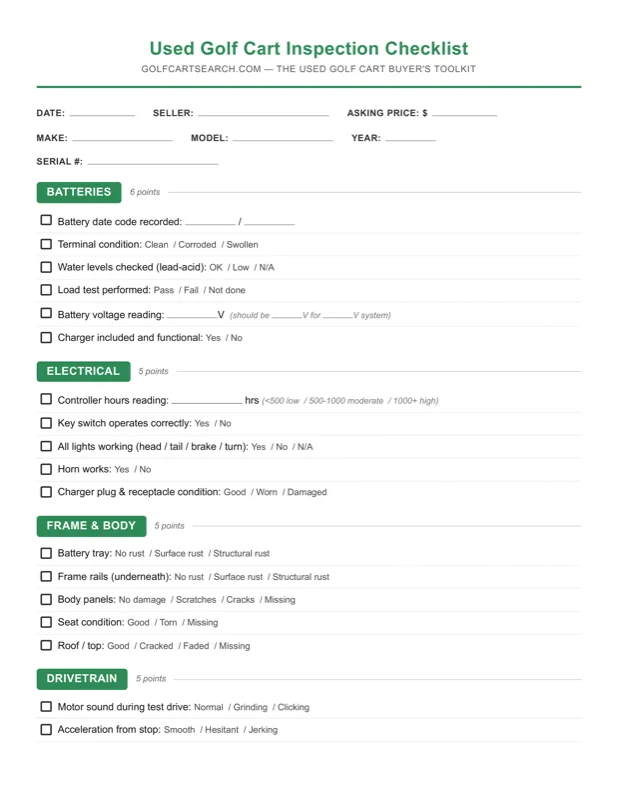
This problem shows up often on hard-used neighborhood carts and older fleet turn-ins. It is also one of the better reasons to inspect a used cart carefully before buying. If you are still in shopping mode, our used golf cart buying guide pairs well with the toolkit note above.
If the issue looks more like a cart-side fault than a charger failure, use our golf cart charging port problems guide for the full receptacle and reed-switch diagnosis path.
Which charger makes sense for your kind of TXT?
Most owners do not need the same answer. A 2004 neighborhood TXT that leaves the garage twice a week is not the same decision as a 48V street-use cart or a lithium-converted hunting rig.
Older 36V neighborhood TXT
Buy the FORM 36V unless you specifically want the nicer premium feel of the MODZ. The FORM gets you the right D-style fitment, a faster 18-amp charge rate, and strong value for a cart that is probably already 15 to 25 years old. If the cart is still on original-style lead-acid batteries, pair the charger decision with a close look at the pack's age and condition.
If you are deciding whether to keep the cart or upgrade to something newer, compare your repair budget with our EZGO review and broader electric vs gas comparison.
Later 48V TXT that still runs lead-acid
Most owners should start with the EPOWREY 48V 15A and only jump to the Delta-Q if the cart gets heavy use or you simply want the premium answer. The value pick is easier to justify on a used TXT. The premium pick makes more sense if the cart already has a healthy battery set and you want to keep it for years.
If your 48V TXT also has lights, mirrors, belts, and neighborhood-road use in mind, read our street-legal guide before you assume the charger is the only thing that matters.
48V lithium-converted TXT
Buy by battery profile. That is the rule. Not by year, not by what the old charger looked like, and not by what the seller said came on the cart before the conversion.
In practical terms, that means the LiTime-style 58.4V charger works when the battery spec calls for that voltage, but a different lithium brand may want a different charger or connector. Keep the install paperwork, and if you do not have it, ask the seller before buying. That is especially important if the cart came from a marketplace listing rather than a dealer.
Seasonal or snowbird cart
Storage behavior matters as much as charging speed. A smart charger with automatic maintenance mode is worth paying for if the cart sits for weeks at a time. That alone is a strong argument for FORM, MODZ, or Delta-Q over any no-name charger that simply promises "fast charging."
For carts that sit for part of the year, follow a full winterization plan and routine maintenance schedule. A good charger cannot save neglected batteries forever.
EZGO TXT charger FAQ
What charger do I need for an EZGO TXT?
First match the battery pack voltage, then the charge-port shape, then the battery chemistry. Most older 36V EZGO TXT carts use a D-style plug. Many later 48V TXT carts use a 3-pin triangle plug. Lithium-converted TXT carts should use the charger profile specified by the battery maker, commonly 58.4V for a 48V LiFePO4 pack.
What is the best 36V EZGO TXT charger?
For most 36V lead-acid EZGO TXT carts with the D-style plug, the best value pick is the FORM 36V 18A charger. It fits the common D-style TXT port, uses smart charging and maintenance behavior, and costs much less than premium fleet-grade chargers. MODZ Max36 is the premium 36V alternative if you want a heavier-duty smart charger.
What is the best 48V EZGO TXT charger?
For most 48V lead-acid TXT carts with the 3-pin triangle plug, a 15A smart charger is the value choice. The EPOWREY-style 48V 15A triangle-plug charger is the budget pick in this guide, while Delta-Q QuiQ is the premium option for fleets or owners who want OEM-grade durability.
Can I use a 48V charger on a 36V EZGO TXT?
No. Do not use a 48V charger on a 36V TXT pack. The charger voltage must match the battery pack voltage and chemistry. Using the wrong charger can prevent charging, overcharge the pack, damage batteries, or create a safety risk.
Does an EZGO TXT lithium conversion need a different charger?
Usually yes. A lithium-converted EZGO TXT should use the charger profile required by the lithium battery maker. For many 48V LiFePO4 packs that means a 58.4V charger, but the battery spec should override the old cart model or the charger that came with the lead-acid setup.
Are EZGO TXT chargers universal?
No. Voltage, plug shape, and chemistry all matter. Many 36V TXT carts use the D-style charger. Many 48V TXT carts use the triangle plug. Lithium conversions add another layer because the battery may need a different charge voltage and sometimes a different connector too.
How do I tell a D-style plug from a triangle plug?
The D-style port has the flatter EZGO shape used on many 36V TXT and Medalist carts. The triangle plug is a 3-pin triangular layout commonly used on many 48V TXT and RXV chargers. The safest move is to compare the cart's receptacle visually against the product photo before you order.
Can a smart charger wake up a totally dead TXT battery pack?
Sometimes, but not always. Many smart chargers need to see a minimum pack voltage before they start. If the cart sat long enough for the pack to collapse below that threshold, the charger may not click on. At that point you are diagnosing batteries and wiring, not just the charger.
How long should a healthy EZGO TXT take to charge?
On lead-acid batteries, expect roughly 6 to 10 hours with a 15- to 18-amp charger after a deep discharge. Lithium conversions can be faster, often 3 to 6 hours, depending on charger size and battery capacity.
Can I leave an EZGO TXT charger plugged in all winter?
Only if it is a modern smart charger with a maintenance or float stage and the manufacturer supports storage charging. That is one reason the better chargers in this guide are worth the money. Old manual chargers are a bad choice for long unattended storage.
Is a $100 charger good enough for a TXT?
Sometimes, yes. A value charger can be the right call on an older 48V TXT where you want smart charging without a premium price. It is less compelling if you drive daily, store outside, or want the longest service life possible.
Should I repair my old charger or replace it?
If the charger is old, noisy, heavy, and lacks smart charging, replacement usually wins. If it is a premium sealed charger with one obvious fault, repair can still make sense. The deciding factor is whether the repaired unit would still be worth keeping once fixed.
Golf Cart Search
Find the Best Golf Carts of 2026
Compare top-rated models, read expert reviews, and find the perfect cart for your needs.