
As an Amazon Associate, we earn from qualifying purchases. This helps support our site at no extra cost to you.
If your cart pulls to one side, eats front tires, or suddenly feels twitchy after a lift kit, you probably started searching for golf cart wheel alignment. That is the right instinct, but most owners still aim at the wrong problem.
On many golf carts, alignment is mostly about front toe, not a full car-style alignment session with lots of factory adjustment points. That makes the job simpler, but it also means people blame “alignment” for everything when the real problem is low tire pressure, a dragging brake, worn tie rod ends, wheel-bearing play, or a bent front end.
This guide covers what golf cart alignment actually means, how to check toe at home, when a shop alignment is worth paying for, and when the cart needs parts instead of another round of adjustment. If you recently changed suspension height, pair this with our lift kit guide too, because lift installs are one of the fastest ways to knock a cart out of alignment.
Main Adjustment Front toe
DIY Check Time 20 to 45 minutes
Typical Shop Cost About $50 to $100
Biggest Red Flag One-sided tire wear
Golf Cart Wheel Alignment Guide: Quick Answer
If you want the short version, here it is:
- Set all four tires to the correct pressure first using our tire pressure chart.
- Make sure nothing obvious is worn, bent, or dragging.
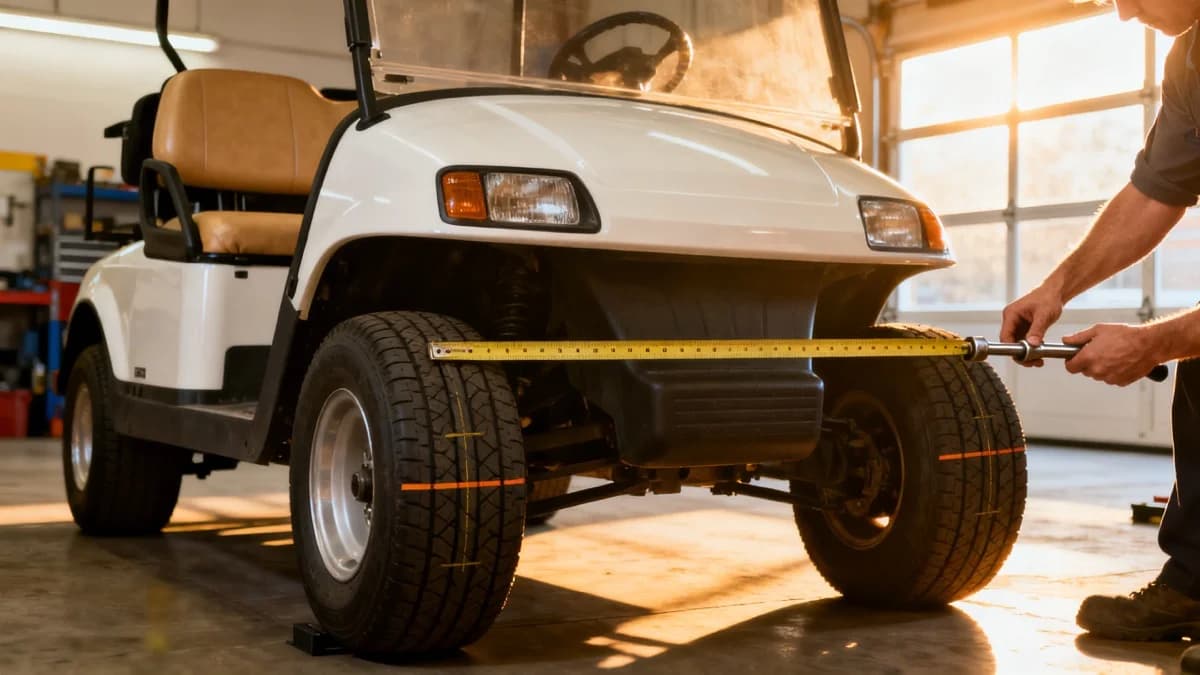
- Measure front toe on a flat surface with the steering held straight.
- Adjust tie rods or drag links equally, then recheck steering-wheel centering.
- If the cart still pulls, stop adjusting and inspect parts.
That last point is the one people skip. Golf cart owners often keep tweaking toe because the steering wheel still looks off or the cart still drifts. But a cart with a bent spindle, sloppy tie rod end, dragging brake, or wobbling wheel bearing will never feel right no matter how many times you move the tie rods.
If your cart already has multiple symptoms, use our troubleshooting guide first, then come back to the alignment check.
What Golf Cart Alignment Actually Means
On a normal street car, “alignment” often means camber, caster, and toe across multiple wheels. On a golf cart, the story is usually much simpler.
Club Car’s 2016 Precedent service manual says wheel alignment is limited to equalizing front camber and adjusting front toe-in, which is a much narrower job than what people picture at an auto shop. The same manual measures toe by marking the tread, comparing the rear and front measurements, and adjusting the drag links equally until the cart tracks straight. You can read that directly in the Club Car Precedent service manual.
That is why the most useful mental model is this:
- Toe is usually the adjustment you can actually make
- Camber may or may not be adjustable depending on the cart
- Caster is usually not your everyday DIY adjustment on a stock cart
It is also why stock Club Car, E-Z-GO, and Yamaha carts respond differently once you add lift kits, wheel spacers, oversized tires, or worn steering parts. The front end is simple, but it is not immune to bad geometry.
7 Signs Your Golf Cart Is Out of Alignment
Not every bad-driving cart has an alignment problem, but these are the symptoms that put toe and front-end geometry high on the list:
- the cart pulls left or right on a flat paved surface
- the steering wheel sits crooked while the cart drives straight
- front tires show feathering or wear on one edge
- the cart feels darty or twitchy after a lift kit install
- the cart wanders more as speed rises
- the tires squeal or scrub during slow paved turns
- you hit a curb, pothole, stump, or rough trail and the cart never felt right again
If this sounds familiar, also read our top speed guide. A cart that already feels unstable at neighborhood speed has no business being pushed faster.
Before You Touch the Tie Rods, Rule Out the Fake Alignment Problems
This is the most important section in the whole guide.
Owners love blaming alignment because it sounds tidy and fixable. In real life, six other issues cause the same symptoms all the time.
1. Uneven tire pressure
Start here because it is cheap, fast, and embarrassingly common. A front tire that is just a few PSI off can make the cart feel lazy, vague, or like it wants to drift. That is especially true on turf tires and low-profile wheel packages.
Use a real gauge, not your thumb. The simplest tool for this job is a digital gauge like the one below.
Check Price: AstroAI Digital Tire Pressure GaugeIf your tires are smaller turf tires and you fine-tune in the lower pressure range, a low-range gauge can be more useful than a generic car gauge.
2. Dragging brakes
A cart that pulls under braking or slows down unevenly may not have an alignment issue at all. It may have one brake grabbing harder than the other.
That is why the warning signs in our brake maintenance guide and maintenance schedule matter. If a wheel is hot after a short drive, or the cart only pulls when you get into the brakes, fix that first.
3. Worn tie rod ends, bushings, or kingpins
This is the classic “I aligned it twice and it still drives bad” problem.
If the front end has play, the alignment number you set in the garage is not the alignment the cart uses on the road. A little slop at the tie rod becomes a lot of toe change once the cart hits a bump or loads up in a turn.
4. Wheel-bearing play
Grab each front tire and try to wiggle it. If the wheel moves more than it should, the problem may be a bearing or hub issue instead of toe. The cart can feel like it is steering itself because the wheel is no longer staying where you set it.
5. Bent parts from a hit
A curb strike, pothole, tree root, rough trail, or shipping damage can bend a spindle, twist a lift-kit bracket, or shift the steering hardware just enough to ruin tracking. If the cart was fine and then instantly not fine after one hit, think impact damage before anything else.
That is also a real theme on some newer-value carts. Our Evolution review, for example, notes owner reports of steering misalignment on new vehicles. Bad tracking is not always “owner error.”
6. Bad tires
A damaged or oddly worn tire can mimic alignment problems even when the tie rods are set correctly. If the cart has a separated tire, severe cupping, or one front tire worn much more than the other, you may need fresh tires before you judge the alignment honestly.
Our tire and wheel guide is the right next read if the tread is already compromised.
The DIY Tools That Actually Help
You do not need a fancy alignment rack for a golf cart. You do need a few basic tools and a flat, honest work surface.
For most owners, the short list is:
- tire pressure gauge
- tape measure
- marker or chalk
- socket set and wrenches
- floor jack and stands if you need front-end inspection
If your garage is light on basics, these are the most useful purchases:
Check Price: DEWALT Socket Set Check Price: Floor JackFor a broader setup, our essential golf cart tool kit guide covers the rest of the shop staples worth owning.
How to Check Golf Cart Toe at Home
This is the part most people mean when they say “align a golf cart.”
Step 1: Find a flat surface
Driveway slope and uneven concrete can lie to you. You want the flattest spot you have. Roll the cart forward naturally and stop with the wheels pointed straight.
Step 2: Set the tire pressure first
Do not skip this. A toe measurement on mismatched tire pressure is junk data. Use the same baseline on both front tires.
Step 3: Mark the tread center
On each front tire, put a mark at the center of the tread as close to axle height as you can. Service manuals commonly use this basic method because it is repeatable.
Step 4: Measure the rear-facing distance
Measure between the marks on the rear-facing side of the two front tires.
Step 5: Roll the cart forward
Roll the cart forward until those same marks rotate to the front-facing side at roughly the same height from the ground.
Step 6: Measure the front-facing distance
Measure between the same two marks again.
Step 7: Compare the numbers
If the front measurement is smaller than the rear measurement, you have toe-in. If the front measurement is bigger, you have toe-out.
This is the basic logic you will also see in manufacturer guidance. A Club Car Precedent manual, for example, says the front measurement must be less than the rear measurement, then gives its model-specific toe target.
What Toe Spec Should You Actually Use?
This is where golf cart owners get led astray by generic internet advice.
There is not one universal golf cart toe number that fits every brand, model, year, and suspension setup.
Here is the safe way to think about it:
- your exact service manual wins
- your lift-kit instructions matter if the front end is modified
- a stock-cart spec may not be the right target after suspension changes
One concrete example: the 2016 Club Car Precedent service manual lists proper toe-in at 3/8 inch plus or minus 1/8 inch and says the adjustment should be made by rotating both drag links equally. One older Yamaha golf-car service manual also treats toe as a tie-rod adjustment, not a guesswork steering-wheel job, and notes that toe can change materially with one turn of the turnbuckle.
That is why random forum advice like “just set every cart to 1/8 inch” is not good enough by itself. Sometimes it lands close. Sometimes it does not.
If you have a stock cart and no model-specific spec in front of you, the safest move is to use the dealer directory or repair directory and pay for a front-end check instead of locking in the wrong number.
How to Adjust Golf Cart Toe
On many carts, the actual adjustment happens at the tie rods or drag links. The exact hardware differs, but the logic stays consistent.
1. Center the wheels first
Do not start with the steering wheel. Start with the front wheels pointing straight.
2. Loosen the jam nuts
Loosen the jam nuts at the tie rod or drag link ends so the link can rotate.
3. Make equal changes side to side when the design calls for it
This matters. Club Car’s Precedent manual specifically says to rotate both drag links equally. That keeps the steering wheel closer to center and avoids creating a new problem while chasing the old one.
4. Re-measure after every small change
This is not a “one big turn and hope” job. Small changes, then measure again.
5. Tighten the jam nuts and road-test
After the measurement is in spec, tighten everything, then drive the cart on a flat paved surface. If the wheel is still off-center or the cart still drifts, you are not done diagnosing.
When the Steering Wheel Stays Crooked
A crooked steering wheel after adjustment usually means one of three things:
- the front wheels were not actually straight when you started
- the tie rods were not balanced equally
- the front end has wear or damage and will not hold the setting
The Club Car manual makes this clear too: after toe-in adjustment, the steering wheel should be centered in its travel with equal left and right movement. If you end the job with a steering wheel that still looks wrong, assume something else needs attention.
Lift Kits and Bigger Tires Make Alignment More Important
This is where alignment talk becomes practical instead of theoretical.
Most stock golf carts are slow, light, and forgiving. Once you add a lift kit, larger tires, or wheel spacers, a small toe mistake becomes much easier to feel.
That is why our lift-kit guide keeps hammering the same point: alignment is the critical step people skip after suspension work. Bigger tires add leverage, lifts change geometry, and any looseness in the steering parts gets amplified.
If your cart suddenly developed wobble, dartiness, or fast front-tire wear after a lift, do not assume the kit is bad right away. First verify:
- tire pressure
- lug-nut torque
- tie rod and drag-link tightness
- steering play
- front toe
If those check out and the cart still feels wrong, then start looking harder at the lift hardware, spindle quality, and component fitment.
When Alignment Will Not Fix the Problem
This section saves owners the most wasted time.
Do not keep adjusting toe if the cart has any of these:
- visibly bent spindle or steering arm
- wheel-bearing play
- loose tie rod ends
- cracked or badly worn bushings
- one brake dragging
- badly worn or damaged front tires
- frame twist or clear accident damage
At that point, alignment is not the repair. It is the final step after the repair.
This is also why used-cart shoppers should treat one-sided tire wear seriously. It may be a cheap fix, but it may also be the clue that exposes a front-end problem the seller is hoping you ignore.
If you are shopping and the seller says “it just needs alignment,” verify that against our used golf cart buying guide before you hand over money.
Should You DIY or Pay a Shop?
For a simple toe check on a healthy cart, DIY is reasonable.
DIY makes sense when:
- tire pressure is already correct
- there is no obvious front-end damage
- you have basic hand tools
- the cart only needs a sanity check after a lift or tire swap
Pay a shop when:
- the cart still pulls after a basic toe correction
- there is wheel play or steering slop
- you suspect bent parts
- the cart sees regular road or neighborhood use
Recent public golf cart service guides cluster a basic alignment around about $50 to $100, which is cheap compared with ruining a tire set or chasing the wrong fix for a month. If you need a local path, start with the repair directory or browse local dealers who also do front-end work.
Final Verdict
The best way to think about golf cart wheel alignment is this:
It is usually a toe check plus an honesty test.
If the cart is healthy, a toe measurement and adjustment can absolutely fix pulling, off-center steering, and premature front tire wear. If the cart has worn or bent parts, “alignment” is just the word people use before they admit the front end needs real repair.
So do the easy stuff first. Set pressure correctly. Inspect the front end. Then measure toe carefully and use the right spec for your exact cart, not a random number from someone else’s setup.
FAQ: Golf Cart Wheel Alignment Questions
What is the easiest sign that a golf cart needs alignment?
The easiest sign is uneven front tire wear, especially if one edge is scrubbing off faster than the rest of the tread.
Can low tire pressure make a golf cart feel out of alignment?
Yes. That is one of the most common false alarms, which is why pressure should be checked before you touch the tie rods.
Is toe-in or toe-out more common on a golf cart problem?
Bad setups can go either direction, but many owners notice the problem when the cart has too much toe-out and starts feeling nervous or scrubby on pavement.
Do you always need a shop rack to align a golf cart?
No. A basic toe check on a golf cart is often done with careful measurements on a flat surface, not a full automotive alignment rack.
Why did my golf cart start pulling after a lift kit?
Because the suspension geometry changed, the steering hardware was disturbed, or the cart was never rechecked after installation.
Can bad wheel bearings mimic alignment problems?
Yes. If the wheel does not stay tight and true, it can feel like alignment is off even when your toe measurement looks okay in the garage.
Should the steering wheel be centered after alignment?
Yes. If the wheels are straight and the steering wheel is still crooked, the job or diagnosis is not finished.
How long does a golf cart alignment take?
A simple check and toe adjustment can take 20 to 45 minutes at home. A shop may do it quickly, but any worn-part diagnosis adds time.
Is golf cart alignment important on slow carts too?
Yes. Even at lower speeds, bad toe chews through tires and makes the cart less predictable to drive.
Should you align a golf cart every year?
Not automatically. Check it when symptoms show up, after lift-kit work, after a hard curb or pothole hit, or when tire wear patterns start looking wrong.
Can a used cart with alignment issues still be worth buying?
Yes, but only if you price it as a possible front-end repair instead of blindly assuming it needs a cheap adjustment.
Does a golf cart need the same spec after bigger tires?
Not always. Bigger tires and modified suspension setups can change what the cart wants, which is why stock specs and aftermarket setups should not be mixed carelessly.
Golf Cart Search
Find the Best Golf Carts of 2026
Compare top-rated models, read expert reviews, and find the perfect cart for your needs.