As an Amazon Associate, we earn from qualifying purchases. This helps support our site at no extra cost to you.
Every golf cart owner eventually needs tools. Maybe a tire goes flat in the neighborhood. Maybe a battery terminal corrodes and the cart won't start. Maybe you want to install a lift kit or swap out shocks yourself instead of paying a shop $200 in labor.
The problem is that most "golf cart tool" guides list generic categories ("get a socket set") without telling you which socket set, what sizes you actually need for your brand, or how much to spend. This guide is different. Every tool recommendation includes a specific product, the exact sizes that fit Club Car, EZGO, and Yamaha carts, and what jobs that tool handles.
The $75 Starter Kit
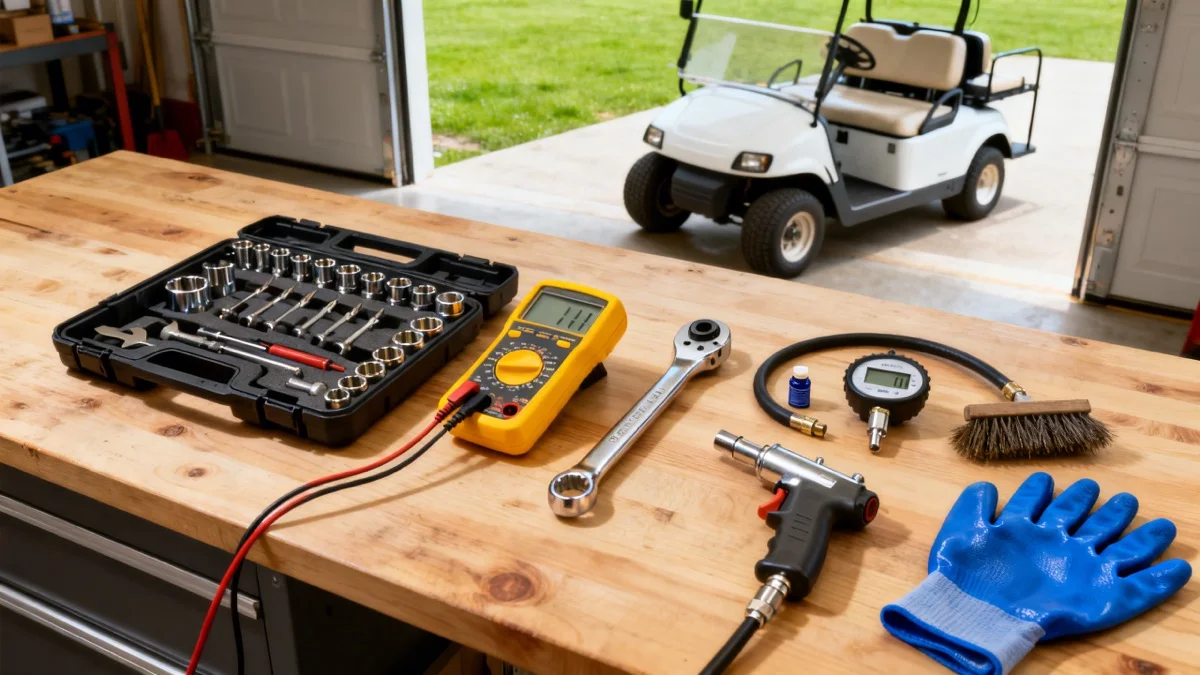
If you only buy five tools, make it these. They handle battery checks, tire pressure, loose connections, and basic tightening, which covers 80% of what golf cart owners actually need to do.
| Tool | Why You Need It | Cost |
|---|---|---|
| Digital multimeter | Test battery voltage, check for dead cells, diagnose electrical issues | $30-35 |
| Tire pressure gauge | Check and maintain proper PSI (most carts need 18-22 PSI) | $8-12 |
| Battery terminal cleaning brush | Remove corrosion that causes no-start conditions | $5-8 |
| Adjustable wrench (10") | Fits most battery cable nuts and general fasteners | $10-15 |
| Multi-bit screwdriver | Handles Phillips, flathead, and hex screws on panels and accessories | $8-12 |
Total: $60-80. This kit fits in a small toolbox that you can store under the cart seat or in the garage.
Diagnostic and Electrical Tools
Electric golf carts are essentially rolling battery packs with a motor and controller. A good multimeter is the single most important tool you can own.
Digital Multimeter (The #1 Tool for Electric Cart Owners)
A multimeter measures voltage, resistance, and continuity. With it, you can test individual battery voltage (a healthy 6V battery reads 6.2-6.4V fully charged), check total pack voltage, diagnose solenoid issues, find broken wires, and verify charger output. Without one, you're guessing.
For golf cart use, you need a multimeter that reads DC voltage up to at least 60V (to test a full 48V pack). The Klein Tools MM400 is the best value option: accurate, durable, and backed by a trusted electrical brand.
If you want the actual target numbers for each battery size and full-pack reading, see our golf cart battery voltage chart and test guide.
- Key specs: DC voltage to 600V, AC voltage, resistance, continuity with audible beep
- Price: Around $33
- Why this one: Klein is the brand professional electricians use. Accurate readings matter when you're deciding whether a $150 battery is dead or just needs charging.
For a deeper guide on using a multimeter to diagnose golf cart problems, see our troubleshooting guide. To understand what amp draw readings mean for your motor, check our motor draw guide.
Battery Hydrometer (Lead-Acid Carts Only)
A hydrometer measures the specific gravity of the electrolyte in each battery cell. This tells you the exact state of charge and health of each cell, which a voltage reading alone can't do. A cell reading below 1.200 specific gravity is weak. If one cell reads significantly lower than the others in the same battery, that battery is failing.
We break down the matching voltage and specific gravity targets in our battery voltage chart guide, which is the best companion to this tool section.
Hydrometers cost $8-15 and take 30 seconds per cell to test. For carts with 6V batteries (6 cells each, 6-8 batteries), a full test takes about 15 minutes. If you're maintaining lead-acid batteries, this tool pays for itself the first time it catches a dying battery before it damages the rest of the pack.
If you've switched to lithium, you don't need a hydrometer. For more on that decision, see our lithium battery conversion guide.
Battery Terminal Cleaning Brush
A dual-ended battery brush has a tapered cone for cleaning the inside of cable clamps and a wire brush for cleaning the battery posts themselves. Corroded terminals cause voltage drop, slow charging, and intermittent no-start conditions.
A battery terminal cleaner kit → is the standard tool. Pair it with baking soda and water (2 tablespoons per cup) for cleaning, and a terminal protector spray to prevent future buildup.
For complete battery care instructions, see our battery maintenance guide.
Socket Sizes by Golf Cart Brand
This is the information no other tool guide provides. Your cart's brand determines whether you need SAE (standard) or metric sockets.
The Brand-Specific Socket Table
| Component | Club Car | EZGO | Yamaha |
|---|---|---|---|
| Lug nuts | 3/4" socket (1/2"-20 thread) | 3/4" socket (1/2"-20 thread) | 19mm socket (12mm x 1.25 thread) |
| Oil drain plug (gas) | 14mm | 14mm | 17mm |
| Spark plug (gas) | 13/16" deep well | 13/16" deep well | 13/16" deep well |
| U-bolts (suspension) | 9/16" | 9/16" | 14mm |
| Steering wheel nut | 3/4" | 5/8" | Varies |
| General body bolts | Mix of SAE | Mix of SAE | Metric (10mm, 12mm, 14mm) |
Bottom line: If you own a Club Car or EZGO, you'll use SAE sockets most of the time. Yamaha owners need metric. Icon, Evolution, and other newer brands typically use metric. Buy a socket set that includes both.
Recommended Socket Set
A good socket set is the foundation of any golf cart toolkit. You need both 3/8" and 1/2" drive sockets in SAE and metric sizes. The DEWALT 192-piece set covers 1/4", 3/8", and 1/2" drives, includes ratchets, extensions, adapters, and hex keys, and comes in a hard case.
- Includes: 1/4", 3/8", and 1/2" drive ratchets, SAE and metric sockets, extensions, adapters, and hex keys
- Price: Around $100-$200 depending on current promotions
- Why this one: Knurled sockets are easier to hand-start in tight spaces. 72-tooth ratchet needs only 5 degrees of swing arc, which matters when working around battery packs.
Torque Wrench
Lug nuts, axle nuts, and suspension bolts all have specific torque specs. Over-tightening cracks wheels and strips studs. Under-tightening risks wheels coming loose at speed. A click-style torque wrench clicks audibly when you reach the target torque.
Common golf cart torque specs:
| Fastener | Torque |
|---|---|
| Lug nuts (most brands) | 50-90 ft-lbs |
| Axle nuts (EZGO) | 26-31 ft-lbs |
| Suspension U-bolts | 35-45 ft-lbs |
| Battery cable terminals | 8-12 ft-lbs |
A 3/8" drive torque wrench with a 10-80 ft-lb range covers every golf cart application.
- Price: $25-35
- Key feature: Click mechanism with +/- 4% accuracy
If you are installing aftermarket wheels, a lift, or any stance parts, our golf cart wheel spacer guide explains why a torque wrench and re-torque check are non-negotiable.
Tire and Lifting Tools
Flat tires, tire rotation, brake inspection, and suspension work all require lifting the cart and working on the wheels.
Digital Tire Pressure Gauge
Golf cart tires typically run 18-22 PSI for standard tires and 12-15 PSI for low-profile turf tires. Even 2-3 PSI off causes uneven wear, poor handling, and reduced battery range on electric carts.
The AstroAI gauge is the best-selling digital tire gauge on Amazon for a reason: backlit display, auto-shutoff, and accurate to +/- 0.5 PSI. At under $10, there's no excuse not to have one.
- Range: 0-150 PSI
- Price: Around $10
- Key feature: Backlit display works in dim garages and at night
For a full guide on tire types, sizing, and pressure recommendations by use case, see our tire and wheel guide.
Portable Air Compressor
A cordless inflator lives in the cart or garage and saves you from driving to a gas station on a flat tire. Look for one that can reach at least 100 PSI (golf cart tires need 18-22, but having headroom is useful for car tires and inflatables too). Cordless models run on rechargeable batteries and take 2-3 minutes to fill a golf cart tire.
Budget corded options that plug into a 12V outlet or wall outlet work fine for garage use. Expect to spend $25-40 for a reliable inflator.
Floor Jack and Jack Stands
Golf carts weigh 800-1,200 lbs (or up to 1,400 with a lifted suspension and aftermarket tires). A 2-ton floor jack handles any cart with a wide safety margin. Pair it with a set of 2-ton jack stands. Never work under a cart supported only by a jack.
- Jack capacity: 2-ton (4,000 lbs) is more than enough
- Price: Around $100 for the dual-pump low-profile jack, plus $20-$40 for a pair of stands
- Key feature: The 3.35-inch minimum height helps with stock-height carts, while the dual-pump design speeds lifting
For brand-specific lift points and a step-by-step tire-change sequence, see our golf cart jack points guide.
Lubrication and Greasing
Golf carts have multiple grease points on the steering, suspension, and pedal assemblies. Dry joints wear faster, create squeaks, and eventually seize.
Grease Gun
A mini grease gun works better than a full-size one for golf cart work because the grease fittings are in tight spaces near the steering column and under the cart. Look for one that accepts standard 3oz grease cartridges.
- Price: $15-25
- What to grease: King pins, steering rack bushings, pedal pivots, spring shackles, and any zerk fitting you can find
- Frequency: Every 6 months or per your maintenance schedule
For gas carts, add an oil filter wrench to your kit. Club Car DS and EZGO gas models use standard automotive oil filters, so any adjustable filter wrench works.
Workspace Lighting
A rechargeable LED work light with a magnetic base is essential for working under the cart or in the battery compartment. Magnetic mounting sticks to the steel frame, freeing both hands. Look for at least 300 lumens and a rechargeable battery so you're not buying AAs constantly.
- Price: $15-25
- Key feature: Magnetic base + hook for versatile mounting
Electric vs. Gas: Additional Tools
Most tools work on both electric and gas carts, but each type has a few extras:
Electric Cart Extras
- Battery hydrometer ($8-15) for lead-acid battery health testing
- Battery terminal brush ($5) for corrosion removal
- Insulated gloves ($10-15) for working around 36V-48V battery packs
Gas Cart Extras
- Spark plug socket (13/16" deep well, $5-8) for plug changes
- Feeler gauge ($5-8, set to .004" for valve adjustment)
- Oil filter wrench ($8-12, adjustable style)
- Compression tester ($20-30) for diagnosing engine issues
- Fuel line clamp ($5) for fuel system work
For a full comparison of electric vs. gas carts including maintenance differences, see our complete guide.
Your On-Cart Emergency Kit
Keep a small toolkit in the cart for roadside issues. Everything here fits in a canvas tool roll or small bag:
- Adjustable wrench (8" or 10")
- Multi-bit screwdriver
- Tire pressure gauge
- Portable air inflator (if cordless)
- Zip ties (assorted sizes)
- Electrical tape
- Small flashlight or headlamp
- Basic first aid kit
- Your cart's owner manual (or a photo of the VIN and model info on your phone)
This kit handles flat tires, loose battery cables, rattling body panels, and minor electrical issues. Total cost: $40-60.
Tools by Common DIY Job
Here's a quick reference for which tools you need for the most common golf cart jobs:
| Job | Tools Needed | Difficulty |
|---|---|---|
| Check battery voltage | Multimeter | Easy |
| Clean battery terminals | Terminal brush, baking soda, water, wire brush | Easy |
| Check tire pressure | Tire pressure gauge | Easy |
| Inflate a tire | Portable air compressor | Easy |
| Change a tire | Floor jack, jack stands, lug wrench (3/4" or 19mm), torque wrench | Easy |
| Replace batteries | Wrenches, terminal brush, anti-corrosion spray, safety glasses, rubber gloves | Moderate |
| Adjust brakes | Screwdriver, pliers, jack and stands | Moderate |
| Grease suspension | Grease gun, jack and stands | Moderate |
| Install LED lights | Wire strippers, crimpers, multimeter, zip ties, drill | Moderate |
| Install a lift kit | Full socket set, torque wrench, jack and stands, drill | Hard |
| Speed controller swap | Multimeter, socket set, wrenches, insulated gloves | Hard |
| Clutch service (gas) | Brand-specific clutch puller, impact wrench, socket set | Hard |
For step-by-step instructions on any of these jobs, check our maintenance guide and customization guide.
Budget Kit Builds
Starter Kit ($75-100)
For basic maintenance and checks:
- Digital multimeter ($33)
- Tire pressure gauge ($10)
- Battery terminal brush ($5)
- Adjustable wrench 10" ($12)
- Multi-bit screwdriver ($10)
- Wire brush set ($8)
Intermediate Kit ($150-200)
Add repair capability:
- Everything from Starter Kit
- Socket set with SAE + metric ($60)
- Torque wrench 3/8" drive ($28)
- Floor jack 2-ton ($35)
- Jack stands pair ($25)
Complete Workshop Kit ($250-350)
Handle almost any job yourself:
- Everything from Intermediate Kit
- Grease gun with cartridges ($20)
- LED work light ($20)
- Portable air compressor ($35)
- Battery hydrometer ($12)
- Spark plug socket, feeler gauge, oil filter wrench (gas carts, $20)
The complete kit pays for itself after 2-3 jobs you would have otherwise paid a shop to do. A typical golf cart repair shop charges $75-125 per hour in labor.
Where to Save and Where to Spend
Not all tools need to be top-quality. Here's where to spend more and where to save:
Spend more on:
- Multimeter — accuracy matters for battery diagnostics. A $10 multimeter can give readings that are off by 0.5V, which is the difference between a healthy battery and a dead one.
- Torque wrench — cheap torque wrenches lose calibration quickly. A $25-35 wrench from EPAuto or Tekton stays accurate.
- Socket set — quality sockets grip better and last longer. DEWALT, Craftsman, and Husky all make solid sets under $80.
Save money on:
- Wire brushes — a $7 set works as well as a $20 one
- Adjustable wrench — any hardware store brand is fine
- Zip ties and electrical tape — bulk packs are all the same quality
- Tire gauge — the $10 AstroAI is as accurate as a $30 gauge
Frequently Asked Questions
What tools do I need to change golf cart batteries?
A socket set or wrench for the cable nuts (size varies by cart), battery terminal brush, anti-corrosion spray, safety glasses, and rubber gloves. Lead-acid batteries weigh 60-70 lbs each, so a battery carrying strap helps. Before removing old batteries, test each one with a hydrometer to confirm which ones actually need replacing. For the full process, see our battery guide.
Are there any golf-cart-specific tools I need?
For 95% of maintenance and repairs, standard automotive tools work fine. The main exception is a clutch puller for gas carts, which is brand-specific (EZGO uses a different puller than Club Car). Some owners also use brand-specific diagnostic tools like the Curtis 1313 programmer for EZGO, but these are expensive ($200+ to rent) and only useful for advanced controller diagnostics.
Where should I store my golf cart tools?
Keep your on-cart emergency kit under the seat or in a rear cargo area. Store the full workshop kit in your garage on a pegboard, in a rolling tool cart, or on a shelf near where you park the cart. Battery maintenance tools (hydrometer, terminal brush, cleaning solution) should be stored away from the battery compartment to avoid acid exposure.
How do I know what size wrench I need?
Check your cart's brand. Club Car and EZGO use mostly SAE (imperial) fasteners. Yamaha, Star EV, Icon, and most newer brands use metric. When in doubt, try a socket: if an SAE size is loose but the next size up is too tight, the bolt is probably metric (and vice versa). A set that includes both eliminates the guesswork.
Can I do my own golf cart maintenance without experience?
Absolutely. Battery terminal cleaning, tire pressure checks, greasing, and basic electrical diagnostics are straightforward with the right tools and our maintenance guide. Start with simple tasks and work your way up. The only jobs that truly need professional help are structural welding, controller programming, and complex gas engine work. Browse our repair directory if you need a pro for those.
Golf Cart Search
Find the Best Golf Carts of 2026
Compare top-rated models, read expert reviews, and find the perfect cart for your needs.