
As an Amazon Associate, we earn from qualifying purchases. This helps support our site at no extra cost to you.
Golf Cart Wheel Spacers: Pros, Cons & Sizes
Golf cart wheel spacers are one of those upgrades that can be either smart or sloppy. Used correctly, golf cart spacers create the extra clearance you need for wider tires, widen the stance on a lifted cart, and make the cart feel more planted. Used incorrectly, they create vibration, chew up studs, and turn a simple wheel upgrade into a safety problem.
That is why this article is not just a list of products. You already have that kind of page from retailers. What most owners actually need is a straight answer to three questions:
- Do I need wheel spacers at all?
- What size spacer fixes the problem without overdoing it?
- Which kits are worth trusting on an EZGO, Club Car, or Yamaha?
This guide answers all three. It also shows when spacers are the right fix, when a lift kit is the real answer, and when you are better off changing wheel or tire size instead. For broader fitment and tire sizing help, keep our tires and wheels guide, tire size chart, and mounted combo guide open in another tab.
Golf Cart Spacers: Quick Answer
| Search question | Practical answer |
|---|---|
| Golf cart spacers | Usually means wheel spacers that move the wheel outward from the hub. |
| Golf cart wheel spacers | Useful for inner tire clearance, stance, and some lifted setups, but only with correct fitment and torque. |
| Golf cart wheel spacer | Singular product terms still need the same checks: bolt pattern, thread pitch, hub bore, thickness, and hardware quality. |
| Spacers for golf cart wheels | Most common sizes are 1 inch and 2 inch; 1 inch is conservative, 2 inch is common for lifted or wider-tire carts. |
| Wheel spacers pros and cons | Pros: clearance, stance, lower cost than new wheels. Cons: extra leverage on bearings, more fasteners to inspect, and possible vibration if fitment is wrong. |
If you are still choosing tires, start with the golf cart tires and wheels finder. If the cart is lifted or heading off pavement, pair this with the lift kit guide, tire pressure chart, and golf cart weight calculator.
What Golf Cart Wheel Spacers Actually Do
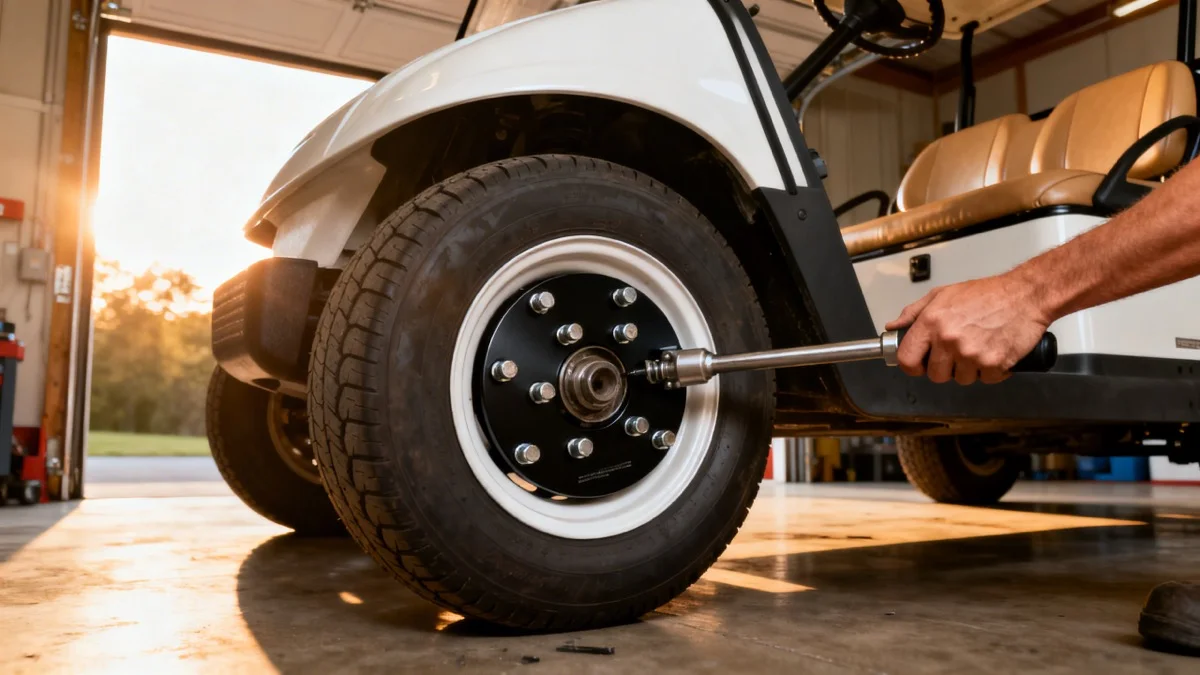
Wheel spacers sit between the hub and the wheel. That pushes the wheel outward from the cart.
On a golf cart, owners usually install them for one of three reasons:
- to clear a wider tire that rubs the leaf spring or inner wheel well
- to widen the stance of a lifted cart
- to get a more aggressive, flush look with aftermarket wheels
A 2-inch spacer does not add 2 inches to the cart overall. It adds about 2 inches per side, so the full track width grows by about 4 inches across that axle.
That extra width can help a cart feel more stable, especially if you already added larger tires or a lift. It can also help certain wheel-and-tire combos clear the inside suspension components. This is why spacer kits show up so often in customization builds, off-road carts, and farm or ranch setups.
The tradeoff is just as important: pushing the wheel farther out increases leverage on bearings, hubs, and steering parts. That does not make spacers automatically unsafe, but it means you should treat them like a real suspension-related modification, not a cosmetic toy.
Golf Cart Wheel Spacers Pros and Cons
For the exact query golf cart wheel spacers pros and cons, the honest answer is that spacers are a fitment tool first and a styling tool second.
| Pros | Cons |
|---|---|
| Creates inner clearance for wider tires | Adds leverage to bearings, hubs, and steering parts |
| Widens stance on lifted carts | Adds another set of fasteners that must be torqued and rechecked |
| Can make the cart feel more planted | Cheap or poorly machined spacers can cause vibration |
| Costs less than replacing wheels for offset | Wrong thread pitch or hub fitment can be unsafe |
| Gives a more aggressive wheel position | Does not solve tire-height rubbing at the fender |
The practical rule: use spacers when you can name the specific clearance problem they solve. Skip them if you are guessing.
When Wheel Spacers Are Actually Worth It
Spacers make the most sense in four situations.
Your wider tires rub the inside, not the top
This is the classic spacer use case. If the inside sidewall or wheel barrel is rubbing the leaf spring, strut, frame, or steering hardware, a spacer can solve the problem cleanly.
If the rubbing is at the top of the wheel opening or fender lip, the issue is tire height, not inward position. In that case you probably need:
- a smaller tire
- a different wheel offset
- or a lift kit
That distinction matters. Plenty of owners buy spacers because they hear "my tires rub, so I need spacers," when the real issue is that the tire is too tall for the cart.
Your lifted cart feels too narrow
A stock-width cart with a 4-inch or 6-inch lift can feel tippy compared with stock, especially in turns, on sloped driveways, or on rough trails. Spacers can help by widening the stance.
They are especially common on carts built for:
- trail riding
- hunting property
- beach paths
- neighborhood use with larger wheel-and-tire combos
If you are building a cart like the ones in our best golf carts for neighborhoods guide or best golf carts for beach towns guide, that wider footprint can make the cart feel more planted.
You want to keep your current wheels
Sometimes the wheel itself is fine, but the offset is too tucked in. A spacer is cheaper than replacing the whole set.
That is why they are often a better value than changing both wheels and tires just to fix one fitment problem. Our mounted wheel and tire combo guide covers when a full combo swap is worth it, but spacers are usually the lower-cost fix when the wheel choice is already right.
You know the exact fitment you need
Spacers are not a guess-and-check accessory. They work best when you already know:
- your bolt pattern
- your stud thread pitch
- your hub bore
- the exact location of the rubbing
If you cannot explain where the wheel is rubbing, you are not ready to buy spacers yet.
When You Should Skip Wheel Spacers
This is the part most seller pages skip because it gets in the way of the sale.
Skip them if your tires already clear
If the cart drives fine and the tires do not rub, spacers are usually a style choice, not a functional need. That is not automatically bad, but it changes the value equation.
If you are only riding on smooth pavement, a spacer may add visual stance without adding much real-world benefit.
Skip them if your bearings or steering are already tired
If your cart already has:
- wheel play
- steering slop
- noisy hubs
- uneven front tire wear
then spacers are not the first purchase. Fix the wear items first. Widening the wheel position on worn components rarely improves anything.
This is where our essential tool kit guide, shocks and suspension guide, golf cart alignment guide, and safety guide matter more than another accessory.
Skip them if the real problem is tire height
If the tire hits the top of the body or fender lip during turns or bumps, the answer is not a spacer. You need more vertical clearance. That usually means a smaller tire or a lift kit.
Skip them if you are buying the cheapest unverified hardware
This is a category where low quality matters. A spacer carries real load. Fitment, machining accuracy, hardware quality, and thread engagement are not optional details.
One-Inch vs Two-Inch Wheel Spacers
Most golf cart owners end up choosing between 1-inch and 2-inch spacers.
| Spacer Size | Best Use | Pros | Cons |
|---|---|---|---|
| 1 inch | Mild clearance and stance correction | Lower stress on parts, cleaner fit, conservative choice | May not clear aggressive setups |
| 2 inch | Wide tires, lifted carts, stronger stance change | Most common solution, real clearance gains | More leverage on bearings and steering parts |
Choose 1-inch spacers if:
- you only need a little inner clearance
- you want a subtle stance change
- your cart is mostly a pavement cruiser
- you are trying to stay conservative with component load
Choose 2-inch spacers if:
- you are running wider aftermarket tires
- the cart is lifted
- you want a visibly wider stance
- the inside sidewall is rubbing suspension or leaf-spring hardware
For most owners doing this for function rather than looks, 2-inch spacers are the common answer, but only when they have a real clearance problem to solve.
Fitment: EZGO vs Club Car vs Yamaha
A lot of universal spacer kits claim to fit all major brands because most golf carts share the common 4x4 bolt pattern. That part is true. The problem is that not every kit handles thread pitch and hardware the same way.
EZGO
Most EZGO carts use 1/2"-20 studs and a 3/4" lug socket. EZGO also has generous wheel-well clearance compared with other brands, which means many owners do not need spacers until they go to wider aftermarket tire packages.
For many EZGO owners, spacers are a secondary add-on after larger tires, not a first-step mod.
Club Car
Club Car carts also commonly use 1/2"-20 hardware, but their wheel-well clearance is tighter than EZGO. That makes spacers more common when owners start mixing aftermarket wheels, lift kits, and wider tires.
Club Car owners building custom carts or lifted neighborhood carts are some of the most common spacer buyers.
Yamaha
Yamaha fitment is where owners get tripped up. Yamaha often uses 12mm x 1.25 hardware, which means some "universal" spacer kits still need different lug nuts or special attention to stud compatibility.
That is why you should verify hardware details before assuming a spacer kit for Club Car and EZGO will be identical for Yamaha.
Spacers for Golf Cart Wheels: Fitment Checklist
Before ordering spacers for golf cart wheels, confirm these details:
- Bolt pattern: most carts use 4x4, also written as 4x101.6mm
- Thread pitch: Club Car and E-Z-GO commonly use 1/2-20; Yamaha commonly uses 12mm x 1.25
- Hub bore: the spacer should sit flat and centered without rocking
- Stud length: factory studs must not bottom out against the wheel or spacer
- Spacer thickness: 1 inch for mild correction, 2 inches for a bigger stance or clearance change
- Torque spec: use the cart, wheel, or spacer manufacturer's spec; many golf cart lug references use about 50 ft-lbs for standard lugs
- Re-torque interval: check after the first 25-50 miles and during routine maintenance
If any of those details are unknown, stop and identify the cart model, wheel package, and hardware before buying. A cheap universal kit is not a good deal if the lug nuts or hub fit are wrong.
Best Golf Cart Wheel Spacer Kits in 2026
This is a smaller product category than tires or lift kits, so I would rather give you fewer picks and explain them properly.
Best overall 2-inch kit: 10L0L 2-inch wheel spacers
This is the strongest fit for most owners because it targets the exact reason people buy spacers in the first place: clearing wider tires and widening stance on Club Car, EZGO, and Yamaha carts with the common 4x4 pattern.
The 10L0L kit is already used in our tires and wheels finder, and it is the cleanest carry-forward recommendation here because it includes lug nuts and is positioned directly at the mainstream golf cart fitment market.
10L0L 2-Inch Golf Cart Wheel Spacer KitUse this if you are trying to clear wider tires or want a visibly wider stance on a lifted cart.
Best conservative option: quality 1-inch spacer kit
If you only need mild clearance or a subtle stance change, a 1-inch spacer is often the better engineering choice. Golf Cart King currently lists 1-inch and 2-inch golf cart spacer options in the roughly $90-$125 range, which is about where a decent spacer should land.
That range also tells you what to avoid. If a full set is dramatically cheaper than that, ask why.
Best add-on tool for safe installation: torque wrench
Spacer installs do not fail because the concept is wrong. They usually fail because somebody guessed at torque or used an impact gun.
Click-Style Torque WrenchOur tool kit guide already recommends a click-style torque wrench because golf cart lug nuts and suspension fasteners live in a narrow range where "tight enough" is not good enough.
Best add-on tool if you are installing in the garage: floor jack
2-Ton Floor JackIf you do not already own a proper jack and stands, stop there first. Do not turn a spacer install into a balancing act with a scissor jack.
Best add-on if you are building a wider setup from scratch: socket set
DEWALT Socket SetIt is not glamorous, but this handles the install better than trying to piece together old sockets that may not match your brand's hardware. Our tool guide also covers the SAE vs metric differences by brand.
Pros and Cons of Wheel Spacers
Here is the honest tradeoff list.
Pros
- Better inner clearance for wider tires
- Wider stance can make a lifted cart feel more planted
- Cheaper than replacing wheels and tires just to fix offset
- More aggressive, flush look
- Can help certain carts corner with less body roll
Cons
- More leverage on wheel bearings and steering parts
- Adds another critical fastener interface you must inspect
- Cheap kits can cause vibration or hardware problems
- Incorrect installation can be unsafe
- Does not fix tire-height issues
That last point is worth repeating. If you need more space above the tire, you need a different fix.
How to Tell if a Spacer Will Fix Your Rubbing
This is the simplest diagnostic approach:
Spacer likely helps if the rubbing is:
- on the inner sidewall
- near the leaf spring
- against the shock or frame
- on the inside barrel of the wheel
Spacer will not help much if the rubbing is:
- on the top of the tire
- at the fender lip
- on full suspension compression from tire height
In that second group, you are usually looking at lift kit territory or a smaller tire.
DIY Installation: The Right Way
Most spacer installs take 30-60 minutes if you already have the tools.
What you need
- floor jack
- jack stands
- correct lug socket
- torque wrench
- wire brush or rag for hub cleanup
If you are missing any of that, start with our tool kit guide.
Basic install process
- Park on flat ground and chock the opposite wheels.
- Loosen the lug nuts slightly before lifting the cart.
- Lift the cart and support it on jack stands.
- Remove the wheel.
- Clean the hub face so the spacer sits perfectly flush.
- Test-fit the spacer and confirm stud and center-bore fitment.
- Tighten the spacer hardware evenly in a star pattern.
- Reinstall the wheel and torque the lug nuts to spec.
- Drive carefully, then re-torque after 25-50 miles.
What not to do
- Do not use an impact gun to finish tightening.
- Do not install over rust, dirt, or paint buildup on the hub face.
- Do not ignore thread pitch differences.
- Do not skip the re-torque interval.
This is especially important if your cart also has lifted suspension or heavier all-terrain tires, because those combos increase loads everywhere.
Safety Rules That Actually Matter
Retailers love vague phrases like "enhanced stability" and "precision engineered." The real safety rules are simpler.
Buy the correct bolt pattern and thread pitch
Golf cart parts are still vehicle parts. Close enough is not good enough.
Use a torque wrench
This is non-negotiable. Spacer installs rely on proper clamp load.
Re-torque after the first 25-50 miles
10L0L explicitly warns owners to re-check torque after initial use, and that is good practice no matter which brand you buy.
Do not treat a wider stance like immunity from rollover
Yes, a wider track can help stability. No, it does not make a lifted cart behave like a sports car. If you drive too fast into corners, carry too many passengers, or take slopes sideways, you can still roll a cart. Our golf cart safety guide covers the bigger picture.
Should You Buy Wheel Spacers or Something Else?
Here is the short buying advice.
Buy wheel spacers if:
- the tires rub on the inside
- your lifted cart feels too tucked in
- you want to keep your current wheels
- you are willing to install and inspect them correctly
Buy a lift kit instead if:
- the tire rubs the top of the fender
- you want taller tires
- you need more ground clearance for trails or work property
Buy different wheels instead if:
- the wheel offset is the root problem
- you want a cleaner one-step setup
- you are already shopping for new tires anyway
Buy nothing yet if:
- you have not identified exactly where the rubbing happens
- your hubs, bearings, or steering already feel worn
Our Verdict
Wheel spacers are worth it when they solve a real fitment problem. They are not worth it when they are being used to avoid sizing the tire and wheel package correctly in the first place.
For most owners, the right spacer setup looks like this:
- 1-inch spacers for mild correction
- 2-inch spacers for lifted carts or meaningful inner clearance issues
- quality hardware
- torque wrench installation
- re-torque after the first 25-50 miles
If that sounds like more effort than you want, that is the answer too. Sometimes the better move is a cleaner wheel-and-tire combo or a properly matched lift kit.
If you want help deciding what full setup makes sense for your cart, start with our golf cart tires and wheels finder, lift kit guide, and customization guide. If you would rather have a shop inspect your current clearance and install everything at once, use our repair directory to find a local golf cart shop.
FAQ About Golf Cart Wheel Spacers
What are golf cart spacers?
Golf cart spacers are metal wheel adapters that move the wheel outward from the hub. Most owners use the term interchangeably with golf cart wheel spacers.
What are the pros and cons of golf cart wheel spacers?
The pros are inner tire clearance, wider stance, a more planted feel on lifted carts, and lower cost than replacing wheels. The cons are more leverage on bearings and steering parts, another fastener interface to inspect, and possible vibration or safety issues if the kit is cheap or installed incorrectly.
What size golf cart wheel spacer should I use?
Use 1-inch spacers for mild clearance or subtle stance changes. Use 2-inch spacers when wider tires or a lifted setup need meaningful inner clearance. Avoid thicker spacers unless you understand the bearing, steering, and fitment tradeoffs.
Do spacers for golf cart wheels fit all brands?
Not automatically. Many carts share the common 4x4 bolt pattern, but thread pitch and hardware differ. Club Car and E-Z-GO commonly use 1/2-20 hardware, while Yamaha commonly uses 12mm x 1.25 hardware.
Are golf cart wheel spacers safe?
Yes, if they match the cart, are installed correctly, and are re-torqued after initial driving. Most problems come from poor fitment or careless installation, not from the concept of spacers themselves.
What do wheel spacers do on a golf cart?
They push the wheels outward. That can create clearance for wider tires, widen the stance, and change the look of the cart.
How much do golf cart wheel spacers cost?
Most decent spacer kits fall around $90-$130 per pair, with complete four-wheel kits often around $115-$145 depending on material and brand.
Should I buy 1-inch or 2-inch golf cart wheel spacers?
Buy 1-inch spacers for mild correction. Buy 2-inch spacers when you have real inner-clearance problems or a lifted setup that needs a wider stance.
Do spacers stop tire rubbing?
They can stop inner rubbing. They do not fix rubbing caused by a tire that is too tall.
Do spacers damage bearings?
They increase load on bearings and steering parts because the wheel sits farther out. That does not guarantee failure, but it means install quality, driving style, and tire weight all matter more.
Can I install wheel spacers myself?
Yes. Most installs take 30-60 minutes with a floor jack, jack stands, the correct socket, and a torque wrench.
Do EZGO, Club Car, and Yamaha use the same spacer kit?
Many kits fit the common 4x4 bolt pattern across those brands, but hardware details still matter. Yamaha fitment especially deserves a double-check.
Should I use an impact wrench?
No. Use hand tools and finish with a torque wrench.
Do I need spacers with a lift kit?
Not always. Lift kits solve height clearance. Spacers solve inward clearance and stance. Some carts need both, many do not.
Will spacers improve stability?
They can help by widening track width, especially on lifted carts, but they do not make unsafe driving safe.
When should I skip wheel spacers?
Skip them when the tires already clear, the real issue is tire height, or your hubs and steering parts already need attention.
Golf Cart Search
Find the Best Golf Carts of 2026
Compare top-rated models, read expert reviews, and find the perfect cart for your needs.