
As an Amazon Associate, we earn from qualifying purchases. This helps support our site at no extra cost to you.
A golf cart controller is expensive enough that you do not want to guess. Jerky acceleration, a cart that clicks but will not move, sudden speed loss, or a flashing fault code can point toward the controller, but those same symptoms can come from weak batteries, hot cables, a bad solenoid, throttle problems, or a wiring issue.
This guide covers the practical version of golf cart controller diagnosis: what the controller does, which symptoms matter, what to test before replacing it, what replacement and upgrade costs look like in 2026, and when an upgraded speed controller actually makes sense for Club Car, EZGO, Yamaha, ICON, Star EV, and other electric carts.
Common Stock Replacement $300 to $900
Installed Repair Range $600 to $1,500
Performance Kits $700 to $1,400+
Common Upgrade Size 400A to 600A
Most Common False Positive Weak batteries
Best First Tool Digital multimeter
Golf Cart Controller Symptoms: Quick Answer
The most common golf cart controller symptoms are:
- jerky or uneven acceleration
- sudden power loss after a few minutes of driving
- a cart that clicks but will not move
- reduced top speed even with a charged battery pack
- surging, pulsing, or cutting out under load
- controller fault codes or blinking status lights
- burning smell, heat damage, or melted high-current terminals
- no motor output after batteries, cables, solenoid, and throttle input test good
Those symptoms make the controller worth testing. They do not prove the controller is bad.
If the cart will not start at all, start with our golf cart won't start guide. If the solenoid clicks, read the golf cart solenoid symptoms guide. If the cart is weak on hills, verify pack voltage with the battery voltage chart before blaming the controller.
What a Golf Cart Controller Actually Does
The controller is the power-management box between the battery pack and the motor. It reads the key switch, throttle input, forward and reverse input, speed sensor or motor feedback, temperature conditions, and safety interlocks. Then it meters current to the motor.
On a stock neighborhood cart, that usually means smooth starts, controlled top speed, and basic protection from overheating or low pack voltage. On a performance cart, the controller also shapes acceleration, regenerative braking on supported systems, motor braking, reverse speed, and low-voltage cutback.
That is why controller problems feel vague. The controller sits in the middle of almost every electric-drive complaint. A bad cable can starve it. A weak battery can trip low-voltage protection. A bad throttle sensor can send the wrong command. A failing motor can demand too much current. The controller may be reporting the problem, not causing it.
For deeper motor context, read our AC vs DC golf cart motor guide and horsepower and torque guide. Controller choice depends heavily on motor type.
Bad Controller Symptoms vs Other Problems
Use this table before ordering a $700 part.
| Symptom | Controller likely? | Check first |
|---|---|---|
| Cart clicks but will not move | Medium | Solenoid output, pack voltage, main cables |
| Jerky launch | Medium | Throttle sensor, MCOR, ITS, cable voltage drop |
| Cart slows after warming up | Medium to high | Controller heat, motor heat, dragging brakes, low voltage |
| No click and no movement | Low to medium | Key switch, tow/run switch, pedal switch, fuse, pack voltage |
| Runs fine on flat ground but dies on hills | Low to medium | Weak batteries, cable heat, undersized wiring, motor load |
| Top speed suddenly limited | Medium | Speed sensor, controller programming, low-voltage cutback |
| Burning smell near controller | High | Loose terminals, heat damage, controller case, cable lugs |
| Fault code stored in controller | High | Decode code before replacing parts |
The most expensive mistake is replacing the controller when the real issue is voltage drop. A tired 48V lead-acid pack may show 50V at rest and still sag badly under load. That sag can make the controller protect itself by reducing speed or shutting output down.
If the cables are swollen, stiff, corroded, hot, or undersized, use our battery cable size and replacement guide before chasing the controller.
How to Test a Golf Cart Controller Safely
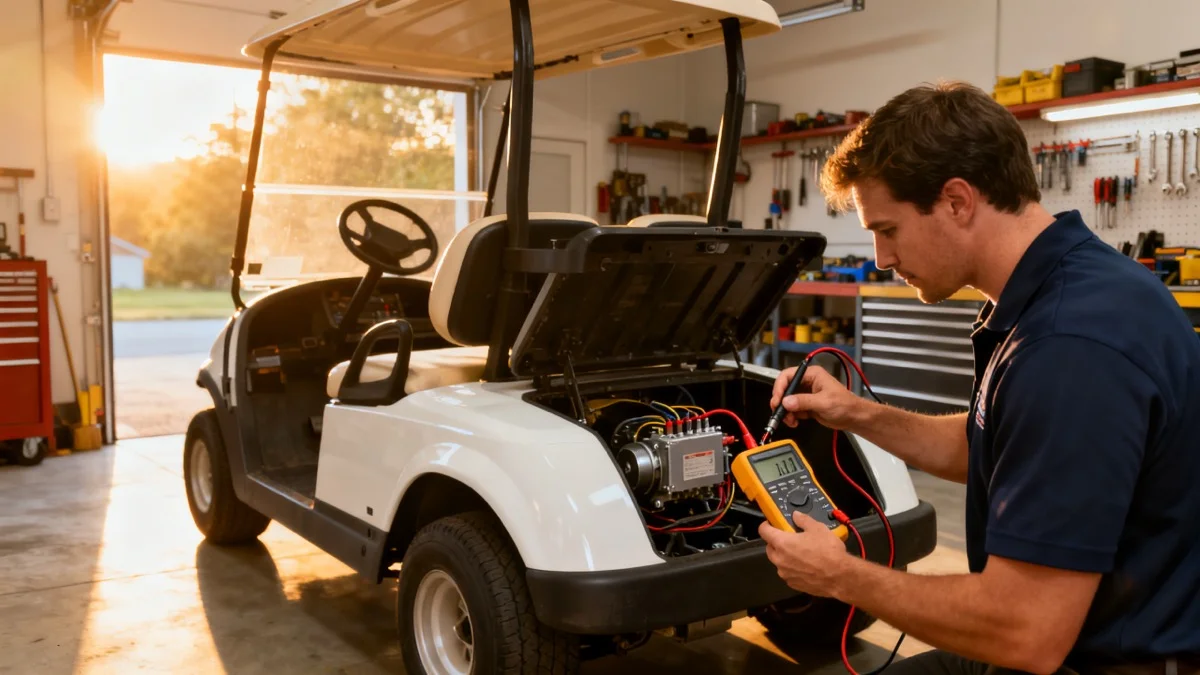
The goal is not to bench-test the controller like a factory technician. The goal is to prove that the controller has clean power, clean inputs, and a real reason to send output to the motor.
Step 1: Confirm Battery Pack Voltage
Measure pack voltage at the main positive and main negative. A fully charged 48V lead-acid pack usually rests around 50.9V after surface charge settles. A 36V pack is usually around 38.2V when full. Lithium systems vary by chemistry and BMS, so use the battery maker's chart.
If voltage is low, charge the pack and retest. If one battery is weak, the controller may cut power even though the controller is not bad.
For basic diagnosis, a digital multimeter is the first tool to buy.
Check Price: AstroAI MultimeterStep 2: Check Voltage Under Load
Resting voltage is not enough. Watch pack voltage while the cart tries to move or climbs a small grade. If voltage collapses, you may have weak batteries, bad cables, or a high-resistance connection.
Do this before any controller swap. A new controller will not fix a pack that cannot deliver current.
Step 3: Inspect Controller Cables and Terminals
Look for:
- darkened insulation near controller terminals
- loose ring lugs
- melted plastic around studs
- green or white corrosion
- cables that feel warm after a short drive
- aftermarket accessory wires stacked on high-current studs
Clean minor corrosion with electronics-safe cleaner and protect dry connections with dielectric grease. Do not spray random solvents into sealed controller connectors.
CRC QD Electronic Contact Cleaner Permatex Dielectric GreaseStep 4: Verify Solenoid Output
The solenoid must send pack voltage to the controller when the cart is commanded to move. If the solenoid clicks but voltage never reaches the controller side, the controller may be innocent.
Use the solenoid guide if you need the exact test path: Golf Cart Solenoid Symptoms & Replacement.
Step 5: Check Throttle Input
Controllers respond to throttle input. If the throttle sensor is dirty, misadjusted, or mismatched to the controller, the cart can jerk, surge, creep, or refuse to move.
Common examples:
- Club Car Precedent and DS IQ carts can have MCOR issues.
- Older EZGO TXT carts may use ITS input.
- Some Yamaha systems use different throttle signals than Club Car or EZGO.
- Aftermarket controllers must be programmed for the correct throttle type.
This is why "same voltage" is not enough when buying a controller. A 48V controller with the wrong throttle input can be a very expensive paperweight.
Step 6: Read Fault Codes or App Diagnostics
Modern controllers often provide fault codes through a status LED, handheld programmer, or phone app. The Curtis 1268 manual describes diagnostics through programmer menus and LED flash codes, while Navitas advertises Bluetooth app telemetry and programmable settings on its TSX3.0 controller.
If the controller has a fault history, read it before clearing anything. A motor temperature fault, throttle fault, main contactor fault, or low-voltage fault points to different repairs.
Golf Cart Controller Replacement Cost in 2026
Here is a realistic cost range for 2026.
| Controller path | Parts cost | Installed cost | Best for |
|---|---|---|---|
| Used or rebuilt stock controller | $150 to $400 | $350 to $800 | Older carts with low value |
| New stock-style replacement | $300 to $900 | $600 to $1,500 | Restoring factory behavior |
| 400A to 500A performance controller | $600 to $1,000 | $900 to $1,800 | More torque and mild speed gains |
| 600A controller kit | $700 to $1,400+ | $1,100 to $2,300+ | Lifted carts, hills, rear seats, performance builds |
| AC motor and controller conversion | $1,800 to $3,500+ | $2,500 to $5,000+ | Major performance rebuilds |
Current market examples support those ranges. Alltrax lists the SR48500 48V 500A controller at $775, and Navitas lists 600A MOSFET technology, Bluetooth telemetry, and programmable settings on the TSX3.0 product page. Retail bundle prices vary by harness, programmer, solenoid, and cable package.
Labor varies because controller work is not only "unbolt the old box." A shop may need to diagnose the fault, identify the control system, program the new controller, update cables, install a heavier solenoid, test throttle input, and road-test the cart. If the wiring harness has been modified by a previous owner, expect more labor.
Should You Repair, Replace, or Upgrade?
Use this decision order.
Repair the Existing Setup
Repair first when:
- the controller itself has no fault codes
- terminals are loose or dirty
- one cable is heating up
- the cart has a weak battery
- the throttle input is out of range
- the solenoid is failing under load
That path can save hundreds of dollars. Many "controller problems" are really connection problems.
Replace With Stock
Choose a stock-style replacement when:
- you want factory speed and behavior
- the cart is used on a golf course or in a quiet neighborhood
- batteries, motor, brakes, and cables are otherwise stock
- warranty or dealer support matters
- resale value matters more than speed
This is the cleanest path for many used golf cart owners. A buyer wants a reliable cart, not a mystery performance build.
Upgrade the Controller
Upgrade when:
- the cart carries rear passengers often
- it has larger tires or a lift kit
- it struggles on hills even with healthy batteries
- you want smoother acceleration tuning
- you already plan to upgrade cables and solenoid
- brakes and steering are in good shape
An upgraded controller can make a cart feel stronger, but it is not magic. More amps create more heat and stress. If the motor, cables, solenoid, battery BMS, and brakes are not matched, the upgrade can expose the next weak part.
If speed is the main goal, read How to Make a Golf Cart Faster before buying parts. If street use is the goal, check golf cart laws and golf cart insurance first. A faster cart may need LSV registration, insurance, mirrors, seat belts, lights, and other equipment.
Controller Amps: 300A vs 400A vs 500A vs 600A
Controller amp ratings describe how much current the controller can deliver under specific conditions. More amps usually mean more torque potential, not a guaranteed top-speed increase.
| Rating | Practical use | Watch-outs |
|---|---|---|
| 250A to 350A | Stock neighborhood and golf-course carts | Limited torque with big tires or rear seats |
| 400A | Mild upgrade for hills and passengers | May need better cables and solenoid |
| 500A | Strong upgrade for lifted carts and heavy use | Check motor heat and battery voltage sag |
| 600A | Serious performance controller | Needs matched cables, solenoid, battery, motor, and brakes |
Alltrax publishes SR controller models from 300A through 600A, and the official SR48500 page lists a 48V 500A peak rating with programmable settings. Navitas lists the TSX3.0 with 36V to 48V support and 600A MOSFET technology.
The smart question is not "what is the biggest controller I can buy?" The smart question is "what can my whole system safely support?"
For many carts, a 400A or 500A controller with clean 4 AWG or 2 AWG cables, a compatible solenoid, healthy batteries, and correctly inflated tires feels better than a 600A controller bolted onto tired wiring.
View Heavy-Duty Battery Cables for EZGO TXTLithium Batteries and Controller Settings
Lithium batteries change the controller conversation because they hold voltage better under load and can deliver current differently than flooded lead-acid batteries. That can make a cart feel stronger, but it also means the controller and battery BMS need to agree.
Before pairing lithium with a performance controller, check:
- maximum continuous discharge from the lithium BMS
- peak discharge rating and time limit
- controller amp setting
- low-voltage cutoff behavior
- charger compatibility
- cable gauge and lug size
- whether the controller has a lithium profile
The active EXEFCH 51.2V 105Ah lithium pack is a relevant example for buyers comparing 48V-class lithium upgrades. It should still be matched against your cart, charger, controller, and BMS limits before purchase.
Check EXEFCH 51.2V Lithium Battery PriceFor the full battery side of the project, read the lithium conversion guide, battery guide, and charger guide.
Brand-Specific Controller Notes
Club Car Controller Notes
Club Car electric carts can vary by year and system. DS, Precedent, Tempo, and Onward carts may use different controller families, throttle inputs, and speed programming. Club Car IQ-style systems are common in the upgrade world, but exact fitment still matters.
If a Club Car launches unevenly, do not jump straight to the controller. Compare symptoms against the Club Car MCOR guide. A bad MCOR can mimic controller hesitation.
EZGO Controller Notes
EZGO TXT, RXV, PDS, DCS, and TXT48 systems are not interchangeable. Older 36V carts, TXT48 carts, and RXV carts use different control logic and motor setups.
EZGO RXV carts are especially different because many use AC drive systems and electronic braking. Treat RXV controller work as more specialized than a simple TXT swap.
If you are also seeing charger or port issues, the EZGO TXT charger guide and charging port problems guide can help separate battery charging problems from drive-control problems.
Yamaha Controller Notes
Yamaha G-series, Drive, and Drive2 carts have their own controller and throttle setups. Gas Yamaha carts do not use an electric drive controller in the same way, so controller guides mostly apply to electric models.
On older electric Yamaha carts, identify the exact model and throttle input before buying an aftermarket controller. If the cart is gas and losing power, start with the drive belt guide instead.
Newer Lithium Brands
ICON, Evolution, Advanced EV, Star EV, Atlas, Denago, Bintelli, Kandi, and other newer lithium-heavy brands often use integrated displays, proprietary harnesses, and dealer-specific programming. If the cart is still under warranty, call the dealer before replacing the controller yourself.
Start with our golf cart warranty guide if you are unsure whether controller work will affect coverage.
What to Upgrade With the Controller
Controller upgrades often need companion parts.
| Companion part | Typical cost | Why it matters |
|---|---|---|
| Heavy-duty solenoid or contactor | $100 to $300+ | Handles higher current safely |
| 4 AWG or 2 AWG cables | $60 to $250+ | Reduces voltage drop and heat |
| Throttle sensor or MCOR | $40 to $200 | Prevents jerky input from ruining the upgrade |
| Battery pack refresh | $900 to $2,500+ | Controller can only use power the pack can deliver |
| Brake service | $75 to $500+ | More speed and torque need better stopping |
| Tires and alignment | $50 to $700+ | Oversized or low-pressure tires overload the system |
For tools, a good socket set is useful for seat removal, battery hold-downs, controller brackets, and cable lugs.
Check Price: DEWALT Socket SetIf the cart already has lights, speakers, GPS, fans, or a 12V reducer, review the golf cart wiring guide. Accessory wiring mistakes can create controller-adjacent symptoms that are painful to diagnose.
When to Use a Repair Shop
Use a golf cart repair shop when:
- the controller case smells burnt
- cables are melted at the controller
- the cart has unknown prior wiring modifications
- you cannot identify the throttle type
- the controller needs dealer-level programming
- the cart has an AC drive system
- the cart is under warranty
- the battery pack is lithium and the BMS limits are unclear
- the repair estimate is close to the cart's value
You can find local service options through our golf cart repair directory. If the cart is not worth repairing, compare replacement options on the dealer directory, best golf carts page, and best golf cart brands guide.
Controller Buying Checklist
Before ordering, write down:
- cart brand, model, year, and serial number
- battery voltage and chemistry
- motor type: series DC, shunt/Sepex DC, AC, or unknown
- existing controller model number
- throttle type
- solenoid rating
- cable gauge
- tire size
- whether the cart has a rear seat, lift kit, or heavy accessories
- whether you want stock behavior, more torque, or more top speed
If the seller cannot confirm fitment from those details, do not buy the controller. Returns on electrical parts are often strict, and a mismatched controller can damage other parts.
Final Recommendation
Do not replace a golf cart controller until you have tested batteries, cables, solenoid output, throttle input, and fault codes. The controller is one of the most expensive electrical parts on the cart, and it is often blamed for problems caused by voltage drop or dirty connections.
If the controller is truly bad, stock replacement is the right answer for most standard neighborhood carts. Upgrade only when the whole system is ready for it: batteries, cables, solenoid, motor, brakes, tires, and legal use case. A properly matched 400A to 600A setup can transform a cart. A mismatched setup just moves the failure to the next weakest part.
Frequently Asked Questions
What are the symptoms of a bad golf cart controller?
Common symptoms include jerky acceleration, sudden power loss, reduced top speed, a cart that clicks but will not move, overheating, fault codes, or no voltage output to the motor. Test batteries, cables, solenoid, and throttle input before replacing the controller.
How much does golf cart controller replacement cost?
Expect $300 to $900 for many stock-style controller parts and $600 to $1,500 installed after diagnosis and labor. Performance controller kits often cost $700 to $1,400+ before companion parts or installation.
Can weak batteries mimic a bad controller?
Yes. Weak batteries are one of the most common false positives. A pack can look charged at rest but sag under load, which makes the controller reduce output or shut down.
Will a controller upgrade make my golf cart faster?
Sometimes, but the bigger improvement is usually torque and acceleration. Top speed also depends on motor type, tire size, voltage, software limits, brakes, and local legal rules.
What amp controller should I buy?
Stock carts often use lower-output controllers, while common upgrades are 400A, 500A, or 600A. Match the amp rating to your batteries, cables, solenoid, motor, tire size, and use case.
Can I install a golf cart controller myself?
A plug-and-play swap is possible for an organized DIY owner, but only if the controller matches the cart, throttle type, voltage, and motor. Use a shop for melted wiring, lithium conversions, AC systems, or warranty carts.
Do lithium golf cart batteries need controller changes?
Not always. Many lithium conversions work with stock controllers, but high-output packs may require updated settings, heavier cables, and a compatible solenoid. Always match the battery BMS discharge limit to the controller settings.
Is a used golf cart controller worth buying?
Only when the cart is older, low-value, and you can confirm the exact part number and return policy. For newer carts, performance builds, or warranty-sensitive repairs, a new controller from a known supplier is safer.
What kills a golf cart controller?
Heat, water intrusion, loose terminals, low-voltage operation, wrong wiring, undersized solenoids, failing motors, corrosion, cheap mismatched replacements, and surge damage are the usual causes.
Should I replace the controller or buy a different cart?
Replace the controller if the cart has a clean frame, healthy batteries, good brakes, and known wiring. Consider another cart if the estimate is near half the cart's value or several major systems are failing together.
Golf Cart Search
Find the Best Golf Carts of 2026
Compare top-rated models, read expert reviews, and find the perfect cart for your needs.