As an Amazon Associate, we earn from qualifying purchases. This helps support our site at no extra cost to you.
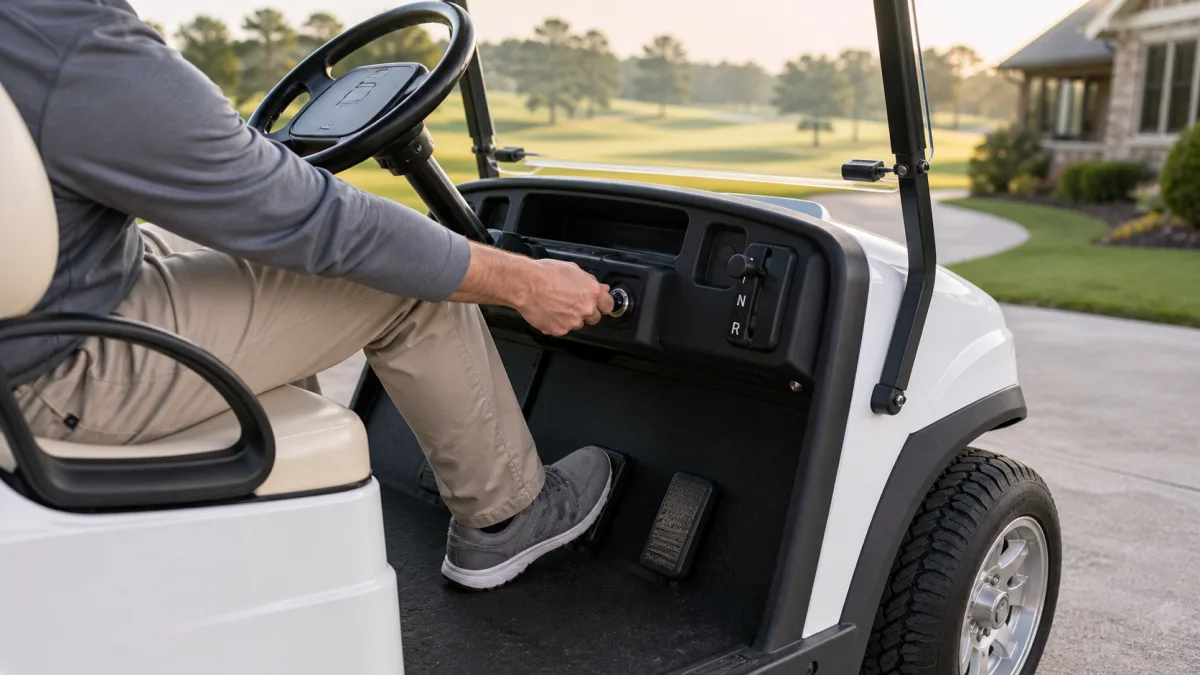
To start a golf cart, sit in the driver seat, hold the brake, insert the key, select forward or reverse, release the parking brake as the manual directs, and press the accelerator slowly. On many carts, that last step is what actually starts the electric motor or gas engine.
The sequence feels unusual if you are used to a car. Most electric golf carts do not crank. Many gas golf carts do not keep idling when you stop. Some models release the parking brake automatically, while others require you to release it first. This guide separates those systems so you can start the cart without guessing.
How to Start a Golf Cart in 5 Steps
This sequence works as a safe overview for most conventional electric and gas carts:
- Prepare the cart. Unplug the charger, remove wheel chocks, and confirm the Tow/Run switch is in Run if the cart has one and was previously placed in Tow.
- Seat everyone. Operate only from the driver side. Every passenger should be fully seated with hands, feet, and loose items inside the cart.
- Hold the brake and choose a direction. Bring the selector to forward or reverse only while the cart is stopped.
- Turn the key on. Keep your foot off the accelerator while energizing the cart unless the exact manual says otherwise.
- Check the path and press the accelerator slowly. Release the parking brake as the model requires. Expect an electric cart to move quietly and many gas carts to crank only when the pedal is pressed.
E-Z-GO's official safety instructions use the same basic pattern: key on, select a direction, release the parking brake, and press the accelerator slowly. The details below explain where electric, gas, and brand-specific controls differ.
Before driving beyond a driveway, check the cold tire pressure against the vehicle label or exact manual. A small digital gauge usually costs about $8-$15 and is easier to read than a pencil gauge.
AstroAI Digital Tire Pressure GaugeFor the correct model-specific values, use our golf cart tire pressure chart.
How to Start an Electric Golf Cart
An electric golf cart does not start like a gasoline car. Turning the key energizes the control system. Pressing the accelerator tells the controller to power the motor, so there is usually no starter noise and no engine idle.
Electric golf cart start sequence
- Disconnect the charger completely. Many modern carts have an interlock that prevents driving while the charger is connected. Store the cord where the cart cannot roll over it.
- Sit in the driver seat and hold the brake. Do not reach in from the passenger side and press the pedal.
- Confirm Run mode if equipped. A Tow/Run switch left in Tow can prevent normal operation. Follow the manual before changing this switch.
- Release the accelerator. Some controllers use high-pedal disable and will refuse to move if the accelerator was pressed when the key was turned on.
- Turn the key on and select forward or reverse. Some E-Z-GO models combine the key and direction selector. Other carts have separate controls.
- Release the parking brake as directed. Traditional carts may use a mechanical brake latch. Newer carts can have an automatic parking brake.
- Look around, then press the accelerator gently. Electric torque arrives immediately, so avoid stabbing the pedal.
The current E-Z-GO RXV owner manual says the charger interlock disables operation while connected. It also describes high-pedal disable and directs the operator to sit down, select the desired direction with the key, and press the accelerator slowly.
What electric-cart silence means
Silence before you press the pedal is usually normal. Silence after you press it is not. A healthy cart may produce a solenoid click, a parking-brake release sound, or a faint motor whine as it begins moving.
If the dashboard turns on but the cart does not move, check these state items before diagnosing parts:
- charger fully unplugged
- selector firmly in forward or reverse
- Tow/Run switch in Run, if equipped
- accelerator released while the key was switched on
- parking brake released or auto brake ready
- usable battery charge shown on the meter
Cycle the key off, remove both feet from the pedals, wait five seconds, and retry once. If the cart still does nothing, move to our golf cart won't-start diagnostic guide or the free golf cart troubleshooter. Repeated pedal presses will not repair a weak battery, open interlock, failed solenoid, or controller fault.
How to Start a Gas Golf Cart
Many gas golf carts use a pedal-start system. Turning the key on prepares the ignition circuit, but pressing the accelerator engages the starter-generator and cranks the engine. On carts designed for golf-course stop-and-go use, releasing the accelerator may shut the engine off again.
Gas golf cart start sequence
- Move outdoors or verify strong ventilation. Never run a gas cart in a closed garage.
- Check fuel and obvious leaks. Do not start the cart if you smell raw fuel or see a wet fuel line.
- Sit down and hold the service brake. Keep the brake applied until the engine has started, especially on a hill.
- Select forward or reverse while stopped. Do not move the selector while the drivetrain is turning.
- Turn the key to On. Many carts do not have a separate spring-loaded Start position like a car.
- Use the choke only for a cold engine when the manual calls for it. Older carts commonly have a pull knob or push-button choke. Warm engines usually do not need it.
- Press the accelerator slowly. The starter-generator should crank and the engine should fire. Release the choke after the engine starts.
The official E-Z-GO gas owner manual instructs the operator to hold the brake, turn the key on, select the direction, and press the accelerator slowly to start the engine. It also warns against starting in an enclosed space and against using the engine to hold the cart on a hill.
Starting a cold gas cart with a choke
A choke temporarily enriches the fuel mixture for a cold start. It is not a cure for a cart that needs choke during normal warm operation.
Use this safe pattern when the exact manual specifies a manual choke:
- Apply the parking brake and select the intended direction.
- Turn the main switch on without pressing the accelerator.
- Engage the choke.
- Check that the path is clear.
- Press the accelerator gradually until the engine starts.
- Release the choke after the engine catches and runs cleanly.
Yamaha's G16 owner manual provides that model-specific sequence and says a warm engine does not require choke. Current and older Yamaha designs vary, so find the model year in the official Yamaha manual library before assuming the G16 procedure applies.
If the cart needs full choke after warming up, stalls as soon as you release it, or smells strongly of fuel, stop. The carburetor, fuel pump, filter, spark plug, or intake may need service. Use our gas golf cart tune-up guide and carburetor cleaning guide to separate maintenance from a genuine repair.
Starting Differences by Brand
The pedals look familiar across brands, but the parking brake, direction selector, and starter behavior can differ.
| Brand or system | What starts the cart | Important difference |
|---|---|---|
| E-Z-GO electric | Key or selector on, then accelerator | Charger interlock and high-pedal disable are common on current models |
| E-Z-GO gas | Key on, direction selected, then accelerator | The pedal starts the engine on current manual examples |
| Club Car conventional cart | Key on, selector set, then accelerator | Mechanical and automatic parking-brake systems both exist |
| Yamaha electric | Main switch on, direction selected, then accelerator | The exact selector wording and brake release vary by generation |
| Yamaha gas | Main switch on, direction selected, then accelerator | Some older models use a manual choke when cold |
| LSV or keyless cart | Key, PIN, fob, or start control | Follow the vehicle display and manual instead of a fleet-cart sequence |
Starting an E-Z-GO
For most conventional E-Z-GO carts, stop fully before changing direction. Unplug electric models, set the vehicle to Run if applicable, turn the key on or to the desired direction, release the parking brake, and apply the accelerator slowly. A reverse alarm is normal when reverse is selected.
If you are unsure whether the cart is a TXT, RXV, Valor, or Express, use our E-Z-GO model identification guide. Model identification matters because a combined key-direction switch on one cart can look different from the separate selector on another.
Starting a Club Car
For a conventional Club Car, seat the passengers, hold the brake, set forward or reverse while stopped, turn the key on, and press the accelerator smoothly. Check whether the cart uses a mechanical parking-brake latch or an automatic system before trying to release it.
Club Car's current Onward LSV page describes an automatic parking brake that engages at a stop and releases when the accelerator is pressed. Older DS and Precedent carts can use a pedal-operated parking-brake latch instead. Match the serial number to the correct document in Club Car's official manual library.
Starting a Yamaha
For a conventional Yamaha golf cart, apply the parking brake, select forward or reverse while stopped, turn the main switch on with your foot off the accelerator, check the path, and press the accelerator slowly. Yamaha's Drive-series manual example warns not to press the accelerator while switching on because the cart can move unexpectedly.
Older Yamaha gas carts can have a visible choke. Newer fuel-injected or differently configured models may not use that routine. The Yamaha G29 guide can help identify a Drive or G29 before you hunt for the right manual.
How to Stop and Park a Golf Cart
Starting safely includes knowing how the cart will stop.
- Release the accelerator completely.
- Use the service brake to reach a complete stop.
- Keep the brake applied while selecting the parked position required by the manual.
- Engage the parking brake unless the model uses an automatic parking brake.
- Turn the key off and remove it before leaving the seat.
Never switch from forward to reverse while moving. Do not coast downhill in neutral, and do not use the accelerator to hold a gas cart on a slope. Carrying extra passengers or cargo increases stopping distance.
If the cart will be used on neighborhood streets, starting technique is only one part of the job. Check our golf cart safety guide, street-legal equipment guide, state law directory, and insurance directory before road use.
Common Starting Mistakes
Pressing the accelerator before turning the key
Modern controllers can block operation when they detect the accelerator during startup. Gas carts can also move unexpectedly if the normal safety sequence is ignored. Start with both feet settled and the accelerator released.
Forgetting the charger interlock
An electric cart that is still plugged in may power the dashboard but refuse to drive. Unplug at the wall or charger as its instructions require, disconnect the vehicle plug, and store the cable before selecting a direction.
Treating Tow mode as a reset button
Tow/Run switches are service and towing controls, not daily ignition switches. Do not flip one under load or use it to mask a fault. Follow the manual when changing modes.
Choking a warm gas engine
Too much choke can flood a warm carbureted engine. If the cart ran recently, try the normal start sequence first. Continued hard starting belongs in the starter-generator guide or the fuel and ignition diagnostic path.
Moving the direction selector while rolling
Stop completely before changing direction. This protects the drivetrain and prevents abrupt deceleration on carts with regenerative braking.
If the Golf Cart Still Will Not Start
Do not replace parts until you separate a control-state mistake from a component fault.
| What happens | First check | Next guide |
|---|---|---|
| Dashboard is completely dark | Battery charge, terminals, main fuse, key switch | Battery voltage chart |
| Lights work but the cart will not move | Charger interlock, Run mode, selector, high-pedal disable | Won't-start guide |
| Solenoid clicks but no movement | Battery voltage under load and solenoid output | Solenoid symptoms guide |
| Gas engine cranks but does not fire | Fuel, choke position, spark, air | Gas tune-up guide |
| Gas engine starts only with choke | Carburetor, intake leak, fuel delivery | Carburetor guide |
| Correct key will not turn or power the cart | Key fitment and ignition switch | Golf cart key guide |
A basic digital multimeter is useful only after the normal start sequence fails. The AstroAI AM33D typically sells around $15, has a 4.5-star tracked rating, and can check battery, fuse, and switch voltage. Do not open a high-voltage lithium battery or probe connectors you cannot identify.
Check Price: AstroAI Digital MultimeterFor tools beyond a meter, see our essential golf cart tool kit guide. If the issue involves a lithium battery enclosure, controller programming, damaged high-current wiring, fuel leak, or unreliable brakes, use the repair directory instead of continuing at home.
Starting a Golf Cart With a Lost Key
Do not hot-wire a golf cart or bridge the ignition wires. Electric carts can expose 36V, 48V, or higher pack voltage elsewhere in the system, and an incorrect connection can damage the controller or make the cart move unexpectedly. Gas carts add a starter circuit and fuel system to the risk.
Use this process:
- Identify the brand, model, and year from the serial plate.
- Check whether the cart uses a common fleet key, unique key, keyless control, or replacement switch.
- Order the matching key or complete switch from a dealer or verified fitment listing.
- Use a locksmith or dealer when the switch is damaged or the cart has been modified.
Common replacement-key packs often cost $5-$15. The pack below fits common E-Z-GO applications, but it is not universal and should be matched to the model before ordering.
E-Z-GO Replacement Key PackOur golf cart key compatibility guide covers Club Car, E-Z-GO, and Yamaha key families without teaching ignition bypasses. If the serial plate is confusing, start with the serial-number guide or VIN decoder.
Golf Cart Starting Questions
Does an electric golf cart make noise when it starts?
Usually very little. You may hear a solenoid click, parking-brake release, or motor whine when the accelerator is pressed. No engine cranking sound is normal. A dashboard that powers up but a cart that stays silent and stationary after pedal input needs diagnosis.
Why does my gas golf cart shut off when I stop?
Many course-style gas carts are designed to stop the engine when the accelerator is released and restart it when the pedal is pressed. That reduces idling. A model that dies while the pedal is still applied or will not restart is showing a fault, not normal pedal-start behavior.
Should I warm up a gas golf cart?
Avoid full-throttle acceleration immediately after a cold start. Use the choke only as the manual directs, release it after the engine starts, and drive gently until operation is smooth. Do not idle a gas cart in an enclosed garage.
Can I start an electric golf cart while it is charging?
No. Disconnect and store the charger cord before moving. Many current electric carts use an interlock that prevents operation while the charger is connected.
What position should the selector be in when parking?
Follow the exact manual. Some gas and electric carts specify different selector positions when parked, and newer models can manage the parking brake electronically. The universal steps are to stop completely, engage the required parking brake, turn the key off, and remove it.
Where can I find the correct starting procedure for my model?
Use the serial number to identify the exact model and year, then download the matching owner manual from the manufacturer. Start with the official Club Car manual library, Yamaha manual library, or E-Z-GO's owner safety resources.
Golf Cart Search
Find the Best Golf Carts of 2026
Compare top-rated models, read expert reviews, and find the perfect cart for your needs.