
As an Amazon Associate, we earn from qualifying purchases. This helps support our site at no extra cost to you.
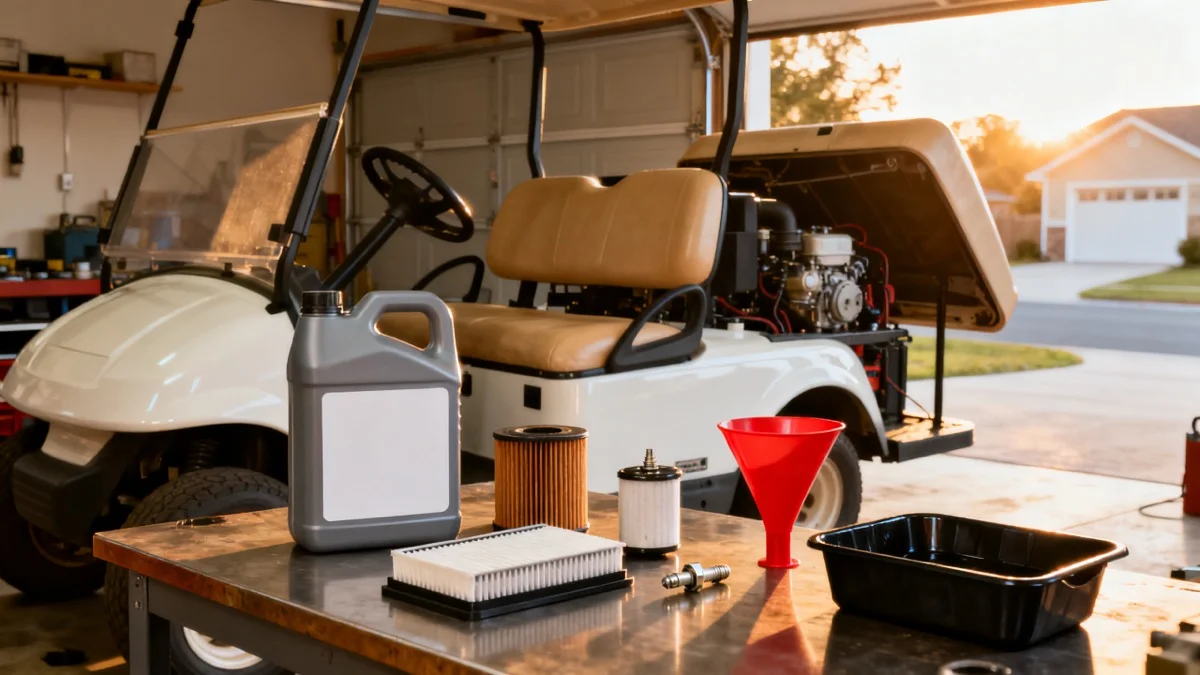
A gas golf cart tune-up is one of the cheapest ways to prevent hard starts, rough idle, fuel starvation, oil leaks, and surprise repair bills. The core job is simple: fresh oil, clean air, clean fuel, a healthy spark plug, and a quick look at belts, cables, brakes, and leaks before you drive it hard.
The mistake is treating every gas cart the same. An older EZGO TXT, a Kawasaki-powered Club Car, and a newer Yamaha Drive2 can use different oil capacities, filter shapes, spark plugs, and service intervals. This guide gives you the practical sequence, the brand-specific checks, and the parts-buying cautions that keep a $40 service from turning into the wrong kit on your garage floor.
Gas Golf Cart Tune-Up Guide: Quick Answer
For most personal-use gas carts, do a tune-up once per year, at spring startup, or every 100 to 150 hours if you drive heavily. At minimum, replace engine oil, replace the oil filter if your engine has one, inspect or replace the air filter, replace the fuel filter, inspect the spark plug, check the plug gap, and test drive the cart under load.
If the cart sat through winter, start with the fuel system before blaming the carburetor. Stale fuel causes many "bad carb" symptoms, especially on carts that ran fine last season. Our spring golf cart maintenance checklist covers the full seasonal restart sequence, while this article focuses on the engine service itself.
The safest rule: use your owner manual for warranty intervals, then service sooner if the cart lives in dust, heat, hills, short-trip neighborhood use, rental duty, farm work, or stop-and-go community driving. If you are deciding whether a gas cart still fits your needs, compare it against electric ownership in our gas vs electric golf cart guide.
Bottom line: A practical gas golf cart tune-up costs $25 to $90 in DIY parts and usually means oil, oil filter or screen service, air filter, fuel filter, spark plug, fuel check, belt inspection, and a short test drive. The exact oil capacity and plug number depend on brand, year, and engine family.
What a Gas Golf Cart Tune-Up Includes
A good tune-up is more than swapping a spark plug. It is a quick health check for every system that lets a small gas engine breathe, ignite, lubricate, and pull the cart without slipping.
| Tune-up item | What to do | Typical DIY cost | Why it matters |
|---|---|---|---|
| Engine oil | Drain warm oil and refill to dipstick mark | $6-$15 | Protects rings, cam, bearings, and governor parts |
| Oil filter or screen | Replace or clean if equipped | $5-$18 | Keeps debris out of the oil circuit |
| Air filter | Inspect, clean pre-filter, replace dirty paper element | $8-$25 | Prevents rich running and dust ingestion |
| Fuel filter | Replace inline filter | $5-$15 | Prevents starvation and carburetor debris |
| Spark plug | Inspect, clean only if lightly sooty, replace if worn | $3-$12 | Restores strong ignition and easy starts |
| Fuel quality | Drain stale fuel or add fresh treated fuel | $5-$20 | Prevents varnish and hard starting |
| Belts | Inspect drive belt and starter-generator belt | $0-$80 | Finds slipping before it strands you |
| Battery and cables | Check 12V battery, grounds, starter connections | $0-$20 | Slow cranking mimics fuel and spark problems |
That last line matters. Gas carts still rely on a 12V starting and charging system. If your cart cranks slowly, clicks, or keeps killing the small battery, read the golf cart starter generator guide before buying fuel-system parts.
Gas Golf Cart Tune-Up Schedule and Intervals
Factory schedules vary more than most owners realize. The E-Z-GO TXT EX1 owner manual lists 5W-30 oil, 1.6 quarts of oil capacity, oil service at 400 hours or 2 years, and spark plug replacement at 500 hours or 2 years for that specific EX1 platform. The Yamaha Drive2 owner manual lists 10W-30 oil, about 1.0 quart capacity, and a BPR2ES spark plug gapped at 0.028 to 0.031 inches.
Older carbureted carts often get serviced more often in the real world because they sit, run short trips, operate in dust, and use small oil capacities. Buggies Unlimited's tune-up reference frames annual service around roughly 125 to 150 hours and lists common kit items like air filters, fuel filters, oil filters, and spark plugs.
Use this owner-friendly schedule unless your manual says otherwise:
| Interval | Owner task | Notes |
|---|---|---|
| Before each ride | Check fuel level, leaks, unusual smell, and oil spots | Stop if you see raw fuel or fresh oil |
| Monthly | Check oil level, tire pressure, lights, and brakes | See our tire pressure chart for PSI targets |
| Spring startup | Inspect fuel, air filter, fuel filter, plug, belts, and battery | Best time for a full tune-up |
| Every 100 to 150 hours | Oil, filters, plug inspection, belt inspection | Use shorter interval for dust, hills, rentals, or farm work |
| Annual | Full tune-up plus brake and suspension inspection | Pair with brake maintenance |
| Before storage | Treat fuel, change dirty oil, clean cart, protect battery | Use the winterization guide |
If you log hours, use hours. If you do not, service annually. Most personal carts do not have hour meters, and calendar-based maintenance is easier to remember.
Fast interval answer: annual service is the safest habit for most owners, 100 to 150 hours is a practical heavy-use interval, and the factory manual wins when it gives a specific service requirement for your exact model.
Oil Change Guide for Gas Golf Carts
Oil is the one tune-up item you should not skip. Gas golf cart engines hold small amounts of oil, often around one quart to one and a half quarts, so contamination and fuel dilution matter. A little overfilling also matters because excess oil can foam, smoke, or push into the air box.
Basic oil change sequence:
- Warm the engine for a few minutes so the oil flows.
- Park on level ground, set the parking brake, remove the key, and chock the wheels.
- Clean dirt around the dipstick, filler cap, oil filter, and drain plug.
- Place a drain pan under the engine.
- Remove the drain plug or use the factory extraction method if your model calls for it.
- Replace the oil filter or clean the oil screen if equipped.
- Reinstall the drain plug with a good gasket.
- Add oil slowly, then check the dipstick.
- Run the engine briefly, shut it down, wait a few minutes, and recheck the level.
- Dispose of used oil at an auto parts store or local recycling site.
Do not assume "10W-30" is correct just because another gas cart uses it. Oil grade depends on engine family and year. The right oil is the one in your manual or on the engine service decal.
EZGO Gas Oil Notes
Older EZGO TXT and Marathon gas carts commonly use 10W-30, with older 295cc and 350cc engines often listed around 44 ounces. Newer EX1 EFI platforms are different. The official EX1 manual lists 5W-30 and 1.6 quarts.
That difference is why you should identify the cart before ordering parts. Our EZGO golf cart models by year guide and serial number lookup guide can help if you are not sure whether you have a TXT, RXV, or another platform.
EZGO quick spec: older TXT gas engines are often around 44 ounces of 10W-30, while EX1 EFI carts list 1.6 quarts of 5W-30. Confirm by serial number before filling.
Club Car Gas Oil Notes
Club Car gas carts span several engine families, including older FE290 and FE350 platforms and newer Subaru or Kohler-related engines depending on year and model. Many owner-service routines use 10W-30 or 10W-40, often around 1.25 to 1.5 quarts, but the safe answer is model-specific.
If you are maintaining a DS, Precedent, Tempo, or Onward, verify the serial number and engine before ordering a tune-up kit. Our Club Car DS vs Precedent guide and Club Car review explain the major model families.
Club Car quick spec: many older Club Car gas service routines use 10W-30 or 10W-40 and roughly 1.25 to 1.5 quarts, but DS, Precedent, Tempo, and Onward parts do not all interchange.
Yamaha Gas Oil Notes
Yamaha Drive and Drive2 gas carts commonly use 10W-30 four-cycle oil, and the Drive2 manual lists 1.0 quart capacity. Older Yamaha G-series carts vary by generation, but many tune-up guides list about 32 ounces for common G14, G16, G20, G21, G22, and Drive-era gas carts.
Yamaha fitment is especially year-sensitive because G-series, Drive, and Drive2 parts are not interchangeable. If you are comparing models, start with our Yamaha golf cart review.
Yamaha quick spec: many Drive and Drive2 gas carts use 10W-30, with Drive2 listed around 1.0 quart and a BPR2ES plug gapped at 0.028 to 0.031 inches.
Spark Plug, Air Filter, and Fuel Filter Checks
The plug, air filter, and fuel filter tell you a lot about the engine before you spend real money.
Spark plug. Remove the plug with the right socket, then inspect the electrode. Light tan or light gray usually means normal combustion. Dry black soot can mean rich mixture, dirty air filter, too much choke, weak ignition, or too much low-speed running. Wet fuel smell can mean flooding or no spark. Oily deposits can point toward engine wear or overfilled oil.
Most gas golf cart plugs are gapped around 0.028 to 0.031 inches, but always confirm by engine. A cheap gap gauge is enough for routine work. If you are diagnosing no-start or intermittent spark, an inline tester is helpful because it lets you see spark while cranking.
Lisle Inline Spark Tester →Air filter. Hold the filter up to light. If you cannot see light through it, or if it is oily, torn, packed with pollen, or full of dust, replace it. Do not run the cart without the air filter, even for a quick test in a dusty garage. Dirt ingestion is a fast way to shorten engine life.
Fuel filter. Inline filters are cheap and easy. Replace the filter if it looks dark, has debris, restricts flow, or has been in the cart for more than a season. Make sure the flow arrow points toward the carburetor or fuel injection rail.
If the cart runs only with choke, starts then dies, or bogs under throttle after fresh filters and a plug, move to fuel delivery. The next checks are in the fuel pump symptoms guide and the carburetor cleaning guide.
Brand-Specific Tune-Up Kits
A tune-up kit is convenient when the fitment is right. The risk is that golf cart product listings often use broad year ranges that do not account for engine swaps, transition years, EFI versus carburetor, or aftermarket air boxes. Before buying, match all of these:
- Brand: EZGO, Club Car, Yamaha, Cushman, or another make
- Model: TXT, RXV, DS, Precedent, Drive, Drive2, and so on
- Model year or serial number range
- Engine family and carburetor or EFI setup
- Air filter shape and pre-filter style
- Oil filter or oil screen style
- Spark plug number
- Fuel filter size and hose diameter
For common carts, these are reasonable starting points to compare against your current parts:
| Cart family | Kit type to look for | Fitment warning |
|---|---|---|
| EZGO TXT or RXV gas | Air filter, oil filter, fuel filter, spark plug | TXT and RXV year ranges are not the same |
| Club Car DS or Precedent gas | FE290 or FE350 kit with oil, air, fuel, plug items | DS, Precedent, and Onward kits differ |
| Yamaha G-series or Drive gas | Air filter, pre-filter, fuel filter, plug, sometimes belts | G16, G22, Drive, and Drive2 need separate checks |
If your cart has been modified, has an engine swap, or came from a fleet, do not trust the body style alone. Photograph the current filters and plug numbers before ordering.
What to Check Before Buying Parts
The best tune-up starts before you open Amazon or call the parts counter. Spend 10 minutes identifying the cart and you will avoid most wrong-part problems.
- Find the serial number or manufacturer code.
- Confirm model and year using a trusted guide or dealer lookup.
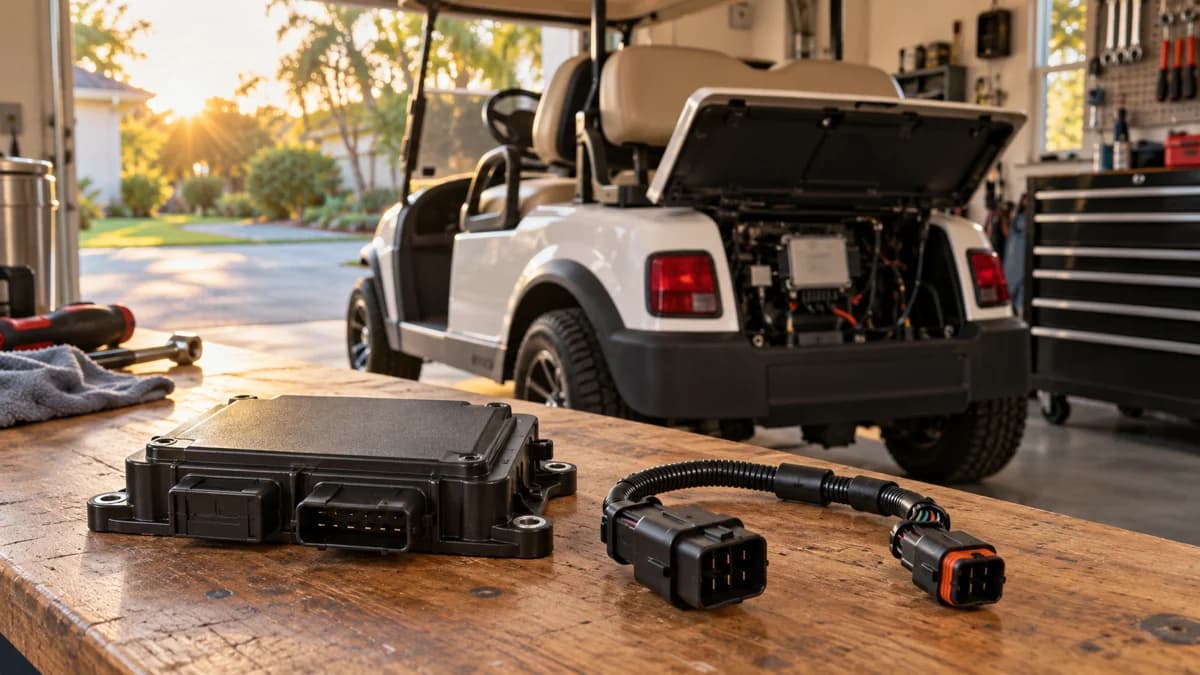
- Lift the seat and photograph the engine bay.
- Note whether the cart is carbureted or fuel injected.
- Photograph the air filter, fuel filter, oil filter, and spark plug number.
- Check whether the oil drains from a plug, screen cover, or extraction tube.
- Look for non-factory air boxes, fuel pumps, or engine swaps.
- Check the belts while you are there.
Drive belts are worth checking during every gas tune-up. A worn belt can make a healthy engine feel weak, especially on hills. Our drive belt size and replacement guide explains measuring and fitment, and the clutch problems guide covers slipping, jerking, and high-RPM no-speed symptoms.
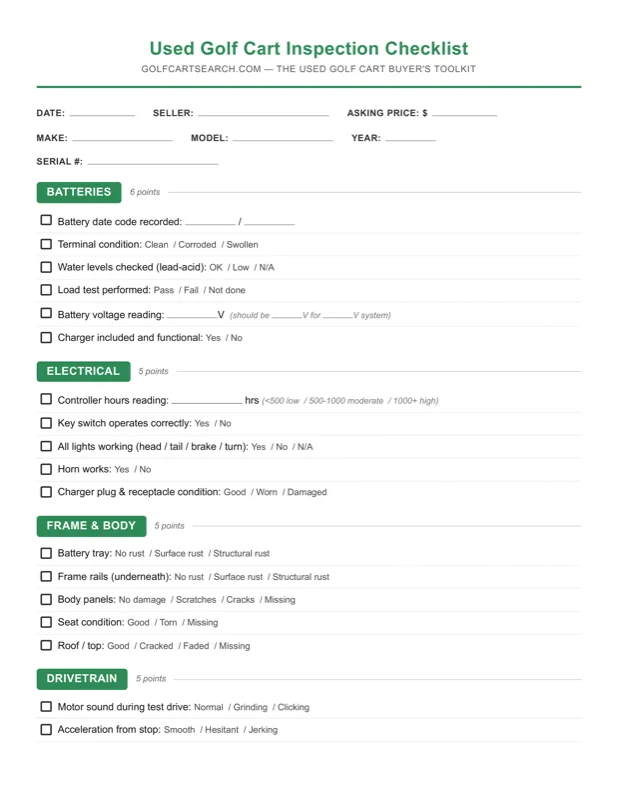
If you are doing this work on a cart you just bought, treat the first tune-up as an inspection, not just maintenance.
Tune-Up Cost: DIY vs Shop
DIY is usually worth it if the cart runs normally and you are comfortable with basic hand tools. A brand-specific kit plus oil usually lands around $25 to $90. Add a plug socket, drain pan, funnel, gap gauge, and shop towels if you do not already have them.
| Service path | Typical cost | Best for | Watch-outs |
|---|---|---|---|
| DIY basic tune-up | $25-$90 | Running cart, owner knows model | Wrong kit, overfilled oil, stripped drain plug |
| DIY with tools | $50-$140 | First-time owner building a kit | One-time tool cost |
| Mobile repair visit | $125-$300 | Cart cannot be moved or owner wants convenience | Trip fees vary by market |
| Dealer or repair shop | $100-$250 | Annual service, records, warranty comfort | Diagnosis and belts cost extra |
| Tune-up plus carb cleaning | $150-$400 | Cart starts then dies or needs choke | Cleaning may reveal fuel pump or valve issues |
For local help, compare shops on the golf cart repair directory, or browse golf carts for sale if the repair estimate is getting close to replacement territory. If the cart will be driven on neighborhood roads after service, check your state golf cart laws and insurance requirements before assuming a tune-up makes it street ready.
Fuel, Storage, and Ethanol Problems
Many gas tune-ups happen because the cart sat. Modern pump gas can go stale, absorb moisture, and leave deposits in small passages. Ethanol fuel is especially hard on carts that sit for months.
If the fuel smells sour or varnish-like, drain it instead of trying to tune around it. Replace the fuel filter, add fresh fuel, and consider a stabilizer before storage. Fuel stabilizer is not a repair for bad gas, but it is cheap prevention when added to fresh fuel before the cart sits.
STA-BIL Fuel Stabilizer →Storage routine for gas carts:
- Fill with fresh fuel if your manual recommends a full tank for storage.
- Add stabilizer at the correct ratio.
- Run the engine long enough to pull treated fuel through the system.
- Change dirty oil before long storage.
- Keep the 12V battery charged.
- Cover the cart but leave ventilation if stored indoors.
For garage layout, ventilation, pest prevention, and storage supplies, use the golf cart garage setup guide.
When a Tune-Up Will Not Fix the Problem
Oil, filters, and a plug fix maintenance problems. They do not fix every running problem.
| Symptom after tune-up | Likely next checks | Related guide |
|---|---|---|
| Starts then dies | Carb idle circuit, stale fuel, vacuum line, fuel pump | Carburetor cleaning |
| Cranks but will not fire | Spark, fuel flow, compression, key switch, starter system | Golf cart will not start |
| Sputters uphill | Fuel pump, clogged pickup, dirty carb, drive belt, clutch | Fuel pump symptoms |
| Engine revs but cart is slow | Drive belt, clutch, transaxle, brake drag | Clutch symptoms |
| Grinding or dragging | Brakes, wheel bearings, axle, suspension | Brake maintenance |
| Random electrical cutout | Grounds, key switch, fuses, battery cables | Troubleshooting guide |
Do the tune-up first when maintenance is overdue. If symptoms remain, diagnose in order: fuel, spark, air, compression, belts, brakes, and electrical. Random parts replacement gets expensive fast.
Final Recommendation
For a normal personal gas cart, make the annual tune-up simple:
- Identify the cart by serial number, not just body shape.
- Use the oil grade and capacity for that exact engine.
- Replace fuel filter yearly.
- Replace or inspect the air filter yearly.
- Inspect the spark plug yearly and replace it if worn, fouled, or unknown.
- Check belts, brakes, tire pressure, and the 12V battery while the seat is up. Use the gas golf cart battery size guide before replacing a battery by brand name alone.
- Treat fresh fuel before storage.
If you own an older gas cart and want the cheapest reliable path, buy the correct kit, change the oil slowly, and test drive before ordering bigger parts. If you are maintaining a fleet, rental cart, hilly-property work cart, or a used cart with unknown history, pay for one professional service to set a baseline, then handle routine annual service yourself.
Gas Golf Cart Tune-Up FAQs
What is included in a gas golf cart tune-up?
A normal gas golf cart tune-up includes an oil change, oil filter or oil screen service if equipped, air filter inspection or replacement, pre-filter service if equipped, fuel filter replacement, spark plug inspection or replacement, fuel check, belt inspection, 12V battery check, leak inspection, and a test drive.
How often should you tune up a gas golf cart?
Tune up most personal gas carts once per year or every 100 to 150 hours. Use the owner manual for warranty intervals, and shorten the interval for dusty paths, hills, heavy loads, rental use, farm work, or carts that sit for months.
What oil does a gas golf cart use?
Many older gas golf carts use 10W-30 four-cycle engine oil, but not all. EZGO EX1 manuals list 5W-30, Yamaha Drive2 manuals list 10W-30, and older EZGO, Club Car, and Yamaha models vary by engine. Check the manual or engine decal before filling.
How much oil does an EZGO gas golf cart take?
Older EZGO TXT 295cc and 350cc engines are commonly listed around 44 ounces. The EZGO EX1 EFI manual lists 1.6 quarts. Fill slowly, run the engine briefly, wait a few minutes, and confirm the dipstick level.
How much oil does a Yamaha gas golf cart take?
Yamaha Drive2 gas carts commonly take about 1.0 quart of 10W-30 oil. Older Yamaha G-series models vary, so confirm the model year and engine before ordering oil and filters.
How much does a gas golf cart tune-up cost?
DIY parts usually cost $25 to $90. A shop tune-up commonly costs $100 to $250. Add more for mobile service, carburetor cleaning, belts, brakes, diagnostic time, or pickup and delivery.
Do electric golf carts need oil changes?
No. Standard electric golf carts do not have engine oil, oil filters, spark plugs, fuel filters, carburetors, or gasoline engines. Electric carts still need battery, cable, charger, tire, brake, steering, and suspension maintenance.
What spark plug gap does a gas golf cart use?
Many gas golf cart spark plugs use a gap around 0.028 to 0.031 inches. Yamaha Drive2 manuals list 0.028 to 0.031 inches for the BPR2ES plug. Always verify the correct plug and gap for your exact engine.
Should I use OEM or aftermarket tune-up kits?
Use OEM when warranty, exact fit, or dealership records matter. Use aftermarket when the listing clearly matches your brand, model, year, engine family, air filter shape, oil filter style, fuel filter, and spark plug number.
Why does my gas golf cart still run rough after a tune-up?
If fresh oil, filters, and a spark plug do not fix it, check stale fuel, carburetor varnish, fuel pump output, vacuum lines, intake leaks, clutch wear, valve clearance, compression, and ignition components.
Can I tune up a gas golf cart myself?
Yes. Most owners can handle oil, filters, and spark plug service with a drain pan, funnel, plug socket, gap gauge, and the correct parts. Hire a shop for fuel leaks, stripped drain plugs, smoke, compression problems, persistent no-start issues, or brake work.
What should I do before tuning a used gas cart?
Identify the exact model and year, check the serial number, photograph the current filters and spark plug, inspect for fuel leaks, test drive it if safe, and avoid buying a kit until fitment is confirmed.
Golf Cart Search
Find the Best Golf Carts of 2026
Compare top-rated models, read expert reviews, and find the perfect cart for your needs.