
As an Amazon Associate, we earn from qualifying purchases. This helps support our site at no extra cost to you.
A Club Car OBC bypass changes the cart's charging wiring so a compatible standalone charger can work without the legacy onboard computer. Choose the wiring diagram by chassis, installed connector, kit part number, and whether the charger sits on a shelf or mounts onboard.
Start with the manufacturer diagram index below, then check fitment before buying parts. The later sections cover diagnosis, charger compatibility, costs, and drive lockout, the circuit that prevents driving while connected for charging.
Club Car OBC bypass wiring diagrams: choose by kit
DS and Precedent bypass diagrams are not interchangeable. Match the chassis, connector, charger location, and kit part number before following a wire instruction.
The Lester Electrical 38836 instructions specify a 6-pin Deutsch OBC connector and separate shelf and onboard charger installations. Use this index to open the appropriate section:
| Installation | Section begins | Simplified diagram |
|---|---|---|
| Precedent, shelf charger | Page 1 | Page 2 |
| DS, shelf charger | Page 8 | Page 9 |
| Precedent, onboard charger | Page 15 | Page 15 |
| DS, onboard charger | Page 21 | Page 21 |
The separate Nivel 43212S instructions cover a Precedent harness on page 1 and DS wiring on page 2. Pages 3 and 4 address additional lockout wiring for specified arrangements. Follow that document if you have that kit.
Do not combine the power wiring from one kit with a lockout instruction from another. A photograph with a similar-looking wire does not establish its function. Club Car directs owners to an authorized dealer for vehicle wiring diagrams in its FAQ.
What if your DS has a different OBC connector?
If your DS lacks the specified 6-pin connector, the Lester 38836 instructions do not apply. Request a bypass arrangement documented for your controller and connector layout; do not transfer wire colors between unrelated diagrams.
Why DS and Precedent instructions differ
The practical question is which connectors, receptacle wiring, and controller connections exist on your cart. A harness sold for one layout may lack the connections required by another, even when both packs are nominally 48V.
For a Club Car DS OBC bypass, send the supplier the chassis identity and photographs of the actual hardware. For a Club Car Precedent OBC bypass, do the same rather than relying on the model name printed on a marketplace listing. Ask the supplier to identify the instruction section that applies.
If the supplier cannot explain fitment beyond “works on Club Car,” choose a source that can. Keep the answer and installation document with the cart, especially if you expect to sell it later.
Club Car OBC bypass: the quick decision
Bypass only when the proposed charger and wiring arrangement are approved for the installed cart and battery pack. If your OBC works and an approved replacement charger meets your needs, keeping that system is a reasonable option.
| What you have | What to do first |
|---|---|
| Working OBC and healthy lead-acid pack | Compare OBC-compatible chargers before changing wiring |
| Suspected OBC failure | Test batteries, receptacle, fuse, and charger before buying a kit |
| Lithium conversion | Follow the battery kit's charger and cart-specific wiring requirements |
| ERIC charging system | Troubleshoot that system using its documentation |
| Unknown wiring or previous bypass | Identify the installed parts and obtain the matching diagram |
Our Club Car charger guide compares charger choices. Use this article when the question is whether the cart's charging wiring needs to change.
Identify your DS, Precedent, and charging hardware
Write down four things before ordering: the serial number, battery configuration, charger model, and installed charging-system components. Photograph the charger label, receptacle, and existing connections without removing wiring.
Club Car says serial-number decals can be below the passenger cup holder or above the accelerator or brake pedal. The prefix identifies the model, followed by year and production-week information. Its example, PH0901-123456, indicates a vehicle built in the first week of 2009. See Club Car's identification guidance and our serial-number lookup.
A model year narrows the search, but it cannot tell you whether a previous owner replaced the charger, changed the receptacle, or converted the pack. Treat a seller's “1995-up” or “fits Precedent” description as a starting point for fitment questions.
The DS versus Precedent guide helps identify the chassis, while Club Car models by year gives additional context. Owners of later carts should also compare the Tempo, Onward, and Precedent families.
OBC and ERIC need different troubleshooting
Club Car's long-term storage bulletin gives different charging checks for OBC and ERIC systems: charger amperage for the former, a flashing green battery LED for the latter. That distinction matters when following charging advice online.
If the installed system is ERIC, do not order an old DS bypass harness because the body badge says Club Car. Confirm the vehicle's charging architecture with an authorized dealer. Body shape, nominal voltage, and connector appearance do not settle every compatibility question.
Check these faults before blaming the OBC
A charger that clicks but never starts is a symptom. It does not identify the failed part. A useful diagnosis records what was checked and the result, rather than replacing three expensive components until charging returns.
| Check | Useful evidence | Why it affects the decision |
|---|---|---|
| AC supply | Known working outlet and charger power indication | No supply can look like a dead charger |
| Battery pack | Resting pack voltage and individual battery readings | A weak battery can hide inside an apparently normal total |
| Receptacle | Firm fit, clean contacts, intact housing | Poor contact can interrupt the charging path |
| Fuse and wiring | Inspection and tests specified by the service manual | An open circuit can mimic an electronic fault |
| Charger | Correct profile and recorded fault indication | A wiring change cannot repair a defective charger |
| OBC-related circuit | Model-specific service diagnosis | This is the evidence needed to justify bypass or replacement |
Start with the charging-port troubleshooting guide, battery voltage and testing guide, and charger light-code guide.
Do not apply a single charger wake-up voltage to every model. Read the installed charger's instructions. Likewise, lights or a working USB outlet do not establish that the traction pack is healthy; accessories may run through a separate reducer. Our golf cart wiring guide explains that distinction.
A useful meter for the first checks
The Klein Tools MM420 measures up to 600V AC/DC and includes resistance and continuity functions, according to Klein's specifications. Budget roughly $60–$75; Home Depot listed it at $69.97 when checked for this guide.
Klein Tools MM420 multimeter →For a pack-voltage measurement, use DC voltage with the leads in the voltage and common sockets. Never place a meter configured for current measurement across the battery pack. Resistance and continuity tests require an isolated, de-energized circuit, as explained in the MM420 manual.
If you cannot identify the terminals confidently, take the readings through a repair shop. A meter helps answer a specific question; it does not make an unfamiliar circuit safe to probe.
Match the charger after the bypass
Treat charger selection as five separate checks:
- Nominal pack voltage: The charger must serve the vehicle's actual battery system.
- Battery chemistry: Flooded lead-acid, AGM, and lithium requirements are not interchangeable.
- Charging profile and current: Use the battery manufacturer's approved settings and limits.
- Connector and wiring: Confirm both physical fit and the intended electrical connections.
- Control and lockout: Confirm how the complete installation manages charging and inhibits driving.
Our charger plug compatibility guide covers connector identification. A plug adapter answers the physical-fit question only if its approved wiring arrangement also matches the application.
Keep a working OBC when it meets your needs
FORM's Club Car FAQ says its 48V Club Car charger works with a functioning OBC or a non-OBC system. That is an example of why buying a new smart charger does not automatically require bypassing a healthy OBC.
Ask about the exact charger model. “Smart charger” describes charging capability, but does not confirm its interface with your cart. Obtain a clear answer about whether it needs the OBC, supports it, or requires a bypass.
A budget lead-acid charger to compare
The EPOWREY 48V 15A Club Car round-plug charger, ASIN B0CYPVLQRX, is a budget option to compare for a compatible lead-acid installation. Allow roughly $95–$150, depending on the selected version and offer. Its Amazon listing identifies it as a lead-acid charger; confirm the current model's OBC instructions before ordering.
Check Price on AmazonThis charger is not a lithium-conversion recommendation. Do not assume a claimed ability to work with a functioning OBC proves that it will work through a failed one. If the seller proposes direct battery connections or an onboard installation, request the matching instructions and a lockout solution before buying.
For broader choices, compare Club Car replacement parts and our charger parts directory. Spending more on a charger with documented support can be worthwhile if the cheaper option leaves installation questions unanswered.
Lithium needs its own charging plan
An OBC bypass does not convert a lead-acid charger into a lithium charger. Nominal “48V” on both labels is insufficient; the battery manufacturer's charge voltage, profile, and current limit govern the choice.
Check our lithium conversion guide before ordering a battery, then follow the kit's cart-specific instructions. A pre-existing bypass also needs review when changing chemistry, because you are changing the complete charging arrangement.
If charging stops after a conversion, compare the charger settings with the battery documentation before revisiting every wire. The lithium battery and BMS troubleshooting guide covers battery-management issues that an OBC bypass cannot resolve.
How to bypass a Club Car OBC: installation checklist
Use this sequence to plan the installation, with the matching manufacturer document supplying the connection details:
- Identify the installed system. Record the serial number, chassis, battery chemistry, OBC connector, and any previous wiring changes.
- Choose the kit and diagram. Confirm the part number and the correct DS or Precedent section for a shelf or onboard charger.
- Confirm the charger. Obtain approval for its pack voltage, charging profile, current limit, and lockout arrangement before changing wires.
- Isolate the cart. Follow the vehicle, battery, and kit manuals for charger disconnection, Run/Tow settings, and battery disconnection order.
- Install and secure the kit. Follow that kit's diagram, use the specified terminal torque, insulate connections, and restrain the harness away from moving or hot parts.
- Verify both functions. Have the installer demonstrate a complete charge cycle and test drive lockout using the manufacturer's procedure before returning the cart to service.
Secure the stationary cart, remove jewelry, and use appropriate eye protection and insulated tools. Do not improvise a jumper as a diagnosis or leave loose leads near battery terminals.
The Lester instructions say their specified installation with a compatible Lester charger retains drive lockout, while disabling legacy OBC functions such as the dash charge light and stored charge history. That promise applies to the documented combination, not every charger substituted later. Read the kit's operating notes.
Use the terminal's torque specification
Battery-terminal construction varies. Use the installed battery manufacturer's torque specification rather than copying a number from a video about another pack. Check the units carefully: 12 inch-pounds equals 1 foot-pound.
The LEXIVON LX-181 is a 1/4-inch-drive wrench with a 20–200 inch-pound range, as listed by LEXIVON. Budget about $35–$45, and choose it only if the specified fastener torque falls within that range. A large wheel-lug wrench is often unsuitable for a small terminal fastener.
LEXIVON LX-181 inch-pound torque wrench →The wrench does not electrically insulate the work. Isolation and tool handling still matter. Our golf cart tool guide covers additional workshop equipment.
Club Car OBC bypass cost versus replacement
Compare an entire working charging system, rather than the price of a harness alone. Revolution Golf Cars listed the CGR-123 kit at $144.55 when checked on October 5, 2026. Confirm the supplied part number and fitment before ordering.
FORM estimates OBC replacement at $400–$700. Treat that as the charger's manufacturer estimate, not a quote for your cart or a confirmed installed price.
| Cost item | What to budget or request |
|---|---|
| Complete bypass kit | $144.55 for the cited CGR-123 listing |
| Replacement charger | A separate quote for the approved model |
| Diagnosis and installation | Itemized labor quote from the shop |
| Receptacle, fuse, or damaged cables | Add only after inspection identifies a fault |
| OBC replacement | Compare a local quote with FORM's $400–$700 estimate |
For illustration, a $144.55 kit plus a $120 charger totals $264.55 before labor, shipping, tax, or other repairs. The $120 charger figure is a budgeting example, not a guarantee that this kit approves a particular budget charger.
Ask the shop to list the approved combination before using that arithmetic to make a purchase. If an existing standalone charger is already suitable, the cost may be lower. If the original charger depends on the OBC, include its replacement in the bypass quote.
For a retirement-community cart used every day, reliable local service and a documented installation may matter more than the cheapest harness. Golf-course fleet owners should also ask how the change affects their charger inventory and maintenance records. Find electric golf cart repair providers or ask a local Club Car dealer to compare both options.
Check the completed system and keep a record
Before collecting the cart, ask for a charging demonstration and the installer's lockout verification. Record the charger model, battery type, selected charging profile, kit number, and diagram revision. Photograph the completed wiring after the installer has secured and covered it.
During the demonstration, confirm that the charger starts, displays the expected status, and completes a cycle under its instructions. A brief start-up does not prove that it finishes correctly. Stop using a connection that becomes unusually hot, smells burnt, or shows discoloration.
Our charging-time guide explains why charge duration varies with pack capacity and discharge level. Follow the new charger's storage instructions, too; do not assume your old routine remains suitable after changing equipment. See the winter storage guide for the wider checklist.
If charging works but the cart will not move
Unplug the charger as directed, then have the installer revisit the lockout circuit and vehicle diagnostics. Do not start changing motor-controller settings to compensate for a charging-wiring problem.
Use our general troubleshooting guide to organize symptoms. The solenoid guide and controller guide cover other possible causes, but a fault that appears immediately after installation deserves a review of that installation first.
Buying a used Club Car with an OBC bypass
Ask the seller what was changed, why, and by whom. A documented conversion with an appropriate charger is easier to evaluate than an unexplained jumper. “It charges fine” is useful only when you can see a complete demonstration and understand the battery condition.
Request the kit instructions, charger model, battery age or purchase record, and evidence that drive lockout was checked. Inspect the receptacle for heat damage and look for unsupported splices or unsecured wiring. A cart sold without the correct charger can cost more than it first appears.
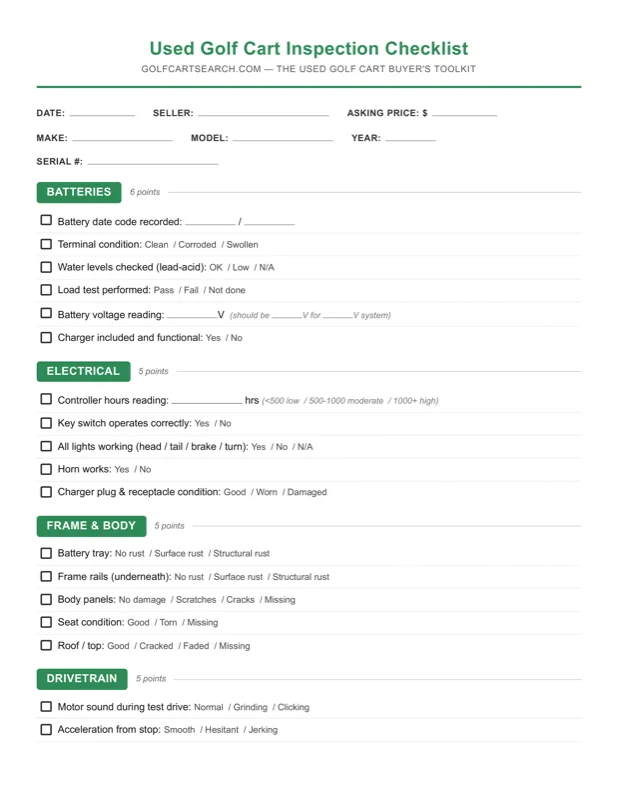
The used golf cart inspection guide covers the rest of the vehicle. Price battery condition separately from the bypass; changing charging electronics does not restore worn-out batteries.
Sources and price checks
This guide compares the published Club Car, Lester Electrical, and Nivel documents linked above. The Lester document is revision 39443C for kit 38836; the Nivel document is revision 43211C for kit 43212S. Retailer prices were checked on October 5, 2026. Confirm the instructions supplied with the kit you receive, since its revision or approved fitment may differ.
Frequently asked questions
What does a Club Car OBC bypass do?
An OBC bypass changes the charging circuit so a compatible standalone charger can manage charging without the legacy onboard computer. It does not repair worn batteries, increase motor speed, or make a lead-acid charger suitable for lithium.
How do you bypass the OBC on a Club Car?
Identify the cart, battery type, and installed connectors; select the matching kit diagram and approved standalone charger; isolate the cart as its manual directs; install the kit using its instructions; then verify charging and drive lockout. DS and Precedent installations can require different harnesses. Use the manufacturer diagram for the exact kit.
Does every 48V Club Car need an OBC bypass?
No. Identify the installed charging system first. A working OBC with a compatible charger may need no changes, and an ERIC-equipped cart needs its own charging-system checks rather than a legacy OBC bypass.
Are Club Car DS and Precedent bypass diagrams interchangeable?
No. Choose the manufacturer diagram for your chassis, installed connectors, kit part number, and shelf or onboard charger. Matching battery voltage alone is insufficient.
How much does a Club Car OBC bypass cost?
Revolution Golf Cars listed the CGR-123 bypass kit at $144.55 when checked in October 2026. A charger, shipping, tax, diagnosis, installation, and damaged receptacle parts can add to the total. Request an itemized installed quote.
Can I keep my original PowerDrive charger after bypassing the OBC?
Do not assume so. An OBC-dependent charger is unsuitable for a bypassed system unless its manufacturer explicitly approves that arrangement. Budget for a compatible standalone charger when the bypass instructions require one.
Does an OBC bypass make any 48V charger compatible with lithium?
No. Lithium requires the charging voltage, current limit, and profile approved by the battery manufacturer. An OBC bypass changes wiring; it does not change a charger profile or replace the battery management system.
Does a round 3-pin Club Car plug guarantee charger compatibility?
No. The plug must fit, but voltage, battery chemistry, OBC compatibility, wiring, and drive lockout must also match. A charger listed for 48V lead-acid batteries is not automatically suitable for a nominal 48V lithium pack.
Does the cart still need a drive lockout after an OBC bypass?
Yes. The completed system should prevent driving while connected for charging. Have the installer verify lockout using the vehicle and charger manufacturers' procedure before returning the cart to service.
Will bypassing the OBC fix a charger that clicks but will not charge?
Only if an OBC-related fault is the cause and the replacement charging arrangement is compatible. Low pack voltage, a weak battery, a damaged receptacle, a fuse fault, or a charger problem can produce similar symptoms.
What should I check when buying a used Club Car with an OBC bypass?
Ask for the charger model, kit part number, installation diagram, battery specifications, and proof of lockout testing. Watch a complete charging demonstration and inspect the receptacle and wiring before accepting an undocumented conversion.
Golf Cart Search
Find the Best Golf Carts of 2026
Compare top-rated models, read expert reviews, and find the perfect cart for your needs.