As an Amazon Associate, we earn from qualifying purchases. This helps support our site at no extra cost to you.
If your golf cart parking brake won't hold, stop using the cart and arrange service. Keep people clear of its path, follow the instructions for securing it in your owner's manual, and ask the shop about pickup if it can't be moved safely. Don't take it back to the hill to see whether it happens again.
The first question for the shop is what the cart failed to do. A foot latch that springs back up before anyone touches another pedal is one symptom. A latch that stays down while the cart rolls is another. A cart that won't move when you try to leave is a third. Those descriptions give a technician more to work with than “the brake is broken.”
Golf cart parking brake: Match the symptom first
Describe the event that already happened. Separate these three failures before buying a part:
| Symptom | Useful description for the shop |
|---|---|
| Parking pedal springs back up with other pedals untouched | The parking control did not stay latched. |
| Pedal stays latched but the cart moves | The control latched, but parking hold failed. |
| Cart stays locked during an ordinary attempt to leave | The brake did not release, or another no-move fault is present. |
A cart with weak stopping and failed parking hold needs both symptoms reported. Our general troubleshooting guide covers the wider no-start and no-move checks; this page focuses on the parking control and what to record.
Which golf cart parking brake do you have?
Check the model and serial label before looking for a parking brake pedal or ordering parts. Even two carts with the same RXV badge can use different controls. The 2027 and newer electric RXV ELiTE applies its parking brake automatically at a stop. The gas RXV EFI of the same model years has a foot latch at the upper left of the brake pedal.
| Model and manual | How it parks | What the manual describes for ordinary release |
|---|---|---|
| 2027 Yamaha Drive2 AC, pp. 16, 20 | Driver presses a parking pedal. The pedal should lock with a positive click. | The accelerator releases the latch. |
| 2027+ E-Z-GO RXV ELiTE, pp. 14, 17 | IntelliBrake applies automatically when the cart stops. | With forward or reverse selected, accelerator input releases it. |
| 2027+ E-Z-GO RXV EFI, pp. 17, 19 | Driver presses the upper left section of the brake pedal until it locks. | E-Z-GO recommends a quick press and release of the lower brake pedal. The accelerator also releases it. |
| Club Car Onward lifted four-passenger lithium, DM serial prefix, pp. 31, 55 | Driver sets a foot control that can latch in more than one position. | Either the brake pedal or the accelerator releases it. |
On November 19, 2026, we compared the control and pre-operation sections of these four manufacturer manuals, recording how each sets, holds and releases the brake. The two RXV manuals list pedal operation and parking hold separately in their pre-operation checks. The examples also show why “it's electric” doesn't identify the control: the electric Drive2 and the lithium Onward in the table both use a foot control. See our TXT vs. RXV guide for more on the model families.
Golf cart parking brake pedal won't stay down
Tell the shop whether the parking latch never caught, caught and immediately sprang back up, or stayed latched until another pedal was pressed. A release after the normal input in your manual is expected. A latch that won't stay set with the other pedals untouched is the symptom you want to report.
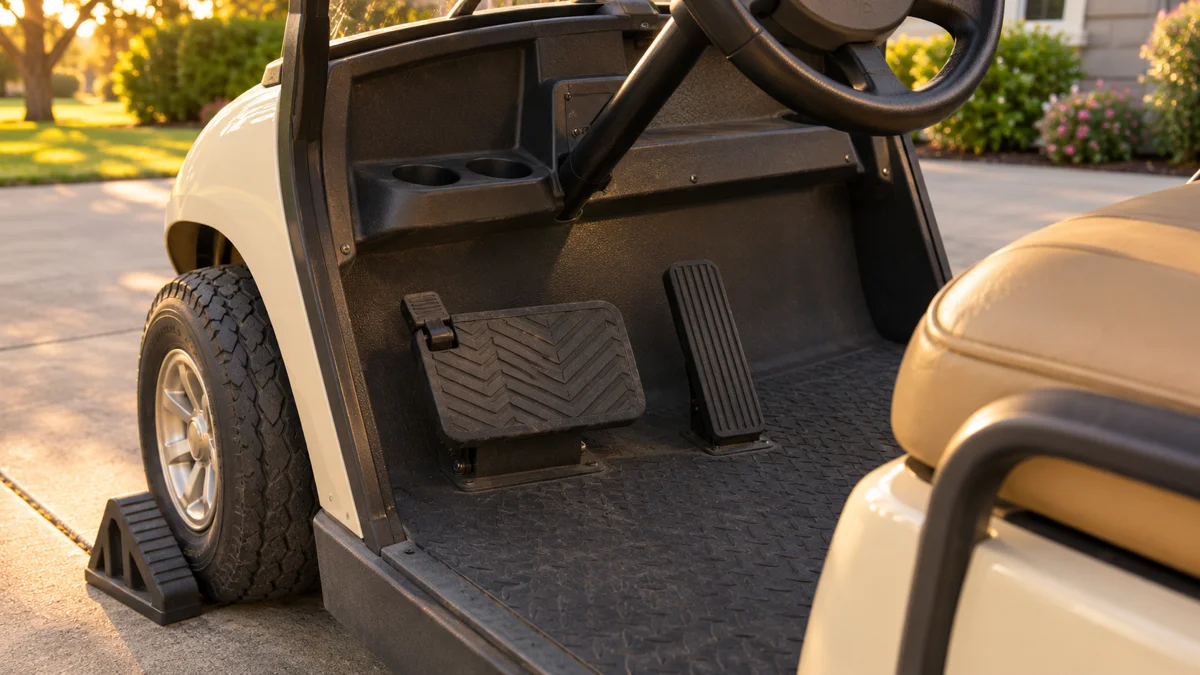
With the cart already secured, look for a loose object or mat that physically blocks the pedal. From the seat or beside the cart, note whether the latch sits crooked or the pedal feels different from usual. Report any recent brake or pedal work. If the problem started after adding a floor mat or liner, include a photo of its edge beside the pedal. A mat obstructing pedal movement is a different repair question from a latch that fails in a clear footwell.
A Streamlight 66118 Stylus Pro penlight is useful for lighting the pedal area from beside the secured cart. Photograph the visible obstruction or crooked part for the shop. Keep hands away from the mechanism while anyone operates a pedal. Don't file a catch, bend a lever, or tighten a cable to try to make the click come back. The brake maintenance guide explains how pedal travel and service brake checks fit into the diagnosis.
Golf cart parking brake latches but won't hold
If it clicked, stayed down, and the cart still moved, tell the shop all three things. A click tells you the control latched. The cart staying put is the holding check. Mention whether the cart also took longer to stop, the regular pedal traveled farther, or one wheel felt like it dragged during the last ordinary drive. Those observations help the shop decide whether to inspect the stopping and parking functions together.
A brake light adds another clue about the pedal switch, but it doesn't show whether the cart will stay put. If the lights also went out or stayed on, report that separately. Keep the stopping symptom in your maintenance record. Our brake light troubleshooting guide covers that symptom.
When an automatic parking brake won't release
On the RXV ELiTE in the table, the manual describes release with forward or reverse selected and accelerator input. If the cart stayed put during ordinary operation, write down the direction selected, what the dash or status light showed, and whether the trouble followed a battery, controller, or towing change. Note whether this happened in both directions if you already observed it. Record the wording of any dash message rather than shortening it to “battery fault.” If the trouble began after a lithium conversion, give the technician the battery and controller details too.
The ordinary release instructions in the table explain the controls. They are not a recovery procedure for a cart that is stuck. Our starting guide is the better reference when learning an unfamiliar, correctly functioning cart. A cart that won't move doesn't tell you by itself that the brake assembly needs replacing.
Leave the brake connected and tell the shop if the cart can't roll for loading. Ask for the recovery procedure for your exact serial number. The Tow/Run guide and transport guide explain why the switch position and loading method are model specific.
Observation tools and a parked-cart setup
Use tools to see and document the symptom, then let the model-specific service procedure determine the repair. From outside a secured cart, an Ullman C-2 inspection mirror helps show the back of a visible pedal bracket without putting your head under the dash. Stop if reaching the view requires removing a cover or entering the cart's path.
If your manual calls for wheel chocks, choose them for the tire and surface. The MaxxHaul 70472 rubber chock pair is one option to compare. Have the shop advise how to secure a cart that is already on a slope; don't step downhill of it to place a block. A chock is not a brake repair or permission to resume driving.
Do not lift the cart, crawl underneath, disconnect an automatic brake, or improvise a release cable to gather more evidence. A photograph from beside the cart, the serial label and an accurate account of the failure are enough to start the service call. Our family safety checklist covers passenger and parking habits for a cart after it is returned to service.
What to tell the repair shop
- Which cart: Make, model, serial number and powertrain. Mention a lithium conversion if it has one.
- What failed: Foot latch wouldn't catch, cart rolled after parking, or brake wouldn't release during normal operation.
- What happened first: Note whether anyone touched another pedal, whether the cart had just been serviced, and what the regular brake pedal felt like before parking.
- What you saw or heard: Give the exact dash message or warning pattern, if one appeared.
- Where the cart is now: Tell the shop about the surface, access and whether pickup needs special loading equipment.
Ask a local golf cart repair shop to quote diagnostic work, parts, labor and pickup separately. Request the fault found, the replacement part number if needed, and the completed parking hold and release checks on the invoice. A pedal-latch problem and an automatic brake fault are different jobs, so a generic online “parking brake replacement cost” is a poor basis for approving either.
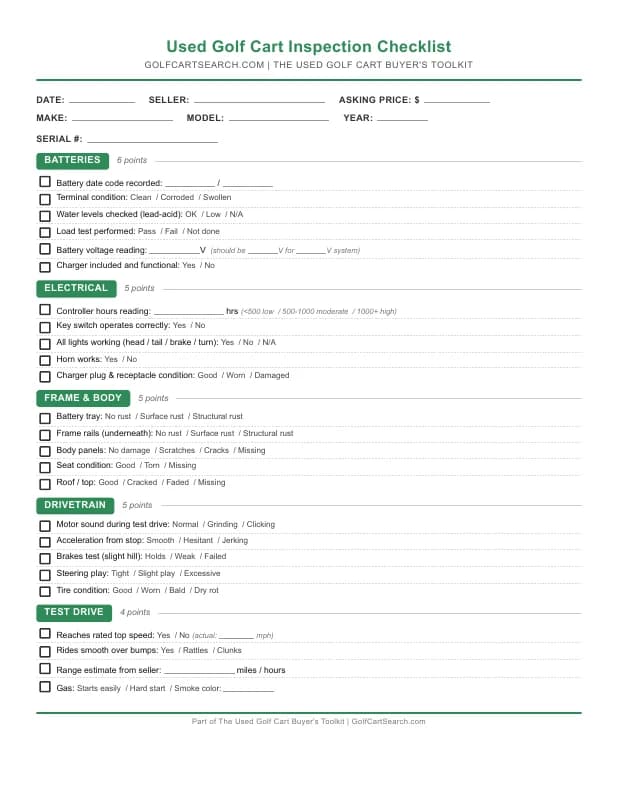
If you're inspecting a used cart and it fails to hold during the seller's normal demonstration, leave the test drive for after the repair. For a vehicle intended for steep routes, our golf carts for hills guide also covers the route and load questions to ask once the braking fault is resolved.
Golf cart parking brake FAQs
Why does my parking brake pedal pop back up?
If it springs up before anyone touches a release control, report a failure to latch. If it releases after the accelerator or service brake is pressed, compare that input with the release method in your cart's manual.
Is a parking brake click enough to tell that the brake works?
No. The click tells you the pedal latched. If the cart rolls with the pedal latched, stop using it and have the parking hold checked.
Does an electric RXV have a parking brake pedal?
The 2027 and newer RXV ELiTE in E-Z-GO manual 10193239-B uses IntelliBrake, which applies automatically at a stop.
Where is the parking brake on a gas RXV?
On the 2027 and newer RXV EFI in E-Z-GO manual 10211507-A, the foot latch is the upper left section of the brake pedal. The manual recommends releasing it with a quick press and release of the lower pedal.
Why did the parking brake release when I pressed the accelerator?
Some foot latches are designed to release when you press the accelerator. The 2027 Yamaha Drive2 AC is one example. Check your model's manual for its normal release method.
Does regenerative braking hold a golf cart in park?
Regenerative slowing and parking hold are separate functions. Identify the cart's parking control and describe what happened after the cart stopped.
Should I order a new latch after brake work?
Have the shop check the symptom against the service instructions for the exact model first. Report which work was done and whether the latch, the service pedal, or the holding behavior changed.
Can I drive the cart to the shop if the parking brake fails?
Stop using the cart and ask the shop about pickup. Tell it whether the cart rolls or stays locked and where it is parked so it can plan the loading procedure.
Golf Cart Search
Find the Best Golf Carts of 2026
Compare top-rated models, read expert reviews, and find the perfect cart for your needs.