
E-Z-GO Golf Cart Review: Every Model, Pricing & Honest Verdict (2026)
Complete E-Z-GO golf cart review covering all 8 models from $8,374 to $15,799, common problems, ELiTE lithium tech, and how EZGO compares to Club Car and Yamaha
Complete Club Car review covering all Onward models from $9,475 to $24,334, the aluminum frame advantage, common problems, and comparisons to EZGO and Yamaha.

As an Amazon Associate, we earn from qualifying purchases. This helps support our site at no extra cost to you.
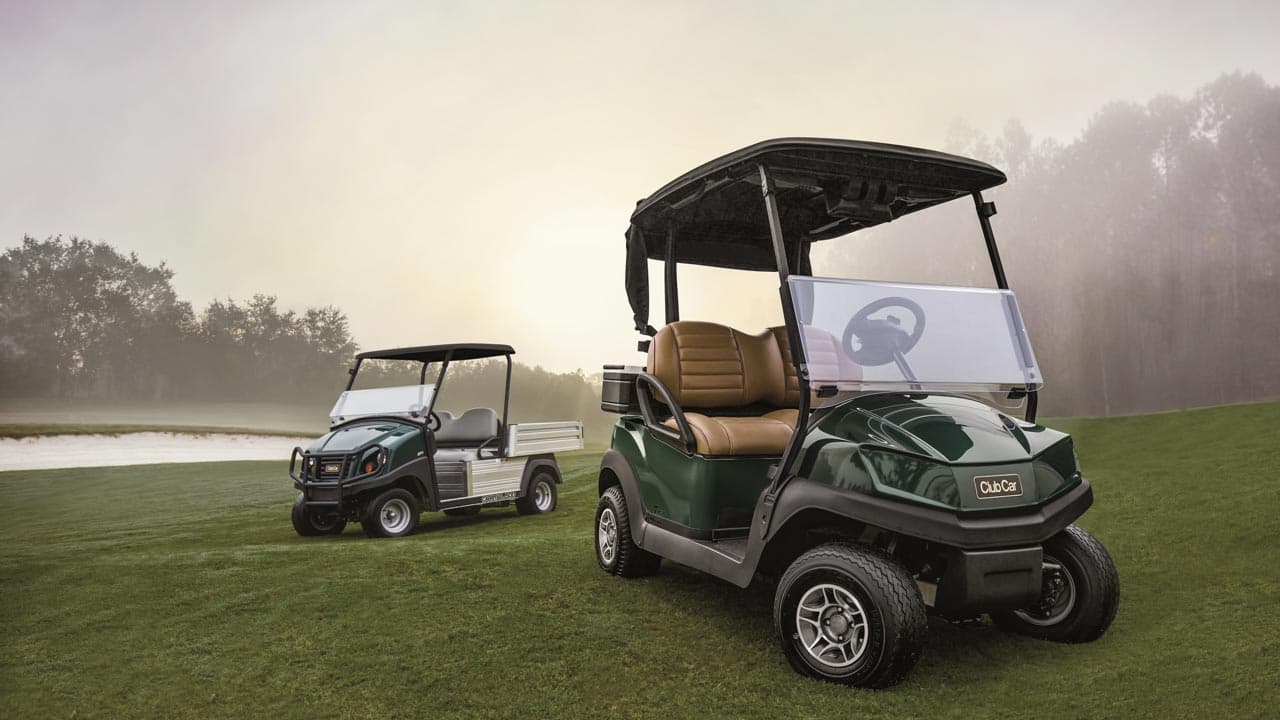
Club Car is the golf cart brand that other brands are measured against. Founded in 1958 and built in Augusta, Georgia, they have spent over six decades establishing the reputation that makes "Club Car" nearly synonymous with "golf cart" in the minds of most buyers.
The company changed hands in 2021 when Platinum Equity acquired it from Ingersoll Rand for $1.7 billion. That price tag tells you something about the brand's value. Today, Club Car builds everything from $9,475 personal carts to $24,334 street-legal neighborhood electric vehicles, all on their signature rust-proof aluminum frame.
But premium comes at a price. Club Car is consistently the most expensive of the Big 3 brands, and newer competitors like ICON and Evolution offer loaded carts at significantly lower price points. The question is whether Club Car's advantages justify the premium.
This review covers every current Club Car model, real pricing, the five most common problems, and honest comparisons to EZGO, Yamaha, and ICON. By the end, you will know exactly whether Club Car is worth the extra money for your situation.
Founded 1958
Owner Platinum Equity ($1.7B)
Price Range $9,475 - $24,334
Frame AlumiCore⢠Aluminum
Club Car was founded in 1958 in Augusta, Georgia, and still builds carts at the same Augusta facility today. For most of its history, the brand was owned by Ingersoll Rand, a Fortune 500 industrial company. In June 2021, Platinum Equity acquired Club Car for $1.7 billion.
The ownership change raised questions in the golf cart community about whether quality would slip under private equity management. So far, Club Car has maintained its manufacturing in Augusta, kept the dealer network intact, and continued releasing updated models. The 2026 lineup includes new interior features like wireless phone charging, dual USB-A/USB-C ports, and relocated controls.
Club Car's product line spans three categories:
The company also builds Carryall utility vehicles for commercial and turf operations, though those are outside the scope of this review.
Every Club Car model, from the $9,475 Onward to the $24,334 CRU, uses an AlumiCore aluminum frame. This is not a premium upgrade or optional feature. It is standard across the entire lineup and is the single most important factor in Club Car's reputation for durability and resale value.
Before diving into individual models, you need to understand the aluminum frame because it influences everything about owning a Club Car.
Club Car uses AlumiCore, an aircraft-quality, ladder-style aluminum box beam frame on every vehicle they build. EZGO uses steel. Yamaha uses steel. ICON uses steel. Star EV uses steel.
Aluminum does not rust. Steel does, no matter how good the powder coating is. Give it 5 to 10 years in a humid climate, coastal air, or anywhere with salt exposure, and a steel frame will show corrosion. An aluminum frame will look the same at year 15 as it did at year 1.
Why this matters practically:
If you live in Florida, the Carolinas, the Gulf Coast, Hawaii, or anywhere with humidity and salt air, the aluminum frame alone can justify choosing Club Car over a comparable steel-frame brand. In dry climates like Arizona or Nevada, the advantage is less dramatic but still real for resale value.
For a deeper look at how frame material affects all major brands, see our best golf cart brands comparison.
Club Car's personal lineup centers on the Onward platform with seven variations, plus the fleet-focused Tempo and the street-legal CRU. Here is each model, what it costs, and who should buy it.
The Onward 2 Passenger is Club Car's most affordable model. At $9,475 MSRP, you get the aluminum frame, LED headlights, turn signals, running lamps, the Monsoon Canopy top (channels water away from passengers), and a choice of gas, standard electric (lead-acid), or AC-drive electric.
The 2-passenger configuration works well for couples, golf course use, and anyone who does not need rear seats. The spacious bagwell holds golf bags or cargo.
Best for: Budget-conscious buyers who want Club Car quality in the simplest package. Also a strong choice for golfers who want a reliable personal cart for course use.
The Onward 4 Passenger adds a rear-facing flip seat for two additional passengers. At $10,722 MSRP, it is a $1,247 step up from the 2-passenger for the added seating. Available with the same gas, standard electric, and AC-drive options.
The rear seat folds down to create a flat cargo area, giving you flexibility between passenger capacity and hauling. This is the same flip-seat design used by EZGO and most other brands.
Best for: Families and neighborhood drivers who need four seats but do not require all passengers to face forward. The most practical Club Car for daily use at a reasonable price.
The Onward Lifted 4 Passenger takes the 4-seat platform and adds a lifted suspension, premium alloy wheels, and all-terrain tires for increased ground clearance. At $11,650 MSRP, the lift package adds roughly $928 over the standard 4-passenger.
Best for: Buyers on properties with unpaved roads, gravel driveways, or rough terrain. Also popular with buyers who prefer the lifted aesthetic. For more on lift kit options, see our lift kit guide.
The Onward 4 Forward is the model to choose if you want all four passengers facing the direction of travel. Most 4-passenger golf carts use rear-facing flip seats for the back row. The 4 Forward puts everyone facing forward, which is more comfortable and feels safer, especially for children.
At $13,800 MSRP, it carries a $3,078 premium over the standard 4-passenger. That is a significant jump, but the forward-facing configuration is a genuine comfort improvement for families who use their cart daily.
Best for: Families with children, buyers who prioritize passenger comfort, and anyone driving on public roads where rear-facing passengers can feel exposed. This competes directly with the EZGO Liberty ($12,699) which also features all forward-facing seats.
The Onward HP upgrades the electric drivetrain to a high-performance AC drive system. The AC motor delivers stronger hill-climbing torque, better acceleration, and more consistent speed control than the standard DC motor in the base Onward.
At $10,858 MSRP for the 2-passenger, it is a $1,383 premium over the base Onward for meaningfully better performance. The HP also gets smart vehicle health monitoring technology.
Best for: Electric cart buyers in hilly areas or anyone who wants noticeably stronger performance without moving to lithium. If your neighborhood has hills, the AC drive difference is real and worth the upgrade.
The Onward HP Li-Ion combines the high-performance AC drive with a maintenance-free lithium-ion battery pack. This is the model that represents Club Car at its best for personal buyers.
The lithium battery carries a 6-year warranty, charges faster than lead-acid, weighs about 200 lbs less, and requires zero maintenance. The HP Li-Ion also offers three dealer-programmable drive modes (Econ, Normal, Sport) and is available in an extended range (XR) option.
At $13,120 MSRP for the 2-passenger configuration, it sits between the EZGO Liberty at $12,699 and the ICON i40 at $12,999. The Club Car costs slightly more but delivers the aluminum frame advantage that neither competitor can match.
Best for: Buyers who want the full premium Club Car experience. If you are spending $13,000+ on a golf cart, the lithium battery, AC drive, and aluminum frame combination makes the HP Li-Ion the most complete personal cart Club Car sells. This is the model to test drive.
The Onward 6 Passenger extends the platform to seat six. Available with gas or electric, it is Club Car's largest personal vehicle.
At $15,266 MSRP, it competes with the EZGO Express 6 at $13,474 and the ICON i60 at $14,999. Club Car's price premium is real here, but the aluminum frame matters more on a heavier, more expensive vehicle that you plan to keep for a decade.
Best for: Large families, resort operators, and buyers who regularly carry 5 to 6 passengers. If four seats handle 90% of your trips, the standard 4-passenger is lighter, cheaper, and more nimble.
The CRU is unlike anything else in Club Car's lineup. It is a factory-built Neighborhood Electric Vehicle that meets federal FMVSS 500 safety standards and SAE J2358 requirements. This is not a golf cart with a street-legal kit bolted on. It was designed from the ground up as a street-legal vehicle.
The CRU seats six with a unique layout: adjustable and reversible front seats plus rear lounge seating around a center table. It features electric power steering, four-wheel hydraulic disc brakes, a windshield with wiper/washer, a tinted see-through roof, an in-dash Bluetooth speaker system, and a digital display with backup camera.
The 72V powertrain with a 10 HP continuous / 30 HP peak motor provides the 25 mph top speed required for LSV classification. Check your state's golf cart laws for where you can drive an NEV/LSV.
At $24,334 MSRP (dealer prices often run $30,000+), the CRU is a significant investment. It competes less with golf carts and more with vehicles like the GEM e6 and polaris street-legal offerings.
Best for: Buyers who want a true street-legal vehicle for daily neighborhood transportation, not just a golf cart that can technically drive on roads. Communities like The Villages, retirement neighborhoods, and beach towns where NEVs are a primary transportation mode. If you only occasionally need street access, converting an Onward is far cheaper.
The Tempo is Club Car's commercial fleet model, designed for golf courses that need carts running thousands of rounds per year. It includes the option for Visage fleet management (GPS tracking, geofencing, pace-of-play monitoring) and is built for high-volume daily abuse.
At $12,878 MSRP, it costs more than the Onward because it is built to a commercial durability standard. Most personal buyers should look at the Onward instead unless you are buying for a fleet.
Best for: Golf course operators, resort fleets, and commercial buyers. Not designed for personal purchase unless you specifically want fleet management features.
Club Car dealer pricing typically runs at or slightly above MSRP in strong markets. The 2026 model year has seen dealer promotions including up to $2,500 off or 0% financing for 48 months.
| Model | MSRP | Typical Dealer Price | Power Options |
|---|---|---|---|
| Onward 2 Passenger | $9,475 | $9,500 - $11,000 | Gas, Electric, AC-Drive |
| Onward 4 Passenger | $10,722 | $10,800 - $12,500 | Gas, Electric, AC-Drive |
| Onward Lifted 4 Passenger | $11,650 | $11,700 - $13,500 | Gas, Electric, AC-Drive |
| Onward 4 Forward | $13,800 | $13,900 - $15,500 | Gas, Electric, AC-Drive |
| Onward HP (AC Drive) | $10,858 | $10,900 - $12,500 | Electric (AC) |
| Onward HP Li-Ion | $13,120 | $13,200 - $15,500 | Lithium-Ion |
| Onward 6 Passenger | $15,266 | $15,300 - $17,000 | Gas, Electric, AC-Drive |
| CRU | $24,334 | $30,000 - $35,000 | Lithium-Ion (72V) |
| Tempo | $12,878 | Contact dealer | Gas, Electric, Lithium |
MSRP excludes destination fees, dealer setup, and optional accessories. Budget $500 to $1,500 beyond the listed price for delivery and prep. The CRU has the widest gap between MSRP and dealer pricing due to high demand and limited inventory.
For a full comparison of pricing across all brands, see our golf cart pricing guide.
Club Car's reputation for quality is earned, but no brand is perfect. Here are the five issues owners report most often. Most affect older models or specific production runs rather than the current lineup.
For general diagnostics, our troubleshooting guide covers step-by-step fixes for electric cart issues.
The most concerning reported issue. Some early Club Car lithium models experienced failures in the VCM (Vehicle Control Module) connector, which uses an unsealed design prone to corrosion. When this connector fails, the battery management system loses communication with the vehicle, causing error codes, charging failures, and in some cases complete shutdowns.
Repair costs for VCM-related failures can reach $3,000 to $6,000 at dealers, including new wiring harness, VCM, and potentially battery replacement.
The good news: Club Car has addressed the connector design in newer production runs, and the 6-year lithium battery warranty covers manufacturing defects. If buying a used lithium Club Car from 2021 to 2023, ask specifically about VCM history and whether the connector has been updated.
The OBC controls charging, motor function, and diagnostics on electric Club Cars. A failing OBC can cause erratic behavior: refusing to charge, cutting out while driving, throwing false error codes, or limiting speed unnecessarily.
Fix: OBC replacement costs $200 to $400 for the part, plus labor. Symptoms often start as intermittent issues that worsen over time. If your Club Car starts behaving inconsistently, the OBC should be the first diagnostic check. This issue is more common on Precedent-era models (2004 to 2018) than current Onward models.
Older Club Car models (particularly the DS and early Precedent platforms) can develop speed controller problems that cause jerky acceleration, reduced top speed, or the cart stopping under load. The controller manages power delivery and can degrade over time.
Fix: Controller replacement runs $300 to $700 for Club Car models. Aftermarket options are available but can void the warranty. See our speed upgrade guide for controller upgrade options if you are replacing one anyway.
Similar to EZGO, Club Car electric models can develop corrosion in the charge receptacle, preventing the charger from making a solid connection. Symptoms include intermittent charging, the charger cycling on and off, or complete failure to charge.
Fix: Clean the receptacle contacts with electrical contact cleaner regularly, especially in humid climates. If the receptacle is damaged, replacement costs $50 to $150. For Club Car 48V models, the EXEFCH charger is a well-reviewed aftermarket replacement option.
Check EXEFCH 48V Club Car Charger PriceThis is less a "problem" and more a reality of Club Car ownership. Club Car replacement parts and dealer labor rates are typically 10 to 20% higher than comparable EZGO or Yamaha parts. The aluminum frame and premium positioning translate to premium pricing across the board.
Mitigation: The aftermarket for Club Car is large, with many third-party parts available at lower prices than OEM. The maintenance guide covers DIY maintenance that can reduce your dependence on dealer service. The higher parts cost is also partially offset by the longer lifespan of the aluminum frame reducing major structural repairs.
The AlumiCore aluminum frame is the foundation. Every bolt-on component benefits from a structural frame that will not corrode, warp, or weaken over decades of use. This is not marketing. Walk through any used golf cart lot and compare 10-year-old Club Cars to 10-year-old EZGOs and Yamahas. The difference in structural condition is visible.
Club Car holds its value better than any golf cart brand. Expect 70-80% retention after 3 years, 50-60% after 5 years, and meaningful value even at 10 to 15 years. The aluminum frame is the primary driver, but brand perception, build quality, and the large dealer network all contribute. If you plan to sell or trade your cart at any point, Club Car is the safest investment.
Club Car offers extensive factory customization (colors, seats, wheels, accessories) and has one of the largest aftermarket ecosystems in the golf cart world. Lift kits, custom bodies, stereos, LED lighting, enclosures, windshields, and more are all readily available for Club Car platforms. See our customization guide for ideas.
Club Car's suspension, seating, and overall chassis tuning deliver a ride that feels more refined than most competitors. The Onward's ergonomic seats and Monsoon Canopy (which channels rainwater away from passengers instead of dripping on them) are details that reflect the brand's attention to the ownership experience.
Club Car maintains one of the largest authorized dealer networks in the industry, with coverage across every major golf cart market in the United States. Finding a Club Car dealer for sales, service, and parts is straightforward in most areas. Use our dealer directory to find options near you.
Here is how Club Car compares to its three closest competitors:
| Factor | Club Car Onward HP Li-Ion | EZGO Express 4 | Yamaha Drive2 | ICON i40 |
|---|---|---|---|---|
| Starting Price (lithium) | $13,120 | $11,369 | $14,000+ | $12,999 |
| Gas Option | Yes (on other Onward trims) | Yes | Yes | No |
| Frame Material | Aluminum (AlumiCore) | Steel | Steel | Steel |
| Battery Warranty | 6 years | 8 years (ELiTE) | 3 years | 10 years |
| Parts Warranty | 2 years | 2 years | 4 years | 3 years |
| Frame Warranty | Lifetime | None specified | None specified | None specified |
| Touchscreen | None (USB, wireless charging) | Optional (2026 Tech Pkg) | None | 10.1" standard |
| Disc Brakes | Rear drum (CRU has 4-wheel disc) | Rear drum | Rear drum | 4-wheel standard |
| Dealer Network | 1,000+ | 1,000+ | 1,000+ | 200+ |
| Resale (3-year) | 70-80% | 60-70% | 60-70% | 60-70% |
| Years in Business | 67+ | 70+ | 40+ | 8 |
Choose Club Car if you want the best long-term value through the aluminum frame and superior resale, live in a humid or coastal climate where rust is a real concern, or plan to keep the cart for 10+ years. The premium you pay upfront comes back in durability and resale. See our detailed Club Car vs EZGO comparison.
Choose EZGO if you want a lower entry price, need the widest parts availability, or want the Samsung SDI ELiTE lithium system with an industry-leading 8-year battery warranty. EZGO is the practical choice. See our complete EZGO review.
Choose Yamaha if you want the longest parts warranty (4 years), the quietest gas engine available (QuieTech at 60.5 dB), or prioritize seat comfort. Yamaha builds their own engines with motorcycle-grade reliability. See our complete Yamaha review or Yamaha vs Club Car comparison.
Choose ICON if you want the most loaded cart for the money. A $12,999 ICON i40 includes a 10.1-inch touchscreen, four-wheel disc brakes, LED lighting, and a 10-year battery warranty. The trade-off is a smaller dealer network, steel frame, and shorter brand track record. See our Club Car vs ICON comparison.
For a full ranking of all brands, visit our best golf cart brands page.
Club Car's resale value is the best in the golf cart industry and it is not close.
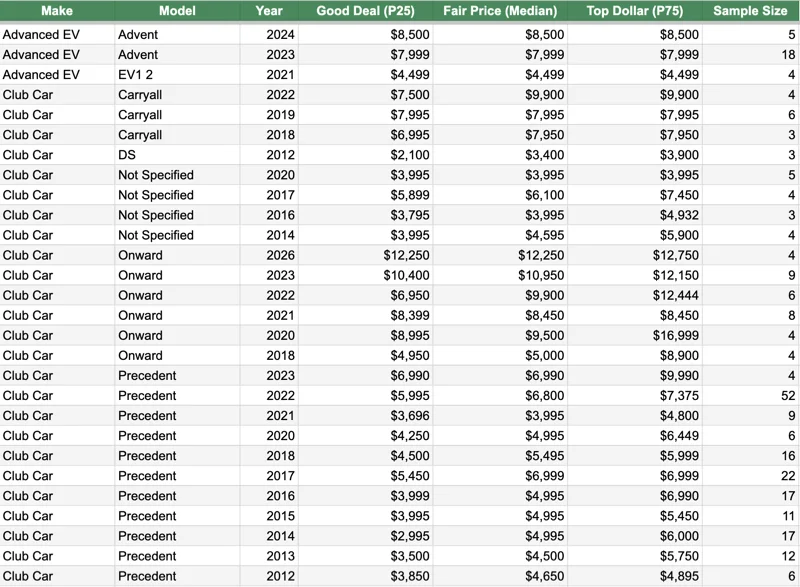
| Age | Typical Resale Range | Retention vs Purchase Price |
|---|---|---|
| 1-2 years old | $8,000 - $13,000 | 75-85% |
| 3-5 years old | $5,000 - $9,000 | 55-70% |
| 6-10 years old | $3,500 - $7,000 | 40-55% |
| 10-15 years old | $2,500 - $4,500 | 25-40% |
| 15+ years old | $1,500 - $3,000 | 15-25% |
The aluminum frame is the primary reason. A used buyer will always pay more for a structurally sound cart that will never rust than for a steel-frame cart that might have hidden corrosion. Lithium models hold an additional 10-15% premium over lead-acid equivalents.
The practical implication: if you buy a Club Car Onward HP Li-Ion at $13,120 and sell it after 5 years for $8,000, your net cost of ownership was $5,120. Buy a comparable EZGO at $11,369 and sell it after 5 years for $6,800, and your net cost was $4,569. The difference narrows significantly when you factor in the aluminum frame's lower maintenance and the Club Car's longer structural lifespan.
For full details on buying and selling used, see our used golf cart buying guide and pricing guide.
Buy a Club Car if:
Consider another brand if:
Club Car's large aftermarket means you have options at every price point. Here are upgrades that make a real difference.
If your stock charger is aging or you need a spare, the EXEFCH 48V 15A charger is designed specifically for Club Car models. It features automatic shutoff, LED charge indicators, and a 3-prong plug that fits Club Car receptacles directly.
Check EXEFCH 48V Club Car Charger PriceFor older Club Cars running on lead-acid batteries, upgrading to lithium transforms the cart. The EXEFCH 48V 105Ah lithium battery drops over 200 lbs and eliminates all battery maintenance. See our lithium conversion guide for the full installation process.
Check EXEFCH 48V Lithium Battery PriceThe NOKINS heated and ventilated seat cushion adds three heating levels and cooling ventilation for year-round comfort. It plugs into the cart's 12V outlet and fits Club Car seats.
Check NOKINS Heated Seat Cushion PriceThe Haxmuti universal clamp mount ($20 to $25) grips Club Car roof frames and roll bars for hands-free phone access. Essential for GPS and music on the go.
Check Haxmuti Phone Mount PriceFor more ideas, see our complete golf cart accessories guide and customization guide.
Club Car is the premium choice in the golf cart world, and the aluminum frame is the reason. Not marketing. Not brand prestige. The frame.
Every decision flows from that one engineering choice made decades ago. The frame does not rust, so the cart lasts longer. The cart lasts longer, so resale holds better. Resale holds better, so the higher purchase price becomes a lower total cost of ownership over 10+ years. Club Car understood this loop before their competitors did, and the AlumiCore frame remains their most durable competitive advantage.
The weaknesses are real. Club Car is the most expensive of the Big 3 at nearly every configuration. The 2-year parts warranty is shorter than Yamaha's 4-year. The lithium battery warranty (6 years) is shorter than EZGO's ELiTE (8 years) and ICON's (10 years). Early lithium models had VCM connector issues that were expensive to fix. And brands like ICON pack more tech features at lower prices.
But if you are buying a golf cart as a 10+ year investment, particularly in a humid or coastal climate, Club Car's aluminum frame and resale value make it the smartest money in the category. Test drive an Onward HP Li-Ion and compare it to the competition. The build quality speaks for itself.
Find Club Car dealers in our dealer directory, compare models on our brand comparison pages, or check your state's requirements for driving a golf cart on public roads.
The DS was Club Car's primary platform from 1981 to 2003. The Precedent replaced it from 2004 to 2018 with a more modern design. The Onward is the current platform (2017+) with updated styling, technology, and features. All three use the signature aluminum frame. Used DS and Precedent models are still widely available at $2,000 to $6,000 and remain solid choices for budget buyers.
Yes. Lithium conversion kits for Club Car models cost $2,000 to $4,000 depending on capacity. The conversion drops 200+ lbs, eliminates battery maintenance, and extends range significantly. It is one of the best upgrades for older Club Cars still running on lead-acid. Our lithium conversion guide covers the process for all major brands.
The Monsoon Canopy is Club Car's proprietary top design with integrated drain spouts that channel rainwater to the rear of the vehicle instead of dripping off the edges onto passengers. It sounds like a small detail, but if you drive in rain regularly, keeping water off your lap makes a real difference in daily comfort.
The Augusta, Georgia manufacturing facility, dealer network, and product lineup have remained intact since the 2021 acquisition. The 2026 models added new convenience features (wireless charging, USB-C ports, updated controls) while maintaining the aluminum frame and build quality standards. So far, the ownership change has not resulted in visible quality degradation.
Club Car golf carts need insurance if driven on public roads. Basic liability policies run $100 to $300 per year. The CRU, as a street-legal NEV, requires full vehicle insurance similar to a car. Check your state's golf cart insurance requirements for specific coverage needs.
For residents of The Villages and similar golf cart communities, the Onward 4 Passenger ($10,722) or Onward HP Li-Ion ($13,120) are the most popular choices. The 4-passenger fits most daily needs, and the HP Li-Ion offers the best combination of performance, range, and low maintenance for daily driving. The aluminum frame is especially important in Florida's humid climate.
Golf Cart Search
Compare top-rated models, read expert reviews, and find the perfect cart for your needs.
Browse Top-Rated Carts
Complete E-Z-GO golf cart review covering all 8 models from $8,374 to $15,799, common problems, ELiTE lithium tech, and how EZGO compares to Club Car and Yamaha

Complete Star EV golf cart review covering all 14 models from $11,888 to $18,999. Sirius, Capella, and Classic lines compared with honest pros and cons.

Complete Yamaha golf cart review covering all 9 models from $9,481 to $20,995. QuieTech EFI tech, common problems, and how Yamaha compares to Club Car and EZGO.
Get the latest updates on golf cart services, tips, and exclusive offers delivered to your inbox.