
As an Amazon Associate, we earn from qualifying purchases. This helps support our site at no extra cost to you.
The short answer: buy the EZGO TXT if you want the cheaper, simpler, easier-to-modify used cart. Buy the EZGO RXV if you want the better driver and are willing to inspect the electronics more carefully before handing over money.
That sounds simple until you start shopping. Sellers call almost everything an EZGO. Some older TXT carts have been converted from 36V to 48V. Some RXV carts have great AC drive systems and automatic braking, while others have controller or parking brake issues that turn a good price into a repair bill. And because both models have been around long enough to be rebuilt, lifted, stretched, and rewired, the badge is only the starting point.
This guide compares TXT vs RXV from the used buyer's point of view: what each model is, what they cost in 2026, how to identify them, what tends to break, which accessories fit, and which one you should buy for neighborhoods, golf communities, projects, and daily errands.
TXT Best For Budget, DIY, aftermarket parts
RXV Best For Drive feel, braking, refinement
TXT Median Used Price $5,399 from 214 listings
RXV Median Used Price $5,795 from 413 listings
EZGO TXT vs RXV: Quick Verdict
For most used-cart shoppers, the TXT is the safer cheap buy and the RXV is the better cart when it has been maintained properly.
Choose the TXT when:
- You want the lowest purchase price.
- You plan to do your own repairs.
- You want the widest selection of windshields, rear seats, roof racks, dashboards, lift kits, and charger options.
- You are looking at an older lead-acid cart and want parts every local shop already knows.
- You would rather accept a simpler ride than pay for more complex electronics.
Choose the RXV when:
- You want a smoother, more controlled electric driving feel.
- You value stronger regenerative braking and automatic parking brake behavior on electric RXV models.
- The cart is newer, cleaner, and only modestly more expensive than a comparable TXT.
- You can verify the charger, controller, batteries, and brake system before buying.
- You are shopping through a dealer or repair shop that can stand behind the cart.
My practical rule: if a clean RXV is within about $500 to $1,500 of a similarly clean TXT, the RXV is usually worth the premium for a buyer who wants to drive it more than wrench on it. If the RXV has unknown batteries, warning codes, brake faults, hacked wiring, or no working charger, the TXT becomes the smarter risk.
For the broader brand context, read our full E-Z-GO golf cart review. If you are still comparing brands, our Club Car vs EZGO comparison and best golf cart brands ranking are better starting points.
Side-by-Side Comparison
| Category | EZGO TXT | EZGO RXV |
|---|---|---|
| Used buyer personality | Budget workhorse | More refined driver |
| Common production era | Mid-1990s and newer | 2008 and newer |
| Typical used price | Lower | Slightly higher |
| Repair difficulty | Easier | More diagnostic work |
| Parts availability | Excellent | Very good |
| Accessory fitment | Huge TXT-specific ecosystem | Good, but model-specific |
| Electric drive feel | Varies by year and controller | Usually smoother and more advanced |
| Braking feel | More conventional on many older carts | Stronger electric braking on many RXV electric models |
| Best use case | Project cart, neighborhood cruiser, budget fleet cart | Daily community cart, better ride, newer used cart |
| Main risk | Rust, battery neglect, old wiring, cheap lift kits | Controller, charger, brake system, battery pack cost |
The TXT wins on simplicity and parts depth. The RXV wins on driving experience when the cart is healthy. Neither model is automatically better if it has bad batteries, a poor lift kit, missing serial plates, or vague ownership history.

What Is the EZGO TXT?
The TXT is the classic E-Z-GO platform most buyers picture when they think of a used EZGO golf cart. It is common on golf courses, in neighborhoods, at campgrounds, and in rental fleets because it is simple, familiar, and supported by a massive parts ecosystem.
Older TXT carts are often 36V lead-acid. Later TXT and Freedom TXT electric carts are commonly 48V. The official Freedom TXT 48V owner's manual lists a 48V electric system and also notes features such as charger lockout and expanded regenerative braking on that platform. That matters because "TXT" alone does not tell you the voltage, controller type, or charger plug.
The TXT is the better choice if you care about:
- Cheap replacement parts.
- A lot of used parts available locally.
- Easy accessory fitment.
- Straightforward lead-acid battery replacement.
- DIY-friendly troubleshooting.
- Low purchase price.
It is also the better project platform. If you want to add a rear seat kit, install a roof rack, swap a windshield, upgrade the dash, or convert batteries later, the TXT market is deep.
The tradeoff is age. A cheap TXT may be cheap because it has tired batteries, rusty steel, sloppy steering, old brake cables, dry-rotted tires, worn suspension, and years of accessory wiring under the seat. The platform is simple, but a neglected cart can still cost real money.
What Is the EZGO RXV?
The RXV is the more modern E-Z-GO platform. It launched for the 2008 model year and became known for its AC drive technology, stronger electric braking behavior, and more refined drive feel than many older fleet-style carts.
The current Freedom RXV specification sheet from E-Z-GO lists ELiTE lithium or EX1 gas power, about 19 mph top speed, 2 or 4 passenger seating, and automatic parking brake with Advanced IntelliBrake technology on ELiTE models. E-Z-GO's official owner's manuals page also separates Freedom RXV, RXV, Valor, TXT, and Freedom TXT manuals, which is a good reminder that parts fitment should be confirmed by exact platform, not by the EZGO name alone.

The RXV is the better choice if you care about:
- Better electric drive feel.
- Stronger braking behavior on electric models.
- A newer platform in the used market.
- More refined controls and ride quality.
- A cart that feels less like a basic fleet cart.
The tradeoff is complexity. RXV carts are not exotic, and plenty of shops know them well. But an RXV with controller issues, charger faults, or parking brake problems is less forgiving than a basic TXT with a weak solenoid or tired batteries. That is why the test drive matters more on an RXV.
Used Price Comparison in 2026
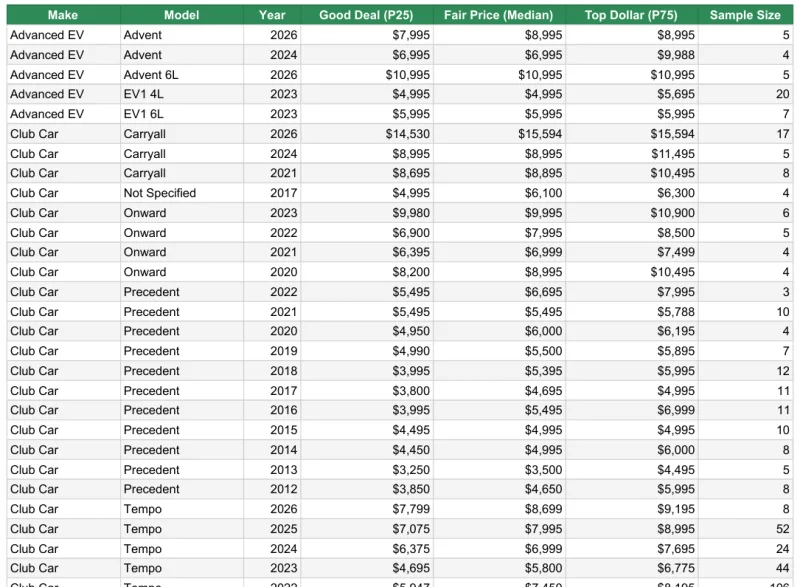
For the Used Golf Cart Buyer's Toolkit, we analyzed 2,288 used dealer listings in March 2026. The E-Z-GO model split is useful because TXT and RXV show up often enough to compare.
| Model | Listings | Low | 25th Percentile | Median | 75th Percentile | High |
|---|---|---|---|---|---|---|
| E-Z-GO TXT | 214 | $1,995 | $3,999 | $5,399 | $6,175 | $10,995 |
| E-Z-GO RXV | 413 | $2,495 | $4,995 | $5,795 | $6,995 | $11,995 |
The median RXV premium in that dataset is only $396, but the 75th percentile spread is bigger: $6,995 for RXV versus $6,175 for TXT. In plain English, clean RXV carts tend to command more money, especially when they are newer, dealer-reconditioned, lithium-equipped, or sold with fresh batteries.
Do not read those numbers as a universal price rule. A 2021 TXT with fresh batteries can be worth more than a 2017 RXV with weak batteries. A lifted RXV with poor steering geometry may be worth less than a stock TXT. A TXT with a clean body, charger, and documented service history may be the better buy than a shiny RXV with unknown electronics.
Use this rule when negotiating:
- TXT under $4,000: Can be a deal, but assume batteries, tires, wiring, or cosmetics need work.
- TXT from $4,000 to $6,500: The normal used sweet spot if condition is good.
- TXT over $7,000: Needs fresh batteries, nice seats, clean bodywork, dealer support, or useful upgrades.
- RXV under $5,000: Inspect carefully. It may be older, rough, or due for batteries.
- RXV from $5,000 to $7,500: The normal used sweet spot for clean examples.
- RXV over $8,000: Should be newer, lithium, dealer-prepped, or exceptionally clean.
If you want a wider market view, compare these numbers with our used golf cart prices by brand guide, golf cart depreciation guide, and what is my golf cart worth guide.
How to Tell If It Is a TXT or RXV
Do not rely on the seller's title alone. Listings often say "EZGO TXT RXV" just to catch search traffic. Start with the body, then verify the serial number.
The fastest checks:
- Model badging: Many carts say TXT, Freedom TXT, RXV, or Freedom RXV on the side panels.
- Serial number location: TXT carts are commonly identified inside the passenger-side glove box or behind the seat on a steel cross member. RXV carts are often identified near the steering column or front frame area.
- Body shape: RXV has a more modern front cowl and dashboard layout than older TXT carts.
- Charger port: Older TXT carts are often 36V with a D-style plug. Later 48V TXT and many RXV carts use different 48V charging setups.
- Controller and brake behavior: Electric RXV carts often feel more controlled when slowing and stopping.
Our golf cart serial number guide has the EZGO serial number locations and year-decoding details. Use it before ordering parts or making an offer. If the plate is missing, damaged, painted over, or does not match the seller's claimed year, slow down.
Batteries, Chargers, and Voltage
This is where TXT vs RXV gets expensive if you guess.
Many older TXT carts are 36V. Many later TXT carts are 48V. Many RXV carts are 48V lead-acid, while newer Freedom RXV ELiTE models use E-Z-GO lithium systems. The only responsible way to buy parts is to confirm the actual battery pack, charge receptacle, charger label, and serial number.
| Setup | Common on | What to check |
|---|---|---|
| Six 6V batteries | Older TXT | 36V pack, often D-style charger plug |
| Six 8V batteries | Later TXT, some RXV | 48V pack, verify plug and charger profile |
| Four 12V batteries | Some 48V carts | Check age, brand, and whether tray wiring is clean |
| Factory lithium | Newer ELiTE RXV and other E-Z-GO models | Verify factory charger and battery management system |
| Aftermarket lithium | Converted TXT or RXV | Match charger to battery maker, not just model name |
Delta-Q's PowerWise QE support article lists separate user guides for E-Z-GO TXT and RXV charger families, including 36V and 48V PowerWise QE chargers. That is the key lesson: TXT and RXV charging is not one universal setup.
If you are buying an older 36V TXT and the charger is missing or unreliable, the FORM 36V charger is the cleanest active Creator Connections fit in this topic. It is for 36V EZGO TXT carts with the D-style plug, not for RXV and not for every 48V TXT.
Check FORM 36V EZGO TXT Charger PriceIf the cart has weak lead-acid batteries and you are thinking about lithium, price the whole project before you buy the cart. Battery, charger, hold-downs, cables, voltage reducer, state-of-charge display, and controller compatibility can turn a cheap cart into a $3,000 project quickly. Our lithium battery conversion guide, battery voltage chart, and how long to charge guide go deeper.
For a 48V LiFePO4 conversion where the battery maker's specs match your plan, the EXEFCH 51.2V pack is the current higher-commission Creator Connections battery we already track across battery content.
Check EXEFCH 51.2V Lithium Battery PriceCommon TXT Problems to Inspect
The TXT is forgiving, but it is also old enough that a lot of used examples have lived hard lives.
Check these before buying:
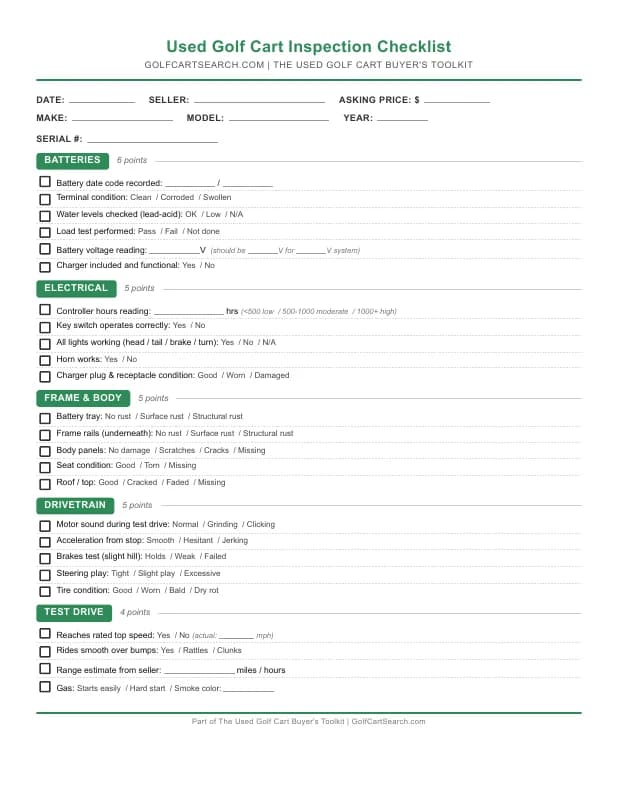
- Battery age and performance. Look for date codes, swelling, corrosion, low water, mismatched batteries, and weak acceleration under load.
- Solenoid click with no movement. A common TXT complaint. It may be a solenoid, key switch, microswitch, controller, wiring, or battery issue.
- Charger receptacle wear. Dirty, loose, or melted plugs can make a good charger look bad.
- Frame rust. E-Z-GO steel frames are durable, but coastal carts, beach carts, and carts stored outside deserve a serious underbody check.
- Steering play. Worn tie rods, bushings, and steering components are common on older fleet carts.
- Brake adjustment. Weak brakes, long pedal travel, and dragging cables are common on neglected carts.
- Accessory wiring. Old lights, radios, turn signals, phone chargers, and lift-kit wiring can leave a mess under the seat.
- Cheap lift kits. Look for rubbing tires, uneven stance, unstable steering, and hacked fender trimming.
A basic multimeter and hydrometer can save you from buying a cart with a weak pack. Use the multimeter for total pack voltage and individual battery voltage. Use the hydrometer only on flooded lead-acid batteries, never sealed AGM or lithium.
Check a basic digital multimeter on Amazon Check a battery hydrometer on AmazonIf the cart will live in salt air or near the beach, read the golf cart rust prevention guide before buying any steel-frame cart.
Common RXV Problems to Inspect
The RXV can be a better driver, but it deserves a more careful test drive.
Check these before buying:
- Brake behavior. The cart should stop predictably, hold when parked, and not give warnings or strange beeps. Electric RXV brake issues can be expensive.
- Controller response. Acceleration should be smooth, not jerky, delayed, or inconsistent.
- Charger operation. Confirm the charger starts, runs through its cycle, and matches the battery chemistry.
- Battery age. A shiny RXV with old lead-acid batteries is still an expensive cart to own.
- Run and tow switch behavior. Make sure the seller understands the correct procedure and has not forced the cart into odd behavior.
- Wiring condition. Lifted, lighted, stereo-equipped RXV carts can have sloppy accessory wiring just like TXT carts.
- Early-cart support. Older RXV examples can still be good buys, but make sure a local golf cart repair shop is comfortable with that year and controller setup.
- Tire and lift clearance. RXV body and suspension fitment is different from TXT, so do not assume TXT lift-kit advice applies.
If the RXV drives cleanly, brakes cleanly, charges correctly, and has good batteries, it is usually worth paying more for than a comparable TXT. If it has unexplained electronic or brake symptoms, walk away or price the repair before you negotiate.
For controller, battery, and no-start symptoms, use our golf cart controller symptoms guide, golf cart won't start guide, and charging port problems guide.
Accessories and Mod Potential
TXT wins this category. RXV has plenty of accessory support, but TXT has the wider and cheaper ecosystem because so many carts were sold into fleets and neighborhoods.
The most common TXT upgrades:
- Fold-down windshield.
- Rear seat kit.
- LED light kit.
- Mirrors and turn signals.
- Seat covers.
- Roof rack.
- Dash tray or dashboard electronics.
- Lift kit and tires.
- Smart charger.
- Lithium conversion.
If you are buying a TXT that needs a windshield, the ENEKERP fold-down windshield is a practical Creator Connections fit for many 1995 to 2013 TXT carts. Confirm your exact model year and strut spacing before ordering, because newer Valor-style carts and RXV carts are different.
Check ENEKERP EZGO TXT Windshield PriceFor weather protection, a full enclosure can make either platform more useful in rain, cold mornings, or seasonal communities. The Xoxocos enclosure campaign is especially relevant because it targets EZGO TXT and RXV fitment, but still verify roof style and year.
Check Xoxocos EZGO TXT/RXV Enclosure PriceA phone mount is a small upgrade, but it is useful if your cart is used for maps, music, community driving, or repair notes while you are testing voltage. The HonicWang magnetic alloy mount is the current high-commission phone holder campaign.
Check HonicWang Phone Mount PriceBefore buying accessories, confirm whether your cart is TXT, RXV, Valor, Freedom TXT, or another E-Z-GO platform. Our golf cart customization guide, windshield guide, floor mat guide, and tire and wheel guide cover fitment mistakes in more detail.
Which One Is Better for Street Use?
Neither a standard TXT nor a standard RXV is automatically street legal. The model name does not matter as much as equipment, speed, registration, title status, and state law.
For public-road use, check:
- Headlights, taillights, brake lights, and turn signals.
- Mirrors, horn, reflectors, and windshield.
- Seat belts if required.
- VIN or serial number paperwork.
- Maximum speed and whether it qualifies as a golf cart or LSV.
- Insurance requirements.
- Local road-speed limits.
Use our golf cart laws by state, golf cart insurance guide, LSV vs golf cart guide, and street legal conversion guide before spending money on lights.
If you are buying specifically for public roads, a factory LSV may be the better path. Compare the cost of converting a TXT or RXV with a factory street-legal cart such as the E-Z-GO Liberty LSV, Club Car Onward LSV, or an LSV-focused model from ICON or Evolution.
Final Buying Advice
Buy the TXT if the budget matters, if you like DIY repairs, or if you want a platform you can modify cheaply over time. A clean TXT with good batteries, a working charger, minimal rust, and tidy wiring is still one of the best used golf cart buys in the market.
Buy the RXV if you want the better drive and can verify the cart is healthy. A clean RXV with strong batteries, proper charger behavior, smooth acceleration, and good braking is worth the small premium over a comparable TXT.
Walk away from either one if:
- The serial number is missing or suspicious.
- The seller cannot show the charger working.
- The batteries are old and the price does not reflect replacement cost.
- The cart has heavy frame rust.
- The wiring looks hacked together.
- The test drive has jerky acceleration, weak braking, or warning behavior.
- The lift kit, tires, or seats were installed poorly.
If you want a dealer-backed used cart rather than a private-party project, browse golf carts for sale near you and compare local options. If the cart already needs diagnosis, check repair shops near you before assuming the cheapest listing is the cheapest cart to own.
FAQ: EZGO TXT vs RXV
Is the EZGO TXT or RXV better?
The TXT is better for budget buyers, simple repairs, and aftermarket modifications. The RXV is better for buyers who care about drive feel, electric braking, and a more modern platform. Condition matters more than the model name.
Which used EZGO costs less?
TXT usually costs less. In our 2026 used-listing dataset, TXT had a $5,399 median price across 214 listings, while RXV had a $5,795 median price across 413 listings.
Is the RXV worth more than the TXT?
Often yes, but only when condition is similar. A clean RXV with good batteries is usually worth paying more for. A rough RXV with brake or controller problems is not.
Are TXT and RXV chargers the same?
Not automatically. Older TXT carts are often 36V with a D-style plug, while later 48V TXT and RXV carts may use different plugs and charging profiles. Always confirm voltage, plug, and battery chemistry before ordering.
Can I use TXT accessories on an RXV?
Some universal accessories may fit both, but model-specific parts usually do not. Windshields, lift kits, floor mats, dashboards, roof racks, and brake parts should be matched to TXT or RXV specifically.
Which is better for a lithium conversion?
TXT is usually easier for aftermarket lithium conversions because the platform is simpler and parts support is broad. RXV conversions can work, but controller, charger, and system compatibility require more care.
Which is better for a neighborhood cart?
For a basic neighborhood cruiser, TXT is enough and usually cheaper. If you drive daily, carry passengers often, or care about smoother braking and acceleration, RXV is the nicer cart when maintained well.
Which is better for golf course use?
TXT is the traditional workhorse and is easy for course shops to keep running. RXV can be a more refined fleet cart, especially where electric braking and modern drive feel matter. For private ownership, buy the cleaner cart.
What year RXV should I buy?
There is no single magic year. Focus on battery age, controller health, charger operation, brake behavior, and maintenance history. Many shoppers prefer later RXV examples because they are easier to inspect through documented service and dealer support.
What year TXT should I buy?
For budget use, a clean older TXT can be a great buy. For less hassle, newer 48V TXT and Freedom TXT carts are easier to live with. Avoid any year with heavy rust, bad batteries, missing charger, or sloppy wiring.
Should I buy from a dealer or private seller?
Buy private if you can inspect and repair carts yourself. Buy from a dealer if you want a checked charger, tested batteries, cleaner paperwork, and some accountability after purchase. The dealer premium can be worth it on RXV carts because diagnostics matter more.
What is the biggest mistake buyers make?
They price the cart and ignore the battery pack. A $4,500 TXT that needs $1,500 in batteries is not cheaper than a $5,800 RXV with a healthy pack. Test voltage, date codes, charger behavior, and performance under load before negotiating.
Golf Cart Search
Find the Best Golf Carts of 2026
Compare top-rated models, read expert reviews, and find the perfect cart for your needs.