As an Amazon Associate, we earn from qualifying purchases. This helps support our site at no extra cost to you.
How to Paint a Golf Cart
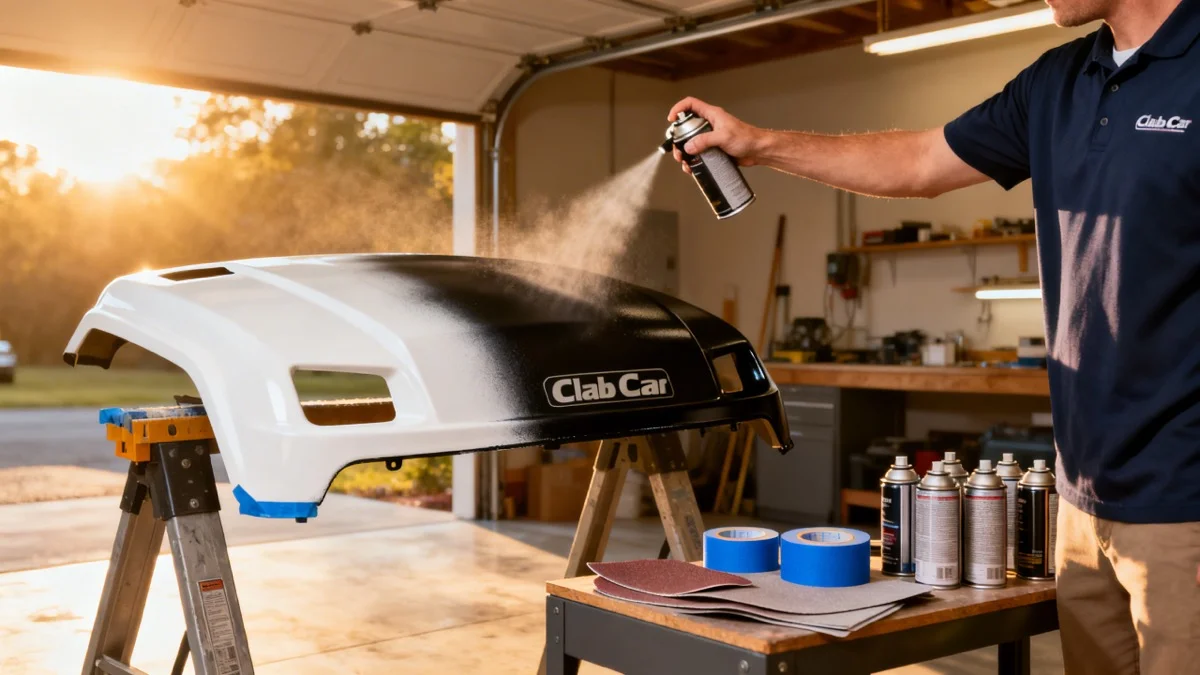
To paint a golf cart, remove the body panels, clean and degrease them, sand with 220-320 grit, use adhesion promoter on plastic, spray primer, apply 3-4 thin color coats, add clear coat, then let the panels cure before reassembly. If you searched for "paint golf cart," "how to paint golf cart," or "painting a golf cart," that prep sequence is the difference between a finish that lasts and one that peels.
| Step | What to Do | Why It Matters |
|---|---|---|
| 1. Remove panels | Take off the cowl, rear body, trim, lights, and hardware | Cleaner edges, less overspray, easier sanding |
| 2. Clean and sand | Wash, degrease, then scuff with 220-320 grit | Paint needs a clean, keyed surface |
| 3. Promote adhesion | Use plastic adhesion promoter on EZGO, Yamaha, newer Club Car, ICON, Evolution, and Star EV panels | Plastic paint failure usually starts with poor adhesion |
| 4. Prime and paint | Spray light primer coats, then 3-4 thin color coats | Thin coats prevent runs and striping |
| 5. Clear and cure | Add 2-3 clear coats and wait 24-48 hours before reassembly | Clear coat adds UV and scratch protection |
A faded, scratched, or just plain boring golf cart body is one of the easiest things to fix yourself. Whether you spray paint it for under $200 or wrap it in vinyl for a completely new look, a color change transforms your cart from tired to head-turning in a single weekend.
This guide walks you through both methods step by step, with real costs, specific product recommendations, and tips for EZGO, Club Car, and Yamaha bodies. By the end, you will know exactly which approach fits your budget, skill level, and goals.
Paint vs. Wrap: Which Should You Choose?
Before you buy anything, decide which method fits your situation. Both have tradeoffs.
| Factor | Paint | Vinyl Wrap |
|---|---|---|
| DIY cost | $100-$500 | $150-$450 |
| Professional cost | $500-$2,000 | $500-$2,000 |
| Durability | 5-10 years (quality paint) | 3-7 years; horizontal panels fade sooner |
| DIY difficulty | Moderate (prep is critical) | Moderate (technique matters) |
| Reversible? | No | Yes, peels off cleanly |
| Color options | Unlimited (mix custom colors) | Huge selection including carbon fiber, chrome, camo |
| Resale impact | Permanent change | Preserves original paint |
| Best for | Long-term color change, damaged bodies | Temporary changes, exotic finishes, protecting paint |
Choose paint if you want a permanent color change, your body panels have scratches or damage that need filling, or you want to spend under $200 on a basic job.
Choose wrapping if you want to change colors every few years, you want finishes that paint cannot replicate (carbon fiber, brushed metal, chrome), or you plan to sell the cart and want to preserve the original paint underneath.
For a full rundown of other visual upgrades, see our golf cart customization guide.
How Much Does It Cost? Full Breakdown
DIY Paint Job Costs
| Item | Budget Tier | Quality Tier |
|---|---|---|
| Spray paint (6-10 cans) | $40-$80 | $80-$150 |
| Adhesion promoter | $10-$15 | $10-$15 |
| Primer (2-3 cans) | $15-$25 | $25-$40 |
| Clear coat (2-3 cans) | $15-$30 | $40-$75 (2K clear) |
| Sandpaper, tape, drop cloths | $20-$40 | $30-$50 |
| Total | $100-$190 | $185-$330 |
Professional Paint Job Costs
| Service Level | Price Range |
|---|---|
| Basic solid color repaint | $500-$800 |
| Quality automotive paint | $800-$1,200 |
| Custom metallic or pearl | $1,000-$1,500 |
| Show-quality custom paint | $1,500-$2,000+ |
DIY Wrap Costs
| Item | Budget Vinyl | Premium Vinyl (3M/Avery) |
|---|---|---|
| Vinyl material (2-seater) | $80-$150 | $200-$350 |
| Vinyl material (4-seater) | $120-$200 | $300-$450 |
| Tool kit (squeegee, knife, heat gun) | $25-$40 | $25-$40 |
| Total (2-seater) | $105-$190 | $225-$390 |
| Total (4-seater) | $145-$240 | $325-$490 |
For context on overall cart pricing, check our golf cart pricing guide. A fresh paint or wrap job can add $300-$800 to your cart's resale value.
How to Paint a Golf Cart: Step-by-Step
What You Will Need
Gather these supplies before you start:
- Spray paint (6-10 cans): Krylon Fusion for plastic bodies, or Rust-Oleum Automotive Enamel for fiberglass
- Adhesion promoter: Bulldog or SEM brand (essential for plastic bodies)
- Primer (2-3 cans): Plastic-compatible automotive primer
- Clear coat (2-3 cans): SprayMax 2K for durability, or standard automotive clear
- Sandpaper: 220-grit for initial scuffing, 320-grit for between coats, 400-grit for final smoothing
- Painter's tape and masking paper
- Wax and grease remover (Prepsol or isopropyl alcohol)
- Drop cloths
- Screwdrivers and socket set for panel removal
Step 1: Remove the Body Panels
Take off every panel you plan to paint. Most golf cart bodies come apart with Phillips screws and a few bolts. On an EZGO TXT, the front cowl, rear body, and fenders each remove separately. Club Car Precedent bodies typically come off as fewer, larger pieces.
Label each piece and bag the hardware. Painting panels off the cart gives you better coverage and prevents overspray on seats, tires, and electrical components.
Step 2: Clean and Sand the Surface
This step makes or breaks your paint job. Skip it and the paint peels within weeks.
- Wash every panel with soap and water to remove dirt, mud, and debris
- Degrease with wax and grease remover or isopropyl alcohol. Wipe in one direction, do not scrub in circles
- Sand the entire surface with 220-320 grit sandpaper. You are not removing material, just creating a rough texture (called "tooth") for the primer to grip. Sand in consistent, overlapping strokes
- Wipe down with a tack cloth to remove all dust
For plastic bodies (EZGO, Yamaha Drive, most newer carts), apply adhesion promoter after sanding. Spray a thin, even coat and let it dry for 5-10 minutes. This step is non-negotiable on plastic. Without it, even the best paint will flake off.
Fiberglass bodies (older Club Car DS models, some custom bodies) do not need adhesion promoter. Light sanding is enough.
Step 3: Apply Primer
Spray 2-3 light coats of plastic-compatible automotive primer. Hold the can 10-12 inches from the surface and use slow, sweeping passes. Each coat should be thin enough that you can still see the surface underneath.
Wait 10-15 minutes between coats. After the final primer coat, let it cure for at least 1 hour (check the can for specific times). Then lightly sand with 320-400 grit to smooth any texture before painting.
Step 4: Spray Your Paint
This is the fun part. Follow these rules for a smooth, drip-free finish:
- Thin coats only. Three thin coats beat one thick coat every time. Thick coats run, sag, and take forever to dry.
- Keep your distance. Hold the can 10-12 inches away. Closer means drips.
- Overlap each pass by 50%. This prevents striping.
- Wait 15-20 minutes between coats. The previous coat should be dry to the touch but not fully cured.
- Apply 3-4 coats total for solid, even coverage.
Start each spray pass before the panel edge and end it past the other edge. Never start or stop spraying directly on the panel surface.
Step 5: Apply Clear Coat
Clear coat protects your paint from UV rays, scratches, and fading. You have two options:
Standard clear coat ($8-15/can): Easier to apply, decent protection. Lasts 2-4 years before yellowing.
2K clear coat ($20-30/can): Contains a hardener that activates when you spray. Far more durable, UV-resistant, and scratch-resistant. Worth the extra cost if you want your paint to last 5+ years.
Apply 2-3 coats of clear, using the same thin-coat technique as your color coats. Let the final coat cure for 24-48 hours before handling the panels.
Step 6: Reassemble and Admire
Once everything is fully cured, reinstall the panels in reverse order. Use your photos from Step 1 as a reference. Tighten screws evenly and check that all panels align before driving.
While you have the cart apart, it is a great time to upgrade LED lights, seat covers, or a new steering wheel.
How to Wrap a Golf Cart: Step-by-Step
Wrapping is faster than painting and completely reversible. Golf carts are actually one of the easier vehicles to wrap because the panels have gentle curves and come off easily.
Wrapping Materials and Tools
- Vinyl wrap material: 15-20 linear feet for a 2-seater, 25-35 feet for a 4-seater (60-inch width)
- Wrap tool kit: Squeegee, heat gun, utility knife, microfiber cloths
- Isopropyl alcohol (70%) for surface prep
- Lint-free gloves to prevent fingerprints on adhesive
Step 1: Remove Panels and Clean
Just like painting, remove the body panels from the cart. Then clean each panel thoroughly with isopropyl alcohol. The surface must be completely free of wax, grease, and dirt. Any contamination under the vinyl will show as bumps and will eventually cause the wrap to lift.
Step 2: Measure and Cut
Lay your vinyl over each panel and cut pieces 2-3 inches larger than needed on all sides. This extra material gives you room to pull, stretch, and tuck the edges. You will trim the excess after application.
Step 3: Apply the Vinyl
Peel back a few inches of the backing paper and position the vinyl on the panel. Press it down with your squeegee, working from the center outward to push air bubbles toward the edges.
Work in small sections, peeling more backing as you go. Keep firm, even pressure with the squeegee. If you get a bubble, lift the vinyl back past the bubble and reapply. Most quality vinyl (3M, Avery Dennison, VViViD) has air-release channels that allow small bubbles to work themselves out.
Step 4: Heat and Conform
Use a heat gun on low setting to warm the vinyl around curves, edges, and recesses. Heated vinyl stretches and conforms to complex shapes without wrinkling. Work slowly, heating a small area, stretching gently, then pressing it down with the squeegee.
Do not overheat. If the vinyl starts to discolor or feel thin, you have stretched it too far. That section will fail prematurely.
Step 5: Trim and Seal the Edges
Once the vinyl is applied, trim the excess with a sharp utility knife. Leave about 1/4 inch of extra material to wrap around edges. Use the heat gun to soften the vinyl at edges and press it firmly with the squeegee for a secure seal.
Edges and corners are where wraps fail first. Take extra time here. Some installers use edge-sealing primer (also called "edge seal" or "wrap primer") for added insurance in high-stress areas.
Best Paint Options for Golf Carts
Not all paint works on golf cart bodies. Here is what actually performs:
Spray Paint (Best for Budget DIY)
Krylon Fusion All-In-One is the top choice for plastic golf cart bodies. Krylon markets it as a direct-to-plastic paint, but a golf cart lives outdoors, flexes, and gets washed, so still clean and scuff the panels first. Plan on $7-10 per can and 6-10 cans for a full cart. The finish is good, not great. Expect 2-4 years before touch-ups are needed.
Rust-Oleum 2X Automotive Enamel is slightly more durable than Krylon and sprays a wider fan pattern for faster coverage. It does require adhesion promoter on plastic, but the finish is smoother. Around $8-12 per can.
Rust-Oleum Automotive Enamel Spray Paint →2K Urethane Aerosol (Best for Durability)
SprayMax 2K and Eastwood 2K AeroSpray are two-component paints in a spray can. You activate the hardener by popping a plunger on the bottom, which mixes the two components. Once activated, the can must be used within 48 hours.
The result is dramatically more durable than regular spray paint. 2K urethane resists UV, chemicals, fuel, and scratches. It is the closest you will get to a professional paint job without a spray gun. Expect to pay $20-30 per can.
Professional Automotive Paint (Best Results)
If you own or can borrow a spray gun and compressor, automotive urethane paint gives you showroom-quality results. A gallon of base coat plus hardener runs $100-$200, and you will get a finish that lasts 7-10 years.
This is the route most professional shops take. The investment in equipment ($200-$400 for a decent HVLP spray gun and compressor) pays for itself if you plan to paint more than one cart or vehicle.
Best Wrap Materials and Finishes
Premium Brands
3M 2080 Series is the industry standard. Strong adhesive, excellent conformability, and broad color availability. 3M's published warranty is longer on vertical exposure than horizontal exposure, so expect hoods and roofs to age faster than side panels on a golf cart.
Avery Dennison Supreme Wrapping Film is slightly more beginner-friendly. The adhesive allows you to slide and reposition the vinyl before pressing it down. It is thin enough to conform around curves and is a strong premium choice for full or partial cart wraps.
Budget-Friendly Brands
VViViD offers quality vinyl at roughly half the price of 3M. Expect 3-5 years of lifespan. Their color selection is massive, including specialty finishes like holographic and color-shift. A solid choice if you want to experiment with wrapping before committing to premium material.
Popular Finish Types
| Finish | Look | Best For |
|---|---|---|
| Gloss | Shiny, wet-look | Classic, clean appearance |
| Matte | Flat, non-reflective | Modern, stealth look |
| Satin | Between gloss and matte | Subtle sophistication |
| Carbon fiber | Textured 3D weave pattern | Sporty, aggressive style |
| Brushed metal | Metallic directional texture | Industrial, premium feel |
| Chrome | Mirror-like reflective | Show carts, attention-getting |
| Camo | Woodland, digital, or custom patterns | Hunting carts, outdoor use |
| Color-shift | Changes color with viewing angle | Unique, eye-catching |
Brand-Specific Tips
Golf cart bodies are made from different materials depending on the brand and year. This matters for prep.
EZGO
Most EZGO TXT and RXV bodies are injection-molded plastic (specifically Surlyn or similar). Plastic bodies absolutely require adhesion promoter before paint. Sand with 220-grit, apply Bulldog adhesion promoter, then prime and paint.
For wrapping, plastic bodies actually work well. The smooth surface accepts vinyl easily. Just make sure the surface is completely clean and free of any mold release agents from the factory.
Club Car
Older Club Car DS models have fiberglass bodies that accept paint very well. Light sanding with 320-grit and standard automotive primer is all you need. No adhesion promoter required.
Newer Club Car Precedent and Onward models use ABS plastic similar to EZGO. Treat these the same as EZGO bodies: adhesion promoter is mandatory.
Yamaha
Yamaha Drive and Drive2 models use plastic body panels. Same rules as EZGO: sand, apply adhesion promoter, prime, then paint. Yamaha bodies tend to have simpler panel shapes, making them slightly easier to wrap than EZGO's more sculpted cowls.
Icon, Star EV, and Evolution
Newer brands like Icon, Star EV, and Evolution typically use injection-molded plastic bodies. Treat them the same as EZGO: adhesion promoter is essential. Check your owner's manual or contact the manufacturer if you are unsure about the body material.
Popular Golf Cart Colors and Designs
Best Colors for Resale Value
If you plan to sell your cart eventually, color choice matters:
- White or pearl white: Best resale value across all brands. Clean, classic, universally appealing.
- Silver or metallic silver: Strong resale. Hides minor scratches and dirt well.
- Black: Popular, but shows every scratch, fingerprint, and dust speck. More maintenance.
- Navy blue: Solid resale in golf course communities.
- Bold colors (red, orange, lime green): Appeal to fewer buyers. Can reduce resale value by $200-$500 compared to neutral colors.
Trending Colors and Finishes in 2026
- Matte black remains the most popular non-traditional finish
- Two-tone combinations (black and silver, navy and white) are growing fast
- Metallic charcoal and gunmetal gray are replacing standard silver
- Earth tones (olive, tan, bronze) are popular for neighborhood carts
- American flag and patriotic wraps spike every summer
- Camo patterns remain popular for hunting and rural use
How to Maintain Your New Paint or Wrap
A fresh finish only stays fresh with proper care. Here is how to protect your investment.
Paint Care
- Wash regularly with automotive soap and water. Avoid pressure washers on fresh paint for the first 30 days.
- Wax every 3-4 months with a quality automotive wax. This adds UV protection and keeps the gloss.
- Address chips immediately. Small chips become rust spots (on metal frames) or cracks that spread (on body panels).
- Park in shade or use a cover when possible. UV is the number one killer of paint finishes. A quality golf cart cover costs far less than a repaint.
Wrap Care
- Hand wash only. Avoid automatic car washes and pressure washers, which can lift edges.
- Use wrap-safe cleaning products. Avoid wax and petroleum-based cleaners on matte or satin wraps. They can alter the finish.
- Inspect edges monthly. If you notice lifting at edges or seams, press them down with heat and a squeegee before the problem spreads.
- Replace damaged sections. One advantage of wrapping is that you can replace a single panel without redoing the whole cart.
For a full care routine, see our golf cart maintenance guide.
Common Mistakes to Avoid
Skipping surface prep. This is the number one cause of paint failure. Clean, sand, and degrease every surface. If the panel still feels smooth after sanding, you have not sanded enough.
Spraying thick coats. Three thin coats always beat one thick coat. Thick paint runs, sags, and takes days to cure. Thin coats dry in minutes and build up evenly.
Painting in bad conditions. Do not paint in direct sunlight, high humidity (above 85%), or temperatures below 50°F or above 90°F. A garage or shaded carport with good airflow is ideal.
Forgetting adhesion promoter on plastic. This mistake is expensive. You will have to strip everything and start over once the paint starts peeling, usually within a few months.
Stretching vinyl wrap too far. Overheated, overstretched vinyl becomes thin and translucent. It will fail at that spot within weeks. If the vinyl resists conforming to a curve, make a relief cut instead of forcing it.
Wrapping over damage. Vinyl wraps conform to the surface underneath. Dents, deep scratches, and rust bumps will show through the wrap. Fix body damage before wrapping.
Pair your new finish with other upgrades like custom tires and wheels, a new top or canopy, or premium accessories to complete the transformation.
Should You DIY or Hire a Professional?
| Factor | DIY | Professional |
|---|---|---|
| Cost | $100-$500 | $500-$2,000 |
| Time | 2-4 days (paint), 4-8 hours (wrap) | 1-3 days |
| Skill needed | Basic (paint), Moderate (wrap) | None, they handle it |
| Finish quality | Good with proper prep | Excellent |
| Warranty | None | Often 1-2 years |
DIY makes sense if you enjoy hands-on projects, your budget is under $300, or you are painting a beater cart that does not need a perfect finish.
Hire a professional if you want a flawless finish, you are working with expensive custom colors or chrome wraps, or you do not have a clean workspace for painting. Find shops near you on our dealer directory or check local repair services.
Frequently Asked Questions
What kind of paint works best on golf carts?
Krylon Fusion is a good budget choice for plastic bodies, but you should still clean and scuff the panels first on a golf cart. Rust-Oleum Automotive Enamel gives a smoother finish with adhesion promoter. For maximum durability, SprayMax 2K urethane aerosol provides professional-grade results in a spray can, but it requires stricter safety precautions. The right choice depends on your body material, workspace, and budget.
What are the steps to paint a golf cart?
Remove the panels, wash and degrease them, sand with 220-320 grit, apply adhesion promoter if the body is plastic, spray primer, apply 3-4 thin color coats, add 2-3 clear coats, then let everything cure before reassembly. Painting a golf cart is mostly prep work; spraying is the short part.
Do I need to sand a golf cart before painting?
Yes. Even if the paint says it bonds to plastic, a golf cart body should be cleaned, degreased, and scuffed before paint. Sanding gives the coating a surface to grip, and adhesion promoter is still the safest step on plastic bodies.
Can I paint over an existing wrap?
Technically yes, but it is not recommended. Remove the wrap first, clean the surface, then paint. Paint applied over vinyl will peel when the vinyl eventually fails. Removing a wrap is straightforward: heat it with a heat gun and peel slowly at a 45-degree angle.
How do I fix paint that is already peeling?
Strip the peeling paint down to the bare surface. Sand the entire panel to remove loose material and feather the edges of any remaining paint. Clean, apply adhesion promoter (on plastic), prime, and repaint. Spot-painting over peeling paint does not work because the original adhesion problem is still there.
What colors hide scratches best?
Silver, metallic gray, and white are the most forgiving colors. They hide minor scratches, swirl marks, and light damage. Black and dark colors show every imperfection. If your cart sees heavy use on trails or in neighborhoods, choose a lighter color.
Is a wrapped golf cart harder to sell?
No. A quality wrap is actually a selling point because the buyer knows the original paint is protected underneath. If the buyer does not like the wrap color, they can remove it to reveal factory paint. Just mention this in your listing. For more selling tips, see our guide to selling your golf cart.
Can I wrap just part of my golf cart?
Yes. Partial wraps (also called accent wraps) are a popular, budget-friendly option. Common partial wraps include the hood, roof, racing stripes, or trim accents. A partial wrap runs $50-$150 in materials and takes 1-2 hours. This is a great way to practice wrapping technique before committing to a full cart.
How do I match my cart's original color?
Find your cart's color code on the manufacturer's label (usually under the seat or on the frame). Search for that code at an automotive paint store. For used carts where the label is missing, take a small removable piece (like a vent cover) to a paint store for computer color matching.
Golf Cart Search
Find the Best Golf Carts of 2026
Compare top-rated models, read expert reviews, and find the perfect cart for your needs.