
How to Sell Your Golf Cart for Top Dollar (2026)

Step-by-step guide to selling your golf cart. Pricing, timing, prep tips, listing advice, and where to sell for the best price in 2026.

Michael
Michael
Mar 16th, 202611 min read
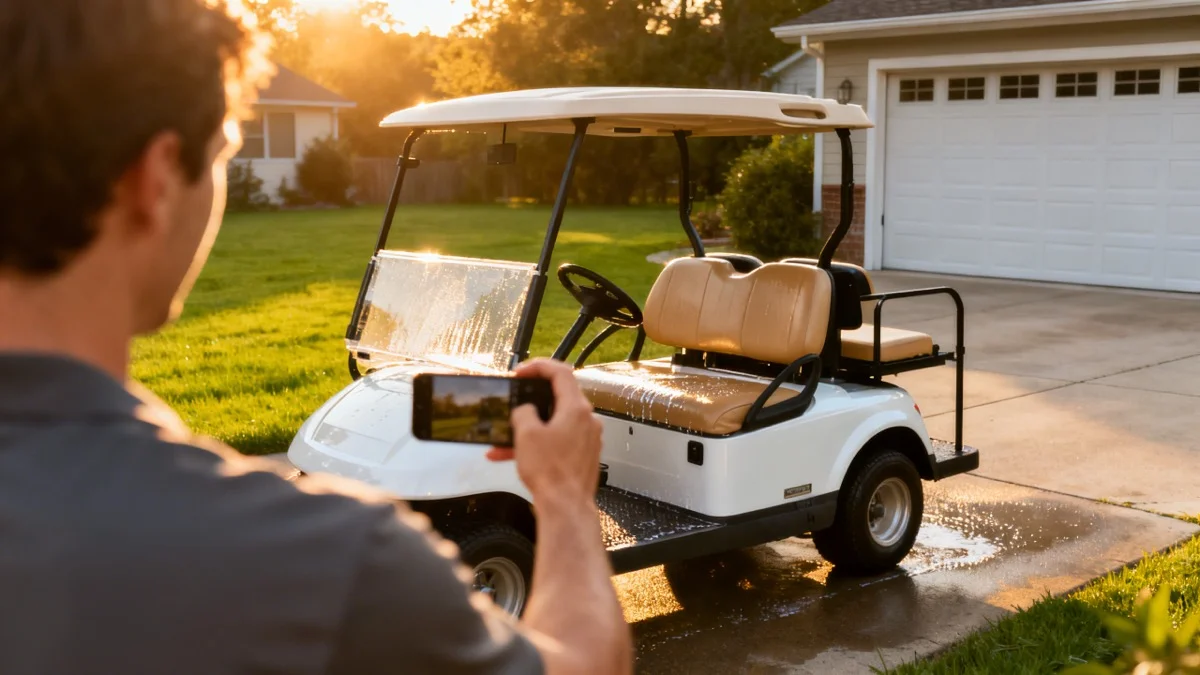
Clean white golf cart with a for sale sign on a driveway being photographed with a smartphone

As an Amazon Associate, we earn from qualifying purchases. This helps support our site at no extra cost to you.

Selling a golf cart is not like selling a car. There is no Kelley Blue Book, no Carfax report, and most carts do not even have titles. That means pricing is part research, part art, and the difference between a good sale and a great one often comes down to preparation.

This guide walks you through every step: figuring out what your cart is worth, timing the sale, prepping the cart to look its best, writing a listing that attracts serious buyers, and handling the transaction safely. Follow these steps and you can realistically get 20-30% more than a dealer trade-in offer.

Private Sale Premium 20-30% more than dealer

Peak Season April - June

Used Cart Range $2,000 - $8,000+

Seasonal Bonus 10-15% higher in spring

Step 1: Know What Your Cart Is Worth

Before you set a price, you need a realistic baseline. Golf cart values depend on five main factors: brand, age, condition, battery health (for electric carts), and your local market.

Brand matters more than you think. Club Car holds its value better than any other brand, retaining 70-80% of its original price after three years and 60-70% after five years. Yamaha is a close second at 65-75% after three years. EZGO and other brands depreciate faster, typically retaining 50-65% after three years.

Battery health is the biggest variable for electric carts. A cart with strong, recent batteries is worth $800-1,500 more than one with weak or dead batteries. If your batteries are more than 4-5 years old (lead-acid) or showing signs of reduced range, factor that into your pricing. For details on battery condition and lifespan, see our batteries guide.

Location affects pricing significantly. If you are in Florida, Arizona, the Carolinas, or any golf cart community, prices run higher because demand is strong year-round. Northern and rural markets typically sell for 15-20% less.

Use our free tools to get a number. Our golf cart value calculator gives you an instant estimate based on your cart's details. For a deeper breakdown, read our complete value guide which covers depreciation curves by brand, age, and condition.

General price ranges for used carts:

AgeConditionTypical Selling Price
1-3 yearsGood to excellent$5,000 - $8,000+
3-5 yearsGood$4,000 - $6,500
5-8 yearsFair to good$2,500 - $4,500
8-10+ yearsRunning$2,000 - $3,000

These are ballpark figures. Your specific cart may be worth more (recent batteries, upgrades, popular model) or less (cosmetic damage, dead batteries, high hours).

Step 2: Time Your Sale Right

Timing your sale correctly can add 10-15% to your final price.

Peak selling season is April through June. Buyers start shopping in late spring as warm weather arrives and they want a cart for summer. Demand peaks, inventory drops, and you have more negotiating power.

Avoid selling in early spring (February-March). This is when dealers flood the used market with trade-ins from new cart purchases. The surplus of inventory pushes prices down.

Worst time to sell: November through January. Demand drops as cold weather sets in (except in Florida and Arizona). If you must sell in winter, expect to discount 10-15% from peak season prices.

Best strategy: List your cart in late March or early April. You catch the early wave of spring buyers before the summer rush brings more competition from other sellers.

Step 3: Prep Your Cart to Sell

Buyers pay a premium for clean, well-maintained carts. A cart in excellent condition can sell for 25-30% more than the same cart in fair condition. Spend a few hours on prep before listing.

Deep clean everything. Wash the body, scrub the seats, clean the dashboard and cup holders, wipe down the windshield, and detail the wheels. Remove any personal items, stickers, or aftermarket accessories you want to keep. A clean cart photographs better and signals to buyers that the cart has been cared for.

Check and top off the batteries. For lead-acid batteries, check water levels and top off with distilled water. Clean any corrosion from the terminals. Fully charge the cart so the buyer can test drive it. If your batteries are marginal, be upfront about it in the listing rather than letting the buyer discover it during a test drive.

Fix small issues. Replace burned-out lights, tighten loose mirrors, patch small tears in the seat covers, and inflate the tires to the correct pressure. These $10-50 fixes prevent buyers from using minor issues as negotiation leverage.

Gather your documentation. Pull together your original purchase receipt, any maintenance records, the charger manual, and the serial number. If you have receipts for battery replacements or upgrades, those add credibility. For title documentation, see our titles and registration guide.

Step 4: Take Great Photos

Your photos are your first impression. Bad photos attract low-ball offers. Good photos attract serious buyers willing to pay asking price.

Take 15-20 photos minimum. Cover every angle:

  • Front, rear, driver side, passenger side (full cart views)
  • Dashboard and gauges (odometer/hour meter if available)
  • Seats (show condition, any wear or tears)
  • Tires (close-up showing tread depth)
  • Batteries (open the seat and show the battery compartment)
  • Charger
  • Serial number plate
  • Any upgrades (lift kit, lights, speakers, rear seat)
  • Any damage or wear (be transparent)

Shoot in natural daylight. Late morning or late afternoon light works best. Avoid shooting in a dark garage or in harsh midday shadows. A clean driveway or green lawn makes the best background.

Clean the cart first. This sounds obvious, but dirty carts in photos cost sellers hundreds of dollars in perceived value.

Step 5: Write a Listing That Sells

A detailed, honest listing attracts serious buyers and filters out time-wasters. Here is what to include:

Essential information:

  • Make, model, and year (e.g., "2019 Club Car Onward 48V Electric")
  • Electric or gas
  • Battery type and age (e.g., "6 Trojan T-105 lead-acid batteries, replaced March 2024")
  • Charger details (brand, voltage, included or not)
  • Seating capacity
  • Any upgrades or modifications (lift kit, lights, tires, rear seat, windshield, etc.)
  • Known issues or cosmetic flaws
  • Reason for selling
  • Asking price

Write like a buyer thinks. Buyers search for specific terms like "Club Car Onward," "48V," "lithium," "lifted," or "street legal." Include these keywords in your title and description so your listing shows up in searches.

Be honest about condition. Listing known issues upfront builds trust and saves you from wasted showings. Buyers who arrive expecting perfection and find problems will lowball you. Buyers who know what they are getting make faster decisions.

Step 6: Choose Where to Sell

Facebook Marketplace

Best for most sellers. Facebook Marketplace has the largest audience, free listings, and buyer profiles you can check before meeting. You can also post in local golf cart groups and community buy/sell groups for extra visibility.

Tips: Enable the "shipping available" option even if you only plan to sell locally, as it puts your listing in front of more people. Respond to messages quickly since buyers often message multiple sellers and go with whoever replies first.

Craigslist

Still works but attracts more scammers and lowballers than Facebook. Useful as a secondary listing. Always include photos and be specific about payment terms in the ad. Avoid responding to any buyer who wants to pay via check or money order without seeing the cart in person.

Golf Cart Specific Marketplaces

Sites like GolfCartSellers.com and GolfCartResource.com offer free or low-cost listings targeted at golf cart buyers specifically. Lower traffic than Facebook but higher-intent buyers.

Local Community Boards

If you live in a golf cart community, post on your HOA bulletin board, community Facebook group, or neighborhood app (Nextdoor). Buyers in golf cart communities often pay premium prices because they need a cart and want to buy locally.

Dealer Trade-In

The fastest option but the lowest payout. Dealers typically offer 20-30% below private market value. A cart worth $5,000 privately might get a $3,500-4,000 dealer offer. Trade-ins make sense when you are buying a new cart from the same dealer and want to simplify the transaction. Find local dealers on our dealer directory.

Step 7: Price It Right

Pricing strategy matters. Too high and your listing sits for weeks. Too low and you leave money on the table.

Research comparable listings. Search Facebook Marketplace and Craigslist in your area for the same make, model, and approximate year. Note what similar carts are listed at (not necessarily what they sold for, but the asking prices give you a range).

Price 5-10% above your target. If you want $5,000, list at $5,250-5,500. This gives you room to negotiate. Most buyers expect to negotiate, and arriving at your target price after a small concession makes them feel like they got a deal.

Use specific numbers. List at $5,250 rather than $5,000. Specific prices suggest you have calculated the value carefully. Round numbers invite aggressive negotiation.

Consider "OBO" (Or Best Offer). Adding "OBO" signals that you are open to negotiation, which attracts more inquiries. If your cart is priced at market value or below, skip OBO and list at a firm price.

Adjust after two weeks. If you have not received serious inquiries after 14 days, your price may be too high. Drop 5-10% and relist with a refreshed description. The first two weeks are when your listing gets the most visibility on Facebook and Craigslist.

Step 8: Handle the Sale Safely

Golf carts are valuable, portable, and often sold in cash. Take basic precautions to protect yourself.

Accepting Payment

  • Cash is king. For sales under $3,000, cash is the simplest and safest option. Count it in front of the buyer.
  • Cashier's checks work for larger amounts but verify them at the issuing bank before releasing the cart.
  • Electronic transfers (Zelle, Venmo, bank wire) are convenient and traceable. Wait for confirmation before handing over the keys.
  • Never accept personal checks. They can bounce days after the sale.
  • Never accept overpayment. A buyer who offers more than asking price and asks you to refund the difference is running a scam.

Meeting Buyers

Meet at your home or a well-lit public location during daylight. Tell someone where you will be and when. If a buyer pressures you to meet in an unusual location or at odd hours, decline. Bring your phone and keep it charged.

Consider placing a small tracking device on your cart during the showing period in case a test drive goes sideways.

Apple AirTag (easy to hide on the cart frame) →

Creating the Bill of Sale

Every golf cart sale needs a bill of sale, even for untitled carts. Include:

  • Buyer and seller full names and addresses
  • Golf cart make, model, year, and serial number
  • Sale price (numbers and written out)
  • Date of sale
  • "Sold as-is" statement (protects you from warranty claims)
  • Signatures from both parties

Print two copies so both parties keep one. Free templates are available at eForms.com and LegalTemplates.net. For more on documentation and title transfers, see our titles and registration guide.

Upgrades Worth Making Before Selling

Not every upgrade pays for itself. Here is what is worth the investment and what to skip.

High-ROI Upgrades

New batteries (if yours are dead or weak). A set of 6V or 8V lead-acid batteries costs $600-1,000. New batteries can add $800-1,500 to your sale price and dramatically speed up the sale since dead batteries scare off many buyers. If your batteries are beyond saving, a lithium conversion ($1,500-2,500) adds even more value.

LED headlights and taillights. A basic LED light kit costs $200-400 installed and adds $150-300 to your sale price. More importantly, lights make your cart look modern and attract a wider pool of buyers who want to drive at dusk.

Street-legal package. Adding headlights, turn signals, mirrors, a horn, and reflectors costs $300-800 total and can add $300-800 to your resale price. In golf cart friendly communities, a street-legal cart sells significantly faster. See our street-legal guide for the full equipment list.

Medium-ROI Upgrades

New tires. If your tires are bald or cracked, replacing them ($200-400 for a set) improves the cart's appearance and test drive experience. Buyers notice tires.

Seat covers. If your seats are torn or stained, new seat covers ($100-200) make the cart look dramatically better in photos for a small investment.

Skip These Before Selling

Custom paint or wraps. Highly personal and rarely recovered at resale. A buyer who hates your color choice will deduct the cost of repainting.

Expensive sound systems. Remove them and sell separately if possible. Most buyers do not value speakers at the installed cost.

Lift kits (if not already installed). A lift kit costs $300-1,000 installed. You will recover some of this at resale but rarely the full amount. Only install one if you plan to enjoy it before selling.

Trading In vs Selling Privately: When Does a Dealer Make Sense?

Selling privately gets you more money. But dealer trade-ins have their place.

Choose a dealer trade-in when:

  • You are buying a new cart from the same dealer (they may offer a better trade-in value to close the new sale)
  • You need to sell quickly and do not have time to list, show, and negotiate
  • Your cart needs significant work (bad batteries, body damage) and you do not want to invest in repairs
  • The hassle of private selling is not worth the extra $500-1,500

Choose private sale when:

  • You want the maximum sale price (20-30% more than dealer offers)
  • Your cart is in good condition and will photograph well
  • You have 2-4 weeks to manage the listing and showings
  • You are comfortable negotiating and handling the paperwork

If you are shopping for a replacement, browse our dealer directory to find local options. Our pricing guide covers what to expect for new and used carts across all major brands, and our budget guide highlights the best values for buyers on a budget.

If you are looking at new carts, the AODES E-TrailCross and Kandi GOAT 2P are two of the best values available online right now.

AODES E-TrailCross: 4-passenger LSV at $7,249 → Kandi GOAT 2P: Premium 2-seater at $7,999 →

Quick Checklist: Before You List

Use this checklist to make sure you have covered everything before publishing your listing:

  • Researched comparable listings and set a price
  • Deep cleaned the cart (body, seats, wheels, dashboard)
  • Checked battery water levels and fully charged the cart
  • Fixed minor issues (lights, mirrors, tire pressure, loose parts)
  • Gathered documentation (serial number, purchase receipts, maintenance records)
  • Taken 15-20 high-quality photos in natural light
  • Written a detailed, honest listing with all specs
  • Prepared a bill of sale template
  • Decided on accepted payment methods

Frequently Asked Questions

How much is my golf cart worth?

Used golf carts typically sell for $2,000-$8,000 depending on age, brand, and condition. A 3-5 year old Club Car or Yamaha in good condition sells for $4,000-$7,000. Use our golf cart value calculator for a personalized estimate based on your specific cart.

Where is the best place to sell a golf cart?

Facebook Marketplace is the best option for most sellers. It has the largest audience, free listings, and buyer profiles you can verify. Post in local golf cart groups and community pages for extra visibility. Craigslist works as a secondary listing but attracts more lowball offers.

When is the best time to sell a golf cart?

Late spring through early summer (April through June) is peak selling season. Buyers start shopping as warm weather arrives. Expect 10-15% higher prices compared to fall or winter. List in late March or early April to catch the first wave of spring buyers.

How do I sell a golf cart without a title?

Most golf carts do not have titles, so selling without one is normal. Create a bill of sale with the make, model, year, serial number, price, date, and signatures from both parties. This document serves as the buyer's legal proof of ownership. See our titles and registration guide for full details.

Should I sell to a dealer or privately?

Selling privately gets you 20-30% more. A cart worth $5,000 on the private market might get $3,500-4,000 from a dealer. Dealer trade-ins are faster and easier, so they make sense when you value your time over maximum price or when the cart needs significant repairs.

What upgrades increase resale value?

The highest ROI upgrades are new batteries (adds $800-1,500), LED lighting (adds $150-300), and street-legal packages (adds $300-800). A lithium battery conversion adds the most value at resale. Avoid expensive cosmetic customizations that reflect personal taste.

How many photos should I include in my listing?

Take at least 15-20 photos covering every angle: front, rear, sides, dashboard, seats, tires, batteries, charger, serial number plate, and any upgrades or damage. Shoot in natural daylight after cleaning the cart. More photos mean fewer questions from buyers and faster sales.

How do I avoid scams when selling a golf cart?

Accept cash, verified cashier's checks, or electronic transfers only. Never accept personal checks or overpayments. Meet in well-lit locations during daylight. Do not release the cart until payment is confirmed. Be cautious of any buyer who wants to complete the transaction without seeing the cart first.

Share this post

Golf Cart Search

Find the Best Golf Carts of 2026

Compare top-rated models, read expert reviews, and find the perfect cart for your needs.
Related posts

Don't Overpay for a Used Golf Cart

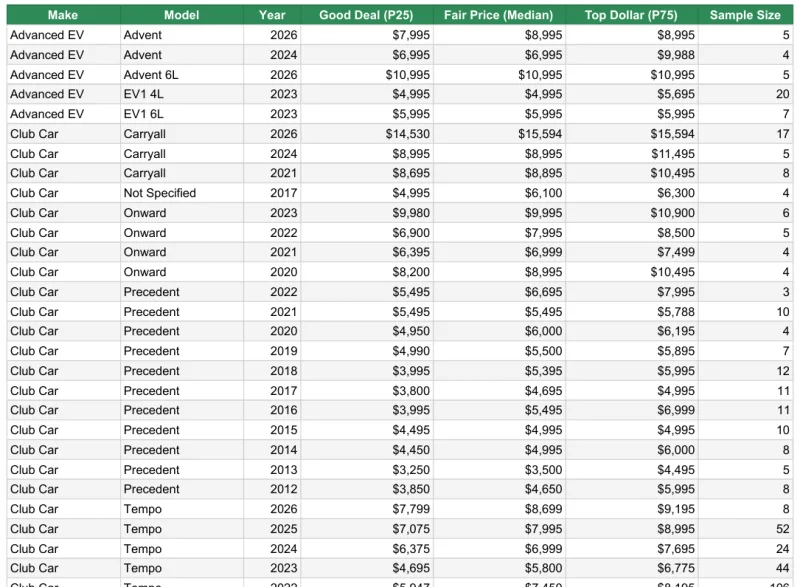
For less than the cost of a tank of gas, you get pricing data from 2,288 listings, a 28-page guide, and a printable inspection checklist. Avoid one bad deal and it pays for itself 100x over.

Get the Buyer's Toolkit
Secure checkoutInstant delivery30-day guarantee