
Golf Cart Trade-In vs Private Sale (2026)

Compare golf cart trade-in value vs private sale in 2026. See dealer offer ranges, private-sale premiums, tax caveats, and when each option wins.

Michael
Michael
Apr 21st, 202611 min read
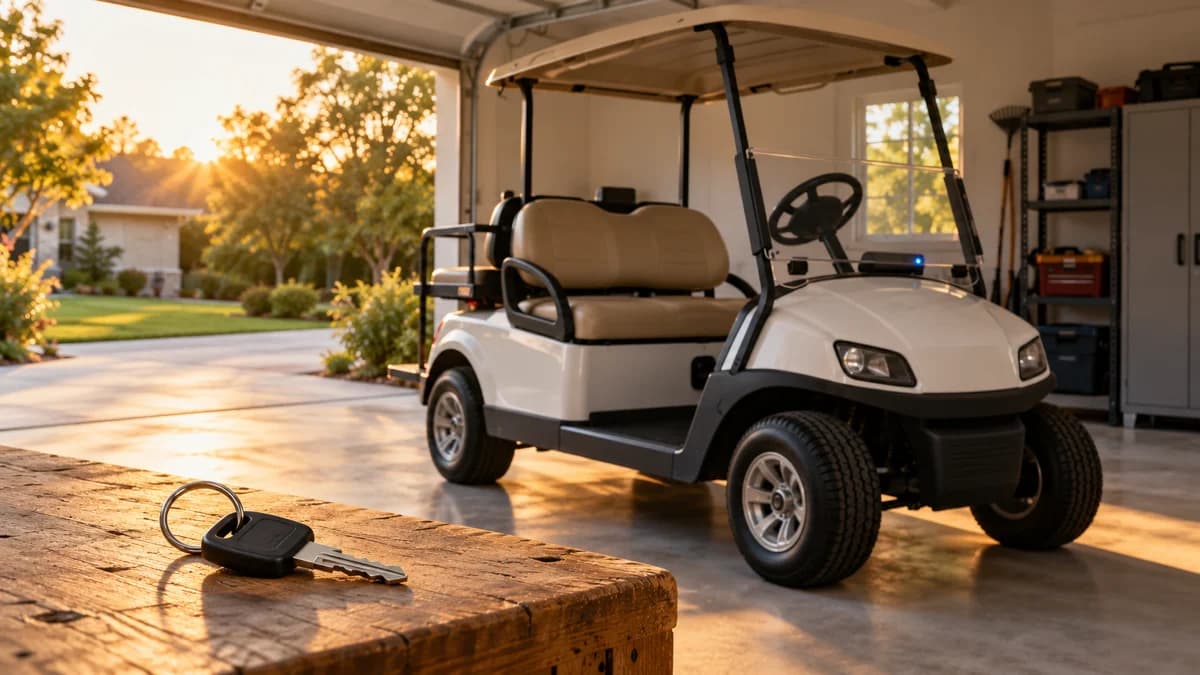
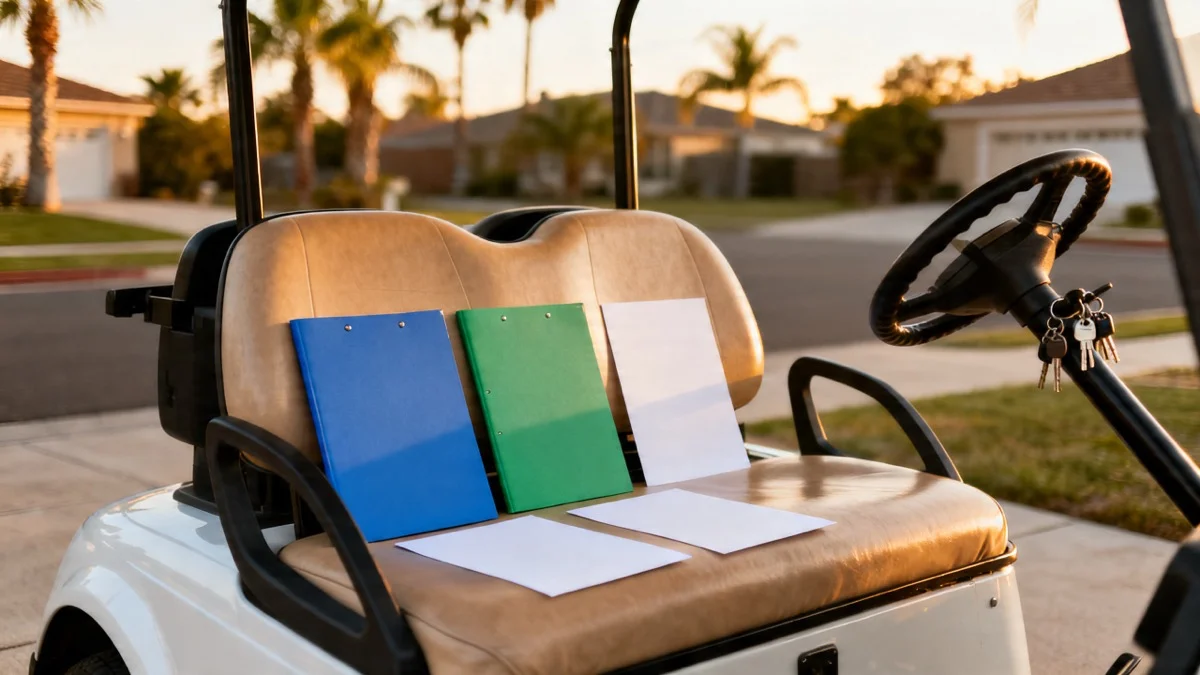
Golf cart keys, trade-in paperwork, and private-sale bill of sale on the seat of a white golf cart

As an Amazon Associate, we earn from qualifying purchases. This helps support our site at no extra cost to you.

The golf cart trade-in value vs private sale decision comes down to one question: is the extra money worth the extra work?

For most clean carts, a private sale brings about 20-30% more than a dealer trade-in. That sounds like an easy answer until you factor in messages, no-shows, test drives, payment risk, paperwork, and the possibility that your old batteries or missing documents turn into a negotiation fight.

This guide is the decision framework. For raw value estimates, use our golf cart value calculator. For brand depreciation, use our golf cart depreciation by brand guide. For the full listing process, read our how to sell your golf cart guide. This post focuses on which exit path actually puts you in the best position.

20-30% Typical private-sale premium over trade-in

70-80% Common trade-in range vs private value

Same day Normal dealer trade-in timeline

1-4 weeks Common private-sale timeline for a clean cart

Quick Answer: Trade-In or Private Sale?

If your cart is clean, documented, and easy to test drive, sell it privately. If your cart has problems, weak batteries, missing paperwork, or you are already buying another cart from a dealer, trade-in can make sense.

SituationBetter ChoiceWhy
Clean Club Car, EZGO, or Yamaha with good batteriesPrivate saleBroad buyer demand and strong resale
Weak or dead lead-acid batteriesTrade-in or discounted private salePrivate buyers will use battery cost against you
Buying a new cart from the same dealerTrade-inSimpler transaction and possible deal leverage
Need the money this weekTrade-inSame-day certainty beats waiting
Cart is titled as an LSV with clean paperworkPrivate saleRoad-ready carts can attract serious buyers
Missing title on a cart that should have oneDealer evaluation firstPrivate sale can become a paperwork problem
Custom cart with niche stylingPrivate sale, but expect timeNeeds the right buyer
Older running cart under $3,000Private saleDealer margin may make the trade offer too low

The simplest math is this:

Private-sale value minus trade-in offer equals the price of convenience.

If that difference is $500, a trade-in might be worth it. If the difference is $2,000, you need a strong reason to avoid private sale.

Golf Cart Trade-In Value vs Private Sale Examples

Use these examples as a sanity check before you accept a dealer offer.

Realistic Private-Sale ValueFair Trade-In RangeConvenience Cost
$3,500$2,450-$2,800$700-$1,050
$5,000$3,500-$4,000$1,000-$1,500
$6,500$4,550-$5,200$1,300-$1,950
$8,000$5,600-$6,400$1,600-$2,400
$10,000$7,000-$8,000$2,000-$3,000

These are not dealer promises. They are realistic ranges for a clean cart where the dealer can recondition and resell it. A rough cart can trade lower. A dealer desperate for used inventory may pay higher. A dealer trying to close a new Club Car, EZGO, Yamaha, ICON, or Star EV sale may improve the trade allowance to win the whole deal.

Custom Golf Carts Columbia gives a dealer-side version of the same logic, saying trade-in value must leave room for dealer profit and estimating a trade allowance roughly one-fourth to one-third below what a dealer might retail the used cart for. The exact spread changes by market, but the business model is the same: the dealer is buying wholesale and selling retail.

Why Dealer Trade-In Offers Are Lower

A dealer is not trying to pay private-sale money because they are not buying as an end user. They have to turn the cart back into sellable inventory.

The trade-in spread covers:

  • pickup or transport
  • inspection time
  • battery testing or replacement
  • tire, brake, charger, and wiring issues
  • detailing and photos
  • sales staff time
  • listing and floor space
  • warranty or goodwill risk after resale
  • profit

That does not mean every low offer is fair. It means you should judge the offer against the dealer's real work. A clean 3-year-old lithium EZGO ELiTE should not be discounted like a 15-year-old cart with dead lead-acid batteries. A rusty steel-frame cart from a coastal market should not expect the same trade number as a clean aluminum-frame Club Car Onward.

If you want the brand-retention side before negotiating, read the depreciation guide and the used price guide first.

When a Trade-In Is the Better Move

Trade-in is not automatically the lazy option. Sometimes it is the rational option.

You Are Buying Another Cart

If you are buying from a dealer, the trade-in can simplify the whole transaction. You avoid listing photos, buyer messages, test drives, and payment risk. You also create another negotiation lever.

The important move is to separate the numbers:

  1. Get the new cart's selling price.
  2. Ask for the full out-the-door quote.
  3. Then ask for the trade-in allowance.
  4. Compare the final difference.

Do not let a dealer hide a weak trade offer inside a monthly payment. Our dealer fees guide and financing guide explain why the total number matters more than the payment.

The Cart Needs Work

Private buyers punish uncertainty. If your cart has weak batteries, worn brakes, a bad charger, intermittent electrical problems, missing keys, or a questionable serial number, private sale becomes slower and more stressful.

A dealer may still discount heavily, but at least the problem is handled in one transaction. This matters most when the cart needs a repair that could trigger buyer complaints after sale.

You Have Paperwork Risk

Most standard golf carts transfer with a bill of sale and serial number. But if the cart is titled as an LSV, registered for road use, or missing a title it should have, slow down.

A private buyer may not understand the paperwork path, and a seller can accidentally create a mess by promising that a cart is "street legal" when it is really just accessorized. Use our ownership transfer guide, titles and registration guide, and registration by state guide before you advertise anything as title-ready.

Your Time Is Worth More Than the Spread

Private sale is not free. Even if listings cost nothing, you still spend time.

Expect:

  • 1-2 hours cleaning and photographing
  • 1 hour researching comparable listings
  • 2-5 hours answering messages
  • 1-3 showings before a serious buyer
  • payment and bill-of-sale coordination
  • possible re-listing if the first buyer flakes

If the private-sale premium is $2,000, that work may be easy to justify. If the premium is $500 and you are already at the dealer buying a new cart, trade-in can be the better deal.

When Private Sale Is Worth the Work

Private sale usually wins when the cart is easy to explain and easy to trust.

Strong Brands Bring Strong Private Demand

Clean Club Car, EZGO, and Yamaha carts are the easiest to sell privately because buyers recognize the names and local shops know how to service them.

The same can be true for ICON, Star EV, and Advanced EV where dealer support is strong. The more local confidence a buyer has, the less you need a dealer in the middle.

Fresh Batteries Make the Listing Easier

Battery condition is the biggest private-sale objection on electric carts. A buyer might love the cart but still ask for $1,000 off if the batteries are 5 years old.

If your cart has recent lead-acid batteries, factory lithium, or a clean lithium conversion, put that near the top of the listing. Include receipts if you have them. If you are not sure what shape the batteries are in, test them before listing.

For a basic pre-sale check, a digital multimeter and a battery hydrometer can help you document lead-acid condition before a buyer shows up. If the pack is clearly failing and you plan to keep the cart another year or two, compare replacement options in our battery guide and lithium conversion guide.

Check EXEFCH 51.2V Lithium Battery Price

Local Golf Cart Communities Pay More

Private sale is strongest where buyers already understand carts: The Villages, Peachtree City, Sun City communities, beach towns, resort areas, campgrounds, and golf-course neighborhoods.

In these markets, a clean cart can sell quickly because buyers want local convenience and may already know what a Club Car Precedent, EZGO RXV, Yamaha Drive2, or ICON i40 should cost.

If you are in a thin rural market, the private-sale premium can shrink. You may still get more than trade-in, but it may take longer.

The Tax Credit Question Sellers Get Wrong

Dealers sometimes mention sales-tax savings when you trade in. That can be real in some vehicle transactions, but it is not safe to assume for every golf cart.

Ask three questions:

  1. Is this cart being treated as a titled vehicle, LSV, NEV, or ordinary personal cart?
  2. Does my state or locality allow a trade-in credit for this type of sale?
  3. Can the dealer show the tax calculation on the written quote?

If the tax benefit is real, compare net numbers:

Private SaleTrade-In OfferPossible Tax BenefitNet Trade Comparison
$6,500$5,000$350Trade still trails by $1,150
$6,500$5,800$350Trade trails by $350
$6,500$6,100$350Trade is close enough to consider

The tax benefit rarely saves a bad trade offer by itself. It can, however, make a close trade offer worth taking if you also value convenience.

How to Negotiate Trade-In Value

The biggest mistake is negotiating only the trade allowance. Dealers can move money between line items. A high trade number can be offset by a higher cart price, prep fee, delivery fee, accessory package, or financing markup.

Use this process:

  1. Get a clean quote on the new cart without your trade.
  2. Ask for the full out-the-door number.
  3. Ask what they will offer for your trade as a separate number.
  4. Ask if the trade affects tax, title, or registration.
  5. Compare the total difference to at least one other dealer.

Bring proof:

  • model year or serial number
  • battery age and receipts
  • charger details
  • service records
  • photos of the battery compartment and underside
  • list of accessories that stay with the cart
  • title, MCO/MSO, permit record, or bill of sale if relevant

If a dealer says the cart is worth very little because it needs work, ask what work they are assuming. A vague "it needs reconditioning" is different from a specific "the batteries are weak, tires are dry-rotted, and the charger is mismatched."

How to Sell Privately Without Losing Your Mind

Private sale works best when you remove uncertainty before buyers ask.

Price the Cart Correctly

Start with the value calculator, then compare active local listings. Do not just copy the highest asking price. Overpriced listings sit for weeks and make the market look stronger than it is.

Good listing price rule:

  • list 5-10% above your target number if you expect negotiation
  • list firm if your price is already fair
  • reduce after 10-14 days with no serious messages

If you are selling in spring, check our best time to buy a golf cart guide because seasonal demand and trade-in supply move together.

Write the Listing Like a Buyer

Include:

  • brand, model, year, and serial number status
  • gas, lead-acid electric, or lithium electric
  • battery age and charger included
  • seats and passenger capacity
  • street-legal equipment, if any
  • known issues
  • title or bill-of-sale status
  • reason for selling

Use specific terms buyers search for, such as "Club Car Onward 4 passenger," "EZGO RXV ELiTE," "Yamaha Drive2 gas," "ICON i40 lithium," or "48V with new batteries."

Control the Test Drive

Meet in daylight. Keep the route short. Hold the buyer's driver license or car keys during the test drive if you are comfortable doing so. Do not let someone take the cart alone.

If you are worried about a test drive disappearing, a small tracker like an Apple AirTag can be hidden on the cart during the selling period. It is not a substitute for common sense, but it is cheap backup.

Use Safe Payment Rules

The FTC warns that check overpayment scams target people selling cars and other valuable items through classified ads and online marketplaces. The pattern is simple: the buyer sends more than the price, asks you to refund the difference, and the original check later fails.

For golf carts:

  • avoid overpayment checks
  • avoid buyers who want to ship without seeing the cart
  • meet in person when possible
  • verify cashier's checks at the issuing bank before releasing the cart
  • use traceable electronic payment only after confirming funds
  • never refund money from a check that has not truly cleared

If the buyer adds urgency, strange pickup arrangements, or payment complexity, move on. There are plenty of local buyers for clean carts.

Paperwork: Trade-In vs Private Sale

Trade-in paperwork is easier because the dealer handles most of it. Private sale requires you to be more careful.

For a standard untitled golf cart, use a bill of sale. eForms describes a golf cart bill of sale as proof of ownership after purchase and recommends signing only after payment is made in full. The document should include:

  • buyer and seller names
  • addresses and contact info
  • make, model, and year if known
  • gas or electric
  • serial number or VIN
  • battery voltage or engine size
  • sale price
  • date
  • as-is language
  • signatures

If the cart is an LSV, NEV, or otherwise titled vehicle, do not rely on a basic bill of sale alone. Complete the title transfer according to your state process. If a local golf cart permit or decal is involved, confirm whether it transfers or must be cancelled.

Use our ownership transfer guide for the full titled vs untitled process.

Decision Formula: The Real Break-Even Point

Use this formula:

Private-sale price minus trade-in offer minus expected prep cost minus your time value equals the real private-sale advantage.

Example:

  • private-sale estimate: $7,000
  • dealer trade offer: $5,500
  • cleaning, small fixes, and listing costs: $150
  • your time value: $400
  • real private-sale advantage: $950

That $950 is the actual question. If $950 is worth the hassle, sell privately. If not, trade it.

Now compare a larger spread:

  • private-sale estimate: $9,000
  • dealer trade offer: $6,300
  • prep cost: $200
  • time value: $500
  • real private-sale advantage: $2,000

In that case, private sale is probably worth the work unless the cart has paperwork or repair risk.

Final Recommendation

Choose private sale if:

  • your cart is clean and running well
  • batteries are strong or recently replaced
  • you have receipts and paperwork
  • you can wait 1-4 weeks
  • the private-sale premium is at least $1,000
  • you are comfortable handling payment and test drives

Choose trade-in if:

  • you are buying from the same dealer
  • the trade offer is within 10-15% of private-sale value
  • the cart has repairs you do not want to handle
  • the batteries are weak and buyers will negotiate hard
  • paperwork is complicated
  • you value same-day certainty more than top dollar

For most sellers, the best path is to get both numbers. Price the cart privately, ask one or two dealers for trade-in offers, and compare the true spread. Do not guess. A clean used golf cart is valuable enough that the difference is often real money.

FAQ

What is the fastest way to sell a golf cart?

Dealer trade-in is usually fastest, especially if you are buying another cart. You can often finish the deal the same day. Private sale usually brings more money but can take days or weeks.

What is the most profitable way to sell a golf cart?

Private sale is usually most profitable. You sell closer to retail value instead of wholesale value, which often adds 20-30% versus trade-in.

How much lower is dealer trade-in than private sale?

Dealer trade-in is commonly 20-30% lower than private sale. A $6,000 private-sale cart might receive a $4,200-$4,800 trade-in offer.

Should I clean my golf cart before trade-in?

Yes. Even if you trade it, wash the body, clean the seats, charge the batteries, and remove personal items. A clean cart signals lower reconditioning risk.

Should I fix problems before selling privately?

Fix cheap, visible problems such as burned-out lights, low tire pressure, loose mirrors, and dirty battery terminals. Think carefully before spending thousands on batteries, controllers, or cosmetic work right before sale.

Can I sell a golf cart without a title?

Often yes for standard golf carts, because many do not have titles. Use a detailed bill of sale and serial number. If the cart is an LSV or titled vehicle, handle the title transfer properly.

Is a dealer trade-in offer negotiable?

Yes, but negotiate the total deal. A dealer can raise the trade allowance while increasing fees elsewhere. Compare the out-the-door price with and without your trade.

Is consignment better than trade-in?

Consignment can bring more than trade-in with less work than private sale, but it takes longer and the dealer keeps a fee or commission. It can be a good middle path for higher-value carts.

What hurts golf cart trade-in value most?

Weak batteries, rust, missing charger, worn tires, bad brakes, damaged seats, unclear model year, missing paperwork, and hard-to-support brands all hurt trade-in value.

Should I accept cash for a private golf cart sale?

Cash can work for lower-priced sales if counted carefully. For higher-priced carts, many sellers prefer meeting at the buyer's bank for a cashier's check or verified transfer before releasing the cart.

Share this post

Golf Cart Search

Find the Best Golf Carts of 2026

Compare top-rated models, read expert reviews, and find the perfect cart for your needs.
Related posts

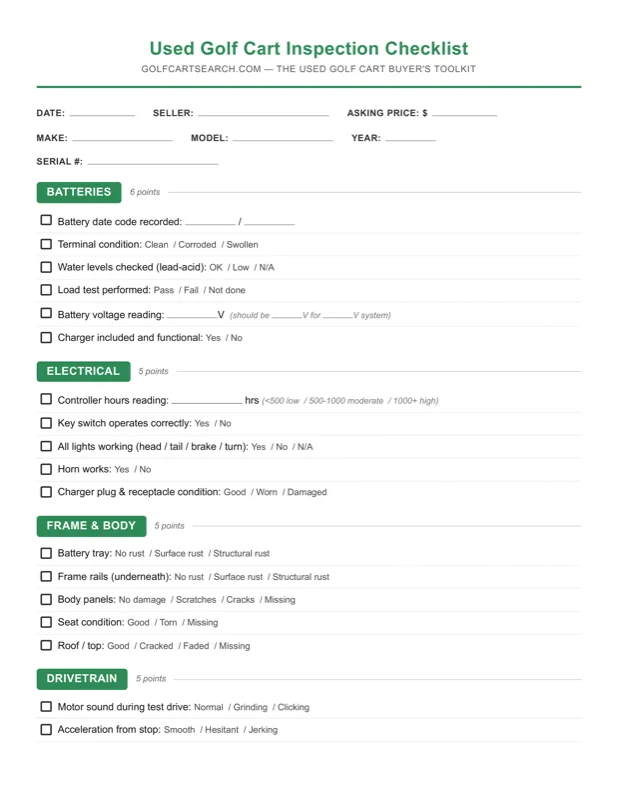
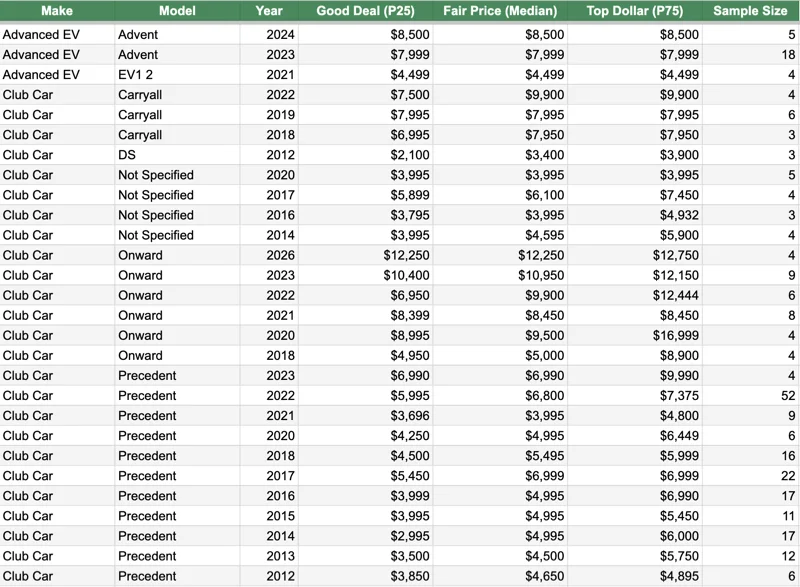
Don't Overpay for a Used Golf Cart

Get pricing data, a printable inspection checklist, and negotiation scripts to help you buy with confidence.

Get the Buyer's Toolkit
Pricing dataInspection checklistNegotiation scripts

Instant download. 30-day guarantee.