
As an Amazon Associate, we earn from qualifying purchases. This helps support our site at no extra cost to you.
Quick Answer: Are Kandi Golf Carts Any Good?
Yes, Kandi golf carts can be good value if you buy the right model from a responsive dealer and confirm local service before paying. The current Kruiser line combines lithium power, useful standard equipment, and starting prices from $8,499. The trade-offs are a 12-month vehicle warranty, less predictable resale, and a shorter long-term reliability record than Club Car, EZGO, or Yamaha.
Kandi golf cart reviews tend to split buyers into two camps. One side sees a lot of equipment for the money. The other sees a newer value brand with less ownership history and a thinner service network than Club Car, EZGO, or Yamaha. Both views contain some truth.
I rechecked Kandi's official lineup and warranty documents on July 18, 2026. The current core range is the Kruiser Element, 4Pro, 4Pro Fwd, and 6Pro. Kandi's owner-manual library now places the GOAT 2P and Collapsible Mini under legacy vehicles, although those models may still appear in remaining dealer, marketplace, or used inventory.
The real buying decision comes down to support: who will service the cart, whether the seller qualifies for warranty coverage, and whether the model actually matches your speed, range, and seating needs. This guide covers current Kandi prices, reviews by model, recurring complaint themes, warranty fine print, and when a Kandi is worth buying. Owners choosing windshields, enclosures, covers, hitches, or running boards should use our Kandi Kruiser accessory fitment guide.
If you are weighing Kandi against the whole import category, our Chinese golf cart guide separates direct-buy carts from dealer-backed value brands and compares both against used Big 3 alternatives.
U.S. Operations 2018 launch
Price Range $8,499 to $13,999
Best Current Model Kruiser 4Pro
Published Warranty 12-month cart / 36-month lithium
Kandi Golf Cart Reviews: Quick Verdict
If you want a feature-rich lithium cart for neighborhood trips, property work, or recreation without legacy-brand pricing, Kandi is worth considering. The current $9,999 Kruiser 4Pro is the best overall balance of price, range, equipment, and four-seat flexibility. The $8,499 Element is the budget pick, and the 4Pro Fwd is the better family layout when all four passengers need to face forward.
| Buyer question | Kandi verdict |
|---|---|
| Are Kandi golf carts good? | Good value with strong local support; weaker resale and ownership history |
| Best Kandi for most buyers | Current Kruiser 4Pro |
| Best Kandi for lower cost | Current Kruiser Element |
| Best Kandi for forward seats | Current Kruiser 4Pro Fwd |
| Main complaints to check | Warranty handling, local service, parts access, delivery condition |
| Best reason to buy Kandi | Features and lithium range for the price |
| Best reason to skip Kandi | Resale and support are weaker than Club Car, EZGO, or Yamaha |
If you want the best long-term ownership experience, easiest parts sourcing, highest resale value, or the safest choice for daily neighborhood transportation, Kandi is harder to recommend than Club Car, EZGO, Yamaha, or even better-supported value brands on our best golf cart brands page.
My verdict: Kandi can be a smart value buy, but the dealer matters as much as the cart. Buy one when the local support plan is clear and the price gap is meaningful. Skip it when you would be depending on distant support for daily transportation.
If you are comparing Kandi against the wider market, see our guide to golf cart brands to avoid in 2026 for the broader checklist on dealer depth, warranty clarity, and resale risk.
Who Makes Kandi Golf Carts?
Kandi America is the U.S. business of Kandi Technologies Group. Its U.S. support operation is based in Dallas, Texas. Kandi previously leaned heavily on big-box and marketplace exposure, but its current official site puts more emphasis on authorized dealers, service centers, test drives, parts, and local support.
That shift is positive, but coverage still varies by market. Before buying, confirm three names and numbers: the selling dealer, the shop authorized to perform warranty repairs, and the source for model-specific parts. Kandi's warranty says covered repairs must be completed by an authorized dealer or service center.
If you are comparing Kandi with AODES and other shipped-direct listings, our golf carts on Amazon guide explains when online ordering is convenient and when it creates service headaches.
2026 Kandi Golf Cart Prices and Current Models
Kandi's current official golf cart lineup has four core choices. All use lithium batteries, electric power steering, backup cameras, and 120V charging. A 25 mph LSV configuration is available, but registration and road access still depend on state and local law.
| Current model | Seats | Battery | Top speed | Advertised range | Starting MSRP | Best for |
|---|---|---|---|---|---|---|
| Kruiser Element | 2+2 | 100Ah lithium | 20 mph, 25 mph LSV | 28 miles | $8,499 | Lowest current price |
| Kruiser 4Pro | 2+2 | 48V/150Ah lithium | 20 mph, 25 mph LSV | 40 miles | $9,999 | Best overall value |
| Kruiser 4Pro Fwd | 4 forward | 48V/150Ah lithium | 20 mph, 25 mph LSV | 40 miles | $10,999 | Forward-facing family use |
| Kruiser 6Pro | 4+2 | 48V/150Ah lithium | 20 mph, 25 mph LSV | 37 miles | $13,999 | Six-passenger transport |
These are manufacturer starting prices, not guaranteed dealer totals. Freight, assembly, LSV equipment, tax, registration, accessories, and dealer preparation can change the out-the-door quote. If you are comparing the full market, use our golf cart pricing guide and best golf carts under $10,000 roundup.
Kandi Golf Cart Reviews by Model
Kandi Kruiser Element Review: Best Current Budget Pick
The Kruiser Element is the lowest-priced model in Kandi's current lineup. At $8,499, it includes a 5,000W AC motor, 100Ah lithium battery, electric power steering, backup camera, hydraulic front disc brakes, and rear seats that fold into a cargo deck.
Its compromise is range. Kandi advertises 28 miles, compared with 40 miles for the 4Pro models. That can be enough for neighborhood errands and property use, but buyers with hills, frequent passenger loads, or long community routes should compare the 4Pro.
Kandi Kruiser 4Pro Review: Best Overall
The Kruiser 4Pro is the best current Kandi for most buyers. The extra $1,500 over the Element buys a 48V/150Ah lithium battery, 40-mile advertised range, 10-inch touchscreen, frunk storage, larger all-terrain tires, and a more complete equipment package.
It uses a 2+2 layout, so the rear bench can carry passengers or fold into a cargo deck. That makes it more versatile than the forward-facing version for buyers who haul coolers, tools, groceries, or yard supplies.
Kandi Kruiser 4Pro Fwd Review: Best Family Layout
The Kruiser 4Pro Fwd is the better choice when four adults need to face forward. It keeps the 5,000W motor, 48V/150Ah lithium battery, 40-mile advertised range, electric power steering, touchscreen, and backup camera, but uses a longer chassis with four forward-facing seats.
At $10,999, it costs $1,000 more than the standard 4Pro. Pay that premium for passenger comfort and conversation, not extra speed or range.
Kandi Kruiser 6Pro Review: Best for Six Passengers
The Kruiser 6Pro starts at $13,999 and adds a 6,500W motor, six-passenger seating, a 37-mile advertised range, frunk and trunk storage, and a longer chassis. It makes sense for large families, resorts, campuses, and property tours.
The price is the issue. At nearly $14,000 before delivery and options, compare the dealer, written warranty process, and resale outlook against better-established six-seat alternatives.
Legacy Kandi GOAT 2P and Collapsible Mini Reviews
Kandi's current owner-manual library lists the GOAT 2P and Collapsible Mini under legacy vehicles. They may still appear in marketplace, dealer, demo, or used inventory, so they remain relevant to shoppers, but do not assume they are part of the current core lineup.
The GOAT 2P uses a 5,000W motor, lithium battery, yoke steering, and bold two-seat styling. Its published 15.5 mph top speed makes it a recreational or private-property cart, not a direct substitute for a current 20 to 25 mph Kruiser. Its Amazon listing is currently unavailable, so any purchase would have to come through a dealer or used inventory.
The Collapsible Mini is the niche portability pick. Its folding design, 9 mph top speed, and 25-mile advertised range suit RV parks, campgrounds, marinas, and tight storage. Its Amazon listing is currently unavailable too, so check the seller and warranty position carefully through any remaining channel.
Best Online Alternative to Compare Against Kandi
If your plan is to buy a four-seat cart online, compare remaining Kandi marketplace inventory with the AODES Trailcross. Compare the live seller, battery, delivered price, local service, and registration paperwork rather than choosing on the product photo alone. Note that the Trailcross is no longer listed on Amazon either.
What Kandi Gets Right
1. Kandi keeps current-model pricing competitive
This is the biggest advantage. The current Element starts at $8,499, and the longer-range 4Pro starts at $9,999. Both include lithium power, electric power steering, a backup camera, lighting, mirrors, seat belts, and hydraulic brakes. That is a strong standard-equipment list for the price.
2. Kandi serves niches the Big 3 mostly ignore
The legacy Collapsible Mini is the best example. Club Car, EZGO, and Yamaha do not really have an answer for a foldable mini-cart buyer. The current Element and 4Pro also appeal to buyers who want a beach, campground, second-home, or property cart. See our best beach golf carts guide and farm and ranch golf carts guide for where these use cases matter.
3. The feature-per-dollar equation is hard to ignore
Electric power steering, lithium power, a backup camera, and road-equipment basics are standard across the current Kruiser range. Even if you are cautious about the brand, the equipment-to-price case is easy to understand.
4. Lithium options are easy to find
The current four-model Kruiser lineup uses lithium batteries. That removes the water checks and corrosion cleanup associated with older flooded lead-acid packs, although the battery still needs correct charging and storage. If you are comparing battery types, read our battery guide and range guide.
Kandi Golf Cart Problems: 5 Buyer Checks
Kandi does not publish a fleet-wide failure-rate study. The themes below come from public complaints, retailer reviews, and owner discussions, so use them as inspection and dealer-support questions rather than assuming every Kandi develops the same problems.
1. Older AGM battery performance
Some complaints about older Kandi carts describe AGM packs losing range or slowing under load. Kandi's current core lineup is lithium, so this concern matters most when shopping a used Kruiser 2P, 4P, or 6P with AGM batteries. Test the pack under load and budget for replacement instead of judging it only by resting voltage.
2. Warranty coverage is short and documentation matters
Kandi's published warranty lists 12 months for the vehicle, 36 months for lithium batteries, and 12 months for AGM batteries purchased on or after October 1, 2024. It also says warranty repairs must be completed by an authorized Kandi dealer or service center and that owners may need maintenance records for a claim.
There is also a used-cart ambiguity. Kandi's warranty PDF describes a transfer process with a $50 fee, while its current FAQ says second-hand units are excluded. Ask Kandi to confirm coverage for the exact VIN in writing before treating remaining warranty as part of a used cart's value.
3. Verify local authorized service
This is the most important practical check. Kandi says it has a growing nationwide dealer and service network, but local coverage is what matters. Call the nearest listed service center before buying and ask whether it services that exact model, handles warranty claims, and stocks common electrical and brake parts.
4. Check speed by exact model
The current Kruiser models run at 20 mph in standard form, with 25 mph LSV configurations available. Legacy models can be much slower: the GOAT 2P is listed at 15.5 mph and the Mini at 9 mph. Read the exact spec sheet before assuming every Kandi is a ready-made street-legal cart.
5. Inspect delivery condition and assembly
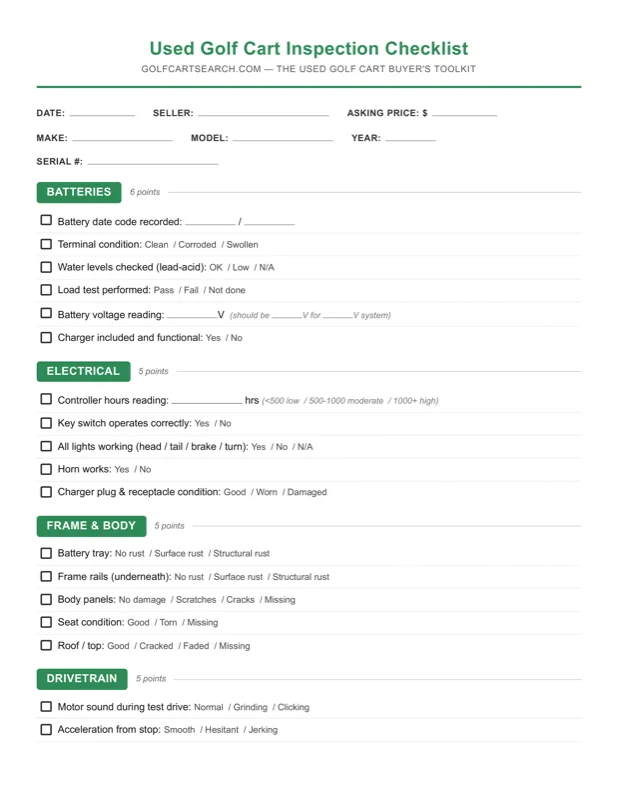
Public owner discussions mention loose hardware, trim alignment, and small delivery issues on some carts. That does not establish a brand-wide defect rate, but it makes a careful delivery inspection worthwhile. Check fasteners, brakes, lights, camera, charging, steering alignment, tire pressure, and body fit before accepting the cart.
Kandi vs Club Car, EZGO, Denago, AODES, and Used Carts
This is where the buying decision gets easier.
| Brand | Starting Point | Biggest Strength | Biggest Weakness | Best Buyer |
|---|---|---|---|---|
| Kandi | Low to mid | Features and lithium range for the price | Short vehicle warranty and uneven local coverage | Value-focused neighborhood buyers |
| Club Car | Higher | Aluminum frame, resale, durability | Expensive | Long-term owner |
| EZGO | Mid to high | Parts access and dealer depth | Fewer bargain models | Traditional buyer who wants support |
| Denago | Mid | Aluminum frame plus modern features | Newer brand | Value buyer wanting better warranty optics |
| AODES | Low to mid | Strong online 4-seat value | Thin dealer network | Price-first 4-seat online buyer |
If I were spending under $9,000, I would compare the $8,499 Element with a used Big 3 cart and lower-priced online alternatives. The Element wins on new-cart equipment, while the used Club Car, EZGO, or Yamaha may win on service and resale.
If I were spending $9,000 to $11,000, the current 4Pro and 4Pro Fwd would be the Kandi models to test. I would compare both with Denago, Evolution, Advanced EV, and nearby used carts before deciding.
If I were spending nearly $14,000 on a 6Pro, dealer quality and written warranty handling would decide the purchase. At that price, Kandi is competing with carts from brands that have longer ownership histories and stronger resale recognition.
When Buying a Kandi Makes Sense
Buy a Kandi if most of these are true:
- You want lithium power and modern equipment below many legacy-brand prices.
- You have tested the exact model and confirmed its passenger layout and range fit your use.
- You already know which authorized shop will service it locally.
- The dealer provides a clear delivered price and warranty process in writing.
- Your use case is neighborhood trips, property work, beaches, resorts, or recreation.
Skip Kandi if most of these are true:
- You want the safest long-term ownership bet.
- You plan to keep the cart for 10 years or more and want proven long-term parts availability.
- Resale value matters a lot.
- You need daily reliability with minimal hassle.
- You live in a market with strong local dealers for better-supported brands.
That used point matters here. In many markets, a used Big 3 cart is the smarter buy than a brand-new Kandi. Read our used golf cart buying guide, what is my golf cart worth guide, and how long golf carts last guide before assuming new is automatically better.
Are Kandi Golf Carts Worth Buying?
Kandi golf carts are worth buying when the current model fits your use, the price gap is meaningful, and an authorized service option is close enough to use. The $9,999 4Pro is the strongest overall current model. The $8,499 Element is the value pick, while the 4Pro Fwd and 6Pro solve specific passenger-layout needs.
The legacy Collapsible Mini remains useful for portability, and the GOAT 2P can be interesting when available at the right price. Neither should be confused with Kandi's current core range, and neither makes sense without checking seller support and warranty eligibility.
If your local market has excellent Big 3 dealer support and resale value matters, I would still lean toward an established brand. If a responsive Kandi dealer is nearby and the equipment-to-price advantage survives the out-the-door quote, Kandi can make sense. Check your state golf cart laws, price out insurance for public-road use, and get the service plan in writing before the cart arrives.
Kandi Golf Cart Reviews FAQ
Are Kandi golf carts good?
Kandi golf carts can be good for value-focused buyers who have an authorized dealer or service center nearby. The current Kruiser lineup offers lithium power and useful equipment at competitive starting prices. The trade-offs are a 12-month vehicle warranty, less predictable resale, and less long-term ownership data than Club Car, EZGO, or Yamaha.
What do Kandi golf cart reviews and complaints say?
Positive reviews often focus on equipment, price, lithium range, and distinctive models. Negative discussions commonly raise warranty handling, parts access, local service, delivery condition, and older AGM battery performance. Those reports are useful buying checks, but Kandi does not publish data showing how frequently each issue occurs.
Is the Kandi GOAT 2-person electric golf cart good?
The legacy Kandi GOAT 2P can suit buyers who want a sporty two-seat lithium cart. It is not ideal if you expect 20 to 25 mph neighborhood-cart performance, because its published specification lists 15.5 mph. Verify inventory, seller status, warranty eligibility, and local service before buying.
Is the Kandi Kruiser Element 4-passenger electric golf cart good?
The current Kruiser Element is a strong value pick at an $8,499 starting MSRP. Kandi lists four-seat 2+2 flexibility, a 5,000W motor, 100Ah lithium battery, electric power steering, backup camera, 28-mile advertised range, and 20 mph top speed, with a 25 mph LSV option.
Are Kandi golf carts any good?
They can be. Kandi is strongest when the buyer values lithium power, range, and standard equipment more than legacy-brand resale confidence. The purchase is easier to defend when a responsive authorized dealer is nearby and the delivered price remains clearly below comparable alternatives.
Who makes Kandi golf carts?
Kandi America is the U.S. business of Kandi Technologies Group. Its support operation is based in Dallas, Texas, and its current golf cart lineup is sold through authorized dealers that offer local test drives and service.
How much does a Kandi golf cart cost?
The current official lineup starts at $8,499 for the Kruiser Element. The Kruiser 4Pro starts at $9,999, the 4Pro Fwd at $10,999, and the six-passenger 6Pro at $13,999. Freight, preparation, LSV equipment, taxes, and accessories can raise the final price.
What is the best Kandi golf cart for most buyers?
The Kruiser 4Pro is the best current Kandi for most buyers. It combines a 40-mile advertised range, 48V/150Ah lithium battery, 5,000W motor, electric power steering, touchscreen, backup camera, and four-seat 2+2 flexibility at a $9,999 starting MSRP.
Is the Kandi Collapsible Mini worth buying?
It can be for the right person. The legacy Mini's folding design, 9 mph speed, and 25-mile advertised range suit RV parks, campgrounds, marinas, and unusual storage constraints. Current availability may be limited, and it is not a substitute for a full-size neighborhood cart.
Is the GOAT 2P actually a neighborhood cart?
Only for slower private-road or community use where 15.5 mph is sufficient. The GOAT 2P is now listed among Kandi's legacy manuals, so buyers should also verify remaining inventory, warranty eligibility, parts access, and local rules before purchasing one.
Can you buy a Kandi golf cart on Amazon?
Some legacy Kandi models have appeared on Amazon, but availability changes. Confirm that the live seller is authorized, the VIN qualifies for warranty coverage, delivery inspection is included, and a nearby shop will service the model before ordering.
What are the most common Kandi golf cart problems?
Recurring discussion themes include older AGM battery performance, warranty handling, local service access, parts delays, speed expectations, and delivery or assembly details. Kandi does not publish fleet-wide failure rates, so use those themes as inspection questions rather than assuming every cart develops them.
Does Kandi have a good warranty?
Kandi publishes 12 months of vehicle coverage and 36 months for lithium batteries. That is workable but not category-leading. The warranty PDF describes a $50 transfer process, while Kandi's FAQ says second-hand units are excluded, so used buyers should confirm the exact VIN's coverage in writing.
Are Kandi golf carts street legal?
Some models can be, depending on speed, equipment, and state rules. Street legality is never just about the brochure. You still need the right registration, title, insurance, and local-road access rules. Start with our street-legal guide.
Is Kandi better than Club Car or EZGO?
On price, often yes. On support, resale, and ownership confidence, no. Kandi wins the first-purchase spreadsheet more often than it wins the 5-year ownership conversation.
Should I buy a new Kandi or a used Club Car?
For many buyers, a used Club Car, EZGO, or Yamaha is the safer long-term choice because parts, service knowledge, and resale demand are deeper. A new Kandi makes more sense when the current model offers a clear equipment or price advantage and a responsive authorized dealer is nearby.
Golf Cart Search
Find the Best Golf Carts of 2026
Compare top-rated models, read expert reviews, and find the perfect cart for your needs.