As an Amazon Associate, we earn from qualifying purchases. This helps support our site at no extra cost to you.
How to Transport or Tow a Golf Cart: Costs & Trailer Tips
Whether you just bought a cart from a dealer two states away, need to transport a golf cart to a vacation home, or are figuring out how to tow a golf cart without a trailer, the decision comes down to fit, weight, tie-downs, and cost.
The good news: golf cart hauling is straightforward once you know your options. The tricky part is choosing the right method for your situation and securing the cart properly so it arrives without a scratch.
This guide covers all three transport methods: transporting a golf cart on a trailer, loading one in a truck bed, and hiring a professional shipping service. It also includes the transport calculation you should run before renting a trailer or asking for a hauling quote.
Golf Cart Transport Calculation: Quick Answer
Before you rent equipment or book a shipper, run a simple golf cart transport calculation. The goal is to prove that the cart fits and that every rated part of the setup can handle the loaded weight.
| Transport question | Calculation to make |
|---|---|
| Will the cart fit? | Compare cart length, width, height, mirrors, roof, and tires against trailer bed, truck bed, ramp opening, or enclosed-trailer door height. |
| Is the setup heavy enough? | Add cart curb weight, accessories, batteries, charger, ramps, straps, and cargo. Compare against trailer load rating, ramp rating, payload, hitch rating, and tow rating. |
| What trailer size do I need? | A 5x10 trailer fits many standard 2-seat carts. A 6x10 or 6x12 is safer for 4-seat, 6-seat, or lifted carts. |
| Can I tow without a trailer? | Do not highway flat-tow most golf carts. Use a pickup bed, toy hauler, enclosed van, or professional golf cart hauling service instead. |
| What will it cost? | Compare fuel, tolls, trailer rental, ramps, straps, time, and insurance against a professional transport quote. |
Use the golf cart dimensions fit checker as a practical transport calculator for trailer and truck-bed fit. Then estimate loaded transport weight with the golf cart weight and trailer calculator and confirm dimensions with the dimensions by brand guide.
Can You Tow a Golf Cart Without a Trailer?
If by "tow a golf cart without a trailer" you mean pulling it down the road with all four tires on the pavement, skip it for most carts. Golf carts are not built like flat-towable cars. The drivetrain, motor, transaxle, steering, tires, and suspension can all be damaged if the cart is dragged at road speed.
The safer no-trailer options are:
- Pickup truck bed: works for many standard 2-seat carts if the truck has enough bed length and payload
- Toy hauler or enclosed cargo vehicle: works when the door height, ramp, and floor rating are sufficient
- Professional golf cart hauling: best when you do not own the right truck, ramps, or trailer
- Short property moves only: only at low speed, only on private property, and only if the manufacturer or dealer says the cart can be moved that way
For RV trips, the answer is usually still a small utility trailer. If the cart is coming with you often, compare a trailer setup with our portable golf carts for camping and RV parks guide.
Method 1: Transporting a Golf Cart on a Utility Trailer (Most Popular)
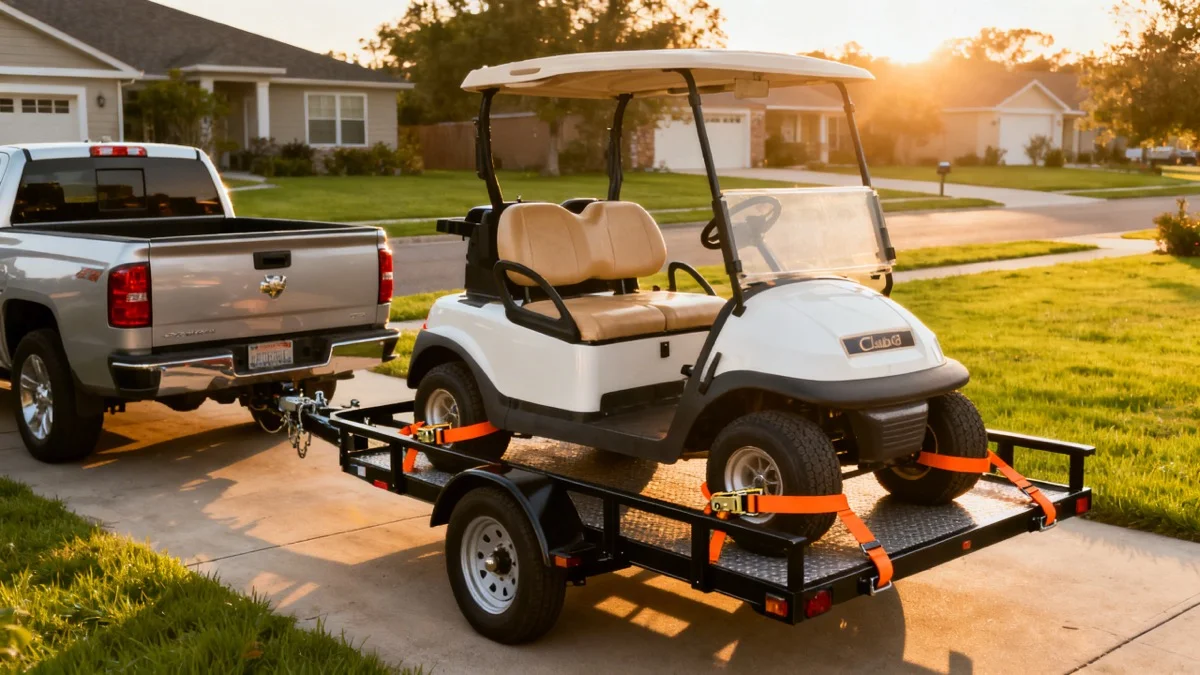
A flatbed utility trailer is the most common way to move a golf cart. It works for any distance, handles all cart sizes, and gives you flexibility to stop and check your load.
For the query transporting golf cart on trailer, the safe setup is not just "any trailer." You need enough deck length, usable width, ramp strength, tie-down points, tire capacity, and tow-vehicle margin.
Choosing the Right Trailer Size
Not all trailers fit all carts. Here's what you need based on your cart type:
| Cart Type | Minimum Trailer Size | Recommended Size | Trailer Weight Rating |
|---|---|---|---|
| 2-passenger standard | 5 x 8 ft | 5 x 10 ft | 1,500 lbs |
| 2-passenger lifted | 5 x 10 ft | 6 x 10 ft | 2,000 lbs |
| 4-passenger | 5 x 10 ft | 6 x 12 ft | 2,500 lbs |
| 6-passenger | 6 x 12 ft | 6 x 14 ft | 3,000 lbs |
A standard 2-passenger golf cart measures about 92 inches long and 48 inches wide. A 5x10 trailer gives you roughly 6 extra inches on each side, which is enough room for comfortable loading. For a 4-passenger cart, the extra length of a 6x12 trailer is worth it.
For exact width, length, height, and clearance planning by model, use the golf cart dimensions fit checker.
Transporting Golf Cart on Trailer: Fast Checklist
Before loading, confirm:
- the trailer bed is longer and wider than the cart, including tires, mirrors, rear seat, and accessories
- the trailer load rating covers the cart plus charger, straps, chocks, ramps, and cargo
- the ramp or gate rating is high enough for the cart's full loaded weight
- the trailer has real tie-down anchors, working lights, good tires, safety chains, and a locked coupler
- the tow vehicle, hitch, ball mount, and ball rating all clear the combined trailer-plus-cart weight
Common rental trailers can be tight. For example, a 5x9 ramp trailer may be listed for golf carts, but the usable bed and ramp opening can be much tighter than a true 5x10 open utility trailer. Measure before you reserve.
Trailer Types and What They Cost
Open flatbed trailers are the most affordable and practical option. A new single-axle 5x10 utility trailer costs $800 to $1,500 from brands like Carry-On and PJ Trailers. Harbor Freight sells a 5x10 modular trailer with 2,000-pound capacity that's popular with golf cart owners.
Tilt trailers make loading easier because the bed tilts to create a gentle ramp. They cost $1,200 to $2,500 and eliminate the need for separate loading ramps. If you plan to transport your cart regularly, a tilt trailer is worth the extra cost.
Enclosed trailers protect your cart from road debris, weather, and theft. They run $3,000 to $6,000 for a size that fits a golf cart. These make sense if you're transporting a high-value or custom-built cart that you want to keep in pristine condition.
Renting a trailer is the budget-friendly option for one-time moves. U-Haul, Tractor Supply, and local equipment rental shops typically charge $50 to $100 per day for a utility trailer.
Step-by-Step: Loading a Golf Cart onto a Trailer
- Park on level ground. Position your tow vehicle and trailer on a flat, paved surface. Engage the parking brake on both the truck and trailer.
- Set up the ramps. Align your ramps with the trailer bed so they sit flush. Most open trailers include fold-down ramp gates. If yours doesn't, use a pair of aluminum loading ramps rated for at least 1,500 pounds.
- Drive up slowly. Sit in the cart and drive straight up the ramps at walking speed. Keep the steering wheel centered. If the ramps are steep, have a spotter stand to the side to guide you.
- Center the cart. Position it in the middle of the trailer bed with roughly equal space on both sides. The weight should sit over or slightly forward of the trailer axle.
- Engage the parking brake. Set your cart's parking brake before stepping out.
- Secure with straps. Use four ratchet straps in the tie-down pattern described below.
Method 2: Pickup Truck Bed
If you own a full-size pickup, you might already have what you need. Loading a golf cart into a truck bed saves the hassle of towing a trailer, though it requires heavy-duty ramps and careful attention to your truck's payload capacity.
This is the best answer when someone asks how to tow a golf cart without a trailer and they own the right truck. You are not towing the cart on its own wheels; you are hauling it as cargo in the bed.
Which Trucks Can Fit a Golf Cart?
The key measurement is bed length. A standard 2-passenger golf cart is about 92 inches (7.7 feet) long.
| Truck Bed Size | Length | Will a 2-Seat Cart Fit? |
|---|---|---|
| Short bed | 5.5 ft (66 in) | No, way too short |
| Standard bed | 6.5 ft (78 in) | Tight fit, tailgate down with extender |
| Long bed | 8 ft (96 in) | Yes, with a few inches to spare |
Best trucks for golf cart hauling: Ford F-150, F-250, and F-350 with 8-foot beds. Chevy Silverado and GMC Sierra long beds. RAM 1500, 2500, and 3500 long beds.
The width of most truck beds (50 to 65 inches) fits a standard golf cart (47 to 51 inches wide) without issue. The real limiting factor is always length.
Check Your Payload Capacity
This step is critical. Electric golf carts weigh 900 to 1,100 pounds with batteries. Gas models weigh 650 to 950 pounds. Add the weight of your ramps (30 to 50 pounds for a pair), and you need to stay within your truck's payload rating.
Most half-ton trucks (F-150, Silverado 1500, RAM 1500) have payload capacities between 1,500 and 2,300 pounds. That's enough for a standard 2-seater, but a 4-passenger cart at 1,200 to 1,500 pounds can push the limit. Check the sticker inside your driver's door for your specific truck's payload rating.
Loading Ramps You Can Trust
You need ramps rated for the full weight of your cart, not half. A pair of aluminum folding ramps in the 1,500 to 1,800 pound range gives you a solid safety margin.
WheelX 1,800 lb Aluminum Folding RampsThe WheelX ramps fold for storage, feature anti-slip crossbars, and handle up to 1,800 pounds. At 90 inches long, they create a gradual incline that makes loading manageable. Expect to pay $150 to $250 for a quality pair of aluminum ramps.
Loading tip: Set the ramps at the shallowest angle possible. The steeper the angle, the harder the cart works to climb and the greater the risk of the undercarriage scraping. If your truck sits high, look for longer ramps (8 to 10 feet) to reduce the incline.
Method 3: Professional Shipping
Sometimes the smartest move is letting someone else handle it. Professional golf cart shipping makes sense when you're buying a cart from across the country, relocating long-distance, or simply don't have the equipment to haul it yourself.
What Professional Shipping Costs
| Distance | Open Transport | Enclosed Transport |
|---|---|---|
| Local (under 100 mi) | $150 to $300 | $250 to $450 |
| Regional (100 to 500 mi) | $300 to $700 | $450 to $900 |
| Cross-country (500+ mi) | $700 to $1,200 | $900 to $1,500 |
Prices are higher in spring and summer when snowbirds and vacationers are moving carts to seasonal homes. Winter months often bring lower rates. Expedited shipping or weekend delivery adds 20% to 40%.
Open vs. Enclosed Transport
Open transport is the standard option. Your cart rides on an open trailer alongside other vehicles or equipment. It's exposed to road debris and weather but costs 40% to 60% less than enclosed.
Enclosed transport puts your cart inside a sealed trailer. This protects against rocks, rain, dust, and prying eyes. It's the right call for expensive custom carts or if your cart has a fresh paint job or vinyl wrap.
Reputable Shipping Companies
Several carriers specialize in golf cart transport:
- uShip works like a marketplace where carriers bid on your shipment. You can compare prices and read reviews.
- Nexus Auto Transport offers dedicated golf cart service with door-to-door delivery.
- AmeriFreight provides instant online quotes and has been in the vehicle shipping business for over 20 years.
- A1 Auto Transport handles golf carts as part of its specialty vehicle division. Our company profile covers its shipping options, pricing factors, and preparation steps.
Get quotes from at least three companies. Ask about insurance coverage, delivery windows, and whether the price includes pickup and delivery or just terminal-to-terminal.
How to Prepare Your Cart for a Shipper
- Clean the cart and take photos from all angles. Document any existing scratches or dents.
- Remove loose items: mirrors, phone holders, coolers, bags, and anything not bolted down.
- Disconnect the negative battery terminal and tape over the exposed post.
- Check tire pressure and make sure all tires are properly inflated.
- Leave the key with the driver (most shippers need it to load and unload the cart).
- Disable any GPS trackers or alarms so they don't drain the battery or trigger during transport.
How to Secure a Golf Cart for Transport
This is the part that matters most. A poorly secured cart can shift during transit, damaging the cart, the trailer, or worse, coming loose on the highway.
The Four-Point Ratchet Strap Method
You need four ratchet straps, each rated for at least 1,000 pounds of working load (3,000 pounds break strength). Here's the pattern:
- Front left: Hook one strap to the front-left axle or frame rail. Run it diagonally to the front-left trailer tie-down point. Tighten until snug.
- Front right: Same setup, front-right axle to front-right trailer point.
- Rear left: Hook to the rear axle, tow hook, or rear frame rail. Run diagonally to the rear-left trailer point.
- Rear right: Mirror the rear-left setup on the opposite side.
Tighten all four straps until the cart's suspension compresses slightly. This preloads the suspension and prevents the cart from bouncing. The diagonal X-pattern keeps the cart from sliding forward, backward, or side to side.
Stalwart Ratchet Straps 4-Pack (1,500 lb)For heavier 4-passenger or lifted carts with aftermarket tires and wheels, step up to heavy-duty straps with higher break strength.
Heavy-Duty Ratchet Straps 4-Pack (4,400 lb)What NOT to Use
- Bungee cords stretch under load and can snap back violently. Never use them to secure a vehicle.
- Rope loosens with vibration and doesn't provide consistent tension.
- Chains without padding will scratch and dent your cart's frame. If you must use chains, wrap them in rubber or foam where they contact the cart.
Add Wheel Chocks for Extra Security
Wheel chocks block the tires from rolling even if a strap loosens. Place one chock in front of and one behind at least two wheels. This is especially important on an open flatbed without side rails.
Preparing Your Golf Cart Before Transport
A few minutes of prep prevents headaches on the road.
Pre-Transport Checklist
- Charge the battery fully (electric) or fill the gas tank (gas). A full charge means the cart is ready to unload under its own power at the destination. For gas carts, a full tank prevents fuel line issues from sloshing.
- Check tire pressure. Underinflated tires make loading harder and can shift on the trailer. Match the PSI listed on the tire sidewall.
- Remove accessories. Take off phone mounts, cup holders, aftermarket mirrors, Bluetooth speakers, and anything that could fall off or get stolen.
- Fold down the windshield if it's a flip-down style. This reduces wind resistance during towing and prevents cracking from road vibration.
- Protect the seats. Throw a golf cart cover over the cart or at least cover the seats with a tarp to protect them from road grime.
- Disconnect the battery for trips over 50 miles. Remove the negative terminal and tape it. This prevents electrical shorts from vibration and accidental discharge.
- Take photos. Document the cart's condition before loading, including close-ups of any existing scratches. This is your proof if damage occurs during shipping.
Golf Cart Dimensions and Weight by Brand
Knowing your cart's exact measurements saves you from showing up with the wrong trailer or ramps that are too narrow. Here are the specs for the most popular brands:
For a cleaner brand-by-brand length, width, and height breakdown, see our golf cart dimensions by brand guide.
| Brand & Model | Length | Width | Height | Weight |
|---|---|---|---|---|
| Club Car Onward 2 | 92 in | 49 in | 71 in | 950 lbs |
| Club Car Tempo | 91.5 in | 48 in | 68.5 in | 940 lbs |
| EZGO TXT | 93 in | 51 in | 67.5 in | 960 lbs |
| EZGO RXV | 93 in | 47.5 in | 70 in | 970 lbs |
| Yamaha Drive2 | 91 in | 44 in | 70 in | 900 lbs |
| Icon i40 | 94 in | 49 in | 72 in | 1,050 lbs |
| Star EV Sirius | 93 in | 48 in | 71 in | 980 lbs |
| 4-passenger (typical) | 110 in | 48 in | 72 in | 1,200 to 1,400 lbs |
| 6-passenger (typical) | 144 in | 48 in | 72 in | 1,500 to 1,800 lbs |
Weights shown are for electric models with batteries installed. Gas golf carts weigh roughly 15% to 25% less. For a published-spec breakdown and loaded transport estimate, use our golf cart weight calculator.
Special Transport Situations
Transporting a Lifted Golf Cart
Lifted carts with 4 to 6 inch lifts and oversized tires are taller, wider, and heavier than stock carts. The extra height can be a problem with enclosed trailers (measure the door opening before you commit) and low-clearance bridges or parking garages. A 6x10 or wider open trailer is the safest bet.
The wider tires may also hang over standard-width ramps. Measure your tire width and make sure your ramps or trailer gate are at least 12 inches wide per track.
Hauling a Golf Cart with an RV
RV owners and campers often want their cart at the campground or RV park. The most common setup is a small single-axle utility trailer (5x8 or 5x10) towed behind the RV. Make sure your RV hitch and towing capacity can handle the combined weight of the trailer (300 to 500 lbs) plus the cart (800 to 1,100 lbs).
Important: You cannot flat-tow most golf carts. The drivetrain (whether electric motor or gas engine) will be damaged if the wheels spin freely on the road. Always use a trailer.
If transporting a golf cart with your RV is a regular thing, consider a collapsible cart designed for portability.
The Kandi Collapsible Mini folds down for storage and transport, making it purpose-built for RV owners and people with limited garage space. It weighs significantly less than a standard cart and fits in many truck beds without ramps.
Moving Cross-Country
For moves over 1,000 miles, professional shipping is usually the better choice unless you're already driving a truck and trailer. The fuel cost, wear on your vehicle, hotel stays, and time spent on the road can add up to more than a $700 to $1,200 shipping quote.
If you are driving the distance yourself, plan your route for major highways with truck stops where you can check your straps and take breaks. Avoid mountain passes if possible, as the steep grades put extra strain on the tie-downs.
Transporting a Cart You Just Purchased
Buying a used golf cart from a private seller or out-of-town dealer means figuring out transport before the purchase. Some dealers offer delivery within a certain radius (usually 50 to 100 miles) for free or a flat fee. Ask about delivery options when negotiating the price.
If you're buying from a private seller on Craigslist or Facebook Marketplace, bring your own trailer or arrange a shipping quote before you commit. Factor transport cost into your total budget.
Golf Cart Hauling Cost Comparison
If your query is simply transport golf cart or golf cart hauling, costs depend on distance, equipment, season, fuel prices, open vs enclosed transport, and whether you already own a truck or trailer. Here's a side-by-side look at what each method costs:
| Method | One-Time Cost | Recurring Cost | Best For |
|---|---|---|---|
| Own a utility trailer | $800 to $2,500 (trailer purchase) | $50 to $150 per trip (fuel, tolls) | Regular transport, multi-use |
| Rent a trailer | $50 to $100/day + fuel | Same rental fee each time | One-time or infrequent moves |
| Pickup truck bed | $150 to $250 (ramps, one-time) | $50 to $150 per trip (fuel) | Short to medium distances |
| Professional shipping | N/A | $300 to $1,200 per shipment | Long-distance, no equipment |
If you transport your cart more than twice a year, buying a utility trailer pays for itself quickly. A $1,200 trailer that you use four times costs $300 per trip, and the trailer holds its resale value well. Plus, you can use it for hauling furniture, yard equipment, and other projects.
For a one-time cross-country move, professional shipping at $700 to $1,000 is hard to beat when you factor in the time, fuel, and stress of a long tow.
Safety Tips for Towing a Golf Cart
Towing adds weight behind your vehicle and changes how it handles. A few precautions go a long way.
On the Road
- Drive slower than normal. Most trailer speed limits are 55 to 65 mph, but 55 mph is safest with a loaded trailer. The faster you go, the more the trailer sways.
- Increase following distance. Your stopping distance is significantly longer with 1,500 to 2,000 extra pounds behind you. Leave at least 4 seconds of following distance.
- Brake early and gently. Sudden braking causes the trailer to push the tow vehicle. Apply brakes gradually.
- Check straps every 100 miles. Pull over at rest stops and inspect all four tie-downs. Ratchet straps can loosen from road vibration, especially in the first hour.
- Watch for crosswinds. An open trailer with a golf cart acts like a sail in strong crosswinds. Slow down and grip the wheel firmly.
Before You Leave
- Check all trailer lights. Brake lights, turn signals, and running lights must work. Most states require functional trailer lights by law.
- Verify the hitch connection. The coupler should be locked, the safety pin inserted, and safety chains crossed under the tongue.
- Confirm insurance coverage. Your auto insurance may cover the trailer, but check with your insurer. Golf cart insurance policies sometimes include transit coverage. If not, the shipping company should provide cargo insurance.
- Know your state's towing laws. Some states have specific requirements for trailer registration, mirrors, and maximum towing speed.
When to Skip DIY and Hire a Pro
Professional shipping makes more financial sense than DIY in a few specific situations:
- Distance is over 500 miles and you don't already own a trailer
- You're buying a cart online from another state and can't pick it up
- Your vehicle can't tow safely (sedans, small SUVs, or vehicles near their tow rating)
- The cart is high-value and you want insured, enclosed transport
- You're a snowbird who needs the cart at a seasonal home and would rather fly than drive
For local moves and regular transport to the golf course, vacation home, or campground, doing it yourself with a trailer or truck is the most practical and affordable option.
Frequently Asked Questions
Can you tow a golf cart without a trailer?
Usually no if you mean flat-towing it on public roads. Most golf carts should not be pulled at road speed with their wheels on the pavement. Use a pickup bed, toy hauler, utility trailer, or professional golf cart hauling service instead.
What is the best way to transport a golf cart on a trailer?
Use a trailer that has enough bed length, bed width, load capacity, ramp capacity, and tie-down points for the cart. Load on level ground, center the cart over or slightly forward of the axle, set the parking brake, chock the wheels, and use four ratchet straps.
How do I calculate golf cart transport needs?
Measure the cart and confirm loaded weight first. Then compare those numbers to trailer bed size, ramp opening, ramp rating, trailer load rating, truck payload, hitch rating, and tow rating. Add a safety margin for accessories, batteries, charger, straps, ramps, and anything stored on the cart.
What does golf cart hauling cost?
DIY hauling can be as low as fuel and tolls if you already own the equipment. Trailer rental often adds $50 to $100 per day. Professional golf cart hauling commonly costs $150 to $300 locally, $300 to $700 regionally, and $700 to $1,200+ for long-distance moves.
How much does it cost to ship a golf cart across the country?
Cross-country golf cart shipping (1,000+ miles) costs $700 to $1,200 for open transport and $900 to $1,500 for enclosed. Prices increase during spring and summer. Get quotes from at least three companies and check reviews before booking.
Can I transport a golf cart with the batteries removed?
Yes, and some shipping companies prefer it for lithium battery carts due to hazmat regulations. If you remove the batteries, the cart will be lighter (250 to 500 pounds less), but you'll need to arrange separate battery transport or purchase new ones at your destination.
What about transporting a gas golf cart?
Gas golf carts are lighter than electric models, which makes them easier to load and puts less strain on your tow vehicle. However, most professional shippers require the fuel tank to be one-quarter full or less. Turn off the fuel valve if your cart has one, and ensure there are no fuel leaks before loading.
Do golf cart dealers offer delivery?
Many golf cart dealers offer local delivery, sometimes free within a certain radius (typically 25 to 50 miles). For longer distances, they may charge a flat delivery fee or connect you with a shipping partner. When shopping for a new or used cart, always ask about delivery before finalizing the purchase. It could save you hundreds versus arranging your own transport.
Is my golf cart covered by insurance during transport?
It depends on your policy. Some golf cart insurance plans include transit coverage. Homeowners insurance may cover theft or damage during transport. If you're using a professional shipper, they should carry cargo insurance. Always ask for proof of insurance and understand what's covered before handing over your cart.
How do I find the best golf cart brands for transport durability?
The major brands like Club Car, EZGO, and Yamaha all transport well. Aluminum-frame carts like those from Evolution and some Club Car models resist corrosion better if transported through rain or salt-sprayed highways. Check our best golf carts rankings for the most durable models.
Golf Cart Search
Find the Best Golf Carts of 2026
Compare top-rated models, read expert reviews, and find the perfect cart for your needs.