As an Amazon Associate, we earn from qualifying purchases. This helps support our site at no extra cost to you.
Golf Carts with AC Motors: AC vs DC Guide
Looking for golf carts with AC motors? Start with the EZGO RXV/ELiTE, E-Z-GO 48V AC packages, Yamaha Drive2 PowerTech AC, and most newer value-brand carts from ICON, Evolution, Star EV, Bintelli, and Advanced EV. Older Club Car, Yamaha, and EZGO TXT models are often DC, so always confirm by model, year, and motor/controller labels before buying parts.
| Search Intent | Short Answer |
|---|---|
| Which golf carts have AC motors? | EZGO RXV/ELiTE, E-Z-GO 48V AC packages, Yamaha PowerTech AC, ICON, Evolution, Star EV, Bintelli, and Advanced EV. |
| Is AC better than DC in a golf cart? | Usually yes for new carts: better hill performance, no brushes, and regenerative braking. |
| Is an AC motor for golf cart upgrades worth it? | Sometimes, but only if the cart has a solid frame, good batteries, and you plan to keep it. |
| Should I convert an old DC cart to AC? | Usually no. Lithium batteries or a newer factory-AC cart often give a better return. |
Every electric golf cart runs on either an AC or DC motor. The type you have affects how fast your cart climbs hills, how far it goes on a charge, how much maintenance it needs, and how long the motor lasts. Yet most golf cart buyers never think about it until they start comparing models or pricing an AC motor for golf cart upgrades.
Here is the short version: AC motors are more efficient, last longer, and require less maintenance. DC motors cost less and are easier to repair. If you are buying a new cart, AC is generally the better choice. If you already own a DC cart that runs fine, converting to AC rarely makes financial sense.
This guide explains exactly how each motor type works, which brands use which type, and how to decide whether an AC upgrade is worth the investment. For a broader comparison between electric and gas carts, see our electric vs gas guide.
How DC Motors Work in Golf Carts
DC (direct current) motors have been the standard in golf carts since the 1950s. They are straightforward, affordable, and well-understood by every golf cart mechanic in the country.
A DC motor works by passing electrical current through wire coils (the armature) inside a magnetic field. Carbon brushes press against a spinning commutator to deliver current to the armature. The friction between brushes and commutator is what eventually wears the brushes down, requiring periodic replacement.
Series Wound DC Motors
The oldest and simplest type. The field coils and armature are wired in series (one circuit). These motors produce high starting torque, which is great for pulling heavy loads from a standstill, but their speed is harder to control precisely.
Found in: Older EZGO TXT models, older Club Car DS models, older Yamaha G-series carts, and budget aftermarket motors.
Characteristics:
- High starting torque
- Speed varies significantly with load (slows down on hills)
- No regenerative braking capability
- Simple and cheap to rebuild
SepEx (Separately Excited) DC Motors
A more advanced DC motor where the field coils are powered by a separate circuit from the armature. This allows the controller to independently adjust field strength and armature current, enabling precise speed control and dynamic braking (the motor resists rotation to slow the cart).
Found in: Club Car Precedent (2004+), Onward, and Tempo. Also used in EZGO PDS (Precision Drive System) models.
Characteristics:
- Better speed control than series wound
- Supports dynamic braking (motor-assisted braking, but does not recharge batteries)
- Smoother acceleration
- Still requires brush maintenance
- More complex controller
DC Motor Pros and Cons
Pros:
- Lower purchase price (motors cost $200-$600)
- Simple technology that any golf cart shop can repair
- Abundant parts availability (brushes, armatures, commutators)
- Easy to upgrade with higher-performance aftermarket motors
Cons:
- Brushes wear out every 3-5 years ($50-$150 to replace)
- Less efficient (70-85%) means shorter range per charge
- Performance drops noticeably on hills
- No true regenerative braking (SepEx has dynamic braking, but it does not recharge batteries)
- More heat generation under load
How AC Motors Work in Golf Carts
AC (alternating current) induction motors represent the newer generation of golf cart drivetrain technology. They work on a fundamentally different principle than DC motors.
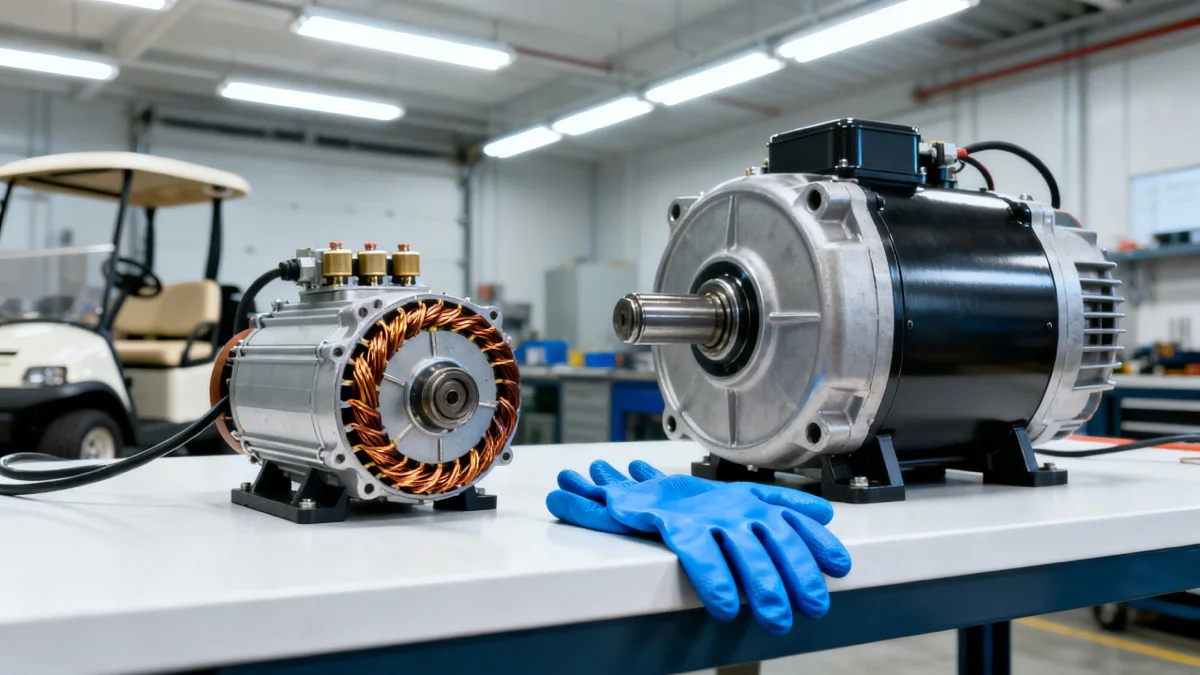
An AC motor has no brushes and no commutator. Instead, the controller (called an inverter) converts the battery's DC power into three-phase AC power, which creates a rotating magnetic field in the stator (the stationary outer coils). This magnetic field induces current in the rotor (the spinning inner part), causing it to turn. The rotor "chases" the rotating magnetic field, which is why these are called induction motors.
Because there is no physical contact between the electrical components and the spinning parts, AC motors produce less heat, less friction, and far less wear than DC motors.
Regenerative Braking
The signature advantage of AC motors. When you release the accelerator, the inverter switches the motor into generator mode. The cart's momentum spins the rotor, which generates electricity that flows back into the batteries.
What this means for you:
- Extended range: Regenerative braking recovers energy during deceleration and downhill driving, adding up to 15% more range per charge. For more on range factors, see our range guide.
- Reduced brake wear: The motor does a significant portion of the slowing, reducing mechanical brake wear by 30-50%.
- Smoother driving: Lifting off the accelerator produces a predictable, gradual deceleration instead of freewheeling.
- Hill control: Regenerative braking provides a natural speed governor on downhill slopes, reducing the need to ride the brake pedal.
AC Motor Pros and Cons
Pros:
- Highly efficient (90-95%), meaning more miles per charge
- Zero brush maintenance (no brushes to replace, ever)
- Regenerative braking extends range and reduces brake wear
- Consistent power delivery on hills and under load
- Longer lifespan (20-30+ years)
- Smoother, quieter operation
Cons:
- Higher upfront cost (motors cost $500-$1,500)
- More complex controller/inverter (harder to diagnose issues)
- Fewer independent mechanics experienced with AC systems
- Aftermarket upgrade options are more limited than DC
AC vs DC: Head-to-Head Comparison
Here is how the two motor types compare across every factor that matters to golf cart owners.
| Factor | AC Motor | DC Motor | Winner |
|---|---|---|---|
| Efficiency | 90-95% | 70-85% | AC |
| Range per charge | 15-25% more than DC | Baseline | AC |
| Hill climbing | Maintains speed under load | Slows noticeably on hills | AC |
| Top speed | Similar (depends on controller) | Similar (depends on controller) | Tie |
| Acceleration | Smooth and linear | Can be jerky (series wound) | AC |
| Regenerative braking | Yes (recovers energy) | No (SepEx has dynamic braking only) | AC |
| Brush maintenance | None (brushless) | Every 3-5 years ($50-$150) | AC |
| Motor lifespan | 20-30+ years | 15-20 years | AC |
| Motor cost (replacement) | $500-$1,500 | $200-$600 | DC |
| Repair complexity | Requires inverter knowledge | Simple, any shop can fix | DC |
| Parts availability | Growing but still limited | Abundant and cheap | DC |
| Aftermarket upgrades | Limited options | Huge aftermarket ecosystem | DC |
| Noise level | Very quiet | Slightly louder (brush noise) | AC |
| Heat generation | Lower | Higher under heavy loads | AC |
Bottom line: AC wins on performance and long-term ownership cost. DC wins on upfront price and repairability. For a new cart purchase, AC is the better value. For keeping an older cart running, DC's simplicity and cheap parts are advantages.
Which Golf Carts Have AC Motors?
Knowing your motor type helps with maintenance planning, parts ordering, and understanding what to expect when shopping. Here is what the major brands use across their current and recent electric models.
| Brand | Model | Years | Motor Type | Notes |
|---|---|---|---|---|
| EZGO | RXV / ELiTE / 48V AC packages | 2008+ | AC | RXV is the easiest Big 3 AC cart to identify |
| EZGO | TXT (PDS) | 2000+ | DC (SepEx) | Precision Drive System |
| EZGO | TXT (older) | Pre-2000 | DC (Series) | Basic series wound |
| Club Car | Onward / Tempo IQ | Current/recent | DC (SepEx) | Public specs list DC motor controllers; verify exact package |
| Club Car | Precedent | 2004-2017 | DC (SepEx) | IQ system; verify if modified |
| Club Car | DS (Regen) | 1998-2004 | DC (SepEx) | Regen model has dynamic braking |
| Club Car | DS (older) | Pre-1998 | DC (Series) | Basic series wound |
| Yamaha | Drive2 PowerTech AC | Current | AC | Yamaha lists PowerTech AC as an electric powertrain |
| Yamaha | PowerTech Li / older Drive and G29 | 2007+ | Varies / DC | Do not assume lithium or Drive2 automatically means AC |
| Icon | i-Series | Current | AC | AC motor standard |
| Evolution | All models | Current | AC | AC motor standard |
| Star EV | Most models | Current | AC | AC motor standard |
| Bintelli | All models | Current | AC | AC motor standard |
| Advanced EV | Advent series | Current | AC | AC motor standard |
The trend is clear: newer carts are moving toward AC, but the Big 3 are not uniform. EZGO RXV/ELiTE is the cleanest AC answer. Yamaha sells PowerTech AC packages while some lithium, older, and fleet carts should be verified by package. Club Car still has many IQ-style DC carts. If you are shopping used, confirm the exact package instead of assuming by brand.
For detailed brand reviews, see our guides on Club Car, EZGO, Yamaha, Icon, Evolution, and Star EV. For head-to-head comparisons, check Club Car vs EZGO or Yamaha vs Club Car.
Should You Convert from DC to AC?
If you own a DC motor golf cart and have heard about the benefits of AC, you might be considering a conversion. Here is an honest assessment of when it makes sense and when it does not.
What a Conversion Involves
A DC-to-AC conversion replaces three main components:
- Motor: The DC motor comes out and an AC induction motor goes in
- Controller/Inverter: The DC controller is replaced with an AC inverter that converts battery DC power to three-phase AC
- Wiring harness: New wiring connects the motor, inverter, throttle, and batteries
Popular conversion kit brands include Navitas, SilverWolf/TEEKON, and others. Kits are available for EZGO TXT, Club Car Precedent/DS, and Yamaha models. If you are shopping for an AC motor for golf cart upgrades, match the motor, controller/inverter, harness, throttle type, battery voltage, and programming support before ordering. If you are starting with a gas cart rather than an older DC electric cart, use our golf cart gas to electric conversion kit guide because the project needs more than a motor/controller upgrade.
Conversion Costs
| Component | Cost Range |
|---|---|
| AC conversion kit (motor + controller + harness) | $1,500-$3,000 |
| Professional installation labor | $500-$1,500 |
| Total (DIY install) | $1,500-$3,000 |
| Total (professional install) | $2,500-$5,000 |
When Conversion Makes Sense
- You have already invested in the cart. If you recently installed lithium batteries ($2,000-$4,500) and the frame is solid, adding AC maximizes the value of those batteries with 20%+ more range.
- You drive hilly terrain daily. AC motors maintain speed on hills where DC motors struggle. If hills are your daily reality, the performance difference is significant.
- You want regenerative braking. Especially valuable for hilly routes and extending brake life.
- You plan to keep the cart for 10+ years. The efficiency gains and zero brush maintenance add up over time.
When Conversion Does NOT Make Sense
- Your DC cart runs fine. A working DC motor has years of life left. Spending $2,000+ to gain 15-20% efficiency is hard to justify if you are happy with the current performance.
- Your cart has other issues. If the frame is rusting, the batteries are old, or other major components need work, the money is better spent on a newer cart that comes with AC from the factory.
- You are on a tight budget. The same $2,000-$3,000 could go toward lithium batteries, which provide a bigger everyday improvement in range and performance.
- You drive flat terrain at low speeds. On flat ground at 10-15 mph, the difference between AC and DC is marginal.
A Smarter Path for Most Owners
If your DC cart is showing its age, consider this: instead of a $3,000 AC conversion on a 15-year-old cart, put that money toward a newer cart that already has an AC motor, lithium batteries, and modern features. Many Icon, Evolution, and Star EV models with AC motors start under $10,000. See our guide on the best golf carts under $10,000 for options.
Pairing Your Motor with the Right Battery
Your motor type affects which battery technology delivers the best results. AC motors paired with lithium batteries represent the most efficient combination available today.
Why lithium works especially well with AC motors:
- Lithium batteries deliver consistent voltage throughout the discharge cycle, which AC inverters handle more efficiently than fluctuating lead-acid voltage
- The weight savings (60-70% lighter than lead-acid) reduce the load on the motor, further improving efficiency and range
- Regenerative braking charges lithium batteries more effectively because lithium accepts charge at higher rates
- Combined, an AC motor with lithium batteries can extend range by 30-40% compared to a DC motor with lead-acid
If you are considering a battery upgrade, our lithium conversion guide and complete battery guide cover the full process.
Check Price: DC HOUSE 48V 100Ah Lithium BatteryFor a deeper look at how motor draw affects performance and battery drain, see our guide on golf cart motor draw.
How to Tell If Your Cart Has an AC or DC Motor
Not sure what motor your cart has? Here are the fastest ways to identify it.
Check the Model and Year
The simplest method. If you know your cart's make and model, refer to the brand table above. Most EZGO RXVs (2008+) are AC. Yamaha Drive2 PowerTech AC packages are AC, while older Yamaha Drive and G29 carts may be DC. Many Club Car IQ carts are DC, and Onward specs should be checked by package. Use our serial number decoder if you are not sure of the model year.
Look at the Motor
- DC motors typically have two or four external brush caps (small round caps you can unscrew to access the brushes). They may also have visible wiring to the brush assemblies.
- AC motors have no brush caps. They tend to be smoother and more sealed in appearance. The wiring connects to the motor at a terminal block with three thick wires (for three-phase AC power).
Check the Controller
- DC controllers are relatively simple boxes with two main power wires (positive and negative) going to the motor.
- AC inverters are typically larger, have three output wires going to the motor, and may have a data port or Bluetooth connectivity for programming.
Listen to the Motor
AC motors tend to produce a faint, high-pitched whine during acceleration (the inverter switching frequency). DC motors are quieter at low speed but may produce a slight brush noise at higher speeds.
Motor Maintenance by Type
Maintenance requirements differ significantly between AC and DC motors. This is one of the biggest practical differences for everyday owners.
DC Motor Maintenance
| Task | Frequency | Cost |
|---|---|---|
| Brush inspection | Every 6 months | Free (visual check) |
| Brush replacement | Every 3-5 years | $50-$150 (parts) |
| Commutator inspection | With brush replacement | Free |
| Commutator resurfacing | As needed | $50-$100 (shop) |
| Motor cleaning | Annually | Free (compressed air) |
| Full motor rebuild | Every 10-15 years (if needed) | $200-$500 |
Signs your DC motor needs brush attention: Sluggish acceleration, inconsistent power, visible sparking through the vent holes, grinding or squealing from the motor area, or reduced top speed. See our troubleshooting guide for more diagnostic steps.
AC Motor Maintenance
| Task | Frequency | Cost |
|---|---|---|
| Visual inspection | Annually | Free |
| Bearing check | Every 5-10 years | Free (listen for noise) |
| Bearing replacement | Every 10-15 years (if needed) | $50-$150 |
| Motor cleaning | Annually | Free (compressed air) |
That is the complete list. AC motors genuinely require almost no maintenance. The bearings are the only wear item, and they typically last the life of the motor.
For a full maintenance schedule covering all cart components (not just the motor), see our complete maintenance guide.
How Motor Type Affects Speed and Performance
The motor type alone does not determine your cart's top speed. The controller (or inverter) amperage, gear ratio, tire size, and battery voltage all play equal or larger roles. For a full breakdown of speed factors and modifications, see our speed upgrade guide.
That said, motor type does affect how your cart delivers power:
AC motors:
- Smooth, linear acceleration from zero to top speed
- Maintain speed better on hills and with heavy loads
- Consistent power curve across the battery's charge range
- Regenerative braking provides controlled deceleration
DC motors:
- Can feel punchier off the line (especially series wound) due to high initial torque
- Speed drops noticeably under load (hills, heavy passengers, headwind)
- Power output decreases as battery voltage drops during a ride
- Freewheels when you release the accelerator (no engine braking except SepEx models)
For most driving scenarios in neighborhoods, golf cart communities, and on the course, both motor types feel similar at cruising speed. The differences become apparent on hills, with heavy loads, and toward the end of a battery charge cycle.
The Bottom Line on AC vs DC
If you are buying a new golf cart, look for one with an AC motor. The efficiency gains, regenerative braking, and zero-maintenance design make AC the clear winner for long-term ownership. Most newer brands already include AC motors as standard.
If you already own a DC cart that runs well, do not rush to convert. Your motor has years of life left. Instead, invest in lithium batteries for the biggest bang for your buck, keep up with regular maintenance, and replace brushes on schedule.
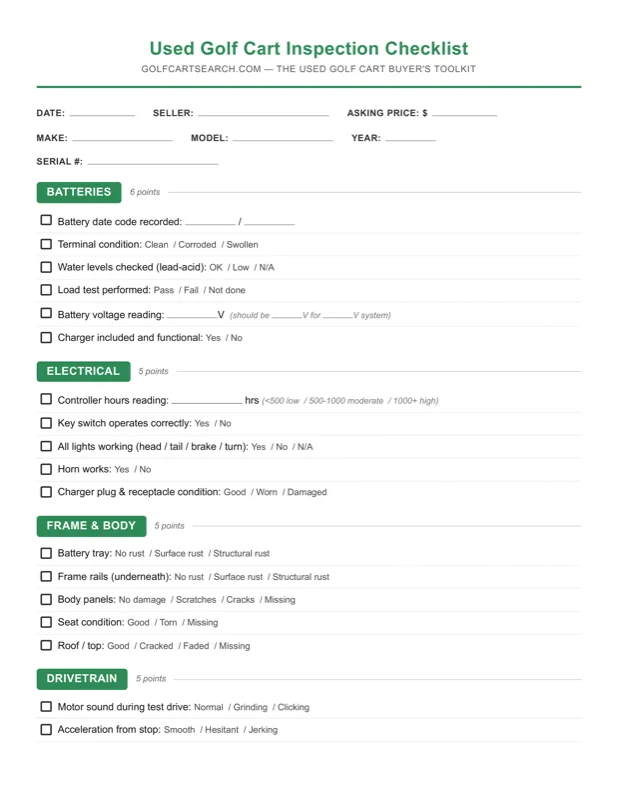
If you are shopping for used carts, know that an AC-equipped cart (like an EZGO RXV) may be worth a premium over a comparable DC cart, because you are buying into lower maintenance costs and better efficiency for the remaining life of the vehicle. Check our used buying guide for what to inspect.
Whatever motor type you have, taking care of it properly will give you decades of reliable use. Browse dealers near you if you are ready to shop, or visit our repair directory if your current motor needs attention.
Frequently Asked Questions
Is an AC or DC motor better for golf carts?
AC is better for most buyers. It offers 20-39% better efficiency, requires no brush maintenance, includes regenerative braking, and lasts 20-30+ years. DC is better only if upfront cost is the primary concern or you need the widest possible selection of aftermarket parts. For new cart purchases, AC is the recommended choice.
Which golf carts have AC motors?
Common golf carts with AC motors include EZGO RXV, E-Z-GO 48V AC / ELiTE packages, Yamaha Drive2 PowerTech AC, ICON, Evolution, Star EV, Bintelli, and Advanced EV. Do not assume every cart from a brand is AC. Package, year, and battery option matter.
Can I buy an AC motor for a golf cart upgrade?
Yes, but buy a complete matched system, not just a loose motor. A reliable AC conversion needs the AC motor, inverter/controller, harness, throttle compatibility, correct battery voltage, and programming support. On older carts, the total installed cost often makes lithium batteries or a newer factory-AC cart a better value.
Can I tell the motor type from the outside of the cart?
Not always from a glance, but there are clues. EZGO RXV carts (2008+) and Yamaha PowerTech AC packages are AC. Older Club Car Precedent, many Club Car IQ carts, older Yamaha Drive/G29 carts, and EZGO TXT carts are commonly DC. Check for brush caps on the motor (DC) or three thick wires going to the motor (AC). The controller/inverter size is also a clue: AC inverters are typically larger than DC controllers.
Does motor type affect resale value?
AC motor carts, especially EZGO RXVs, tend to hold value slightly better than comparable DC carts because buyers know they are getting lower maintenance costs and better efficiency. The premium is modest, usually a few hundred dollars on the used market. See our value guide for pricing benchmarks.
Why does Club Car still use DC motors?
Club Car still supports many DC SepEx / IQ-style carts because the system is well-proven, parts are widely available, and its dealer network knows the platform. Some Club Car powertrain details vary by package and model year, so the right answer depends on the actual motor/controller label rather than the Onward name alone.
How much horsepower does a golf cart motor have?
Stock golf cart motors typically produce 3-5 HP (electric) or 10-14 HP (gas). Aftermarket high-performance electric motors range from 7-15 HP. Motor wattage is a more common specification for electric carts: stock motors are typically 3,000-5,000 watts, while performance upgrades range from 5,000-10,000+ watts. For a full brand-by-brand HP comparison with conversion formulas, see our golf cart horsepower guide. For how HP translates to actual speeds, see our speed guide.
Golf Cart Search
Find the Best Golf Carts of 2026
Compare top-rated models, read expert reviews, and find the perfect cart for your needs.