

A golf cart warranty is a set of component-specific promises. Obtain the exact vehicle Warranty Statement, battery terms and any paid Service Agreement before comparing brands or paying for an extension.
The documents below were checked on October 10, 2026. They establish published terms, not our experience processing claims or a ranking of which manufacturer pays most reliably.
Club Car warranty information: start with the actual agreement
Club Car's warranty page directs owners to its manual system's Warranty Statement (WS) and an authorized dealer. The public chart is an overview; the serial/model-specific statement determines the applicable terms.
Its overview says covered repairs include parts and labor through the specified service channel. It also separates factory vehicle transfer rules from lithium-battery and paid-extension transfer rules. Have the dealer confirm those separately for the cart being sold rather than treating every “transferable warranty” claim as equivalent.
The Onward extension brochure currently linked by Club Car carries a 2022 Portfolio copyright and directs readers to the Service Agreement. A live brochure link is not proof that every newly delivered vehicle uses identical terms.
What the Onward brochure actually distinguishes
| Coverage in the linked overview | Standard | Extended |
|---|---|---|
| Major electronics, including controller and charger | 2–3 years, depending on configuration | 6 years |
| Seats: bottom, back and armrests | 2–3 years | 6 years |
| Base lithium battery | Earlier of 6 years or 2.8 MWh | Earlier of 8 years or 4.9 MWh |
| Extended-range lithium battery | Earlier of 6 years or 4.9 MWh | Earlier of 8 years or 4.9 MWh |
These are brochure entries, not a promise of six additional years after the factory warranty. Get the actual start/end dates and contract limits. Onward brochure.
For extended-range lithium, this overview adds two calendar years but leaves the energy cap at 4.9 MWh. For base lithium, it also raises the listed cap by 2.1 MWh. That difference is a reason to identify the pack before paying for an extension; it does not establish the exact delivered contract.
The brochure's frame row and its excluded-components list also need reconciliation: the table contains a limited-lifetime frame reference while the exclusion list names frames. Do not turn either line into a blanket coastal-corrosion guarantee. Ask for the controlling frame provision and whether corrosion, coatings and environmental damage are covered.
A usage-cap calculation
Hypothetical usage: if a covered pack accumulated 5 kWh of qualifying energy per use-day, a 2.8 MWh cap equals 2,800 kWh ÷ 5 = 560 use-days. This is arithmetic, not a measured cart consumption rate or a forecast of claim eligibility.
Confirm how the agreement measures energy, whether its counter is cumulative from the original in-service date, and how the manufacturer reads it. A buyer cannot decide remaining coverage from battery age alone. Published battery-cap reference.
Other named policies: a headline is only the first row
| Document checked | Specific terms worth comparing | Limit of this example |
|---|---|---|
| Yamaha MY2025 Drive2 PTV PowerTech AC IRS, LIT-19626-A3-84 | Four-year vehicle headline; frame 3 years, body and electrical wires 3, seats 2, windshield 3; transport and field-service charges excluded | This is the identified MY2025 schedule, not proof of every MY2026/2027 component term |
| Atlas MY2026 and later policy | Original-owner, nontransferable lifetime electric powertrain; lithium/BMS limited 10 years; seat structure 3, cushions 1; transport excluded | Defect coverage, exclusions and service-channel rules still apply |
Yamaha's MY2027 PowerTech AC specification page still advertises a four-year limited vehicle warranty. Obtain the actual newer component schedule before carrying the MY2025 table forward.
The MY2025 Yamaha document also requires authorized inspection and registration within 10 days of ownership transfer, with a possible dealer fee. Its battery terms are separate. A seller's “four years remaining” description is incomplete without the in-service date, component and transfer process. MY2025 warranty, printed page 1.
For E-Z-GO, obtain the vehicle and battery statements matched to the actual model, year and in-service date from its authorized dealer. Do not infer one uniform ELiTE battery/BMS/vehicle term across RXV, Express and Liberty LSV. The E-Z-GO review provides model research; it does not replace that contract check.
Defects, wear and damage are different
A seat or windshield can be covered for a manufacturing defect while ordinary wear, tears, fading or impact damage is excluded. The Yamaha schedule above demonstrates why “seats and glass are never covered” is an unreliable shopping rule.
Atlas's policy similarly distinguishes its seat structure from cushions and ordinary wear. It lists wear exclusions separately from the covered components. Identify the failed part, cause, time/usage limit and exclusion rather than assigning coverage from the part's name alone. Atlas policy, pages 1–3.
Ask for the written provision when a shop proposes a denial. Save the diagnosis, photographs, service records and the warranty version used. Do not alter or discard a failed part before the claim handler says what evidence it needs.
Aftermarket parts and maintenance
The FTC explains that, for covered consumer-product warranties, requiring paid parts or service from a named company is generally restricted, with exceptions. Coverage can still exclude damage caused by other parts or service. That is different from automatic loss of all coverage because an aftermarket part exists. Application and state-law rights depend on the transaction; a consumer rule is not a universal fleet-contract rule. FTC warranty-law guide.
Read the actual modification clause and keep the maintenance records. Club Car and Atlas publish restrictions on changes that move the vehicle outside its specifications. A speed change, battery conversion or accessory installation needs both technical approval and a check of the applicable agreement; a working installation does not settle coverage.
Authorized handling of a covered claim is also a different question from paying someone to perform routine maintenance. Ask who may service the vehicle, who must approve a repair, and what records are required.
For unresolved disputes, use the agreement's appeal process and the applicable consumer-protection office or legal advice. Avoid accepting or publishing a whole-warranty cancellation claim without its written basis.
Is a paid extension worth the price?
First obtain a quote and the complete contract. Record the premium, deductible, claim cap, covered components, prior authorization, diagnostic charges, labor allowance, pickup/transport cost, cancellation and transfer rules.
Hypothetical comparison, not a dealer quote or observed failure rate:
| Input | Example |
|---|---|
| Plan premium | $800 |
| One otherwise payable covered repair | $2,500 |
| Claim deductible | $100 |
| Unpaid transport incurred for that claim | $300 |
| Claim cost without the plan | $2,500 repair + $300 transport = $2,800 |
| Claim cost with the plan, excluding its premium | $100 deductible + $300 transport = $400 |
| Cost avoided by coverage | $2,800 − $400 = $2,400 |
In a simplified one-claim calculation, an $800 premium breaks even at $800 ÷ $2,400 = 33.3% probability of that net benefit. The actual probability is unknown. Multiple claims, exclusions, reimbursement limits, timing and risk preference change the decision.
If the battery is excluded, a battery failure contributes zero benefit to this plan. Here transport is paid in both alternatives, so it is not counted as a coverage saving. If the plan also pays transport, recalculate the example. Price the actual agreement rather than assuming expensive electronics make any extension worthwhile.
Used-cart transfer: verify each layer
Before paying, obtain the original in-service date and the current vehicle and battery identifiers. Ask the claim administrator to confirm remaining coverage and required transfer paperwork. Keep the confirmation with the sale records.
Check the factory vehicle warranty, battery warranty, paid extension and any dealer-only used-cart promise independently. The Atlas powertrain example is nontransferable; the named Yamaha policy has a transfer deadline. Neither establishes the rule for another manufacturer or another policy year.
Dealer used-cart warranties also need their own written terms. There is no documented basis here for a universal 30–90 day policy. An “as-is” phrase does not settle every buyer's statutory rights; the FTC notes state differences. FTC guide.
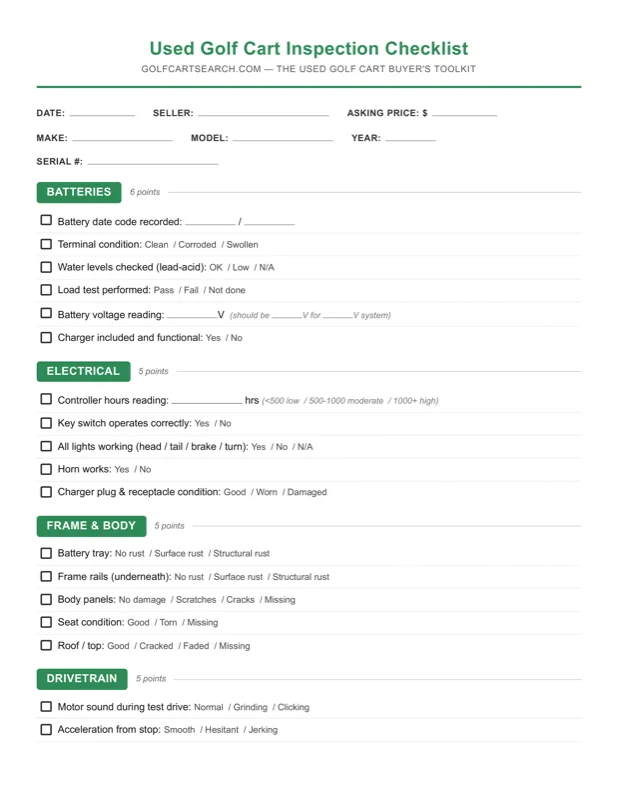
Use the used-cart inspection guide to check condition and the ownership-transfer guide for transaction paperwork. Warranty transfer and vehicle ownership transfer are separate steps.
What to get before signing
- The exact vehicle Warranty Statement, battery statement and separate Service Agreement.
- Coverage start/end dates and time, energy, mileage or other applicable limits.
- Component coverage, defect definitions, modifications and wear exclusions.
- Authorized service location, approval procedure, labor/diagnostic terms and transport costs.
- Claim, appeal, cancellation and transfer requirements.
- Written confirmation for dealer-installed equipment and any conflicting brochure language.
Ask the selling dealer for the paperwork with the purchase quote. Compare like components and unpaid costs rather than selecting a brand from its longest advertised number.
Frequently asked questions
Where can I find Club Car warranty information?
Use the official warranty page, then obtain the Warranty Statement and any separate Service Agreement matched to the actual vehicle. Ask an authorized dealer to confirm model, serial number, in-service date, component and transfer eligibility.
Does a four-year warranty cover every part for four years?
No. Yamaha’s identified MY2025 Drive2 PTV schedule includes shorter component periods. Compare the component table and exclusions, not only the vehicle headline.
Are seats and windshields always excluded?
No. A manufacturing defect can have coverage while ordinary wear, fading or breakage is excluded. Check the named component and cause in the actual warranty.
Does six-year extended coverage mean six extra years?
Do not assume that. Get the coverage start and expiry dates in writing, along with any usage cap. Calendar coverage and battery energy limits can end at different times.
Does a used cart keep its factory warranty?
Only if the applicable coverage remains and the policy allows the transfer. Vehicle, battery and paid-extension transfer rules can differ, so confirm each separately before buying.
Is an extended golf cart warranty worth buying?
Compare its actual price, deductible, covered failures and unpaid costs. The worked example here is hypothetical and does not establish a brand’s failure probability or recommend a specific plan.
Golf Cart Search
Find the Best Golf Carts of 2026
Compare top-rated models, read expert reviews, and find the perfect cart for your needs.