As an Amazon Associate, we earn from qualifying purchases. This helps support our site at no extra cost to you.
Quick Answer: Golf Cart Horsepower
Most stock electric golf carts have 3 to 8 continuous HP, usually listed as 2.2 to 6.3 kW. Gas golf carts usually have 10 to 14 HP from 350 to 430cc engines. Those numbers are not directly comparable because electric motors deliver torque at low speed and manufacturers may advertise either peak or continuous power. Use the stock setup chart below, or jump to the full brand and model chart.
Electric carts usually list motor power in kilowatts, gas carts use traditional horsepower, and some manufacturers promote peak output while others publish continuous power. This guide puts those figures on the same scale, then shows what the numbers mean for hills, passengers, speed, and real-world use.
Electric Cart HP 3 - 8 HP (2.2 - 6.3 kW)
Gas Cart HP 10 - 14 HP (350 - 430cc)
Conversion 1 kW = 1.341 HP
Electric Torque Edge 100% at 0 RPM
Golf Cart Horsepower Chart: Stock Electric vs Gas
If you are trying to identify stock electric golf cart motor horsepower, look for the motor's kW rating first. The chart below compares common factory setups on the same continuous horsepower scale.
| Stock setup | Typical power source | Rated or continuous HP | What it feels like |
|---|---|---|---|
| Older 36V electric | 2.2 kW motor | 3.0 HP | Adequate on flat courses, slower with hills or passengers |
| Common 48V electric | 2.4-3.5 kW motor | 3.2-4.7 HP | Normal neighborhood and course performance |
| Stronger AC/lithium electric | 4.0-5.0 kW motor | 5.4-6.7 HP | Better hill climbing and full-passenger acceleration |
| High-output electric | 6.3 kW motor | 8.4 HP | Strong acceleration and heavier-duty performance |
| Stock gas cart | 350-430cc engine | 10-14 HP | Better sustained power for long workdays and heavy hauling |
These are representative factory ranges, not a substitute for the specification sheet for your exact model year and powertrain. Peak horsepower can be much higher for a few seconds during launch or hill climbing, which is why a cart advertised with a large peak HP number may still use a modest motor underneath.
Golf Cart Torque: Why HP Alone Misleads Buyers
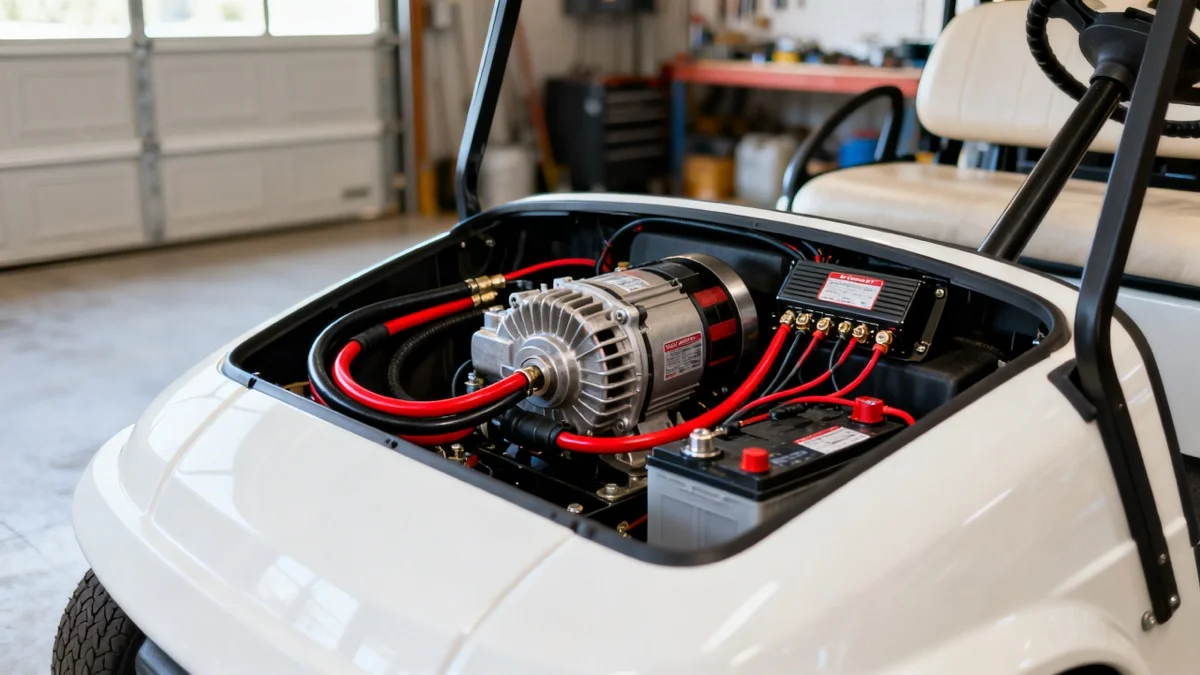
Golf cart torque is the twisting force that gets the cart moving, climbs hills, and handles passenger or cargo weight. Horsepower matters for sustained speed, but torque is what you feel when the cart pulls away from a stop.
Electric carts often feel stronger than their HP rating suggests because electric motors deliver torque immediately at low speed. Gas carts usually publish higher HP numbers, but they need RPM before they reach peak torque. That is why a 4.4 HP electric cart can feel more responsive around a neighborhood than the raw number suggests.
If your search is really about golf cart torque, ask what problem you are solving first. For hill climbing, passengers, or towing, prioritize a stronger motor-controller setup and torque-focused gearing. For top speed, prioritize controller programming, voltage, motor RPM, and tire size. Our AC vs DC motor guide explains motor behavior in more detail, and our top speed guide compares published MPH by model.
Understanding Golf Cart Power: HP vs kW vs Watts
Golf cart manufacturers use three different units to describe motor power, which makes comparison confusing. Here is how they relate:
| Unit | Formula | Example |
|---|---|---|
| Watts (W) | Base unit | 5,000W motor |
| Kilowatts (kW) | Watts / 1,000 | 5.0 kW motor |
| Horsepower (HP) | kW x 1.341 | 6.7 HP motor |
Quick conversion: Multiply kW by 1.341 to get HP. Divide watts by 746 to get HP.
Most electric golf cart manufacturers list motor specs in kW or watts. Gas golf cart engines use traditional HP. To compare them directly, convert everything to HP using the formulas above.
| Motor Size (kW) | Horsepower (HP) | Typical Use |
|---|---|---|
| 2.2 kW | 3.0 HP | Budget electric carts (EZGO TXT) |
| 3.3 kW | 4.4 HP | Standard electric (Club Car, EZGO RXV) |
| 3.7 kW | 5.0 HP | Mid-range electric (Star EV) |
| 4.0 kW | 5.4 HP | Value brands (ICON ECO, Advanced EV, Evolution) |
| 5.0 kW | 6.7 HP | Premium electric (ICON i40, Yamaha AC, Advanced EV Horizon) |
| 6.3 kW | 8.4 HP | High-performance (ICON EPIC, Evolution D-Max) |
For a deeper look at motor types and how they differ mechanically, see our AC vs DC motor guide.
Peak vs Continuous HP: Why Specs Are Confusing
Electric motor specs are confusing because manufacturers sometimes list peak HP and sometimes list continuous HP. These are very different numbers.
Continuous (rated) HP is the power a motor produces indefinitely under normal operating conditions. This is the honest number for comparing performance.
Peak HP is the maximum burst output during hard acceleration, steep hill climbing, or heavy load starts. Peak power lasts seconds, not minutes, and is typically 2 to 4 times the continuous rating.
For example, current Club Car Onward 4 specifications list the standard electric powertrain at 3.3 HP rated and 13 HP peak. The larger number represents a short burst, not the power the motor sustains continuously.
Gas engines do not have this distinction. A 13.5 HP gas engine produces 13.5 HP continuously at its rated RPM. This makes gas specs more straightforward but also makes direct gas-to-electric comparison misleading if you are comparing gas continuous to electric peak.
Rule of thumb: When comparing motors, always compare continuous to continuous. If a spec sheet only lists one number, it is usually continuous for gas and could be either for electric. Look for "rated" or "continuous" labels.
Golf Cart Horsepower Specs by Brand
Here are the motor specs for every major golf cart brand, converted to a common HP format for easy comparison. All HP values are continuous (rated) unless noted otherwise.
Specifications change by model year and powertrain. Key current examples were checked against official specifications from Club Car, E-Z-GO, Yamaha, ICON, and Evolution. Verify the sheet for the exact cart you are comparing, especially when a model name spans several years.
Club Car
| Model | Motor Type | Power (kW) | HP (Continuous) | Torque | Notes |
|---|---|---|---|---|---|
| Onward (electric) | Electric | 2.4 kW | 3.3 HP (13 HP peak) | N/A | 250A controller |
| Onward Base/XR Lithium | Electric | 3.5 kW | 4.7 HP | N/A | 375A controller |
| Onward (gas) | Kohler 429cc | N/A | 14 HP | ~20 lb-ft | Overhead valve, EFI |
| Precedent (electric) | DC/AC | 3.3 kW | 4.4 HP | N/A | Legacy platform |
Club Car publishes both rated and peak output for its standard Onward electric powertrain, which is a useful reminder to compare like-for-like ratings. Read our complete Club Car review for full model details.
EZGO
| Model | Motor Type | Power (kW) | HP (Continuous) | Torque | Notes |
|---|---|---|---|---|---|
| TXT (electric) | DC shunt-wound | 2.2 kW | 3.0 HP | N/A | Most basic motor |
| RXV (electric) | AC | 3.3 kW | 4.4 HP | N/A | AC upgrade over TXT |
| ELiTE (lithium) | AC | 3.4 kW | 4.6 HP | N/A | Samsung lithium battery |
| Liberty (electric) | AC | 3.4 kW | 4.6 HP | N/A | Street-legal LSV |
| Express (gas) | Kawasaki 357cc | N/A | 13.5 HP | ~19 lb-ft | Closed-loop EFI |
EZGO offers the widest motor range among the Big 3, from the basic 3 HP TXT to the 13.5 HP gas Express. The TXT's DC motor is the weakest stock motor from any major brand, which is why controller and motor upgrades are so popular on this platform. See our complete EZGO review for every model.
Yamaha
| Model | Motor Type | Power (kW) | HP (Continuous) | Torque | Notes |
|---|---|---|---|---|---|
| Drive2 PowerTech AC | AC | 5.0 kW | 6.7 HP | N/A | Most powerful Big 3 electric |
| Drive2 DC | DC | 2.6 kW | 3.5 HP | N/A | Budget electric option |
| Drive2 PowerTech Li | AC | 3.3 kW | 4.4 HP | N/A | Lithium variant |
| Drive2 Gas EFI | 357cc | N/A | 11.4 HP | ~18 lb-ft | Quietest gas engine |
Yamaha produces the most powerful stock electric motor among the Big 3 with the 5.0 kW PowerTech AC system at 6.7 HP. That is over 50% more power than Club Car and EZGO's standard electric offerings. If you want the strongest electric motor without leaving the established brands, Yamaha is the pick. Full breakdown in our Yamaha review.
ICON
| Model | Motor Type | Power (kW) | HP (Continuous) | Controller | Notes |
|---|---|---|---|---|---|
| i40-ECO | AC | 4.0 kW | 5.4 HP | 350A | Budget entry |
| i40 / i60 | AC | 5.0 kW | 6.7 HP | 450A | Best-selling model |
| i40L / i60L | AC | 5.0 kW | 6.7 HP | 450A | Lifted version |
| EPIC E40FX | AC | 6.3 kW | 8.4 HP | 450A | Most powerful ICON |
ICON leads the value segment on motor power. The 6.3 kW EPIC motor produces 8.4 HP continuous, which is more raw electric power than anything from the Big 3. The 450-amp controller paired with the 5 kW and 6.3 kW motors provides stronger hill climbing and faster acceleration than the 250-350 amp controllers used by Club Car and EZGO. See our complete ICON review.
Evolution
| Model | Motor Type | Power (kW) | HP (Continuous) | Controller | Notes |
|---|---|---|---|---|---|
| Classic 4 Plus | AC | 4.0 kW | 5.4 HP | 400A Curtis | Entry model |
| D5 Plus series | AC | 6.3 kW | 8.4 HP | 400A | Current premium line |
| Forester series | AC | 4.0 kW | 5.4 HP | 400A Curtis | Off-road styling |
| D-Max GT | AC | 5.0 kW | 6.7 HP | 500A | Flagship RWD |
| D-Max XT | Dual AC | 6.3 kW+ each | 8.4+ HP each | Dual 500A | On-demand 4WD |
Evolution matches ICON's 6.3 kW output in the current D5 Plus line. The D-Max XT uses dual motors and on-demand 4WD for off-road and steep-grade performance. Read our Evolution review for the full lineup.
Advanced EV
| Model | Motor Type | Power (kW) | HP (Continuous) | Controller | Notes |
|---|---|---|---|---|---|
| Advent 2/4/6/8 | AC | 4.0 kW | 5.4 HP | Toyota 350A | Personal line |
| Horizon 4 | AC | 5.0 kW | 6.7 HP | 450A | Premium model |
| Advent Click series | AC | 5.0 kW | 6.7 HP | 450A | Commercial/fleet |
Advanced EV uses Toyota-programmed controllers across the lineup, providing smooth power delivery and reliable speed management. The step from 4 kW (Advent) to 5 kW (Horizon) is noticeable in acceleration and hill climbing. Read our Advanced EV review for full specs and pricing.
Star EV
| Model | Motor Type | Power (kW) | HP (Continuous) | Notes |
|---|---|---|---|---|
| Sirius | AC | 3.7 kW | 5.0 HP | Standard model |
| Capella | AC | 5.0 kW | 6.7 HP | Premium model |
Star EV sits in the middle of the pack with the 3.7 kW standard motor. The upgrade to 5.0 kW on the Capella matches ICON and Yamaha's top electric offerings. See our Star EV review for the full model breakdown.
Golf Cart Horsepower Chart by Brand and Model
Here is every brand side by side for the easiest comparison:
| Brand | Model | kW | HP | Type |
|---|---|---|---|---|
| ICON | EPIC E40FX | 6.3 | 8.4 | Electric |
| Evolution | D5 Plus | 6.3 | 8.4 | Electric |
| Evolution | D-Max GT | 5.0 | 6.7 | Electric |
| Yamaha | Drive2 AC | 5.0 | 6.7 | Electric |
| ICON | i40 | 5.0 | 6.7 | Electric |
| Advanced EV | Horizon | 5.0 | 6.7 | Electric |
| Star EV | Capella | 5.0 | 6.7 | Electric |
| Advanced EV | Advent | 4.0 | 5.4 | Electric |
| ICON | i40-ECO | 4.0 | 5.4 | Electric |
| Evolution | Classic 4 Plus | 4.0 | 5.4 | Electric |
| Club Car | Onward Base/XR Li | 3.5 | 4.7 | Electric |
| EZGO | ELiTE / Liberty | 3.4 | 4.6 | Electric |
| EZGO | RXV | 3.3 | 4.4 | Electric |
| Yamaha | Drive2 Li | 3.3 | 4.4 | Electric |
| Club Car | Onward | 2.4 | 3.3 | Electric |
| Yamaha | Drive2 DC | 2.6 | 3.5 | Electric |
| EZGO | TXT | 2.2 | 3.0 | Electric |
| Club Car | Onward Gas | N/A | ~14 | Gas |
| EZGO | Express Gas | N/A | 13.5 | Gas |
| Yamaha | Drive2 Gas | N/A | 11.4 | Gas |
Gas carts produce 2 to 4 times the raw horsepower of electric carts. But as the next section explains, that does not mean they are 2 to 4 times more powerful in real-world use.
Electric vs Gas: Why HP Numbers Are Misleading
If you only compared HP ratings, gas golf carts would seem dramatically more powerful than electric. A 13.5 HP EZGO gas cart vs a 4.4 HP EZGO RXV electric looks like a blowout. But drive both carts back to back and the performance gap is far smaller than the numbers suggest. Here is why.
Electric Motors Produce More Torque Where It Matters
Torque is the twisting force that accelerates the cart from a stop and pulls it up hills. Horsepower is torque multiplied by RPM, so it measures sustained high-speed power.
Here is real-world data from the Club Car Villager 4 (same cart, different drivetrains):
| Spec | Electric Version | Gas Version |
|---|---|---|
| Horsepower | 13 HP | 14 HP |
| Torque | 34.5 lb-ft | 19.9 lb-ft |
| Torque RPM | 1,980 RPM | 2,400 RPM |
| Torque at 0 RPM | 100% available | Near zero |
The electric version produces 73% more torque than the gas version despite having slightly less horsepower. And it delivers that torque instantly from a dead stop, while the gas engine needs to rev up to 2,400 RPM before reaching peak output.
This is why an electric cart with 5 HP can feel as responsive as a gas cart with 12 HP in stop-and-go neighborhood driving. The torque delivery pattern matters more than the peak number.
If you are comparing published MPH ratings instead of motor output, use our golf cart top speed by brand and model guide.
Where Gas HP Advantages Show Up
Gas carts genuinely outperform electric in two scenarios:
- Sustained high-speed driving: Gas engines maintain full power at higher RPMs for longer periods. Electric motors draw heavily from the battery under sustained load, which reduces range.
- Extended heavy hauling: Towing trailers, carrying heavy cargo uphill repeatedly, or operating for hours without a break. Gas engines refuel in minutes; electric batteries need hours.
For most golf cart buyers driving in neighborhoods, on courses, or around retirement communities, electric motors provide more than enough power. For hunting properties and farm/ranch work with sustained heavy loads, gas remains the stronger choice. For a full comparison, see our electric vs gas guide.
How Much HP Do You Actually Need?
More horsepower sounds better, but you can waste money on power you will never use. Here is what different use cases actually require.
3-5 HP: Flat Terrain and Light Use
A 2.2 to 3.7 kW motor handles flat golf courses, paved neighborhoods, and light passenger loads (1-2 people) without issues. This covers the EZGO TXT, Club Car Onward standard, and similar base-model carts.
You do not need more power if your terrain is flat, your commutes are short (under 5 miles), and you rarely carry more than 2 passengers. Millions of golf carts with 3-4 HP motors run daily on courses worldwide.
5-7 HP: Moderate Hills and Full Loads
A 3.7 to 5.0 kW motor provides the power margin for moderate inclines, 4 passengers plus gear, and slightly longer commutes. This is the sweet spot for most golf cart community residents.
Carts in this range include the ICON i40 (5 kW), Yamaha Drive2 AC (5 kW), and Advanced EV Horizon (5 kW). If you live in a hilly area or regularly carry 4 adults, the difference between a 3.3 kW and 5 kW motor is immediately noticeable on inclines.
7+ HP: Performance, Off-Road, and Heavy Duty
A 5.0+ kW motor with a high-amp controller handles steep grades, off-road terrain, towing, and heavy cargo. The ICON EPIC E40FX (6.3 kW), Evolution D-Max, and aftermarket motor upgrades fall into this category.
You need this level of power for properties with steep driveways, off-road use, towing utility trailers, or commercial/fleet operations where the cart runs at high capacity all day.
Gas: 10+ HP for Maximum Sustained Power
If you need sustained high power for hours without stopping to charge, a gas cart with 11-14 HP is the practical choice. Farm and ranch use, large properties without charging access, and heavy towing are the main use cases.
How to Increase Your Golf Cart's Horsepower
If your current cart lacks the power you need, upgrades can add significant horsepower. Here are the most effective options, ranked by impact and cost.
Motor Upgrade ($300 - $800)
Replacing the stock motor with a high-performance aftermarket motor is the biggest single upgrade. Companies like D&D Motor Systems and Plum Quick Motors offer motors from 7 to 14+ HP for most Club Car, EZGO, and Yamaha platforms.
Speed motors prioritize top speed. Torque motors prioritize acceleration and hill climbing. Combo motors balance both. Choose based on your primary need.
Important: A motor upgrade usually requires a matching controller upgrade to supply the additional amperage the motor needs. Installing a 10 HP motor with a stock 250-amp controller will not deliver the full performance gain.
Controller Upgrade ($200 - $500)
The controller regulates power delivery from battery to motor. Upgrading from a stock 250-300 amp controller to a 400-500 amp unit allows the motor to draw more power, improving acceleration, hill climbing, and top speed.
Alltrax and Navitas are the two most popular aftermarket controller brands. Many come with Bluetooth programming so you can adjust throttle response, speed limits, and regen braking from your phone.
Critical: When upgrading to a higher-amp controller, you must also upgrade the solenoid and high-amperage cables. A stock solenoid or thin cables in a high-amp system will overheat and fail. For a step-by-step walkthrough, see our speed upgrade guide.
Voltage Conversion: 36V to 48V
Converting a 36V cart to 48V can create room for more power, but the extra voltage does not guarantee a 33% speed or torque increase. The result depends on the motor, controller programming, current limit, gearing, tire size, and total load. This upgrade is most common on older EZGO TXT and Club Car DS carts.
The conversion requires a 48V battery bank, such as six 8V lead-acid batteries or a compatible lithium pack, plus a 48V charger. Depending on the cart, you may also need a compatible controller, solenoid, high-amperage cables, motor, and voltage reducer for 12V accessories. Total cost runs $1,000 to $2,500 depending on whether you choose lead-acid or lithium batteries.
Upgrading to a lithium battery pack at the same time provides more consistent power delivery throughout the discharge cycle. Lead-acid batteries lose voltage as they discharge, which reduces motor power. Lithium maintains stable voltage until nearly empty, keeping horsepower consistent from full charge to 20% remaining.
Check DC HOUSE 48V Lithium Battery PriceOther Power-Boosting Upgrades
Lighter wheels and tires reduce rotational mass, making existing HP more effective. Switching from heavy steel wheels to aluminum alloys saves 10-15 lbs per wheel. See our tire and wheel guide.
Proper maintenance preserves the HP you already have. Dirty battery terminals, corroded connections, low tire pressure, and dragging brakes all rob power. Regular maintenance keeps your motor delivering its rated output.
Gear ratio changes (different rear axle ratios) trade top speed for torque or vice versa. A higher ratio improves hill climbing at the cost of top speed. This is a dealer-level modification for most owners.
Understanding Motor Draw and Efficiency
Horsepower tells you what the motor can produce, but motor draw tells you how much current it pulls from the batteries to produce that power. A motor drawing 300+ amps continuously will drain your batteries faster and reduce your range per charge.
Efficient motors produce more HP per amp drawn. AC motors are generally more efficient than DC motors at partial loads, which is why most modern golf carts use AC systems. This efficiency advantage means AC carts get more range from the same battery capacity while delivering equal or better performance.
For a deep dive into how motor draw affects battery life, range, and performance, see our motor draw guide.
Frequently Asked Questions
What is stock electric golf cart motor horsepower?
Most stock electric golf cart motors are about 3 to 7 continuous horsepower, or roughly 2.2 to 5.0 kW. Older EZGO TXT-style carts can be close to 3 HP, many Club Car and EZGO AC systems are around 4.4 to 4.6 HP, and stronger AC/lithium personal carts can be around 6.7 HP or more.
What is average golf cart horsepower?
Average golf cart horsepower is roughly 3 to 7 HP for standard electric carts and about 10 to 14 HP for gas carts. Electric carts often feel stronger than their continuous HP number suggests because they deliver torque immediately at low speed.
How much HP is a stock golf cart motor?
A stock electric golf cart motor is usually 2.2 to 5.0 kW, which converts to about 3.0 to 6.7 continuous HP. Some performance-focused electric carts use 6.3 kW motors, about 8.4 continuous HP, while peak power can be much higher for short bursts.
What is golf cart torque?
Golf cart torque is the twisting force that moves the cart from a stop, climbs hills, and handles passengers or cargo. Electric carts can feel strong with modest HP because they deliver peak torque immediately, while gas engines need RPM to reach peak torque.
Do golf cart HP specs vary by model year?
Yes. Manufacturers update motors and controllers across model years. The EZGO TXT used a 2.2 kW DC motor for decades but newer TXT models and the ELiTE line upgraded to 3.4 kW AC motors. Always check the spec sheet for your specific model year. Our individual brand reviews (Club Car, EZGO, Yamaha) cover model-year changes in detail.
Is a 48V golf cart more powerful than a 36V?
Often, but not automatically. A 48V system can support a more powerful motor and controller than a typical 36V setup, but speed and torque depend on the entire powertrain. A poorly matched 48V conversion can overheat components or deliver little improvement, so verify motor, controller, solenoid, cable, charger, and accessory compatibility before upgrading.
How fast does a 5 HP golf cart go?
A stock 5 HP (3.7 kW) electric golf cart typically reaches 19 to 20 mph. With a street-legal LSV configuration, some 5 kW (6.7 HP) models reach 25 mph. Top speed depends on the controller programming, gear ratio, tire size, and total weight, not just motor HP. See our speed guide for more detail.
Does weight affect how much HP I need?
Absolutely. A heavier cart needs more HP to achieve the same performance. Total weight includes the cart itself (800-2,000 lbs depending on model), passengers (150-200 lbs each), cargo, and accessories. A 2-seater with one passenger needs far less power than a 6-seater carrying six adults up a hill. See our weight guide for how much different carts weigh.
Can I check my golf cart's horsepower without the spec sheet?
Find the motor's data plate (usually stamped on the motor housing). It will list voltage, amperage, and wattage or kW. Convert kW to HP by multiplying by 1.341. If only watts is listed, divide by 746. If you can find the serial number, you can look up the exact motor specs for your model year.
Are aftermarket motors reliable?
Quality aftermarket motors from established brands (D&D Motor Systems, Plum Quick, Admiral) are reliable when properly installed with matching controllers and wiring. Cheap no-name motors from marketplace sellers are a gamble. Stick to motors with documented specs, warranty coverage, and a track record in the golf cart community. Professional installation is recommended if you are not comfortable with high-amperage electrical work.
Should I upgrade my motor or buy a new cart?
If your cart is mechanically sound and the frame is in good condition, a motor and controller upgrade ($500 to $1,300 total) is far cheaper than a new cart ($8,000 to $15,000). The upgrade makes sense for carts under 10 years old with good batteries and no frame rust. If the batteries, frame, suspension, and brakes all need work, a new cart may be the better investment. Find dealers near you to compare upgrade costs to new cart pricing, or check our best golf cart brands for current model recommendations.
Golf Cart Search
Find the Best Golf Carts of 2026
Compare top-rated models, read expert reviews, and find the perfect cart for your needs.