As an Amazon Associate, we earn from qualifying purchases. This helps support our site at no extra cost to you.
Beach towns and golf carts go together like sand and sunscreen. From Bald Head Island to the Florida Gulf Coast, millions of people use golf carts as their primary transportation in coastal communities. The salt air, sandy roads, and humid conditions make these some of the toughest environments for a golf cart to survive, though.
Choosing the wrong cart for the coast means dealing with rusted frames, corroded electrical connections, and cracked vinyl seats within a couple of years. The right cart, built with corrosion-resistant materials and properly maintained, can last a decade or more in the same conditions.
This guide covers the best golf cart brands and models for coastal living, the modifications that matter most for beach use, and how to protect your investment from salt air damage.
What Makes a Golf Cart "Beach-Ready"?
Not every golf cart can handle coastal life. The combination of salt air, sand, humidity, and direct sun exposure destroys components that hold up fine in inland areas. Here's what separates a beach-worthy cart from one that will fall apart in two seasons.
Aluminum Frame (Non-Negotiable)
This is the single most important feature for a beach golf cart. Steel frames rust. Period. Salt air accelerates corrosion on steel by 20% or more compared to inland conditions, and once rust starts on a frame, it spreads fast.
Aluminum frames don't rust the way steel does. They can develop a surface oxidation layer, but it is usually cosmetic and helps protect the underlying metal. Brands that use aluminum frames as standard construction include Evolution and Bintelli. Club Car uses aluminum on several models. E-Z-GO and Yamaha primarily use steel frames.
Sealed Electrical Components
Salt air corrodes electrical connections faster than anything else on a golf cart. Carts designed for coastal use feature sealed wiring harnesses, waterproof connectors, and protected controller housings. Ask the dealer specifically about the electrical system's moisture resistance.
Electric Over Gas
Electric golf carts are the clear winner for beach use:
- Fewer exposed mechanical parts to corrode (no carburetor, fuel lines, or exhaust)
- Electric motors are sealed and handle humidity better than gas engines
- Lithium batteries outperform lead-acid in hot, humid conditions
- Many beach communities restrict or ban gas carts for noise and emissions
- Lower maintenance requirements overall
All-Terrain Tires
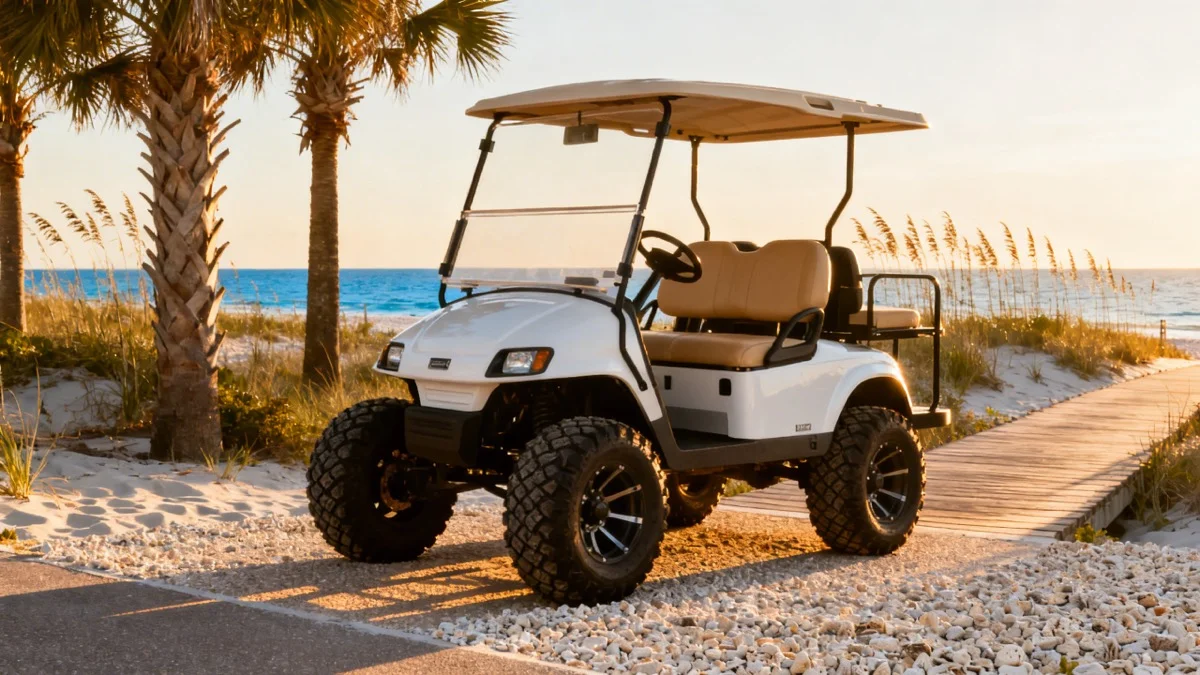
Standard turf tires slip and sink on sandy surfaces. A beach cart needs all-terrain tires with aggressive tread patterns that handle paved roads, packed sand, gravel paths, and crushed shell driveways. For communities near actual beach sand, wider tires (10 to 12 inches) with flotation properties prevent the cart from sinking.
Lifted Suspension
A lift kit (3 to 6 inches) provides clearance for larger all-terrain tires and keeps the undercarriage above sandy, wet surfaces. Lifted carts also handle uneven terrain, speed bumps, and beach access ramps better than stock-height carts.
Best Golf Cart Brands for the Coast
Not all brands are created equal when it comes to corrosion resistance. Here's how the major brands stack up for coastal use:
| Brand | Frame Material | Corrosion Rating | Starting Price | Best For |
|---|---|---|---|---|
| Evolution | Aircraft-grade aluminum | Excellent | $6,795 | Best value for coastal use |
| Bintelli | Aluminum | Excellent | $10,000 | Purpose-built beach models |
| Club Car | Aluminum (select models) | Very good | $9,475 | Premium quality and resale |
| E-Z-GO | Steel | Fair | $8,974 | Best with aftermarket protection |
| Yamaha | Steel | Fair | $9,481 | Reliable engine if choosing gas |
| Star EV | Steel | Fair | $8,000 | Budget option with decent features |
| Icon | Steel | Fair | $8,500 | Good features, needs rust protection |
Evolution: Best Value for Beach Living
Evolution golf carts use aircraft-grade aluminum frames across their entire lineup, making them the most affordable aluminum-frame cart on the market. The D5 Ranger and Forester models are popular in beach communities because they come standard with features that other brands charge extra for: a 9-inch touchscreen, lithium battery, LED lighting, and a rear-facing seat.
The trade-off is a shorter brand history (founded 2016) and documented warranty service delays. For beach buyers, the aluminum frame alone makes Evolution worth serious consideration.
Bintelli: Built for the Beach
Bintelli explicitly designs carts for coastal environments. Their Beyond series features aluminum frames, sealed electrical systems, and corrosion-resistant hardware. Bintelli has a strong dealer network along the Southeast coast (the heart of beach cart country), which makes service and parts easy to find. If Bintelli is on your coastal shortlist, our Bintelli golf cart review covers the real pricing, warranty, and dealer-support tradeoffs in more detail.
Club Car: Premium Coastal Choice
Club Car uses aluminum frames on several models including the Onward and the Tempo. The Onward Lifted 4-Passenger is a popular beach cart because it comes from the factory with a lift, larger tires, and the build quality Club Car is known for. The premium price ($12,000 to $18,000 for lifted models) reflects the brand's reputation for longevity and strong resale value.
E-Z-GO and Yamaha: Steel Frames Need Extra Work
E-Z-GO and Yamaha are both established brands with strong ownership support, but their steel frames need more attention in salt air than aluminum-frame carts. If you choose either brand for beach use, plan on applying a corrosion inhibitor spray every 2 to 3 months and rinsing the frame regularly. Both brands have broad dealer and parts availability, which is an advantage for long-term ownership.
Our Top Picks for Beach Golf Carts
Best Overall: Evolution D5 Ranger 4
Aluminum frame, lithium battery, 9-inch touchscreen, LED lights, and a rear flip seat all standard. Starting around $9,000 to $12,000 depending on the dealer, the D5 Ranger offers the most corrosion-resistant cart at the most competitive price. Add aftermarket all-terrain tires and a lift kit for full beach capability.
Best Budget: Kandi GOAT 2P
If you want an affordable electric cart for beach errands and neighborhood driving, the Kandi GOAT 2P delivers a 5,000W motor and 40-mile range at a compelling price.
The GOAT has a steel frame, so it's not the most corrosion-resistant option. But at under $8,000 delivered to your door, the savings give you budget for aftermarket rust protection and a marine-grade cover. The 40-mile range handles full days of beach town driving on a single charge.
For the full support, warranty, and pricing picture, see our Kandi golf cart review before choosing it over a dealer-backed beach cart.
Best Premium: Club Car Onward Lifted 4-Passenger
For buyers who want to buy once and keep the cart for 15+ years at the coast, the Club Car Onward Lifted with aluminum frame is the gold standard. Factory lift, premium suspension, proven dealer support, and the strongest resale value of any golf cart brand. Expect to pay $14,000 to $18,000 fully equipped.
Best for RV Beach Trips: Kandi Collapsible Mini
If you tow an RV to coastal campgrounds and need a cart you can transport easily, the Kandi Collapsible Mini folds down for storage in a truck bed or RV garage.
At under $4,000, it's the most affordable entry point for beach cart ownership. Perfect for campground and RV park use where you need portability over long-range performance.
Best Value 4-Seater: AODES Trailcross
For families who need a 4-passenger cart with room for a cooler and beach chairs, the AODES Trailcross offers a 48V system and 40-mile range with rugged styling.
The Trailcross comes with a street-legal package, making it ready for beach town roads out of the box. At $7,249, it undercuts most 4-passenger carts by $2,000 to $5,000.
Must-Have Modifications for Beach Use
Even the best beach cart benefits from a few upgrades tailored to coastal conditions.
Tires and Lift Kit
Stock turf tires and standard ride height are fine for the golf course but not for the coast. Upgrade to:
- All-terrain tires with 22 to 23 inch diameter and aggressive tread for packed sand, gravel, and crushed shell roads
- 3 to 6 inch lift kit to clear the larger tires and raise the undercarriage above sandy, wet surfaces
- Stainless steel lug nuts to replace factory steel lugs that will rust within months at the coast
Weather Protection
Beach weather changes fast. A sudden afternoon storm can soak an unprotected cart.
- Fold-down windshield: Blocks wind and rain while driving, folds flat on sunny days
- Golf cart enclosure: Full rain protection for all passengers and the seats
- Extended roof or canopy: Provides shade from direct sun and keeps rain off the rear passengers
Beach-Specific Accessories
These accessories make beach cart life genuinely better:
- Phone mount for GPS navigation in unfamiliar beach towns. The A2C below requires a square iron roof strut that passes a magnet test; salt-prone aluminum and round supports need a clamp or strap mount.
- Cooler rack or hitch-mounted carrier for drinks and beach supplies
- Roof rack for beach chairs, towels, umbrellas, paddleboards, and other light bulky gear
- Fishing rod holders for pier, pond, and beach-town trips where rods need to stay clear of passengers and salt spray
- Bluetooth speakers for music on the ride
- LED light kit for evening rides and street-legal compliance
- Rubber floor mats with raised edges to contain sand (rubber is easier to clean than carpet)
- Side mirrors required for road use in most beach towns
Corrosion Protection Upgrades
A corrosion inhibitor spray is cheap insurance for any cart at the coast. Apply to the frame, suspension hardware, bolts, and any exposed steel components every 2 to 3 months.
Meguiar's Marine Corrosion Protectant SprayThis spray leaves a clear, dry coating that blocks salt air from reaching metal surfaces. One can covers an entire golf cart frame and hardware. For best results, rinse the cart with fresh water first, let it dry, then apply the protectant. For a deeper look at undercoating, treatment products, and climate-specific strategies, see our complete rust prevention and corrosion guide.
Protecting Your Cart from Salt Air Damage
Salt air is the number one enemy of golf carts at the coast. Here's a proven maintenance routine that keeps coastal carts running for years.
After Every Ride
- Rinse the entire cart with fresh water. Focus on the undercarriage, wheel wells, and any exposed metal hardware. This takes 5 minutes and removes salt deposits before they start corroding.
- Wipe down the seats. Sunscreen, salt spray, and sand on vinyl seats degrade the material over time. A quick wipe with a damp cloth prevents buildup.
For a complete step-by-step cleaning process, see our golf cart cleaning guide.
Monthly Maintenance
- Apply UV protectant to all vinyl seats, dashboard, and plastic trim. Salt air combined with sun exposure is especially harsh on vinyl. 303 Aerospace Protectant is the standard for UV protection.
- Check battery terminals for corrosion. Clean with baking soda solution if needed. Coastal humidity accelerates terminal corrosion. See our battery guide for detailed cleaning instructions.
- Inspect the frame and hardware for early signs of rust (orange/brown spots, white powdery residue on aluminum). Catching corrosion early is much easier to fix than advanced rust.
Quarterly Protection
- Spray corrosion inhibitor on the entire frame, all bolts and brackets, suspension components, and steering hardware.
- Wax all painted surfaces to create a barrier against salt deposits. See our cleaning guide for waxing techniques.
- Lubricate all moving parts with a marine-grade lubricant (not WD-40, which dries out quickly). Hinges, pedal mechanisms, seat latches, and steering joints all benefit.
Storage Matters
Store your cart in a garage, carport, or under a breathable cover when not in use. Leaving a cart uncovered in salt air 24/7 dramatically shortens its lifespan. If garage space is tight, even a simple carport or covered parking spot makes a significant difference.
Make sure the storage area is ventilated. Enclosed, humid spaces without airflow promote mold growth on seats and condensation on electrical components.
Top Beach Towns Where Golf Carts Rule
Golf carts are a way of life in these coastal communities. If you're considering a move or vacation property, these towns have the infrastructure, laws, and culture to support full-time cart ownership.
Bald Head Island, North Carolina
The gold standard for golf cart living. Bald Head Island is car-free. You take a 20-minute ferry from Southport, and personal automobiles are not allowed on the island. Every resident and visitor gets around by golf cart, bicycle, or foot. The island speed limit is 18 mph, and all carts must be electric.
Myrtle Beach Area, South Carolina
The Grand Strand (Myrtle Beach, North Myrtle Beach, Surfside Beach) has one of the largest golf cart communities in the country. South Carolina law allows golf carts on roads with speed limits of 35 mph or lower. Carts must be registered, permitted, and insured through the DMV. Operators must be at least 16 with a valid driver's license.
The Villages, Florida
While technically not a beach town, The Villages is the world's largest golf cart community and a short drive from Florida's Gulf Coast. Over 80,000 golf carts navigate 100+ miles of dedicated cart paths connecting shops, restaurants, and recreation centers. Florida's golf cart laws are among the most cart-friendly in the country.
Hilton Head Island, South Carolina
Hilton Head's network of multi-use paths makes it one of the most bike and cart-friendly beach destinations in the Southeast. The island allows golf carts on designated paths and roads. Most resort communities within Hilton Head have their own cart-friendly infrastructure.
Outer Banks, North Carolina
Multiple Outer Banks communities including Duck, Corolla, and Ocracoke are golf cart friendly. North Carolina law allows golf carts on roads with speed limits of 35 mph or lower. The OBX's flat terrain and short distances between attractions make carts ideal for vacation transportation.
Gulf Shores and Orange Beach, Alabama
The Alabama Gulf Coast has embraced golf carts as vacation transportation. Alabama law permits golf carts on roads with speed limits of 25 mph or lower. Beach rental companies offer carts by the day or week, making it easy to try before you buy. You can also compare golf cart rentals near you if you want a local vacation option before buying.
Other Notable Beach Cart Towns
- Destin and 30A, Florida - Cart-friendly planned communities along the Gulf Coast
- Galveston, Texas - Cart-legal on many island roads with proper registration
- Put-in-Bay, Ohio - Island community on Lake Erie where golf carts outnumber cars
- Isle of Palms, South Carolina - Cart-friendly beach community near Charleston
- Kiawah Island, South Carolina - Upscale resort community with cart paths everywhere
For a deeper dive into golf cart communities, see our guide to the best golf cart communities in America.
Beach Cart Laws and Requirements
Before driving a golf cart on beach town roads, you need to know the local laws. Requirements vary by state and municipality, but most beach towns share these common rules:
Typical Requirements for Street Use
- Registration with the state DMV or local municipality
- Insurance with minimum liability coverage (check your state requirements)
- Valid driver's license for the operator (minimum age varies, typically 16)
- Safety equipment: headlights, taillights, turn signals, mirrors, horn, and seat belts
- Speed limit compliance: Golf carts are restricted to roads with speed limits of 25 to 35 mph depending on the state
- Daytime-only operation in some areas (South Carolina restricts to daylight hours unless the cart has a full lighting package)
Street-Legal vs. LSV
Most beach towns distinguish between standard golf carts (top speed under 20 mph) and Low-Speed Vehicles (LSVs, 20 to 25 mph). LSVs meet federal safety standards and are legal on more roads. Converting your cart to street-legal status typically requires adding lights, mirrors, seat belts, and a VIN/serial number plate.
Check our state-by-state golf cart laws page for the specific regulations in your area.
Beach Cart Cost Breakdown
Here's what to budget for a beach-ready golf cart setup:
| Item | Budget Option | Mid-Range | Premium |
|---|---|---|---|
| Base cart (new) | $7,000 to $9,000 | $10,000 to $14,000 | $15,000 to $20,000 |
| Lift kit + installation | $300 to $600 | $600 to $1,200 | $1,200 to $2,000 |
| All-terrain tires + wheels | $400 to $700 | $700 to $1,200 | $1,200 to $1,800 |
| Street-legal package | $200 to $500 | Included | Included |
| Cover/enclosure | $100 to $200 | $200 to $400 | $400 to $800 |
| Accessories | $100 to $300 | $300 to $600 | $600 to $1,000 |
| Annual insurance | $75 to $200 | $200 to $400 | $400 to $700 |
| Total first-year cost | $8,175 to $11,500 | $12,000 to $17,800 | $18,800 to $26,300 |
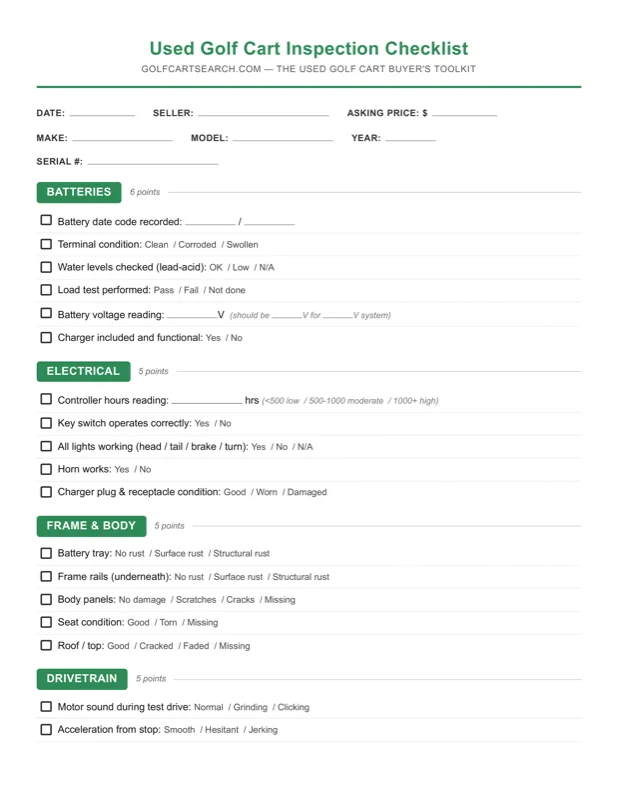
A used golf cart in good condition cuts the base price by 40% to 60%. Just inspect the frame carefully for corrosion if buying a used cart from a coastal area. What looks like a great deal on a 5-year-old beach cart can turn into an expensive frame replacement if rust has taken hold.
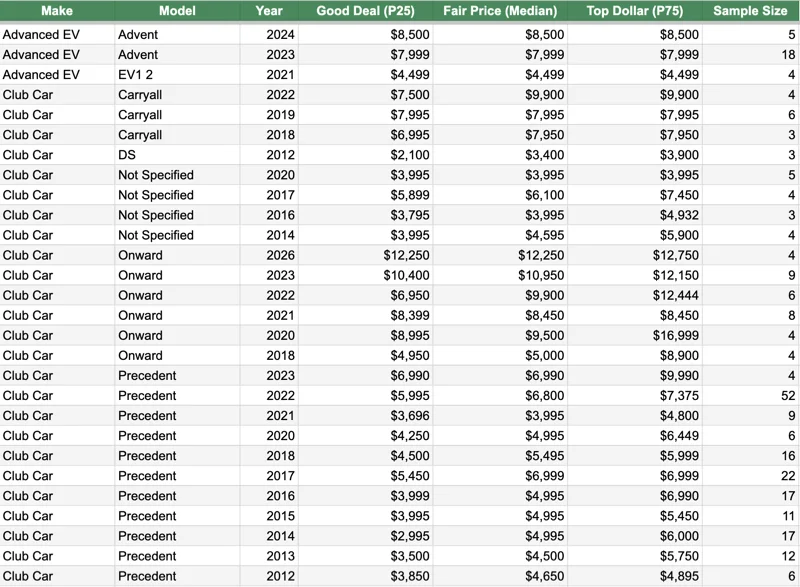
For current pricing and value data, check our pricing guide.
Finding a Beach Golf Cart Dealer
The best way to buy a beach-ready golf cart is from a local dealer in a coastal area. These dealers understand the specific needs of beach cart owners and stock models with the right features. They can also recommend the best accessories and modifications for your specific location.
Search our dealer directory to find golf cart dealers near your beach town. For South Carolina dealers, Florida dealers, North Carolina dealers, and Texas dealers, we have curated lists of the best golf cart brands and top-rated models to help you compare.
Frequently Asked Questions
How long does a golf cart last at the beach?
With an aluminum frame and proper maintenance, a beach golf cart can last 15 to 20 years. Steel-frame carts in coastal conditions typically show significant rust within 3 to 5 years. The batteries will need replacement every 5 to 7 years for lead-acid or 10 to 15 years for lithium, but the cart itself should last much longer with regular care.
Can you rent a golf cart at the beach?
Yes, most beach towns with golf cart culture have rental companies. Daily rentals run $50 to $150, weekly rentals $200 to $500. Renting is a great way to test whether beach cart life is for you before committing to a purchase. Browse golf cart rentals near you for current local options, and see our rent vs. buy guide for the cost math.
What speed do beach golf carts go?
Standard golf carts top out at 15 to 19 mph. LSVs (Low-Speed Vehicles) reach 20 to 25 mph. Most beach towns set speed limits at 15 to 25 mph on cart-legal roads, so stock speed is usually sufficient. If you want more speed, see our speed guide and speed upgrade options.
Should I buy new or used for a beach cart?
Both work, but inspect used carts carefully. Check the frame for rust (look under seats, around the battery tray, and at the rear axle), test all electrical connections, and inspect the battery condition. A used cart from an inland area that you bring to the coast is often a better deal than a used cart that has already spent years in salt air. Check our used buying guide and value calculator for help.
Do I need a DUI worry on a golf cart at the beach?
Yes. In every state, DUI laws apply to golf carts on public roads. Beach vacation areas see a spike in golf cart DUI arrests during tourist season. The penalties are the same as a regular vehicle DUI. Don't drink and drive, even on a golf cart.
Can I write off a beach golf cart on my taxes?
If you use the golf cart for business purposes (rental property management, business transportation), you may qualify for a Section 179 deduction. Personal-use beach carts are not tax-deductible. Consult a tax professional for your specific situation.
Golf Cart Search
Find the Best Golf Carts of 2026
Compare top-rated models, read expert reviews, and find the perfect cart for your needs.