As an Amazon Associate, we earn from qualifying purchases. This helps support our site at no extra cost to you.
Knowing how to jack up a golf cart is basic owner safety. A flat tire, brake adjustment, wheel spacer install, lift kit, or shock replacement all start the same way: get the cart stable before you remove anything.
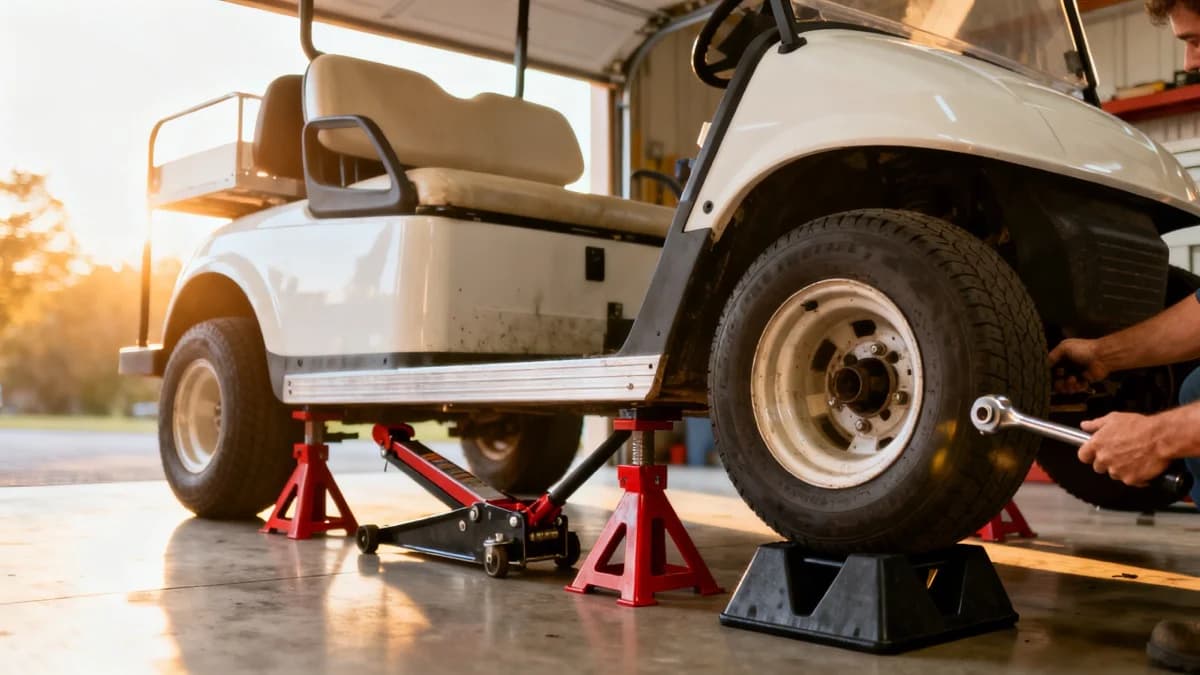
The short answer is simple. For most owners, the best golf cart jack is a low-profile 2-ton hydraulic floor jack used with a pair of rated jack stands and wheel chocks. Park on flat concrete, find the approved lift point in the exact model manual, lift slowly, and lower the cart onto stands. Never choose a contact point by appearance alone.
This guide covers the best jack type, how official lift instructions differ by model, and the sequence to lift a cart without bending parts or putting yourself under a suspended load.
Best Golf Cart Jack: Quick Answer
| Tool | Best choice | Job |
|---|---|---|
| Floor jack | Low-profile hydraulic, about 2 tons | Lifts the cart in a controlled way |
| Jack stands | A matched pair rated for 2 to 3 tons | Supports the cart after lifting |
| Wheel chocks | Solid rubber pair | Prevents the grounded wheels from rolling |
| Bottle or scissor jack | Emergency use only when the manual permits it | A tire change away from the garage |
| ATV or motorcycle lift | Only when its contact points match the cart maker's instructions | Specialized full-cart work |
A higher weight rating does not make an unapproved contact point safe. The manual for the exact model controls both jack placement and stand placement.
The Safe Way to Jack Up a Golf Cart
Use this sequence for a tire change, brake inspection, wheel swap, spacer install, or any basic undercarriage job.
- Park on flat concrete.
- Turn the key off and set the parking brake.
- Put the cart in tow/maintenance mode if it is electric and you will be near wiring or the motor.
- Chock the wheels that stay on the ground.
- Break the lug nuts loose while the tire is still touching the ground.
- Place the floor jack at the lift point shown in the exact model manual.
- Raise the cart slowly, just high enough for the job.
- Slide jack stands under the frame.
- Lower the cart onto the stands and confirm it is stable.
- Remove the wheel or start the repair.
This is not just cautious garage advice. OSHA's portable jack rule says the jack must be rated for the load and the raised load must be secured at once. You are not running a workplace in your driveway, but the physics are the same.
Tools You Need Before Lifting
The basic lifting kit is small, but every item matters.
| Tool | What to buy | Typical cost | Why it matters |
|---|---|---|---|
| Floor jack | Low-profile hydraulic, 1.5 to 2 tons | $45-$90 | Lifts the cart smoothly from the frame |
| Jack stands | Pair rated for 2 to 3 tons | $30-$50 | Supports the cart after lifting |
| Wheel chocks | Solid rubber pair | $15-$25 | Stops rolling while one end is raised |
| Lug wrench or socket | 3/4-inch and 19mm coverage | $15-$80 | Fits the common lug sizes |
| Torque wrench | 10-80 ft-lb or broader range | $30-$60 | Tightens wheels without guessing |
| Gloves and eye protection | Mechanic gloves and safety glasses | $10-$25 | Protects hands and eyes from slipping tools and debris |
If you are building a garage kit from scratch, our essential golf cart tool kit guide covers socket sizes, multimeters, tire gauges, and battery tools by brand.
Best Floor Jack for Most Owners
A 2-ton low-profile hydraulic floor jack is the right balance for most carts. It slides under stock carts, has enough capacity for lifted carts, and is much more stable than a bottle jack.
The Pro-Lift F-767 is a practical budget pick because it has a low starting height, 2-ton rating, and a compact body that fits in small garages. Expect a typical street price around $50 to $80.
Check Pro-Lift 2-Ton Floor Jack PriceBest Jack Stands for Golf Cart Work
Use stands even if the job feels quick. A pair of 3-ton jack stands is more capacity than a golf cart needs, but the wider base and double-locking pin style are worth the small price difference. The Torin Big Red stands are a common garage pick in the $35 to $45 range.
Check Torin Big Red Jack Stands PriceBest Wheel Chocks for a Golf Cart
Do not skip chocks. Golf carts are light enough to roll if one end is raised and the parking brake is not holding both sides evenly. Solid rubber chocks grip better than cheap hollow plastic wedges and still cost about $15 to $20 per pair.
Check MaxxHaul Rubber Wheel Chocks PriceBest Socket and Torque Setup
Golf Cart Tire Supply's lug guide gives the common split clearly: Club Car and EZGO usually use 1/2-20 lugs, while Yamaha uses 12mm x 1.25 lugs. In the garage, that usually means a 3/4-inch socket for Club Car, EZGO, and ICON, and a 19mm socket for Yamaha and many Star EV carts.
A combined SAE and metric socket set keeps you covered across brands.
Check DEWALT Socket Set PriceFinish with a torque wrench, but do not use one generic setting for every golf cart. One current Yamaha owner's manual, for example, specifies 74 ft-lb for its wheel nuts. Use the exact cart, wheel, spacer, or hub specification that applies to your setup.
Check EPAuto 3/8-Inch Torque Wrench PriceGolf Cart Jack Points by Brand
The exact lifting points change by model. The table below tells you where to find the controlling instruction, not permission to use one generic point across an entire brand.
| Brand or model family | What the official guidance establishes | What to do |
|---|---|---|
| Club Car DS, Precedent, Tempo, and Onward | Lift and support locations vary by chassis and year | Use the exact owner or service manual diagram |
| E-Z-GO TXT, RXV, Valor, and Express | E-Z-GO manuals show different points for front, rear, and whole-cart lifting | Match the model and lift procedure to its diagram |
| Yamaha G-series, Drive, and Drive2 | Yamaha requires blocked wheels, a suitable jack, and stands; model instructions control placement | Use the exact Yamaha manual for the model code |
| ICON, Star EV, Evolution, and Advanced EV | Chassis and battery layouts differ substantially | Use the manufacturer's model-specific instructions |
| Lifted or modified carts | A lift kit changes height and may change approved service steps | Follow both the cart and lift-kit instructions |
If you cannot match the underside of your cart to the manual diagram, stop. Looking stronger is not enough to identify an approved lifting point.
Club Car Jack Points
Club Car has several chassis families, so do not transfer a DS lifting point to a Precedent, Tempo, or Onward. Identify the model and year, then use its owner or service manual diagram for both the jack and the stands.
Club Car's aluminum frame is a strength advantage for corrosion resistance, which we discuss in the Club Car review, but aluminum can still dent if you concentrate the jack saddle on a thin edge. Use a flat saddle pad or wood block if the contact area is narrow. The block spreads load. It is not a substitute for the correct lift point.
EZGO Jack Points
E-Z-GO's official lifting procedure shows why model-specific instructions matter. In that manual, the whole-cart procedure places the jack under the bag-well center and the stands under the frame at the leaf-spring mounting brackets. Its front-only procedure uses a different center point behind the bumper and different stand locations. Do not assume those locations transfer to another TXT, RXV, Valor, or Express chassis.
The main EZGO mistakes are lifting under the rear motor area, the battery tray, or a body bracket. Those parts may look solid from a distance, but they are not designed to carry the cart's weight on a small jack saddle.
If you are lifting an older EZGO for brakes, combine this guide with our golf cart brakes maintenance guide. Rear brake work usually requires both rear wheels off the ground, and that means two stands under the frame, not one jack under the center.
Yamaha Jack Points
Yamaha owners need to pay attention because Drive, G29, and Drive2 carts are often grouped together in product listings even when body and underbody details differ.
Yamaha's official manuals require wheel blocks, a suitable jack, and car stands. Because the G-series, Drive G29, and Drive2 underbodies differ, use the model code to find the correct diagram before the jack touches the cart.
Yamaha also differs on lug hardware. Many Yamaha carts use metric 12mm x 1.25 lugs and a 19mm socket. If your socket feels slightly loose, stop and verify the size instead of rounding a lug nut.
For model identification before ordering parts, use our golf cart serial number lookup guide. It helps separate Drive G29 from Drive2, which matters for seats, windshields, lights, and some underbody parts.
How to Change a Golf Cart Tire Safely
A tire change is the most common reason owners search for jack points. The process is short, but the order matters.
Tire Change Steps
- Park on level concrete.
- Set the parking brake.
- Chock the wheel diagonally opposite the tire you are changing.
- Break the lug nuts loose one half turn while the tire is on the ground.
- Place the jack under the frame near that wheel.
- Raise the cart until the tire clears the ground by about 1 inch.
- Place a jack stand under the frame.
- Lower the frame onto the stand.
- Remove the lug nuts and wheel.
- Install the new wheel and hand-thread the lug nuts.
- Snug the nuts in a star pattern.
- Lower the cart until the tire touches the ground.
- Torque the lug nuts in a star pattern.
- Lower fully and remove the chock.
If you are replacing all four tires, work one corner at a time unless you have enough stands and experience to support the whole cart. Pre-mounted tire and wheel combos are the easiest DIY route. Our golf cart tires and wheels finder covers turf, street, all-terrain, and DOT tire choices.
Lug Nut Socket and Torque Reference
| Brand | Common socket | Common thread | Practical torque guidance |
|---|---|---|---|
| Club Car | 3/4-inch | 1/2-20 | Use the exact cart or wheel specification |
| EZGO | 3/4-inch | 1/2-20 | Use the exact cart or wheel specification |
| ICON | 3/4-inch | 1/2-20 on many models | Verify before forcing |
| Yamaha | 19mm | 12mm x 1.25 | Verify metric hardware |
| Star EV | 19mm on many models | 12mm x 1.25 on many models | Verify metric hardware |
After any wheel removal, drive slowly for a short loop, then recheck torque. This matters even more if you installed wheel spacers, new wheels, or a lift kit.
Front, Rear, and Full-Cart Lifting
Different jobs need different lift setups. Match the lift to the job instead of raising more of the cart than needed.
Lifting One Front Corner
Use this for a front tire change, front shock check, front-end inspection, or wheel alignment prep.
Chock both rear wheels, then use the front jack point and stand location shown in the exact model manual. Do not substitute a steering arm, spindle, body bracket, or suspension arm.
Lifting One Rear Corner
Use this for a rear tire change or quick inspection.
Chock the front wheels, then use the rear jack point and stand location shown in the exact model manual. Do not substitute a rear body bracket, differential housing, motor housing, or suspension part. If the parking brake is cable-operated on the rear axle, remember that raising one rear wheel can change how secure the cart feels. Chocks are not optional.
Lifting the Full Front or Full Rear
Use this for brake adjustment, underbody cleaning, or paired suspension work.
Use a center lifting point only when the exact manual identifies it for that procedure. Follow its order for placing both stands. When both sides are supported, confirm the cart is stable before removing wheels.
Lifting All Four Wheels
Four-wheel lifting is useful for long-term storage, tire rotation, full undercarriage cleaning, and some garage storage setups. It also carries more risk because the whole cart is off the ground.
Use four stands, keep the surface level, and never raise one end high enough to make the other end unstable. If your cart has a rear seat kit, cargo box, roof rack, or heavy battery pack, account for the weight distribution. A six-passenger cart is not balanced like a basic two-passenger fleet cart.
What Not to Use as a Jack Point
Most damage happens because a part looks stronger than it really is. Avoid these areas unless your service manual specifically says otherwise.
- Plastic rocker panels or body skirts
- Front cowl or rear body panel
- Battery tray or battery box
- Controller tray
- Motor housing
- Rear differential housing
- Brake cables
- Steering rack or tie rods
- Leaf springs
- A-arms and spindles
- Rear footrest brackets
- Lift blocks or wheel spacers
If a jack saddle starts bending, slipping, or biting into a part, stop immediately and lower the cart. A damaged frame contact point is cheaper than a dropped cart, but both are avoidable.
Special Cases: Lifted, Lithium, and Rusty Carts
Lifted Golf Carts
Lifted carts need more care because the center of gravity is higher and the frame may sit above the normal jack range. A low-profile jack may fit under the frame but not lift high enough to get a tall tire off the ground. In that case, use a higher-lift floor jack or a stable wood crib under the jack wheels, not loose blocks under the cart.
If you are installing a lift kit, read the kit instructions before lifting. Some kits require the suspension to hang freely, while others want one axle supported in a specific way.
Lithium Battery Carts
Lithium conversions remove a lot of battery weight from the middle of the cart. That is good for performance, but it can change how the cart feels on a jack compared with the same model on lead-acid batteries. Lift slowly and keep the jack saddle centered.
If you are converting to lithium, our lithium battery conversion guide covers battery weight, mounting, cables, and charger compatibility.
Rusty or Coastal Carts
On older coastal carts, frame rails and crossmembers may have rust, corrosion, or crushed spots from prior bad jacking. Inspect before you lift. If the frame flakes, cracks, or bends around the jack saddle, stop and get help from a shop.
Our rust prevention guide covers battery acid cleanup, frame protection, and coastal corrosion. If the cart already has structural rust, find a local golf cart repair shop through our repair directory before you crawl underneath it.
Jobs That Require Jacking Up a Golf Cart
You do not need to raise a cart for every maintenance task. Battery voltage checks, dashboard work, basic charging problems, and many no-start diagnostics can be done with the cart on the ground.
You usually do need to lift the cart for these jobs:
- Tire replacement or rotation
- Brake shoe inspection and adjustment
- Wheel spacer install
- Lift kit install
- Shock replacement
- Front-end inspection
- Wheel bearing checks
- Undercarriage cleaning
- Rust treatment
- Long-term storage on stands
For seasonal maintenance, combine a safe lift with our spring golf cart checklist, tire pressure chart, and cleaning guide.
Common Mistakes to Avoid
Using a Bottle Jack on a Light Cart
Bottle jacks can lift a lot of weight, but their small base is not ideal for a light, narrow golf cart. They are more likely to tilt as the cart shifts. A floor jack with wheels and a wider stance is the better tool.
Jacking on Grass or Gravel
Grass and gravel let the jack sink or roll unpredictably. If you cannot move to concrete, wait until you can. A rushed repair on soft ground is where simple tire changes become dangerous.
Lifting Too High
Lift only high enough to do the job. For a tire change, you need about 1 inch of clearance under the tire. Raising the cart higher just increases the chance that it shifts.
Removing Lug Nuts Before Lifting
Break the lugs loose before lifting, but do not remove them until the cart is supported on a stand. If you try to loosen tight lugs while the wheel is hanging, the wheel spins and the cart can move on the jack.
Trusting the Parking Brake Alone
A parking brake is not a wheel chock. Cables stretch, brake shoes wear, and some carts only hold one axle well. Use chocks on the wheels that stay down.
Forgetting the Final Torque Check
Hand-tight is not good enough. After reinstalling a wheel, torque the lugs in a star pattern. Recheck after a short drive, especially after installing aftermarket wheels, spacers, or a lift.
When to Let a Shop Handle It
Jacking a golf cart for a tire change is a reasonable DIY job. Some situations are not.
Call a shop if:
- The frame is rusty, cracked, bent, or previously crushed
- You cannot identify a safe frame lift point
- The cart is lifted and your stands do not reach safely
- Suspension bolts are seized
- The job involves welding
- The cart shifts while you are lifting
- You need brake repair but are not comfortable adjusting both sides evenly
Most golf cart repair shops charge less than the cost of one damaged body panel or bent suspension part. If you are buying a used cart and notice crushed frame rails, uneven lift-kit hardware, or mangled jack points, use our used golf cart buying guide before negotiating. If the cart looks abused underneath, compare cleaner local options in the dealer directory before you inherit somebody else's bad repair history.
Frequently Asked Questions
Where do you jack up a golf cart?
Use only the point shown in the lifting diagram for your exact model and procedure. Do not substitute body panels, battery trays, steering parts, suspension parts, axle housings, or motor housings.
What kind of jack do I need for a golf cart?
A low-profile hydraulic floor jack rated for 1.5 to 2 tons is the best choice. A 2-ton jack gives plenty of margin for most stock, lifted, and four-passenger carts.
Do I need jack stands for a golf cart?
Yes. If a wheel is coming off or you are working near the underside, lower the cart onto jack stands first. The floor jack should not be the only support.
Can I jack up a golf cart by the axle?
Avoid it unless the exact manual specifically approves that point. Use the model-specific jack and stand locations instead. Axle housings, differential housings, and motor areas can be damaged by concentrated jack pressure.
Where are Club Car jack points?
They vary among DS, Precedent, Tempo, and Onward chassis. Use the lifting diagram in the manual for the exact model and year rather than a generic Club Car location.
Where are EZGO jack points?
They vary by model and by whether you are lifting the front, rear, or whole cart. Use the exact E-Z-GO manual diagram. Do not transfer the points from one TXT, RXV, Valor, or Express procedure to another.
Where are Yamaha jack points?
They vary by model. Yamaha manuals require blocked wheels, a suitable jack, and stands, while the exact contact location comes from the model-specific diagram.
What size socket do golf cart lug nuts use?
Club Car, EZGO, and ICON commonly use a 3/4-inch socket. Yamaha and many Star EV carts commonly use a 19mm socket. Aftermarket wheels may use different hardware, so verify fit before applying force.
What torque should golf cart lug nuts be?
There is no universal number. Use the exact cart, wheel, hub, or spacer specification. One current Yamaha manual specifies 74 ft-lb, so a generic 50 ft-lb target can under-torque some carts.
Can I store a golf cart on jack stands?
Yes. For storage longer than a couple months, stands can prevent tire flat spots. Support the frame evenly, keep the cart on level concrete, and do not leave the cart balanced on a jack.
Is a lifted golf cart harder to jack up?
Yes. A lifted cart sits higher and has a higher center of gravity. You may need taller stands or a jack with more lift range. Work slowly and keep the cart level.
Should I put the cart in tow mode before lifting?
For many electric carts, yes, especially if you will be near wiring, the motor, controller, or battery cables. Tow/maintenance mode helps prevent unexpected movement and protects sensitive electronics during some service tasks.
Golf Cart Search
Find the Best Golf Carts of 2026
Compare top-rated models, read expert reviews, and find the perfect cart for your needs.