As an Amazon Associate, we earn from qualifying purchases. This helps support our site at no extra cost to you.
A golf cart battery hydrometer is useful for comparing individual serviceable flooded lead-acid cells. It cannot certify battery capacity, and it must never become a reason to open a sealed battery. Record the actual battery model, charge preparation, electrolyte temperature and every cell reading before deciding what the numbers mean.
If the cart runs out of power early, a single pack-voltage reading can leave questions unanswered. A cell log gives a repair shop something more specific to investigate. This guide covers that log and its limits; our battery voltage chart covers electrical measurements, while the battery replacement guide covers chemistry and replacement choices.
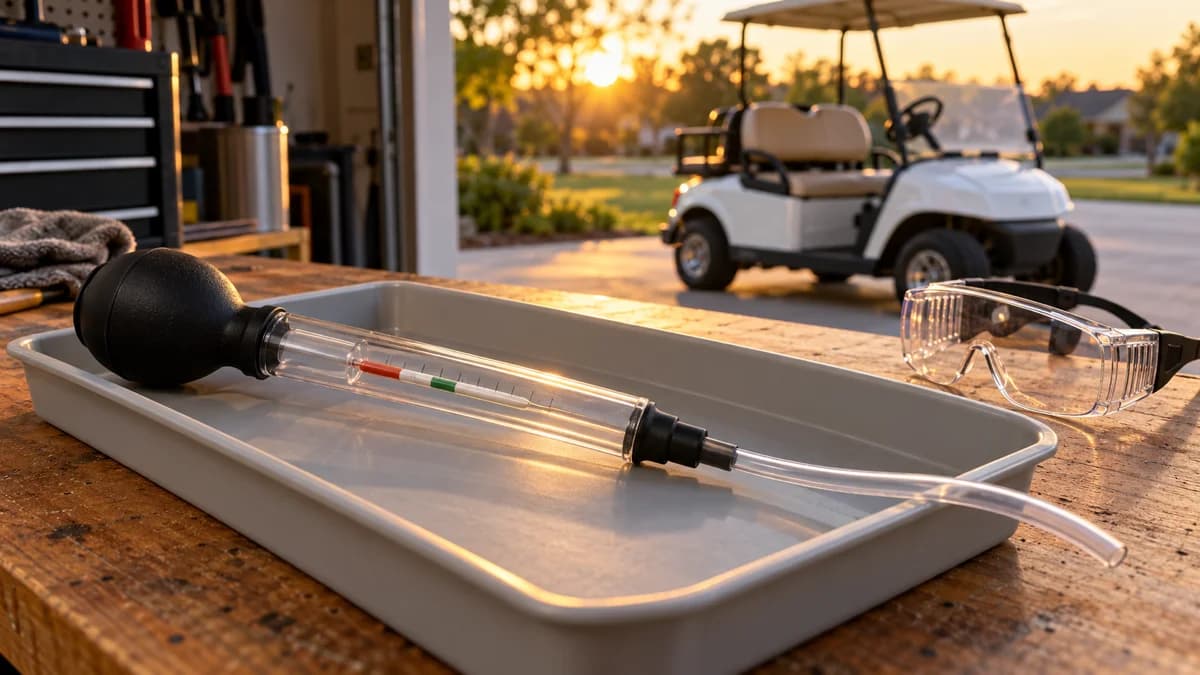
Hero: AI-generated editorial illustration. It does not show equipment we physically tested.
Golf cart battery hydrometer readings: two source checks
On October 20, 2026, we compared two manufacturer references: Trojan’s current Battery Maintenance webpage and U.S. Battery’s rev. 12_21 lead-battery user manual, still hosted on its manufacturer site. We extracted the reference temperature, full-charge entry and follow-up instructions. This is document research, not a test of batteries or instruments.
| Reference checked | Full-charge entry | Temperature basis |
|---|---|---|
| Trojan Battery Maintenance, Testing section | 1.277, with stated factory tolerance of ±0.007 | 80°F |
| U.S. Battery manual, Table 8, printed p. 39 | 1.270 in its 100% state-of-charge row | 80°F |
Sources: Trojan’s maintenance instructions and U.S. Battery’s manual, pp. 36–39. Confirm the specification for the exact battery rather than assigning either row to every product that manufacturer has made.
Our comparison: the listed central values differ by 0.007. That difference is not a measured performance advantage. It shows why a screenshot of somebody else’s charge chart is a poor replacement for the installed battery’s documentation. This two-reference sample cannot describe all flooded batteries on the market.
There is also a documentation problem worth catching. Trojan’s FAQ states a correction of four points per 10°F, but its adjacent worked examples use three points. Our arithmetic below explicitly uses the separate maintenance page’s 0.004 per 10°F rule. Ask the manufacturer to resolve conflicting instructions for your application; do not average them into a new rule.
A Club Car, E-Z-GO or Yamaha badge cannot identify replacement batteries installed years later. Photograph the battery labels. Use the serial-number guide for the vehicle’s identity, then document the battery pack separately.
Decide whether sampling is appropriate
Look for a manufacturer-confirmed, serviceable flooded lead-acid battery with accessible cell vents. A cap-shaped feature is not proof that a battery should be opened. AGM, gel and lithium require their own diagnostic procedures. For a lithium pack that will not accept charge, start with the BMS and charging guide, not an acid-sampling tool.
Read the battery safety instructions before removing a cap. U.S. Battery specifies acid-resistant gloves, goggles and protective clothing, ventilation, removal of metal jewelry, and keeping ignition sources away. Never set conductive objects across battery terminals. Its manual also requires securing vents before charging. A cracked, leaking or otherwise damaged pack needs service rather than a sampling session. Use a golf cart repair provider if the battery is inaccessible or you cannot follow the required handling and isolation procedure.
The cart and charger have separate shutdown instructions. Follow both before access; switching off the key does not remove stored battery energy. This article does not supply a universal cable-disconnection sequence. Keep children, pets and distractions out of the work area, and have the manufacturer’s spill and exposure instructions available.
Prepare a record before opening the first cell
Label batteries on a sketch as B1, B2 and so on. Give cells a repeatable order on that sketch, and use the same orientation every time. Do not rely on memory once the seat is lowered.
Record these items at the top of the sheet:
- Cart identity and actual pack configuration.
- Battery manufacturer, model, date code and installation date if known.
- Charger model and selected battery profile.
- Date and time the charge completed, and the required preparation or rest condition.
- Any recent water addition, spill, repair or battery replacement.
- Instrument model, whether it compensates automatically, and the temperature method.
This separates a real comparison from a collection of unexplained numbers. A photograph reading “1.250” has little diagnostic value if nobody knows which cell it came from or whether water was just added.
For watering preparation, follow the battery watering guide. Do not top off solely to obtain a test reading. Exposed plates require the battery maker’s minimum-water and charging procedure first. Record what happened, then test under its specified conditions. Do not add acid or additives to chase a target number.
Take consistent samples and retain the raw readings
The applicable manufacturer and instrument instructions control the actual sampling procedure. Trojan’s maintenance page calls for conditioning the hydrometer with repeated fills and drains, enough sample to support the float, recording every cell, returning the sample, and replacing the vents. Keep each sample with its original cell; transferring electrolyte between cells destroys the meaning of the comparison.
Read a floating scale as its instrument instructions require, with the float free rather than touching the barrel. Record the raw value before any manual correction. If the reading is unclear, repeat it and retain both results instead of selecting whichever looks healthier.
Rolls’ instrument guidance favors a numerical float reading over colored-ball interpretation and warns that hydrometers have measurement limits. This matters when the decision turns on a few points: instrument resolution is not the same as verified accuracy. We have not calibrated or compared the tools linked below.
Do not insert a general-purpose temperature probe into electrolyte unless its manufacturer explicitly approves that chemical use. Temperature capability on a multimeter does not establish acid compatibility. Follow an approved electrolyte-temperature method rather than substituting garage air temperature without checking the procedure.
Golf cart battery hydrometer temperature correction
For an instrument requiring manual correction under the cited Trojan maintenance rule, our Fahrenheit calculation is:
Corrected SG = raw SG + 0.004 × (electrolyte °F − 80) ÷ 10.
These are illustrative calculations, not readings from a customer’s cart. The arithmetic isolates temperature’s effect by holding the raw reading at 1.260 in all five rows.
| Electrolyte temperature | Manual correction | Corrected result from raw 1.260 |
|---|---|---|
| 50°F | −0.012 | 1.248 |
| 60°F | −0.008 | 1.252 |
| 80°F | 0.000 | 1.260 |
| 90°F | +0.004 | 1.264 |
| 100°F | +0.008 | 1.268 |
The cold-weather sign is easy to reverse. At 60°F, raw 1.280 − 0.008 = 1.272. Adding instead would produce 1.288, a 0.016 error relative to this calculation. Do not use that example as a universal state-of-charge label.
A temperature-compensating instrument may already make an adjustment. Adding this table again can double-correct the result. Establish what the instrument reports and which reference it uses before comparing it with a battery chart. If those instructions do not align, get clarification rather than applying two corrections.
For fall storage, retain the corrected value and test date alongside the winter-storage plan. The comparison is only useful next month if the same preparation and recording method can be repeated.
A cell worksheet that does not hide the outlier
Our second worked example uses invented teaching inputs, deliberately labeled here so they cannot be mistaken for an owner test. Assume one serviceable 8V flooded battery with four cells, all sampled at 60°F using the manual-correction rule above.
| Cell | Raw SG | Corrected SG |
|---|---|---|
| B1-C1 | 1.280 | 1.272 |
| B1-C2 | 1.278 | 1.270 |
| B1-C3 | 1.279 | 1.271 |
| B1-C4 | 1.250 | 1.242 |
The corrected average is 1.26375, rounded to 1.264. The highest-to-lowest spread is 1.272 − 1.242 = 0.030. Reporting only the average conceals which cell needs a repeat check. Applying the same temperature correction to all four cells changes their average but leaves their spread unchanged.
That last result holds only because all four corrections are equal. If cell temperatures differ, calculate each separately. This is an arithmetic demonstration, not proof that a battery is bad or an instruction to equalize it.
U.S. Battery’s p. 36 procedure identifies a within-battery spread greater than 0.015 as a reason for its specified equalization follow-up. It separately discusses a single cell more than 0.050 away from the others. Those are different decision points in that manufacturer’s procedure. Our 0.030 teaching spread must not be converted into a universal replacement threshold. Have the shop apply the current instructions for the installed pack and compatible charger.
For conventional nominal 2V lead-acid cells, the worksheet size is calculated as follows:
| Example pack | Cells per battery | Entries in the full pack log |
|---|---|---|
| Six 6V batteries, nominal 36V | 3 | 18 |
| Six 8V batteries, nominal 48V | 4 | 24 |
| Eight 6V batteries, nominal 48V | 3 | 24 |
These are configuration examples, not a claim about what is installed in your cart. The 36V versus 48V guide explains why pack voltage alone does not identify the battery arrangement.
Choose a tool for the measurement you need
Buy one suitable hydrometer, not both alternatives below. For a spending plan, set separate allowances for the sampler, required protection and any voltage instrument; compare the live prices with the cost of having a shop perform the test. Follow each link for the current delivered price, including shipping.
Mighty Max flooded-battery hydrometer
The Mighty Max product page identifies a battery-acid specific-gravity tester. It is an option for an accessible flooded pack when its scale, sampling access and instructions meet the battery maker’s needs. Confirm temperature handling before using the worked table; no independently verified accuracy is claimed here.
Check current hydrometer price on AmazonEZRED SP101 alternative
EZRED lists the SP101 as temperature-compensating with a 1.100–1.300 SG range. That is a manufacturer specification, not our calibration result. Read its instructions before applying a manual adjustment. Do not confuse it with the manufacturer’s separate antifreeze tester.
Check current SP101 price on AmazonKlein MM420 for a separate voltage record
The Klein MM420 measures DC voltage. It can support a properly performed voltage log alongside the cell sheet; it does not replace acid-density sampling or a capacity test. Follow its lead, port and range instructions. Never put a meter set to current directly across a battery. Its supplied thermocouple is not recommended here for electrolyte immersion.
Check current MM420 price on AmazonSee the owner’s tool-kit guide before buying duplicate equipment. Three tools on a webpage are not a complete protective-equipment kit.
Use the results to choose the next test
Bring the cell sheet, battery labels and charging record to the service provider. Ask for an explanation that fits the complaint. Is the pack undercharged, is a cell persistently different, or does usable capacity fall short under a controlled discharge? A normal-looking density reading does not answer all three questions.
If the symptom appears while parked, the battery-drain guide addresses a different problem. If the charger stops early, record its displayed code and use the charger-light guide. A low-density sample alone does not identify a failed charger, cable or controller.
For ongoing records, add the log to your maintenance checklist. If the issue is reduced driving distance, bring a route and load description from the range guide. The useful outcome is a justified next test, not a battery purchase based on one number.
Frequently asked questions
What should a golf cart battery hydrometer read?
Use the battery manufacturer’s full-charge specification after applying the correct temperature procedure. The two references compared here list 1.277 for most Trojan flooded batteries and 1.270 in U.S. Battery’s Table 8, both referenced to 80°F.
Can I use a hydrometer on lithium or AGM batteries?
No. This sampling procedure is for serviceable flooded lead-acid cells only. Do not open lithium, AGM or gel batteries to obtain a sample.
Do I add or subtract specific gravity in cold weather?
For the cited Trojan maintenance procedure, subtract 0.004 per 10°F below 80°F. A raw 1.280 reading at 60°F becomes 1.272. Use the instructions for your battery and instrument, and do not compensate twice.
Does a hydrometer prove how much range is left?
No. It measures electrolyte density and supports state-of-charge assessment. It does not measure usable amp-hours or certify remaining driving range; poor runtime may require a controlled discharge test.
Should I add water before a hydrometer test?
Do not top off merely to take a reading. If plates are exposed, follow the manufacturer’s minimum-water and charging instructions first. Record recent watering because an unmixed sample can mislead.
How many cells do I record in a 48V flooded pack?
The conventional lead-acid configurations in our worksheet have 24 nominal 2V cells: six 8V batteries contain four cells each, while eight 6V batteries contain three each. Verify the actual installed batteries.
What does one low cell mean?
Repeat the measurement under the correct preparation and temperature conditions. A persistent outlier needs manufacturer-specific evaluation; a pack average can hide it. Do not replace a battery based on one uncorrected sample.
Do I need both a hydrometer and a voltmeter?
They answer different questions. A hydrometer compares electrolyte density in accessible flooded cells; a voltmeter records electrical potential. Neither substitutes for a capacity test when the complaint is poor runtime.
Golf Cart Search
Find the Best Golf Carts of 2026
Compare top-rated models, read expert reviews, and find the perfect cart for your needs.