
As an Amazon Associate, we earn from qualifying purchases. This helps support our site at no extra cost to you.
Golf Cart Battery Watering System: Kits & Terminal Care
If you own a flooded lead-acid cart, a golf cart battery watering system can turn a messy monthly chore into a quick fill from one hose. Skip battery watering, and the plates get exposed, range drops, terminals corrode faster, and you end up reading our golf cart won't start guide on a Saturday morning instead of driving.
That is why a golf cart watering system sounds so appealing. One quick-connect hose, one squeeze bulb or pump, and the whole pack tops off without opening every cap by hand. For the right owner, that is money well spent. For the wrong owner, it is a fancy accessory that solves a small problem while ignoring the bigger one.
This guide covers what a golf cart battery watering system actually does, how a golf cart battery water fill system differs from a cheap filler bottle, what to watch for in battery terminal protector golf cart Amazon reviews, and when it makes more sense to skip the whole category and switch to lithium. If you need a broader battery refresher first, start with our complete golf cart battery guide and year-round maintenance guide.
Golf Cart Battery Watering System: Quick Answer
| Shopper question | Practical answer |
|---|---|
| Best golf cart battery watering system | Choose a Flow-Rite Pro-Fill or Trojan HydroLink-style single-point kit matched to your exact battery count, voltage, cap style, and cell spacing. |
| Golf cart watering system vs filler bottle | A watering system is faster for six-battery packs and awkward trays. A filler bottle is cheaper and better when you want to inspect each cell. |
| Golf cart battery water fill system | This usually means caps, valves, tubing, quick-connect fill point, and a hand pump or water supply tool for flooded batteries. |
| Battery terminal protector | Useful after cleaning terminals and cables, but it does not replace watering, cable tightening, or battery testing. |
| Lithium carts | Skip watering kits entirely. Lithium, AGM, and gel batteries are sealed and should not be watered. |
If the cart is already hard to start, losing range, or showing corrosion, diagnose the battery pack first with the battery guide, troubleshooting guide, and repair directory. If you are shopping used, compare the battery setup against local listings in the dealer directory before spending money on maintenance accessories.
What a Golf Cart Battery Watering System Actually Does
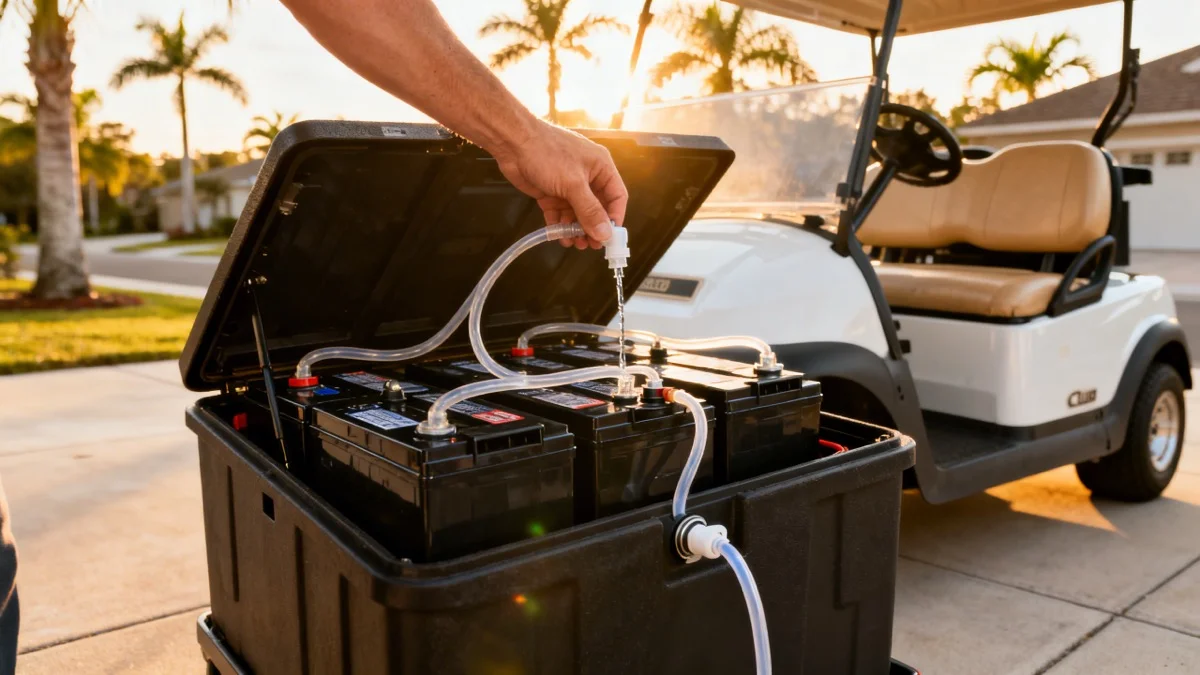
A battery watering system is a set of replacement caps, manifolds, tubing, and a quick-connect fill point that lets you add distilled water to the entire pack from one access point. The best-known systems in golf carts are Flow-Rite Pro-Fill and Trojan HydroLink.
Inside each cap is a small valve that is supposed to shut off when the electrolyte reaches the correct level. In theory, that gives you three advantages over opening each cap by hand:
- Less chance of overfilling one cell and underfilling the next
- Less acid splash on the battery tops and tray
- Much faster monthly maintenance on six-battery carts
That last point matters most on carts with awkward battery access. A Club Car DS, older EZGO TXT, or lead-acid Yamaha cart can turn a simple water check into a cramped, messy job, especially if the tray is dirty or the cable routing is tight.
What a watering system does not do is fix undercharging, bad batteries, sulfation, loose cables, corrosion already on the tray, or a charger mismatch. If your pack is already weak, the better move may be a new set of batteries, a charger upgrade, or a full lithium conversion.
Golf Cart Battery Water Fill System vs Manual Filler Bottle
The phrase golf cart battery water fill system gets used two ways online, which is why buyers end up comparing the wrong products.
| Option | What it is | Best for | Watch-outs |
|---|---|---|---|
| Single-point water fill system | Caps, valves, tubing, quick-connect fill point, and pump | Frequent-use lead-acid carts, six-battery packs, tight trays | Must match battery layout; valves and tubing still need inspection |
| Auto-shutoff filler bottle | Handheld bottle with a spout that helps stop at the right level | Low-use carts and owners who inspect every cell | Slower on six batteries; still opens every cap |
| Plain funnel or jug | Basic manual pouring | Emergency top-off only | Easy to overfill, spill acid, or contaminate cells |
If you only water the pack a few times per year, start with a filler bottle. If you are opening 18 caps every month in summer heat, a single-point system is easier to justify.
When a Watering System Is Worth the Money
For the right owner, a watering system is not just convenience. It is a way to keep a healthy lead-acid pack alive longer.
Your cart gets used several times per week
If you drive around the neighborhood, the campground, or the marina three to seven days per week, your batteries cycle often and use water faster. This is especially true in heat. Owners in Florida, Arizona, Texas, and South Carolina typically need tighter watering habits than owners in milder climates.
That profile matches the carts we see most often in our best golf carts for neighborhoods guide, best golf carts for beach towns guide, and best golf carts for seniors guide. If your cart is transportation, not a once-a-month toy, making maintenance easier matters.
You have six batteries with annoying access
A watering system feels a lot more useful on:
- a 36V cart with six 6V batteries
- a 48V cart with six 8V batteries
It can still help on four 12V batteries, but the savings are smaller because you are opening fewer caps to begin with.
You are keeping lead-acid for at least 2 more years
This is the key math question. If your batteries are healthy today and you expect to run them for another 2-4 years, spending about $165-$220 on a proper kit can be reasonable. It reduces the maintenance hassle that causes many owners to procrastinate, and procrastination kills lead-acid batteries faster than most people admit.
Multiple carts share the same maintenance routine
If you manage a family fleet, a campground cart, or two carts at a beach house, the value goes up quickly. One watering point per cart is far cleaner than opening 12 or 18 caps every month.
When Manual Watering Is Still the Smarter Move
Battery watering systems are not automatic enough to justify buying them for everyone.
Manual watering is usually still the better call if:
- you only drive the cart a few weekends a month
- the battery tray is easy to access
- you already check the pack on schedule
- your current batteries are near end of life
In that case, a simple filler bottle is hard to beat. It costs a fraction of a full system, takes up almost no space, and has very little to fail.
The manual approach is also easier to trust if you like inspecting every cell yourself. That matters because a watering system can hide problems if you stop doing visual checks entirely. You still need to look for corrosion, acid residue, cable heat, and physical battery damage. Our spring checklist and troubleshooting guide both assume you are still opening the compartment and paying attention.
Best budget choice: auto-shutoff filler bottle
If you are staying manual, the cheapest good upgrade is an auto-shutoff filler. It is cleaner than pouring from a gallon jug and easier to control than a generic funnel.
OEMTOOLS Battery Filler BottleExpect to spend about $10-$15. For a light-use cart, that is often all you need.
When You Should Skip the Kit and Go Lithium Instead
This is where a lot of owners get the decision wrong.
If your flooded batteries are already 4-6 years old, your range is falling, and you are tired of corrosion, a watering system is solving yesterday's problem. You are adding convenience to a battery type you may be replacing soon anyway.
That is the moment to compare the watering kit money against the first chunk of a lithium upgrade.
Lithium makes more sense if you want to eliminate:
- monthly water checks
- terminal corrosion cleanup
- acid residue in the tray
- power fade near the end of the charge
- repeated battery-related no-start issues
Our lithium conversion guide breaks this out in detail, but the short version is simple: if you already know you hate lead-acid maintenance, do not keep buying accessories to make lead-acid slightly less annoying.
DC HOUSE 48V 100Ah Lithium Battery KitA 48V lithium kit is a much bigger purchase, but it removes the watering problem completely. If you are shopping used and cannot tell whether an old pack is worth saving, read our used golf cart buying guide and golf cart value guide.
Fitment by Battery Setup and Cart Type
Buying the wrong kit is the easiest way to waste money. Watering systems are matched to battery count, battery voltage, cap style, and cell spacing.
| Setup | Typical Cart Examples | Good Fit for Watering Kit? | Notes |
|---|---|---|---|
| 36V with six 6V batteries | older EZGO TXT, older Club Car DS | Yes | Good candidate because six batteries means more caps and more mess |
| 48V with six 8V batteries | Club Car Precedent, Onward, some EZGO TXT | Yes | One of the best use cases for a kit |
| 48V with four 12V batteries | Yamaha Drive, some RXV, some aftermarket packs | Maybe | Fewer batteries means less time savings |
| AGM or sealed lead-acid | some replacement packs | No | No watering required |
| Lithium | newer premium carts and conversions | No | No watering required |
Here is the practical rule: if you are not certain what batteries are in the cart, do not order a watering system yet. Pull the seat, read the labels, count the batteries, and confirm whether the caps are removable.
This matters even more on used carts listed on our dealer directory, because many sellers advertise a cart as "48 volt" without clarifying whether it is six 8V batteries, four 12V batteries, AGM, or lithium.
Best Products to Make Battery Watering Easier
This category really breaks into two buckets: true onboard watering systems, and simple tools that make manual watering less sloppy.
Best overall if you are keeping lead-acid: single-point watering kit
If your batteries are healthy and you plan to stay flooded lead-acid, buy a real kit from a known brand and match it to your exact battery layout. The Water My Battery system below is specifically for Club Car Precedent and Onward carts with six compatible 8V flooded batteries.
Check Water My Battery Club Car System PriceExpect a complete single-point kit in this class to cost roughly $230. Confirm battery brand, cap spacing, connector type, and whether the supply pump is included before ordering. It is not for AGM, sealed, or lithium packs.
That price range tells you a lot. This is not a $20 impulse buy. It only pays off if your cart gets enough use to justify the time savings and you are disciplined enough to install it correctly.
Best pump for Water My Battery blue connectors
The Water My Battery manual squeeze-bulb pump connects to Water My Battery and Battery Watering Technologies systems that use the matching blue connector. It is only the water-supply pump; it does not include the valves, caps, and tubing installed on the battery pack.
Check Water My Battery Manual Pump PriceBest pump for an existing HydroLink or Flow-Rite system
The Micacia hand pump is the lower-cost option for existing Trojan HydroLink, Flow-Rite Pro-Fill, Millennium Plus, or Qwik-Fill systems. Compare the quick connector with your installed system before ordering because a similar-looking bulb pump is not automatically interchangeable.
Check Micacia Watering Pump PriceBest manual tool for low-use owners
If you only need a cleaner way to top off cells a few times per season, this is the move:
OEMTOOLS Battery Filler Bottle →It is cheap, compact, and good enough for owners who still inspect each cell individually.
Best add-on for corrosion prevention
No watering system replaces terminal care. If your battery tops already show residue, clean them and protect them before the corrosion starts creeping into the cable ends.
CRC Battery Terminal ProtectorThis is especially useful after you follow the cleaning steps in our rust prevention guide.
Battery terminal protector golf cart Amazon reviews: what to check
If you are searching battery terminal protector golf cart Amazon reviews, do not judge only by the star rating. The product is simple, but the prep work matters more than the spray.
Look for reviews that mention:
- whether the buyer cleaned corrosion before spraying
- whether the coating made coverage easy to see
- whether the spray reached cable ends, hold-downs, and posts without making a mess
- whether corrosion stayed away after weeks or months of humid storage
- whether the user had flooded lead-acid batteries, not a sealed lithium pack
Terminal protector is a finishing step after cleaning. If the terminals are loose, the cables are hot, the batteries are gassing heavily, or acid is pushing out of overfilled cells, spray will not fix the real problem. Work through the battery maintenance guide and charger guide first.
Best tool for cleaning cable ends and posts
Battery Terminal Cleaner KitYou will use it whether you stay manual, install a watering kit, or prep the tray for a future lithium swap.
Real Cost, Time Saved, and Return on Effort
Here is the honest math.
| Option | Upfront Cost | Ongoing Effort | Best For | Main Downside |
|---|---|---|---|---|
| Manual filler bottle | $10-$15 | Open every cap and check each cell | Light-use owners | More time, more mess |
| Single-point watering kit | About $230, plus a pump if not included | Still inspect pack, but fill from one point | High-use lead-acid owners | Pack-specific fit and more parts to maintain |
| Lithium conversion | $1,300+ for budget 48V kits, more for premium | No watering | Owners keeping cart long term | Highest upfront cost |
If you water six batteries 8-12 times per year, a single-point system can save real time and reduce accidental overfill. If you only top off the pack four times a year, the savings are modest.
That is why I do not recommend watering systems as a universal upgrade the way I would recommend a smart charger, a proper battery maintenance routine, or a multimeter in your tool kit. A watering kit is a convenience multiplier, not a foundational fix.
Installation Mistakes That Shorten Battery Life
This is the section most competitor pages skip, and it is the part that actually matters.
Watering before the charge cycle
Trojan and U.S. Battery both say the same thing: water after charging, unless the plates are exposed before the charge. Charging expands electrolyte. Fill first and you risk overflow, acid mess, and corrosion in the tray.
Using tap water
Do not do it. Distilled water costs about $1-$2 per gallon, which is trivial compared to the price of a battery pack. Tap water minerals build deposits and shorten battery life.
Treating the watering kit as a replacement for inspections
Even with a single-point system, you still need periodic visual checks. Look for:
- uneven fill levels
- cracked caps or brittle tubing
- residue around the battery tops
- loose cables
- tray rust
- heat damage around terminals
If the tray already looks rough, work through our corrosion guide before you decide your maintenance problem is just a watering problem.
Installing a kit on a battery pack that is already dying
If the cart already struggles on hills, loses charge quickly, or constantly needs troubleshooting, a watering system is not the priority. Start with battery testing, then read our battery guide, range guide, and draw on a golf cart motor guide to see whether the pack is still worth maintaining.
Our Verdict for Real-World Owners
Here is the short answer.
Buy a battery watering system if:
- your cart has flooded lead-acid batteries
- the pack is still healthy
- you use the cart often
- the battery tray is annoying to access
- you expect to keep lead-acid for a few more years
Skip it and stay manual if:
- you use the cart lightly
- you do not mind monthly inspections
- your current filler routine already works
Skip it and go lithium if:
- your lead-acid pack is aging out
- you are tired of maintenance entirely
- you want better power and longer range, not just easier watering
If you are still on the fence, ask yourself one simple question: am I trying to maintain a good lead-acid pack, or am I trying to postpone replacing a bad one? The first scenario can justify a watering kit. The second usually does not.
If you want a shop to test the pack, install a kit, or quote a lithium swap, start with local golf cart repair services. If you are shopping for a different cart entirely, compare inventory on GolfCartSearch dealers near you.
FAQ About Golf Cart Battery Watering Systems
What is the best golf cart battery watering system?
The best golf cart battery watering system is a single-point kit that fits your exact flooded lead-acid battery layout. Flow-Rite Pro-Fill and Trojan HydroLink are the main name-brand choices, but the correct kit depends on battery count, voltage, cap style, and cell spacing.
What is a golf cart battery water fill system?
A golf cart battery water fill system is an onboard setup with replacement caps, valves, tubing, and a quick-connect fill point. It lets you add distilled water to flooded lead-acid batteries from one hose or pump instead of opening every cap by hand.
What should I look for in battery terminal protector golf cart Amazon reviews?
Look for reviews that mention corrosion prevention after cleaning, visible coating coverage, spray mess, durability in humidity, and use on flooded lead-acid battery terminals. Ignore reviews that treat terminal spray as a fix for loose cables, leaking batteries, or a weak pack.
Is a golf cart battery watering system better than a filler bottle?
It is better when you have a frequent-use cart, six flooded batteries, hard-to-reach caps, or multiple carts to maintain. A filler bottle is better when the cart is used lightly, the battery tray is easy to reach, or you want to inspect every cell manually.
Are golf cart battery watering systems worth it?
Yes, for frequent-use lead-acid carts they can be worth it. Expect to spend about $165-$220 for the kit and another $30-$45 for a hand pump. The value is highest when you have six flooded batteries and limited battery access.
Do battery watering systems work on lithium or AGM batteries?
No. They only work on flooded lead-acid batteries with removable caps. AGM, gel, and lithium packs are sealed and should not be watered.
Should I add water before or after charging?
After charging. If the plates are exposed before charging, add just enough distilled water to cover them, complete the charge cycle, then top off to the correct level.
How often should I water flooded golf cart batteries?
Most owners should inspect monthly. Heavy summer use and hot climates often push that schedule to every 2-3 weeks. Occasional-use carts can sometimes stretch to every 4-6 weeks.
Can a watering system overfill the batteries?
It should not if the correct kit is installed and the valves are working, but worn valves, blocked lines, or the wrong setup can still cause uneven filling. That is why periodic visual checks still matter.
How long does installation take?
Usually 45-90 minutes for a DIY install. The time goes into matching the manifolds, routing the tubing cleanly, and mounting the fill point where you can reach it without kinking the line.
Which golf carts benefit most from a watering system?
Lead-acid Club Car, EZGO, and Yamaha carts with six-battery layouts benefit the most, especially if the cart is used several times per week.
Can I reuse my watering system when I buy new batteries?
Sometimes. You need the same battery case style, cap format, and cell spacing. If you change battery brand or switch configurations, you may need a different kit.
What water should I use in my golf cart batteries?
Distilled water only. It is inexpensive and avoids mineral buildup that damages the plates over time.
Should I buy a watering system or convert to lithium?
If your flooded pack is still healthy and you plan to keep it a few more years, a watering system can make sense. If the batteries are already old and your maintenance fatigue is high, lithium is usually the better long-term answer.
Golf Cart Search
Find the Best Golf Carts of 2026
Compare top-rated models, read expert reviews, and find the perfect cart for your needs.