As an Amazon Associate, we earn from qualifying purchases. This helps support our site at no extra cost to you.
Golf Cart Battery Corrosion and Rust Prevention
If your main problem is golf cart battery corrosion, clean and neutralize the terminals first, dry everything completely, reconnect and tighten the cables, then coat the posts and cable ends with a battery terminal protector spray. For frame rust, clean the underside, treat any existing surface rust, then apply a lanolin rust inhibitor or rubberized undercoating based on your climate.
| Problem | Fast Fix | Best Product Type |
|---|---|---|
| White or green crust on battery terminals | Neutralize with baking soda and water, rinse, dry, tighten, then coat | Battery terminal protector spray |
| Corrosion returning after cleaning | Check for overfilled batteries, loose cables, leaking caps, or overcharging | Terminal spray plus correct water level |
| Rust on steel frame rails | Wire brush, convert surface rust, then seal | Rust converter plus undercoating |
| Coastal or road-salt exposure | Rinse with fresh water and reapply protection more often | Fluid Film or similar lanolin inhibitor |
Rust is the silent killer of golf carts. A cart that looks fine on the outside can have a battery tray eaten through by acid, frame rails weakened by corrosion, or electrical connections rotted past the point of reliable contact. By the time you see orange flakes or hear creaking over bumps, the damage is already expensive to fix.
The good news: rust prevention is cheap. A $15 can of rust inhibitor spray and 30 minutes of work twice a year can add a decade to your cart's frame life. This guide covers what causes golf cart corrosion, which parts fail first, the best prevention products, and how to treat rust that's already started.
What Causes Golf Cart Rust
Not all rust has the same source. Understanding what's attacking your cart helps you choose the right defense.
Battery Acid (The #1 Cause)
Lead-acid batteries release sulfuric acid fumes during every charge cycle. If you overfill the batteries with water, diluted acid overflows onto the battery tray, cables, and nearby frame components. This acid eats through steel in months and even attacks aluminum over time.
One golf cart community dealer shared a real-world example: a 2018 Club Car brought in after just one year of ownership had significant corrosion from the owner never cleaning the battery compartment. The damage would have been preventable with basic battery maintenance.
The fix is simple: Fill batteries only to 1/4 inch above the plates, and only after charging (not before). Water expands when batteries charge, so filling before charging guarantees overflow.
Salt Air and Road Salt
If you live near the coast or in a northern state that salts roads in winter, your cart faces accelerated corrosion. Salt acts as an electrolyte that speeds up the oxidation process on any exposed metal surface.
Coastal areas like Florida, South Carolina, and the Gulf Coast are especially tough on steel-frame carts. Check our beach and coastal living guide for cart recommendations if you live near salt water.
Northern road salt is actually worse than coastal salt air because it coats the undercarriage directly and sits in wet contact with the metal for months.
Moisture and Humidity
Parking on wet grass, storing without a breathable cover, or trapping condensation under a non-breathable tarp all accelerate rust. Moisture needs to evaporate away from metal surfaces, not sit against them.
Fertilizer and Turf Chemicals
Golf course carts roll through fertilizer, herbicides, and pesticide residue daily. These chemicals are corrosive and cling to tires, wheel wells, and undercarriages. Rinse your cart after exposure to treated turf.
Which Parts Rust First
Rust doesn't attack your cart evenly. Here's where to look, ranked by how quickly problems develop:
- Battery compartment and tray — Acid overflow and fumes make this the first area to corrode on any lead-acid cart. Check monthly.
- Frame rails (undercarriage) — Constant exposure to moisture, salt, and road splash. Inspect every 3 months.
- Leaf springs, brackets, and U-bolts — Small steel parts exposed to water and mud. They corrode faster than the main frame.
- Battery terminals and cables — Green or white crust on terminals reduces performance and can cause no-start conditions.
- Fasteners (bolts, nuts, hardware) — Small parts rust first and can seize or snap. Use anti-seize compound on critical bolts.
- Brake backing plates — Behind the rear wheels, constantly splashed by water. Often overlooked until a brake inspection reveals paper-thin metal.
- Steering linkage and pedal pivots — Moisture collects in joints. Lubricate during routine maintenance.
Aluminum vs. Steel: Rust Risk by Brand
Your cart's frame material is the single biggest factor in corrosion resistance.
| Brand | Frame Material | Rust Risk | Key Detail |
|---|---|---|---|
| Club Car | Aluminum | Low | Aircraft-quality aluminum with a lifetime structural warranty. Self-healing oxide layer resists corrosion. |
| EZGO | Steel (transitioning) | High | Most commonly discussed for frame rust in forums. Began converting some components to aluminum in late 2023. |
| Yamaha | Powder-coated steel | Medium | Electrostatic undercoating from the factory offers better protection than bare steel, but still vulnerable over time. |
| Icon, Star EV | Varies by model | Varies | Newer brands often use aluminum frames. Check the specific model's spec sheet. |
If you're shopping for a cart in a coastal area or humid climate, an aluminum frame is worth the premium. For a full breakdown of each brand's build quality, see our Club Car, EZGO, and Yamaha reviews. Our Atlas golf cart review is also worth a look if you are considering a newer aluminum-frame cart and want to understand the tradeoff between Atlas's corrosion story and its still-evolving warranty documentation.
Best Rust Prevention Products
These products protect bare and painted metal from moisture and corrosion. Apply them to the frame, undercarriage, suspension components, and any exposed metal surfaces.
Fluid Film AS11 (Best Overall Rust Inhibitor)
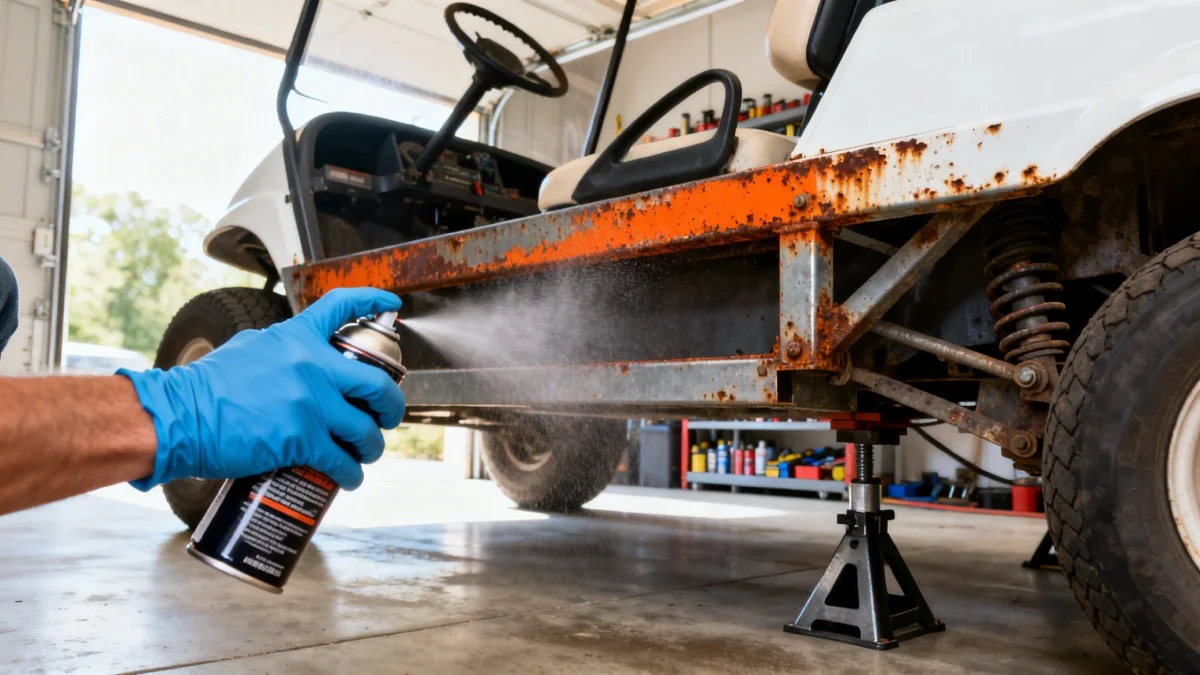
Fluid Film is a lanolin-based (wool wax) corrosion inhibitor originally developed for the marine industry. It creeps into seams, crevices, and hard-to-reach areas, forming a self-healing film that displaces moisture. Unlike WD-40 (which evaporates quickly and offers minimal long-term protection), Fluid Film stays active for 6-12 months per application.
- Coverage: The current listing includes two 11.75 oz aerosol cans, enough for a thorough frame and undercarriage application with product left for touch-ups
- Price: Around $25-$35 for the two-pack
- Reapply: Every 6-12 months, or after heavy rain/wash
- Best for: Frame rails, suspension, steering components, leaf springs
How to apply: Lift the seat to access the battery compartment area. Spray all exposed metal on the frame, focusing on joints, seams, and areas where water collects. Flip the cart on a jack to coat the undercarriage. The spray goes on wet and stays tacky, which is normal.
Rust-Oleum Rubberized Undercoating (Best Frame Protection)
For heavier protection on steel-frame EZGO and Yamaha carts, rubberized undercoating creates a thick, flexible barrier between the metal and the environment. It deadens vibration, resists chipping, and blocks moisture from reaching the frame.
- Coverage: One 15 oz can covers about half a golf cart undercarriage (buy 2)
- Price: $8-12 per can
- Reapply: Every 1-2 years
- Best for: Frame rails, wheel wells, battery tray area
Prep matters: Undercoating sticks best to clean, dry, rust-free metal. Wire brush loose rust first, then wipe with a degreaser. Apply 2-3 light coats, letting each dry for 15 minutes. For a deeper guide on cleaning your cart before treatment, see our cleaning and detailing guide.
Battery Compartment Protection
Since battery acid is the #1 cause of golf cart corrosion, protecting the battery compartment deserves its own section. Three products, totaling under $20, form a complete battery corrosion prevention kit.
Battery Terminal Protector for Golf Cart Amazon Reviews: What to Check
If you landed here searching for battery terminal protector golf cart Amazon reviews, do not judge the product by star rating alone. A terminal protector that works on a car battery may still be fine for a golf cart, but the useful reviews are the ones from lead-acid, marine, RV, lawn equipment, or golf cart owners who deal with acid fumes and outdoor storage.
Before buying, check for:
- The exact product type: terminal protector spray, dielectric grease, felt washers, and brush kits solve different parts of the problem. Spray is the main corrosion barrier for posts and cable ends.
- Photos after real use: look for reviewers showing terminals after several months, not just fresh unboxing photos.
- Coverage comments: good spray leaves a visible coating on the post, nut, and cable clamp so you can see missed spots.
- Failure complaints: repeated mentions of clogged nozzles, coating that flakes off, or products that only include felt pads are more important than generic one-star shipping complaints.
Search results can mix CRC 05046 Battery Terminal Protector with generic felt-pad kits. Verify the listing title and size before buying, especially if you are comparing Amazon reviews from different sellers.
CRC Battery Terminal Protector (Best Terminal Spray)
This spray forms a visible blue-tinted protective coating on battery terminals, cable ends, and nearby metal. It prevents the green and white crusty buildup that causes poor electrical connections and eventually eats into cables and trays.
- Price: $6-9
- Application: Spray on clean terminals after connecting cables. The blue tint shows where you've applied it.
- Reapply: Every 3-6 months, or whenever you see new buildup
Also essential: Permatex Dielectric Grease ($5-8) → protects all electrical connections beyond just the battery terminals. Apply a thin layer to controller connectors, solenoid terminals, light wiring plugs, and any exposed electrical junction. It seals out moisture without interfering with conductivity.
Battery Maintenance Tips That Prevent Corrosion
Products alone won't save a battery compartment if you're overfilling or ignoring acid buildup:
- Fill correctly: Add distilled water to 1/4 inch above the plates, after charging, never before. Water expands during charging.
- Clean monthly: Wipe the battery tops with a damp cloth. If you see white powder or wet spots, neutralize with a baking soda and water solution (2 tablespoons per cup).
- Check water levels: Every 2-4 weeks during riding season. Use a battery watering system to automate this.
- Ventilate: Make sure the battery compartment has adequate airflow. Acid fumes that can't escape concentrate on nearby metal.
For a complete guide to battery types, sizing, and maintenance schedules, see our golf cart battery guide.
Treating Existing Rust
If your cart already has rust, you need to stop it before adding protection on top.
Surface Rust (Orange Discoloration, Rough Texture)
This is the easiest stage to fix. The metal is still structurally sound.
Step 1: Remove loose rust with a wire brush set ($7-10) →. Use the steel brush for heavy rust on frames, the brass brush for battery terminals (brass won't spark near batteries), and the nylon brush for painted surfaces.
Step 2: Apply a rust converter to transform remaining rust into a stable, paintable surface. The current Rust-Oleum Rust Reformer listing is a two-pack of 10.25 oz aerosol cans that spray directly onto rusty metal and turn the surface black for recoating.
Check Price on AmazonStep 3: Once dry (24 hours), apply a topcoat. Use rubberized undercoating for hidden areas (frame, undercarriage) or color-matched paint for visible panels. For body panel refinishing options, see our golf cart painting and wrapping guide.
Total cost: $15-50 in materials for a full cart treatment.
Moderate Rust (Pitting, Flaking, Thinning Metal)
The metal has lost some thickness but is still functional. Wire brush aggressively, apply rust converter, and add a heavy undercoating layer. Pay attention to structural areas like frame joints and spring mounts. If you can push a screwdriver through the metal, it's past this stage.
Severe Rust (Holes, Crumbling Metal, Structural Weakness)
This requires welding or part replacement. Common repairs include:
- Battery tray replacement (EZGO): Bolt-on trays are available for $50-150. A straightforward DIY job.
- Frame welding: $600-4,000+ depending on extent. Use a welder experienced with golf cart frames, as thin-gauge steel requires careful technique.
- Donor frame swap: $200-800 for a used frame, plus $500-2,000 in labor to swap everything over.
At this stage, compare repair costs against the cart's current value. If repairs exceed 50% of the cart's value, you're better off finding a replacement through our dealer directory.
Protecting Body Panels and Paint
Frame rust gets all the attention, but body panels, roofs, and windshields need protection from UV damage and oxidation too.
Meguiar's Flagship Marine Wax (Best Body Panel Protection)
Marine-grade wax is formulated for harsher conditions than automotive wax. Meguiar's Flagship provides UV inhibitors that prevent paint fading, plus a hydrophobic barrier that repels water, salt spray, and chemical contaminants.
- Coverage: A 32 oz bottle covers 4-6 full wax applications on a golf cart
- Price: $22-28
- Reapply: Every 3-4 months, or when water stops beading on the surface
- Best for: Body panels, roof, windshield frame, plastic trim
Apply after washing and drying. Use a foam applicator pad in circular motions, let it haze for 5 minutes, then buff with a clean microfiber cloth. The entire cart takes about 20 minutes.
The Lithium Battery Solution
The most effective way to eliminate acid-related corrosion is to remove the acid entirely. Lithium battery conversions replace 4-6 heavy lead-acid batteries with a single lithium iron phosphate (LiFePO4) pack that produces zero acid, zero fumes, and zero overflow.
Beyond ending corrosion, lithium batteries offer 2-3x the range, weigh 60-70% less, charge faster, and last 8-10 years versus 4-5 for lead-acid. The upfront cost ($1,500-3,500 DIY, $2,000-5,000 installed) pays for itself through eliminated battery replacements and zero corrosion maintenance.
If you're already spending $100-200+ per year on battery water, terminal protectors, cleaning supplies, and corrosion repairs, the math starts to favor lithium within 5-7 years. For a full breakdown of the conversion process, costs, and which packs fit which carts, see our lithium battery conversion guide.
For a deeper comparison of electric vs. gas golf carts, including long-term maintenance costs, check our full comparison guide.
Climate-Specific Protection Strategies
Coastal (Florida, South Carolina, Gulf Coast, California Coast)
Salt air corrodes exposed metal year-round. Steel-frame carts in coastal areas can show visible rust within 1-2 years without protection.
- Rinse after every ride near the ocean or salt-treated roads
- Apply Fluid Film every 6 months to the entire undercarriage
- Wax body panels every 3-4 months with marine-grade wax
- Consider aluminum frames when buying. Club Car offers the best corrosion resistance for coastal owners
- Use an enclosure to reduce salt spray exposure during drives
Northern Winter (Road Salt, Freeze-Thaw Cycles)
Road salt is more corrosive than coastal salt air because it sits in direct contact with wet metal.
- Apply rubberized undercoating before winter
- Store indoors when possible. See our winterization guide
- Wash the undercarriage in early spring to remove salt buildup. Our spring maintenance checklist covers the full post-winter inspection
- Disconnect and clean battery terminals before storage
Humid Southeast (Georgia, Alabama, Mississippi, Louisiana)
High humidity without salt still promotes rust through constant moisture exposure.
- Store under cover or in a garage, not on wet grass
- Use a breathable cart cover, never a plastic tarp (traps condensation)
- Apply Fluid Film annually to the frame
- Keep the battery compartment dry and clean
Seasonal Rust Prevention Calendar
| Season | Tasks |
|---|---|
| Spring | Full inspection after winter storage. Clean battery terminals. Apply Fluid Film to frame. Wax body panels. Check for new rust spots. |
| Summer | Monthly battery compartment check. Rinse after beach or golf course use. Top off battery water (after charging). |
| Fall | Pre-winter protection. Apply rubberized undercoating if in northern climate. Clean entire undercarriage. Wax body panels before storage. |
| Winter | If storing, follow the winterization guide. If driving, rinse salt off weekly. Keep battery terminals protected. |
When to Repair vs. Walk Away
Use this framework to decide whether rust repair makes financial sense:
| Severity | Repair Cost (DIY) | Repair Cost (Pro) | Worth It If Cart Value Is... |
|---|---|---|---|
| Surface rust | $15-50 | $50-200 | Any functional cart |
| Battery tray replacement | $50-150 | $150-350 | Over $1,500 |
| Moderate frame rust (no holes) | $50-100 | $250-500 | Over $2,500 |
| Structural frame damage | Not recommended | $600-4,000+ | Over $5,000 |
| Full frame replacement | $200-800 (parts) | $1,000-3,000+ | Over $4,000 |
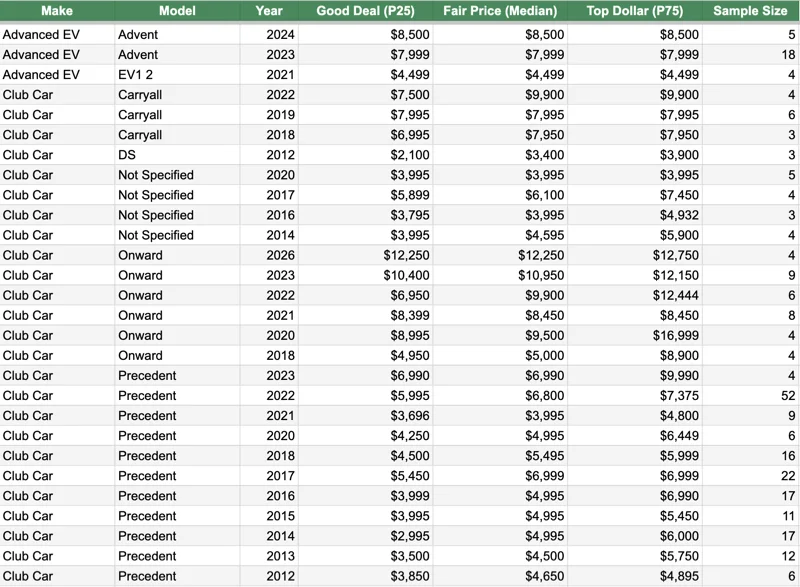
Rule of thumb: If the repair costs more than 50% of the cart's value, start shopping for a replacement. Check your cart's current market value before deciding. Browse our dealer directory for new and used options if it's time to replace.
Frequently Asked Questions
How do I prevent rust on my golf cart?
Three steps cover 90% of rust prevention. First, keep the battery compartment clean and avoid overfilling batteries. Second, spray the frame and undercarriage with Fluid Film or a similar rust inhibitor twice a year. Third, wash the cart regularly, especially after exposure to salt, fertilizer, or road chemicals. Total cost: under $50 per year.
Do aluminum frame golf carts rust?
Aluminum doesn't rust the way steel does. It forms a self-healing oxide layer that protects against further corrosion. That's why Club Car's aluminum frames carry a lifetime structural warranty. However, battery acid can still damage aluminum over time, so keeping the battery compartment clean matters regardless of frame material.
How do I clean corrosion off battery terminals?
Disconnect the negative cable first. Mix 2 tablespoons of baking soda with 1 cup of warm water. Brush the paste onto corroded terminals with a wire brush, scrub until the green or white crust is gone, rinse with clean water, and dry thoroughly. Apply a terminal protector spray before reconnecting. For the full process, see our cleaning guide.
What is the best battery terminal protector for golf carts?
Use a terminal protector spray after cleaning the posts and reconnecting the cables. CRC Battery Terminal Protector is the main spray recommendation in this guide because the colored coating makes coverage easy to see. Felt washers can help under the cable clamp, but they do not protect the cable end, nut, tray hardware, or nearby metal by themselves.
Are battery terminal protector Amazon reviews useful?
Yes, but only if you read the right reviews. Look for Amazon reviews from golf cart, marine, RV, lawn tractor, or other lead-acid battery owners. Prioritize photos after months of use and comments about coating coverage. Skip reviews that only discuss shipping, packaging, or felt washers when you are trying to compare terminal protector sprays.
Can I use regular WD-40 for rust prevention?
Regular WD-40 is a water displacer, not a long-term rust inhibitor. It evaporates within days and provides almost no lasting protection. Use WD-40 Specialist Long-Term Corrosion Inhibitor (a different product) or, better yet, Fluid Film, which stays active for 6-12 months.
Which is worse for rust: coastal salt air or road salt?
Road salt is actually worse. Coastal salt air creates a thin film of corrosive moisture on surfaces, but road salt coats the undercarriage in a thick, wet layer that sits in direct contact with metal for months. Northern carts exposed to road salt without undercoating can corrode faster than coastal carts.
Golf Cart Search
Find the Best Golf Carts of 2026
Compare top-rated models, read expert reviews, and find the perfect cart for your needs.