As an Amazon Associate, we earn from qualifying purchases. This helps support our site at no extra cost to you.
The correct golf cart spark plug gap comes from the installed engine and approved plug, not the cart brand alone. A setting copied from a neighbor's Yamaha can be wrong for an E-Z-GO EX1. Even one Kohler engine family has different documented gaps for different plug numbers.
Use the table below to find the relevant manual, then match it to the cart before buying a plug or adjusting anything. These are four identified examples, not an all-model compatibility chart. Electric golf carts have no combustion-engine spark plugs; the gas versus electric comparison explains that distinction.
Hero: AI-generated editorial illustration, not a photograph of our testing or a specific replacement part.
Golf cart spark plug gap: four documented examples
On October 19, 2026, we compared the spark-plug sections of three manufacturer manuals and separated the two plug-specific Kohler entries. We recorded the engine/application, plug designation, gap and document identity. That produces four rows, not four carts tested.
| Exact documented example | Plug listed | Gap in that document |
|---|---|---|
| 2020 E-Z-GO TXT Fleet EX1, 694206-C | NGK CR6HSA | 0.6-0.7 mm |
| 2026 Yamaha DR2 EFI, J0K-F8199-37-E0 | BPR2ES | 0.7-0.8 mm, or 0.028-0.031 in. |
| Kohler ECH440, 17 690 14 Rev. E | 25 132 27-S, Champion RC12LC4 | 1.02 mm, or 0.040 in. |
| Kohler ECH440, same service manual | 25 132 32-S, Champion RC14MCX4 | 1.11 mm, or 0.044 in. |
Sources: E-Z-GO, specifications p. 32 and spark-plug section p. 39, Yamaha, spark-plug inspection p. 38, and Kohler, ignition specifications p. 24. Page numbers are the printed page numbers inside the documents.
Our comparison result: a blanket 0.030-inch setting falls inside only one of these four rows, the Yamaha example. It exceeds the EX1 range and is below both Kohler values. This deliberately selected sample demonstrates a compatibility problem; it does not estimate how many carts on the market use any particular gap.
There is a second useful distinction in the Kohler table. Its separate ECH440LE row lists RC12LC4 at 0.040 inch. Do not carry the ECH440 RC14MCX4 entry across to ECH440LE without application approval. The manual provides no basis for making that substitution merely because the engine names look similar.
For Club Car, identify the engine before using either Kohler row. A Club Car badge does not establish ECH440 applicability. The same caution applies across E-Z-GO and Yamaha generations. A replacement engine can make the original vehicle's quick-reference chart irrelevant.
Identify the engine before ordering a spark plug
Start a short record with the cart's serial number, model and year, then photograph the engine identification plate and the markings on the installed plug. Keep a readable copy of the applicable manual beside those photographs. Our serial-number guide helps establish vehicle identity; it cannot certify an engine that someone has swapped.
An old plug is a clue, not proof of the correct replacement. A previous owner may have fitted the wrong part. Ask the supplier to match the approved part number to the engine identification, including any superseded numbers, before accepting a substitute.
Have these questions answered together:
- Does this exact plug belong in this engine/application?
- Does its thread, reach and seat match the approved part?
- What gap applies to this plug in this engine?
- What installation torque and thread condition apply?
- Does the manufacturer allow the owner to perform this job?
A package marked “fits golf carts” does not answer those questions. Neither does a shared socket size. Two plugs can accept the same wrench while having different installation requirements.
For a complete service, use the gas golf cart tune-up guide to plan oil, filters and scheduled tasks separately. This page covers plug selection and measurement; it does not replace an engine service manual or provide a universal maintenance interval.
Golf cart spark plug gap: inches, mm and gauge choice
Small numbers are easy to copy incorrectly. One inch equals 25.4 mm, so multiply an inch measurement by 25.4 to convert it to millimeters. Divide millimeters by 25.4 to convert in the other direction.
These calculations use the printed imperial measurements. They do not replace the manufacturer's original limits or add an extra tolerance:
| Gauge marking in inches | Calculated millimeters | Comparison with the two ranged examples |
|---|---|---|
| 0.025 | 0.635 | Inside the EX1 range; below the Yamaha range |
| 0.028 | 0.7112 | Inside the Yamaha metric range; above the EX1 maximum |
| 0.030 | 0.762 | Inside the Yamaha range; above the EX1 maximum |
| 0.035 | 0.889 | Above both ranges |
For example, 0.030 × 25.4 = 0.762 mm. It is not 0.030 mm, and it is not an acceptable EX1 setting merely because another golf cart uses it.
Manufacturers round equivalent units. Keep the specified target and its stated units in your record. Do not manufacture a new acceptance band from extra decimal places in a conversion, or average two incompatible specifications to pick a compromise.
Choose a wire gauge with the size you need
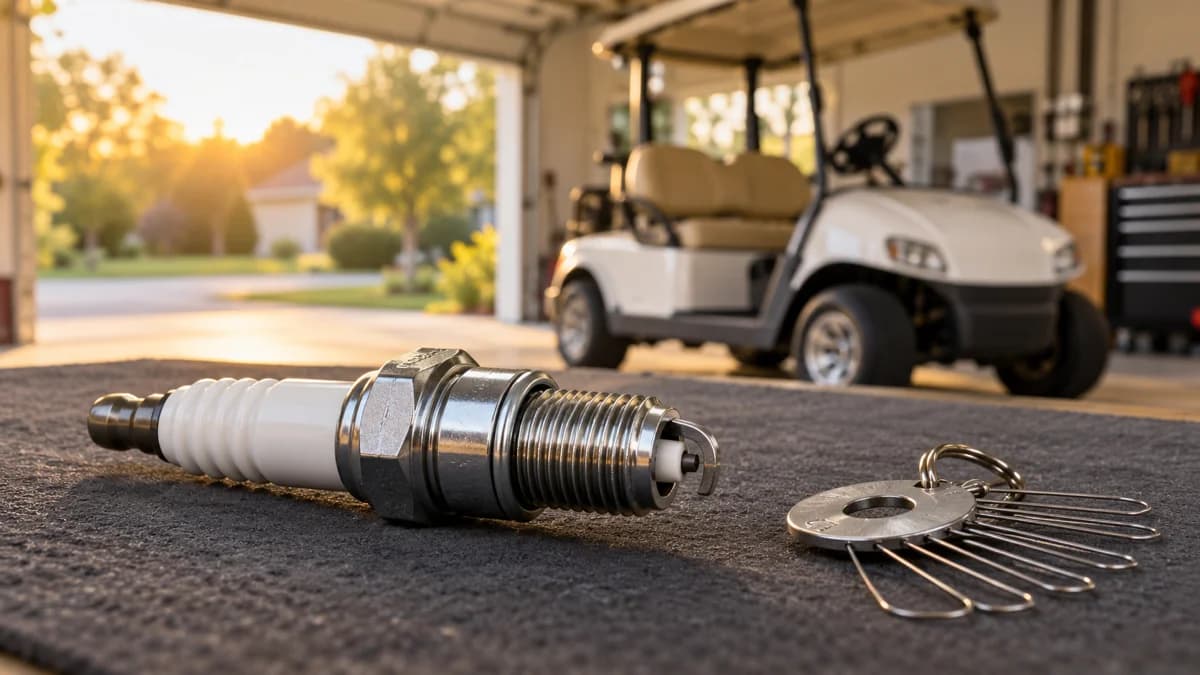
NGK's gapping guidance recommends wire gauges for checking spark-plug gaps. Read the sizes included in a gauge rather than assuming a larger number of wires means it covers every application.
The CTA Tools 3238 lists nine wires, including 0.025, 0.030, 0.040 and 0.044 inch on the manufacturer's product page. The first two are useful interior measurements for the EX1 and Yamaha ranges in our worked comparison. The last two correspond to the Kohler imperial targets above. It has no 0.028-inch wire, so it cannot directly check that particular marking. A single wire passing through also does not establish the exact size of an already oversized gap.
Check CTA 3238 Price on AmazonThis is a tool option based on documented sizes, not a hands-on accuracy test. Check the current listing for the selected version, delivery and total cost. A gauge is useful only if its markings, condition and use are suitable for the job.
NGK also explains that a new plug's factory gap may not match the intended engine. Check it before installation. If adjustment is permitted, protect the center electrode and insulator; do not use either as a lever point. Fine-wire designs need their own handling instructions. A damaged new plug is not made serviceable by getting the gap number right.
Torque and thread preparation need their own check
Gap and tightening torque are separate measurements. Copy both from the applicable instructions, with units. The Yamaha example lists 20 Nm for its plug. The EX1 example lists 87-121 in-lb, shown as 9.8-13.7 Nm. Those are not interchangeable settings.
Our unit check: 87 ÷ 12 = 7.25 ft-lb, and 121 ÷ 12 is about 10.08 ft-lb. Reading the EX1's inch-pound numbers as foot-pounds would multiply the intended torque by 12. Keep “in-lb” visible on the worksheet and wrench selection.
There is also an instruction conflict worth resolving before work. The cited EX1 manual calls for anti-seize, while NGK's current guidance says not to use it on NGK plugs because lubrication changes tightening behavior. We are reporting both documents, not choosing a universal rule. Ask the authorized E-Z-GO service provider to confirm the current procedure for the exact engine and approved replacement plug. Do not improvise a percentage torque correction.
A low-range torque wrench has limits
The EPAuto 1/4-inch drive wrench below lists a 20-200 in-lb range, also displayed as 2.26-22.6 Nm. That nominal range includes the EX1 values and Yamaha's 20 Nm setting. It does not include the 27 Nm Kohler spark-plug value in the cited service manual. Use an appropriate, verified tool for the required torque instead of turning a wrench beyond its scale.
EPAuto 20-200 in-lb torque wrench →Range coverage does not prove calibration, access or drive compatibility. Check the tool instructions, working range, current condition and any required adapter before purchase. A wheel-fastening wrench from the lug-nut torque guide may have a lower limit above a plug's requirement. Select for the fastener, not the size of the cart.
A plug socket must fit the plug and the space
The AEROFORCE 8-piece, 3/8-inch drive set lists 5/8-, 3/4- and 13/16-inch six-point sockets, plus 14 and 18 mm twelve-point sockets, extensions and a universal joint. Confirm the selected listing and actual plug hex; do not assume all five sizes are needed.
AEROFORCE 8-piece spark-plug socket set →The set and 1/4-inch wrench above have different drive sizes. A suitable adapter is a separate compatibility check, not an implied included component. Verify access and the manufacturer's tightening method; the presence of a universal joint does not establish an approved torque setup. An existing correct socket may be all you need. See the owner's tool-kit guide before duplicating tools.
We checked these three exact Amazon listings on October 19, 2026. They are optional tools, not a required bundle. Follow the links for current prices rather than treating an old advertised price as today's total. No replacement plug is recommended here without the engine/application check.
Record the result without guessing the diagnosis
Before handling ignition components, stop and secure the cart using its service procedure, let the engine cool, and follow its instructions to prevent accidental starting. Keep ignition work away from fuel leakage or vapor. Do not crank an exposed plug beside a fuel system to see whether it sparks. If the correct isolation or access procedure is unavailable, arrange qualified golf cart repair.
Use this record for the owner-authorized inspection or give it to the technician:
| Field | What to record |
|---|---|
| Identification | Cart serial/model and installed engine ID |
| Source | Manual number, revision, page and date checked |
| Approved replacement | Full plug number and any confirmed supersession |
| Specification | Gap with units; torque with units; thread instructions |
| Observation | Gauge used, measured condition, visible damage and photographs |
| Completion | Part fitted, who performed the work, date/hours and result |
Keep the observed condition separate from the conclusion. “Plug wet when removed” is an observation. “Carburetor failed” needs diagnosis. The carburetor guide discusses why fuel and ignition symptoms can lead to unnecessary parts replacement.
Likewise, distinguish a cart that does not crank from one that cranks but does not run. Start with the no-start guide. A gas-cart starter battery and starter/generator belong to different checks from electrode gap. A new plug alone cannot establish that those systems are healthy.
Add the result to the maintenance record, including a fault that remains after service. For a seasonal cart, keep its winter-storage instructions separate from normal plug maintenance. If a shop will perform the work, ask it to identify the approved plug, labor, diagnostic allowance and any additional work on the estimate. A gap check should not silently become authorization for unrelated repairs.
Frequently asked questions
What is the correct golf cart spark plug gap?
Use the installed engine and approved plug specification. In our four documented examples, 0.030 inch falls within only the Yamaha range; it does not fit the EX1 or either Kohler row.
What gap does the TXT EX1 manual specify?
E-Z-GO manual 694206-C for the 2020 TXT Fleet EX1 specifies NGK CR6HSA and a 0.6-0.7 mm gap. This is not a specification for every gas TXT or RXV.
What plug and gap does the 2026 Yamaha DR2 EFI use?
Manual J0K-F8199-37-E0 lists BPR2ES and 0.7-0.8 mm, shown as 0.028-0.031 inch. Other Yamaha models and modified engines require their own documentation.
Why are there two Kohler ECH440 gap values?
Service manual 17 690 14 Rev. E assigns 0.040 inch to Champion RC12LC4 and 0.044 inch to RC14MCX4 on ECH440. It lists only RC12LC4 in its separate ECH440LE gap row. Confirm the approved plug for the actual engine.
Is 0.030 inch the same as 0.030 mm?
No. Multiply inches by 25.4: 0.030 inch equals 0.762 mm. A gauge marked 0.030 inch cannot be treated as a 0.030 mm gauge.
Can I install a new plug without checking its gap?
Check it against the applicable engine specification first. NGK explains that the factory setting may serve a different application. A correct gap also does not prove correct thread, reach, seat or heat range.
Should I put anti-seize on the spark plug threads?
Do not apply a universal rule. The cited older EX1 manual calls for anti-seize, while NGK advises against it on NGK plugs. Resolve the exact engine, plug and current installation instructions with the authorized service provider before tightening.
Will a new spark plug fix a golf cart that will not start?
Not necessarily. Record whether the engine cranks, when the fault happens, and what has already been checked. A gap measurement is maintenance evidence, not proof that ignition is the sole cause.
Golf Cart Search
Find the Best Golf Carts of 2026
Compare top-rated models, read expert reviews, and find the perfect cart for your needs.