
As an Amazon Associate, we earn from qualifying purchases. This helps support our site at no extra cost to you.
Golf cart lug nut torque depends on the exact vehicle, wheel and fastening hardware. Find that specification before fitting new wheels or reinstalling a wheel after a flat. A familiar brand name, tire diameter or socket size does not supply the missing setting.
This guide compares manufacturer documents checked on October 18, 2026, then shows how to record the specification, avoid unit mistakes and decide when a shop should handle the job. The comparison is desk research, not a physical torque test. We have not tested the tools linked below or measured wheel retention on a cart.
Golf cart lug nut torque: documented examples
Read the application column before the number. These examples help you locate the right information; they do not authorize using a setting on an unidentified cart.
| Exact document or assembly | Published wheel torque | Where to check |
|---|---|---|
| Club Car assembly 47561646001, LOADSTAR 205/55-10 on MERCURY 10x7 wheel | 65 ft-lb | Approved tire matrix, PDF page 1 |
| Club Car assembly 47561648001, KRAKEN 23x10-12 on MERCURY 12x7 wheel | 65 ft-lb | Same matrix, PDF page 1 |
| Club Car assembly 47562947001, KRAKEN 23x10-14 on MERCURY 14x7 wheel | 65 ft-lb | Same matrix, PDF page 1 |
| E-Z-GO RXV ELiTE, manual 10036459-D, model year 2024–current | 50–85 ft-lb (68–115 Nm) | Wheel Installation, printed page 29 |
| Yamaha DR2 EFI, model year 2026, J0K-F8199-37-E0 | 100 Nm (74 ft-lb) | Wheel Replacement, printed page 42 |
Sources: Club Car approved tire matrix, E-Z-GO RXV ELiTE manual 10036459-D, and Yamaha 2026 DR2 EFI manual.
The matrix also includes vehicle-prefix approval columns and conditions. Matching a row's tire size alone is insufficient. An aftermarket wheel or different nut can change the application, even when the tire size stays the same.
Use our golf cart serial-number guide to establish identity. Then obtain the matching document through the manufacturer or dealer. The E-Z-GO owner-manual library separates RXV versions and other models. Our Club Car, E-Z-GO and Yamaha pages can help narrow the model search, but a model overview is not service authorization. If you need the assembly identified, find a local dealer and send the vehicle serial number and wheel photos before booking service.
Our three-assembly comparison: tire size is not a torque rule
We selected three MERCURY assemblies from the first page of Club Car's matrix, covering 10-, 12- and 14-inch rims. Each lists lug-nut part 47562951001 and 65 ft-lb. The two KRAKEN examples even share a nominal 23-inch tire diameter while using different rim diameters.
That small comparison gives a useful counterexample to choosing torque from tire or rim diameter. It does not prove that every Club Car wheel takes 65 ft-lb. We deliberately sampled three rows, not the entire fleet, and did not inspect any installed hardware. The matrix has no publication date visible in the extracted first-page heading; October 18 is our access date.
The practical task is to identify the assembly, nut and approved vehicle application together. For the other fit questions, use our tire-size and wheel-fit guide. If you are adding a lift, the lift-kit guide covers the separate clearance and compatibility questions. A lift does not supply a wheel-fastener specification.
Golf cart lug nut torque units: ft-lb, Nm and in-lb
A correct number on the wrong scale is still a wrong setting. Read the unit beside the number in the source, then the unit on the tool.
These are our calculations, rounded to one decimal place, using 1 ft-lb = 1.355817948 Nm:
| Original value | Calculated equivalent | What it means |
|---|---|---|
| 50 ft-lb | 67.8 Nm | Lower endpoint conversion only |
| 65 ft-lb | 88.1 Nm | Unit conversion, not a new application approval |
| 85 ft-lb | 115.2 Nm | Upper endpoint conversion only |
| 100 Nm | 73.8 ft-lb | Consistent with Yamaha's rounded 74 ft-lb label |
Manufacturer dual-unit figures can use rounded values. Preserve the original specification and its allowed range rather than replacing it with a falsely precise target. A published range also does not mean the midpoint is a special manufacturer recommendation.
Foot-pounds and inch-pounds differ by a factor of 12. Thus 65 ft-lb equals 780 in-lb. Do not set an inch-pound wrench to 65 when the source says foot-pounds. Check the tool's rated measuring range too: a wrench that can turn a nut is not necessarily suitable for measuring that torque.
For a practical record, write “65 ft-lb, source and application confirmed” rather than simply “65.” These calculations describe torque units only. They do not estimate clamping force, stud stretch or the effect of lubricant.
Match the wheel, nut and stud before tightening
Before ordering replacement nuts, identify the wheel's required nut seat, the stud's thread specification, the nut's reach and the socket clearance. Do not infer thread size from the wrench that fits the outside hex. A nut can fit your socket and still be the wrong part.
The applicable wheel and hardware instructions must establish that the joint fits correctly. If you cannot confirm them, send the supplier photos and part numbers or have a technician inspect the assembly. Avoid forcing a nut that will not start properly by hand. Stop if a closed nut appears to bottom out before the wheel seats.
Do not add anti-seize, grease or threadlocker unless the applicable procedure calls for it. Fastener manufacturer McGard's wheel-installation guidance warns against lubricating its wheel fasteners and directs users to the vehicle's tightening specification. That guidance is evidence to check thread condition, not permission to substitute McGard hardware for an unknown cart application.
A bolt-on spacer adds another joint with its own instructions and access requirements. Our wheel-spacer guide covers the fit checks. Do not transfer the outer-wheel setting to the spacer-to-hub nuts by assumption.
If the issue began after suspension work, also review the alignment guide and shocks and suspension guide. Wheel fastening, alignment and suspension condition are separate checks; one adjustment cannot establish that the others are correct.
A wheel-installation checklist to take to the cart
Use this as a preparation record alongside the exact service procedure. It does not replace the vehicle's lifting, support, isolation or wheel-installation instructions.
- Identify the cart and installed assembly. Record model, year, serial prefix, wheel part and nut part where available.
- Save the source. Write down the manual number, revision, page, torque unit and any specified thread condition or tightening sequence.
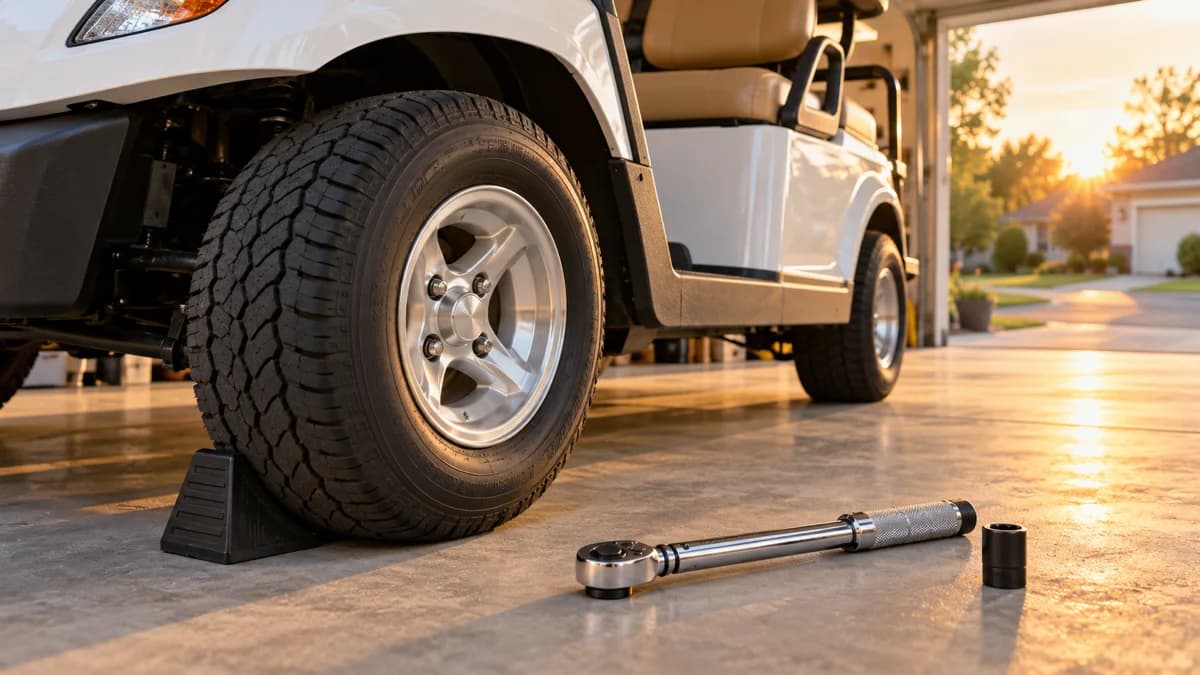
- Prepare the location and equipment. Use the required firm, level working area, chocks and rated lifting/support equipment. Follow the exact vehicle isolation procedure.
- Inspect before assembly. Stop for damaged studs, threads, seats, holes or mounting surfaces. Confirm the correct hardware and a socket that seats fully without fouling the wheel.
- Follow the documented installation order. Start nuts by hand and use the required cross pattern and tightening stages. E-Z-GO's cited RXV manual specifies 20 ft-lb increments; that is a document-specific procedure, not a rule for every cart.
- Measure final tightening with the appropriate tool. Follow the wrench instructions as well as the vehicle instructions. An impact gun's numbered power setting is not a torque measurement.
- Record the recheck requirement. Obtain the interval from the applicable vehicle, wheel or hardware supplier before returning the cart to service.
Our golf cart jack and support guide explains why lifting points must match the cart. Never go beneath a vehicle held only by a jack. If the location, equipment or instructions do not support the work, use a local repair provider.
Do not keep pulling on a click wrench after it signals. TEKTON's operator manual describes a smooth pull, releasing pressure at the click and using another tool to free stuck fasteners. That manual covers its specific wrench; read the instructions supplied with whichever tool you use.
Tools for the job, with clear limits
Buy the missing capability rather than an entire kit by habit. The three items below address torque measurement, movement control and tire-pressure checking. They do not establish compatibility or replace rated supports. We verified their exact Amazon listings on October 18; these are optional shopping examples, not tools we have tested.
Torque wrench: EPAuto 1/2-inch drive
The EPAuto 10–150 ft-lb click wrench, ASIN B01M1D17AW, covers the torque values in our document examples. Its listing describes a dual scale and a signal you can hear and feel. Confirm the current model, measuring direction, instructions and calibration condition before use. Range coverage alone is not proof of accuracy on your particular wrench.
Check EPAuto torque wrench priceChocks: MaxxHaul 70472 two-pack
MaxxHaul 70472, ASIN B01CGU14T2, is a pair of rubber chocks. The manufacturer's product information lists dimensions of 8 by 4 by 6 inches. Select chocks suitable for the actual tire and surface, use the supplied instructions, and keep people out of the vehicle while working. Chocks control movement; they do not support a lifted cart.
Check MaxxHaul chock price →Pressure gauge: AstroAI digital gauge
The AstroAI gauge, ASIN B01J8DLGU2, is useful for the separate pressure check when wheel work is complete. Check the low-pressure accuracy and valve access against your needs. It cannot diagnose a loose wheel or verify nut torque. Use the actual cart/tire operating-pressure specification, as explained in our golf cart tire-pressure guide.
Check AstroAI gauge price →Check current product prices at the links. We do not manually reproduce Amazon prices, discounts or stock promises. For a hypothetical $100 tool allowance, subtract the current wrench, socket and chock quotes first; add the gauge only if you need one and the total still fits. That is a budgeting method, not a claim that these products form a $100 kit. Compare the resulting cost with a local shop's written wheel-service quote.
Save a four-wheel torque record
Keep this record with the service receipt. A photograph of the wheel and its part markings helps the next technician identify what is actually installed.
| Record field | Enter for your cart |
|---|---|
| Vehicle identity | Model, year and serial prefix |
| Wheel and nut identity | Part numbers, seat and thread specification |
| Source | Manual/matrix revision, page and access date |
| Required torque | Number or range, with unit |
| Procedure | Thread condition, pattern and stages |
| Tool | Model, range and calibration/service record |
| Completion | Date and person completing the work |
| Recheck | Supplier's interval and completed date |
Record all four positions, especially if a previous owner mixed wheels or replaced only one hub. Do not fill an unknown field with a guess from a generic chart.
Recheck on the interval supplied for the installed equipment. We did not find a single interval in the three cited documents that could be applied to every golf cart, so this guide does not prescribe a universal 50-mile rule. Ask the supplier for the missing instruction.
If nuts repeatedly loosen, stop use and request an inspection of the complete joint. Note which wheel, whether it was recently removed, any noise or movement, and whether hardware was replaced. Our maintenance checklist helps keep that history organized. A flat-tire diagnosis and a tire-age check answer different questions and remain useful alongside the fastening record.
Frequently asked questions
What is the correct golf cart lug nut torque?
Use the specification for the exact vehicle and installed wheel hardware. Our document examples include 65 ft-lb for selected Club Car assemblies, 50–85 ft-lb in RXV ELiTE manual 10036459-D, and 100 Nm (74 ft-lb) for the 2026 Yamaha DR2 EFI. They are not universal brand settings.
Can I use 65 ft-lb on every golf cart?
No. A value published for one wheel assembly does not establish the requirement for another. The 2026 Yamaha DR2 EFI manual, for example, specifies 100 Nm (74 ft-lb). Match the manual, wheel and hardware before selecting a setting.
How much is 65 ft-lb in Nm?
65 ft-lb is approximately 88.1 Nm, calculated using 1 ft-lb = 1.355817948 Nm. Use the original specification and the correct wrench scale; do not round outside an allowed range.
Are foot-pounds and inch-pounds interchangeable?
No. One foot-pound equals 12 inch-pounds. A specification of 65 ft-lb equals 780 in-lb, not 65 in-lb. Check the unit label before setting the wrench.
Can an impact wrench set the final wheel torque?
An impact setting alone does not verify the specified torque. Follow the vehicle and wheel installation instructions and use an appropriate calibrated torque tool for the final tightening. Stop and inspect hardware that may already have been overtightened.
Should I add anti-seize to golf cart wheel studs?
Do not add anti-seize, grease or another lubricant unless the applicable installation instructions require it. Thread condition affects the relationship between applied torque and clamping force. Ask the wheel or vehicle supplier if the instructions do not specify the required condition.
When should golf cart lug nuts be rechecked?
Follow the interval stated for your vehicle, wheel and hardware, and record it during installation. This guide does not apply an automotive mileage rule to every golf cart. Repeated loosening, movement or wheel damage requires inspection before further use.
Does a wheel spacer use the same torque as the wheel?
Do not assume it does. A bolt-on spacer creates an additional fastening joint. Obtain the exact spacer installation instructions and confirm compatibility, thread engagement and access for both joints before installation.
Golf Cart Search
Find the Best Golf Carts of 2026
Compare top-rated models, read expert reviews, and find the perfect cart for your needs.