
As an Amazon Associate, we earn from qualifying purchases. This helps support our site at no extra cost to you.
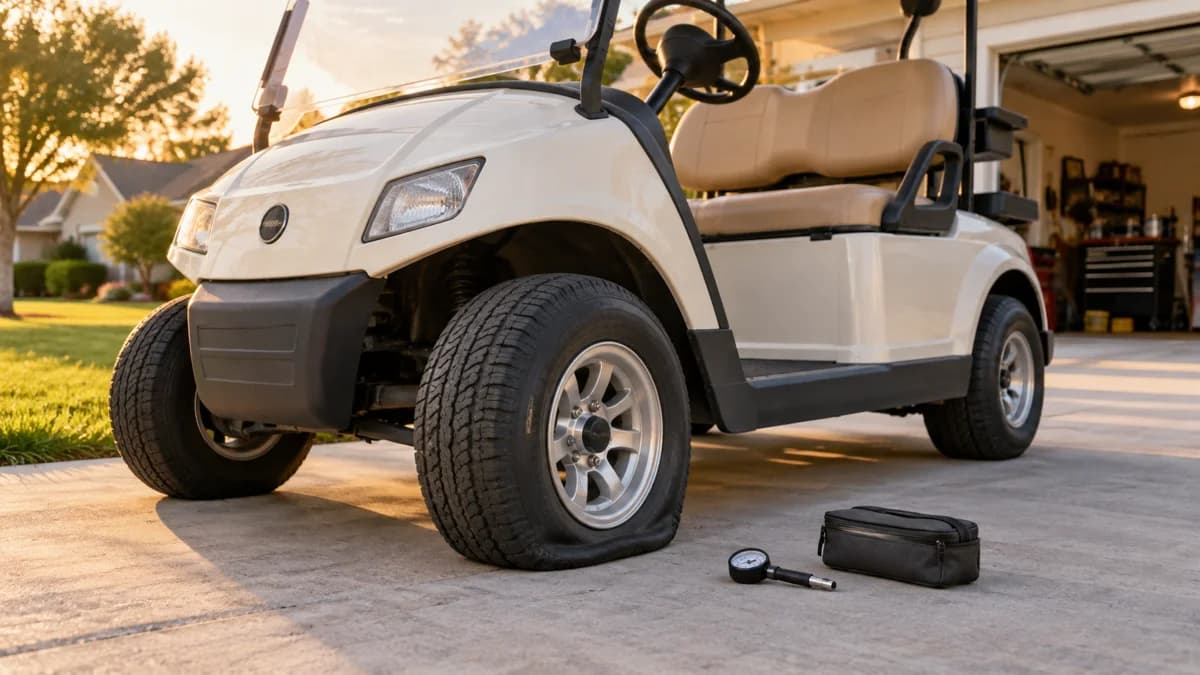
Check golf cart tire age from the installed tire's production marking, then assess condition and the manufacturer's replacement guidance separately. Deep tread, a recently purchased cart or a seller's description of “new wheels” does not establish when the rubber was made. Record all four tires before deciding what needs inspection or replacement.
This guide is for an owner preparing a cart for storage or a buyer examining a used cart with an uncertain tire history. It helps you gather useful evidence for a tire shop. It cannot certify a tire from a photograph, and the date-code examples below are worked examples rather than tires we inspected.
Read golf cart tire age from the right marking
For a tire carrying a modern DOT Tire Identification Number, or TIN, the final four digits identify its manufacturing week and year. For example, 2423 means week 24 of 2023. The code describes production, not the date somebody mounted the tire on a rim. NHTSA's TireWise guidance explains the format and advises checking both sidewalls because the TIN may not appear on both sides.
Start by photographing the tire's brand, model, size and complete marking. A close-up of four isolated digits loses context: another number molded into the sidewall may be a size, part or production-control marking. Keep a wider photo showing where the code sits, then take a closer photo you can read without enlarging a blurry image.
| Example ending of a modern DOT TIN | Read it as | Do not read it as |
|---|---|---|
| 2423 | Week 24 of 2023 | February 4, 2023 |
| 0921 | Week 9 of 2021 | September 2021 |
| 3525 | Week 35 of 2025 | A 35-month service-life rating |
These are decoding examples, not a sample of tires offered for sale. A production week does not identify an exact manufacturing day. Avoid presenting an age calculator's precise day count as more accurate than the marking permits.
If you cannot find a readable date
Park and secure the cart according to its manual on a level surface. Look from a safe position using a light, a phone camera or a mirror. Do not crawl under an unsupported cart or remove a wheel just to complete this worksheet. Our golf cart jack-point guide explains why lifting needs its own vehicle-specific procedure.
If you see a partial DOT marking without its date ending, the other side may hold the complete number. If the inner sidewall cannot be accessed safely, leave that field as unverified and ask a tire shop to read it. Do the same when a code is worn away, obscured or unfamiliar. A missing reading is a reason to investigate, not evidence that a tire is recent.
Identify the cart separately through its serial number and model information. The cart's model year and the tires' production dates answer different questions.
Golf cart tire age: our Kenda source comparison
On October 15, 2026, we read two current Kenda US golf-car product pages and compared their stated applications with NHTSA's date-code guidance. We recorded the tire family, application wording and whether each product page supplied a calendar replacement interval. This is original document-based reporting from two product pages, not a physical inspection, longevity test or survey of every tire variant.
| Manufacturer example | Published application | Calendar replacement interval on that product page |
|---|---|---|
| Kenda K389 Hole-N-1 | Non-highway use only | None stated |
| Kenda K399 Pro Tour | DOT rated for highway use | None stated |
The practical finding: “golf cart tire” identifies neither one road-use category nor one published lifespan. Both pages describe a long-lasting compound, but neither turns that description into a number of years. The K389's non-highway application also means a reader should not assume that every golf-car tire has the same certification markings as a road tire.
This comparison does not establish that a particular K389 lacks a production code, or that the K399 fits your cart. Check the actual tire and ask Kenda to interpret an unfamiliar code. For size, wheel and vehicle compatibility, use our tire size and fitment guide.
Keep road eligibility separate, too. A tire's DOT marking does not establish the cart's vehicle classification or permission to travel a particular road. Those questions belong with the vehicle documentation and your state's golf cart requirements.
Make a four-wheel tire record
Inspect each position rather than copying the first readable code across the set. A cart may have received one puncture replacement, a used wheel assembly or a different rear pair. You do not need to know which happened to record what is fitted now.
Copy this compact record into a note. Add a separate entry for a spare if the cart has one.
| Position | Tire model and size | Full code and photo | Condition or follow-up |
|---|---|---|---|
| Left front | Record installed tire | Record or mark unverified | Note visible issues |
| Right front | Record installed tire | Record or mark unverified | Note visible issues |
| Left rear | Record installed tire | Record or mark unverified | Note visible issues |
| Right rear | Record installed tire | Record or mark unverified | Note visible issues |
For each tire, add the inspection date, cold pressure, the source of the pressure specification and any receipt showing installation. Keep the original photos. If a shop later replaces a tire, retain the invoice and record the new tire's production marking, rather than overwriting the old history without a date.
Worked example: one recent tire does not date the set
Suppose a seller describes a cart's tires as “replaced last year.” Your illustrative record shows 2420, 2420, 3525 and one unreadable code. The readable tires were manufactured in week 24 of 2020 and week 35 of 2025. Their production dates are about five years apart, while the fourth tire's age remains unknown.
That evidence does not prove when any tire was installed or that the seller's statement is false. Ask whether “replaced” meant the complete set, one tire or complete used wheel assemblies, and request the invoice. It also does not establish which tire is fit for service. The useful result is a more precise inspection request: assess the two older tires and identify the unreadable one, rather than accepting a single date for all four.
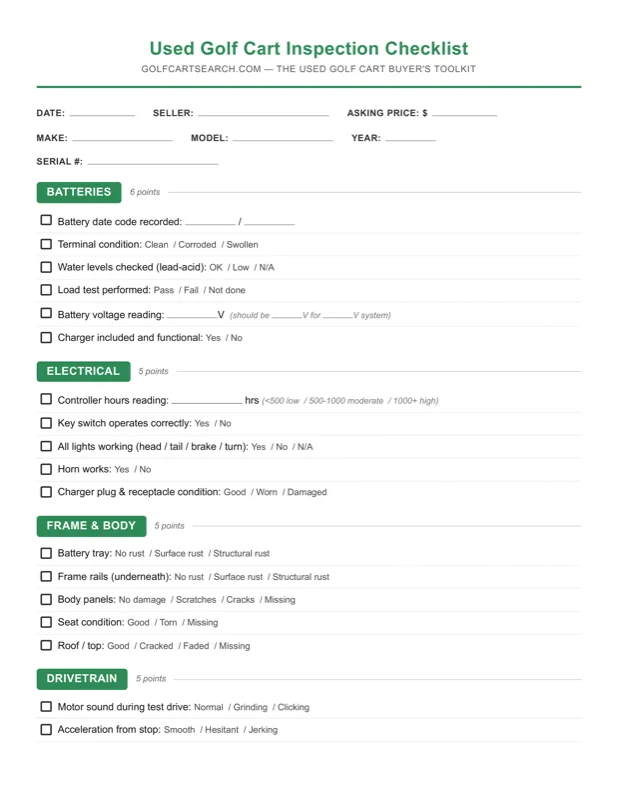
Our used golf cart inspection guide covers the broader purchase checks. A readable tire code cannot establish battery condition, brake performance or ownership paperwork.
Decide what needs professional inspection
There is no universal golf-cart replacement birthday established by the sources compared here. NHTSA says some vehicle and tire manufacturers recommend replacement at six to ten years, regardless of treadwear. That range is not permission to keep any cart tire until its tenth birthday. Obtain the instructions for the exact tire and vehicle, including any earlier replacement or inspection requirement.
Age and visible condition are separate checks. Stop using a tire with a bulge, exposed reinforcement, a significant cut or other apparent structural damage and obtain professional assessment. Persistent pressure loss, new vibration or changed handling also warrant investigation. Do not attempt to resolve those symptoms by choosing a replacement date from a generic chart.
| What you find | Useful next step |
|---|---|
| Readable code, no known tire-specific age guidance | Ask the tire maker or dealer for applicable guidance |
| Unreadable or uncertain code on a used cart | Request identification and condition assessment before relying on it |
| Crack, bulge, cut or suspicious deformation | Take the tire out of use and obtain professional assessment |
| Good-looking tread with an old production code | Check age guidance as well as tread; appearance alone is insufficient |
| One tire repeatedly loses pressure | Find the cause; a code does not distinguish a valve, rim or puncture leak |
| Uneven wear or a new vibration | Check the tire and vehicle installation before buying another set |
For a leaking tire, our flat-tire guide separates tread punctures from other damage. Uneven wear may also require the checks in our alignment guide. Neither repair advice nor sealant reverses tire age.
Three tools for recording, not certifying, condition
Use tools you already own before buying more. A phone camera, a light and the correct pressure specification may be enough to collect the initial record. A tread gauge adds a repeatable wear measurement; it cannot see internal aging.
For an illustrative spending plan, allow $15 for a pressure gauge, $15 for a tread gauge and $30 for a small light: $60 total. These are shopping allowances, not Amazon prices or a claim that every reader needs all three. Check current offers and shipping at the retailer.
Pressure gauge: record changes over time
The AstroAI digital gauge, ASIN B01J8DLGU2, is an option for recording pressure alongside your tire photos within that $15 planning allowance. Check its measurement range and suitability for your specified pressure before buying. We have not tested this unit's accuracy.
Check Price on AmazonFollow the exact cart and approved tire-package pressure specification. Do not inflate to a sidewall maximum just because it is easy to read. Our model-based tire-pressure guide covers that distinction. Record repeated losses for a service shop rather than continuing to top up an unexplained leak.
Tread gauge: measure wear separately from age
The STEELMAN 97831, ASIN B00GWFOSRS, reads in millimeters and 32nds of an inch. Its manufacturer page listed $13.99 on October 15, 2026, within the $15 planning allowance. That is the manufacturer's own store price, not an Amazon offer. Its colored bands do not override the installed tire or vehicle's service criteria.
View STEELMAN 97831 on Amazon →Measure consistently in suitable tread grooves and record the locations. Do not treat a green band or a deep groove as a certificate for an aged casing. NHTSA specifically warns that tire aging cannot be detected simply by appearance.
Inspection light: make the marking readable
The Streamlight MicroStream 66318, ASIN B00143JZ08, is a compact option to compare against the $30 light allowance. Streamlight's current specification sheet identifies the black 66318 as using one AAA alkaline battery and producing 45 lumens. This is the AAA model, not the separate USB model.
View Streamlight MicroStream 66318 on Amazon →A light helps you collect a readable photograph from an accessible position. It does not make reaching beneath the cart safe. If access requires wheel removal, let a suitable shop perform the work.
Check age before storage and before buying replacements
Record the tires before a long absence so the returning owner or service shop has a baseline. Storage is not a pause button for aging. Follow the vehicle's storage instructions for pressure, parking and support, and inspect the cart before its next trip. Our winter storage guide, storage-cover guide and spring checklist address those related jobs.
When ordering replacements, ask the supplier for the exact tire model, application and production information, plus an installed quote. Separate tires, mounting, valves, wheel work and disposal so you can compare like for like. A low price for an unmounted tire cannot be compared directly with a complete fitted wheel package.
Confirm the approved size, load capability and wheel fit for your particular Club Car, E-Z-GO, Yamaha or other cart. More capacity printed on a tire does not increase vehicle load capacity. If it needs transport to a shop, arrange that using the checks in our transport guide, rather than driving on a damaged tire.
You can find a local repair service to read inaccessible markings and provide an itemized assessment. Bring the four-wheel record, the vehicle identity and any invoices. That gives the shop something specific to inspect and keeps your maintenance record useful after the tires are replaced.
Frequently asked questions
How do I check golf cart tire age?
Identify the installed tire and photograph its sidewall markings. On a tire carrying a modern DOT Tire Identification Number, the final four digits show manufacturing week and year. Record each wheel separately.
What does tire date code 2423 mean?
At the end of a modern DOT Tire Identification Number, 2423 means week 24 of 2023. It does not mean February 4, an installation date or a replacement deadline.
Do all golf cart tires have a DOT date code?
Do not assume they do. Kenda lists its K389 golf-car tire for non-highway use and its K399 Pro Tour as DOT rated. Identify the exact tire and ask its maker about unfamiliar production markings.
Should golf cart tires be replaced every five years?
There is no five-year interval established by the two Kenda product pages compared here. Follow the exact tire and vehicle manufacturers. NHTSA says some manufacturers recommend six to ten years, not that every golf cart tire has that lifespan.
Can tires be too old even with deep tread?
Yes. Tread depth and age measure different things. NHTSA warns that appearance alone cannot establish tire aging. A tread gauge cannot certify the internal condition of an old tire.
Why can I find DOT letters but no date?
You may be looking at a side without the complete Tire Identification Number. Check the other side safely. If the full marking remains inaccessible or unreadable, ask a tire shop to identify it instead of guessing from another molded number.
Does winter storage stop tire aging?
No. Storage conditions are part of tire aging. Record the production code before storage, follow the vehicle storage instructions and inspect the tires before returning the cart to service.
Should I check all four golf cart tires?
Yes. Four tires can have different production dates and replacement histories. Record left front, right front, left rear and right rear, plus any spare, rather than using one tire as the age of the whole set.
Golf Cart Search
Find the Best Golf Carts of 2026
Compare top-rated models, read expert reviews, and find the perfect cart for your needs.