

As an Amazon Associate, we earn from qualifying purchases. This helps support our site at no extra cost to you.
Golf cart load capacity is the documented weight the vehicle can carry, subject to its seating and local load limits. Count the driver, passengers, packed gear and equipment included by the manufacturer’s definition. Then check where that weight sits. An empty seat does not guarantee enough capacity for another rider, and unused total payload does not cancel a rear-seat or trunk limit.
The examples below help an owner plan a neighborhood trip, a buyer compare factory passenger layouts, or a used-cart shopper question a rear-seat conversion. Start with the instructions for the actual cart. A family nickname such as “Onward” or “Express” is not enough to select a rating.
Golf cart load capacity: documented examples
On October 13, 2026, we compared three Club Car specification pages, an E-Z-GO MY2026 specification page and E-Z-GO Express ELiTE manual 10082881-B, served under an August 2024 filename and marked “Model Year 2025 - Current” inside. We transcribed the published limits, separated whole-vehicle and local limits, and calculated the load examples below. This is original document-based reporting, not a physical load test or a representative survey of carts.
| Exact source configuration | Whole-vehicle load | Separate limit to notice |
|---|---|---|
| Club Car Onward two-passenger, configurations shown | 500 lb | Two designated seats |
| Club Car Onward four-passenger 2+2, eight configurations shown | 800 lb | Check the applicable operator manual for local limits |
| Club Car Onward four-forward LSV | 850 lb | Rear trunk: 50 lb |
| E-Z-GO MY2026 Express 4, configurations shown | 800 lb | Specification page does not settle every local limit |
| Express 4 ELiTE covered by manual 10082881-B, printed pages 3 and 23 | 800 lb | Rear seat/load deck: 300 lb |
The useful finding is that the rating has a location as well as a number. The last row is a manual-specific example. Do not transfer its 300 lb limit to every vehicle sold under the Express name, including later variants, without confirming the applicable instructions.
These sources do not establish a universal capacity for Yamaha, ICON, Evolution or a modified fleet cart. Ask the manufacturer or authorized dealer for the model, serial range and fitted configuration. Our serial-number guide can help you identify the vehicle before requesting documents.
Curb weight is different from carrying capacity
Club Car’s four-passenger page lists curb weights from 794 to 1,125 lb, while all eight columns retain an 800 lb vehicle load capacity. Our subtraction gives a 331 lb spread in curb weight, with no corresponding change in the published load number. The columns represent different factory configurations, not a before-and-after battery experiment.
For hauling, use the actual ready-to-transport vehicle weight and trailer limits. For carrying people, use approved occupancy and vehicle load limits. Our golf cart weight guide covers the transport calculation; the gas-versus-electric comparison covers powertrain choices. Neither a lighter cart nor a stronger motor establishes permission for more occupants.
Calculate golf cart load capacity for your trip
Use one worksheet for the actual trip, not a generic average passenger weight. You can record only the combined rider total if individual weights are private. Include the things you will put aboard after leaving the driveway, such as shopping or a return passenger.
Planning calculation: remaining total capacity = applicable vehicle load limit minus occupants, cargo and counted added equipment. Confirm what the manufacturer includes before using that formula. Do not subtract standard equipment already included in the manufacturer’s vehicle configuration twice. For a modified cart, obtain the resulting approved rating rather than reconstructing one from a generic curb-weight figure.
| Assumed item | Two-person outing | Four-person outing |
|---|---|---|
| Combined occupants | 350 lb | 720 lb |
| Packed cargo | 40 lb | 45 lb |
| Added equipment counted against load | 30 lb | 20 lb |
| Total counted load | 420 lb | 785 lb |
| Example whole-vehicle limit | 500 lb | 800 lb |
| Arithmetic remainder | 80 lb | 15 lb |
These are illustrative assumptions, not measured riders, accessory weights or approved loading plans. They show why a four-seat cart can have little remaining capacity once its intended occupants and gear are counted. The 15 lb remainder is particularly sensitive to an unweighed bag or an omitted accessory.
A positive remainder only passes the whole-vehicle arithmetic. You still need approved seats, local limits, suitable load placement and the operating conditions allowed by the vehicle instructions. It is not a safety margin certified by Golf Cart Search. If the numbers are close, replace estimates with suitable measurements and ask the dealer to resolve uncertain equipment accounting.
Weigh gear in its packed condition
An empty cooler’s advertised weight does not include its contents. Weigh the cooler ready for the outing, the complete golf bag rather than just its clubs, and a tool bag with the tools inside. Remove items you do not need before buying suspension parts to accommodate them.
The Etekcity EL11 specification lists a 110 lb / 50 kg capacity and 0.1 lb / 50 g increments. It is a useful small-bag option when the bag can be lifted safely and its handle can support it. Display increments are not proof of measurement accuracy. Do not use a luggage scale to suspend a person, battery pack or cart, or lift an awkward cooler by an unsuitable handle. Use a suitable platform scale when handheld weighing is impractical.
Check Etekcity EL11 Price on AmazonA simple written list is enough: item, packed weight, where it will ride, and whether the number is measured or estimated. Keep accessories separate so you can update the list when a sound bar, enclosure or cargo carrier is installed.
Rear-seat and cargo limits can fail first
Consider the manual-specific Express 4 ELiTE example in the table. Assume four riders each weigh 170 lb and the counted gear weighs 40 lb. The total is 4 × 170 + 40 = 720 lb, leaving 80 lb below the 800 lb whole-vehicle figure. But two rear riders alone total 340 lb, exceeding the documented 300 lb rear-seat/load-deck limit by 40 lb.
That calculation is the reason to check each seating area. It does not authorize rearranging occupants, modifying the rear seat, or applying this older manual to a different cart. If the planned group cannot fit the actual approved limits, use another suitable vehicle or divide the trip.
The Onward four-forward LSV provides a cargo example. Assume four occupants total 740 lb and 65 lb of gear goes entirely in the rear trunk. Total load is 805 lb, which is 45 lb below its listed 850 lb whole-vehicle limit. The trunk nevertheless exceeds its 50 lb limit by 15 lb. Unused capacity elsewhere is not permission to overfill that compartment.
A small trunk may be the deciding factor for groceries even when everyone has a seat. Compare the actual layout through our forward-facing four-seat guide, then ask the seller to demonstrate where your packed items can be carried within the instructions. Our cargo-box guide focuses on selecting the hardware; this worksheet checks the load after hardware is chosen.
A rear-seat kit does not supply a new vehicle rating
For a used cart with a flip seat, ask two separate questions: what can the kit hold, and what is the host vehicle approved to carry in that configuration? A high component rating answers neither approved occupancy nor the cart’s resulting total payload by itself.
Obtain the kit part number, application instructions, installed mass and the documentation approving the resulting passenger configuration. Include roof brackets, foot platforms, handholds and restraints in the installation review. Keep any separate passenger-mode and cargo-mode limits with the vehicle records. Our rear-seat kit guide explains the fit and installation questions.
Do not infer capacity from ride height. A cart that sits level on replacement springs still needs an approved loading plan and working brakes. Have a qualified installer assess the conversion, tire clearance and relevant limits. The shocks and suspension guide helps distinguish worn parts from an accessory-shopping decision; the brake guide explains why stopping condition deserves its own check.
Battery conversions need documentation too
Use the installed battery system’s actual identification when discussing a converted cart with the manufacturer or installer. A lighter pack can change measured vehicle weight, but you cannot turn the removed pounds into extra seats or a revised manufacturer load rating on your own. The factory comparison above shows that curb weight and published carrying capacity are not interchangeable.
Before buying a conversion, check compatible charging, mounting, electrical protection and the resulting vehicle approval. Our lithium conversion guide covers that separate decision. Keep the capacity question in writing so it is not lost in a discussion about advertised range.
Check dimensions, tires and placement before departure
Weight is only one part of a usable cargo space. Check that the planned gear stays within the permitted carrying area, does not obstruct controls or access, and can be secured at approved points. The loaded configuration must also meet the vehicle’s visibility and operating requirements.
A tape measure helps compare the cargo area with the packed item, rather than relying on a seller’s “fits most carts” claim. STANLEY’s model 33-425 has a 25-foot blade. It can also support the garage and trailer measurements in our dimensions guide. It measures fit, not carrying capacity or attachment strength.
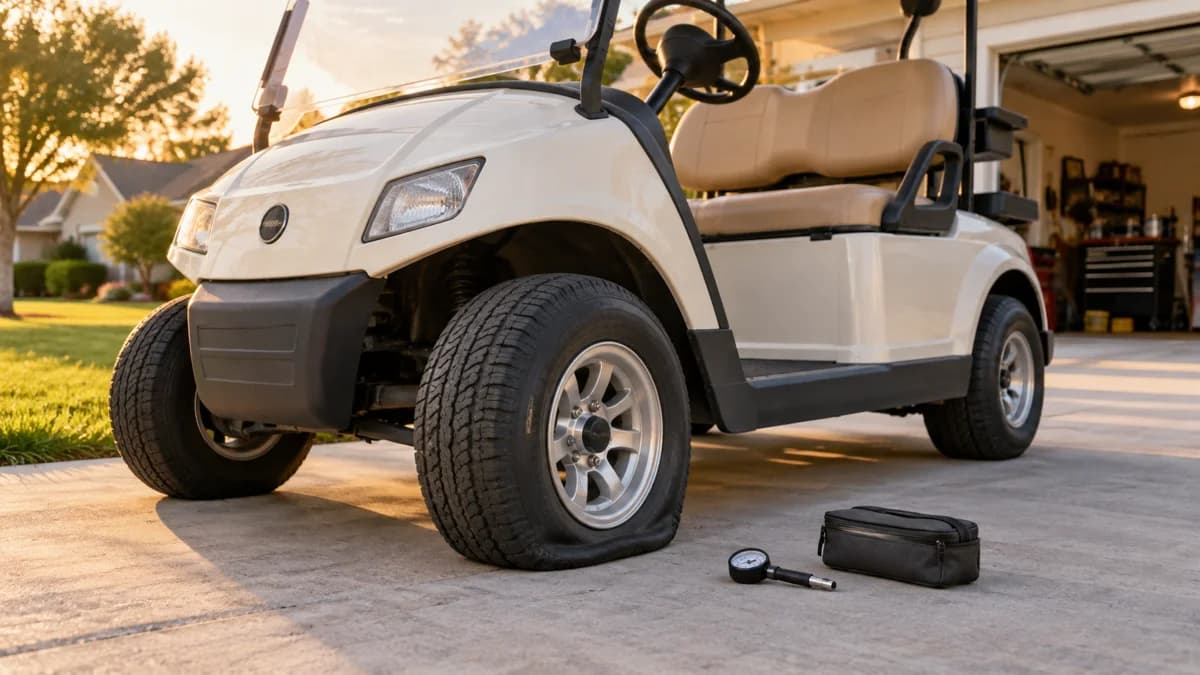
Check STANLEY 33-425 Price on Amazon →Check tires against the actual vehicle instructions and installed tire requirements. Do not inflate to a sidewall maximum simply to compensate for extra passengers. A tire’s own load rating cannot replace the vehicle rating. Our tire-pressure guide covers operating specifications, and the tire and wheel guide covers replacement fit.
The AstroAI silver digital gauge is one compact pressure-check option. Match a gauge’s range, valve access and stated accuracy to the readings you need. We have not tested this gauge on the example carts; a pressure reading cannot validate an overloaded cart.
Check AstroAI Gauge Price on Amazon →Illustrative equipment budget: allocating $15 for a small bag scale, $20 for a tape measure and $15 for a gauge totals $50. Those are planning allowances, not current offers or manually copied Amazon prices. Reuse suitable tools you already own; the buttons show the seller’s current terms. Buying tools is optional, but resolving the loading limits is part of planning the trip.
What to request before buying a passenger cart
Send the dealer your combined rider weight, packed cargo weight, intended cargo location and typical route. Ask for the exact configuration’s seating, total load and local load limits. If an advertised “four-person” cart fails the proposed load, compare a different approved layout instead of budgeting for an unverified spring upgrade.
Use our two-, four- and six-seat comparison for passenger-space and buying trade-offs. Our Club Car directory, E-Z-GO directory and dealer directory can help identify sellers who can supply the documents for the actual vehicle.
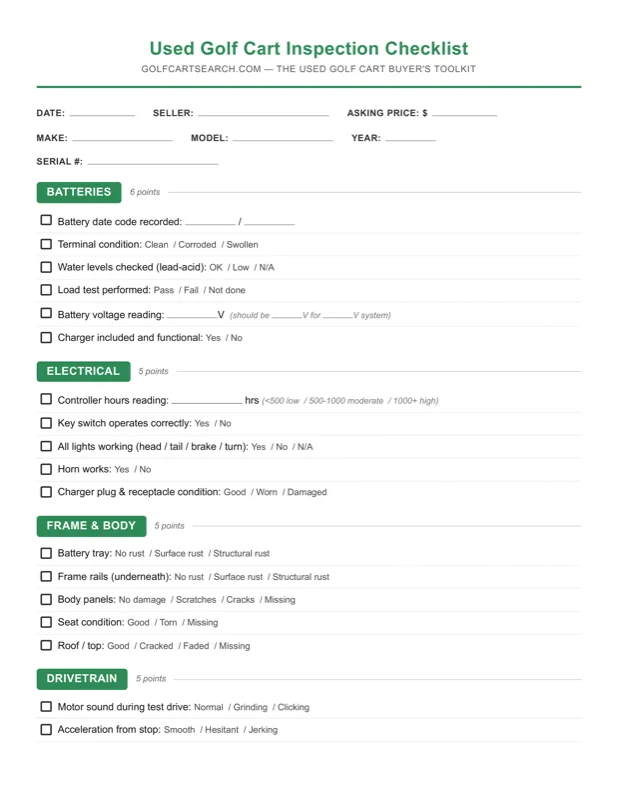
For a used cart, check whether the configuration matches its records and whether the conversion has a documented approval path. The used-cart inspection guide covers the wider condition review. Ask a repair shop to assess unexplained sag, tire contact or loose seat mounts before carrying passengers.
If the cart will use public roads, load capacity is only one decision. Check vehicle classification and your state and local golf cart rules; discuss the actual passenger configuration with your insurer using our insurance guide as a starting point. A satisfactory weight calculation does not establish road permission or coverage.
Frequently asked questions
How much weight can a golf cart carry?
Use the exact vehicle rating. The three Club Car examples above list 500, 800 and 850 lb, depending on configuration. They are documented examples, not a universal range for every cart. Check any separate compartment or seating-area limit too.
Does the driver count toward the load limit?
Yes in the cited Express ELiTE manual’s definition. Confirm your own vehicle’s definition and equipment accounting. Treat an unexplained “capacity” number in a sales listing as a question for the seller, not a finished loading calculation.
Can four adults use every four-seat cart?
No automatic assumption follows from four seats. Our hypothetical four-rider Express example passes the total-weight arithmetic but exceeds the cited rear-seat limit. The planned occupants must fit both approved seating and all applicable weight limits.
Can a rear-seat conversion increase payload?
A kit’s component rating is not the vehicle rating. Get documented approval for the resulting configuration and account for added equipment as instructed. A physical fit or a seller’s passenger-count claim does not supply that approval.
Do heavy-duty springs increase carrying capacity?
Do not use reduced sag as evidence of a revised vehicle rating. Ask for the approval and limits for the exact modification. Brake condition, tire clearance, seating and load distribution still require review.
Can I carry more after fitting a lighter lithium battery?
Do not convert the apparent weight saving into extra occupants or load without documented approval. The factory Onward comparison has different curb weights but the same 800 lb carrying figure. A retrofit is a separate configuration question.
Does a trunk have its own weight limit?
It can. Club Car’s four-forward LSV lists a 50 lb rear-trunk limit in addition to its whole-vehicle load figure. Our assumed 65 lb trunk load exceeds that local limit by 15 lb, regardless of unused total capacity.
What should I include when weighing cargo?
Weigh packed bags, filled coolers and complete tool kits. Include the items expected on the return journey and account for installed equipment once. If a weight is estimated, keep that uncertainty visible and resolve it before relying on a small remainder.
Golf Cart Search
Find the Best Golf Carts of 2026
Compare top-rated models, read expert reviews, and find the perfect cart for your needs.