As an Amazon Associate, we earn from qualifying purchases. This helps support our site at no extra cost to you.
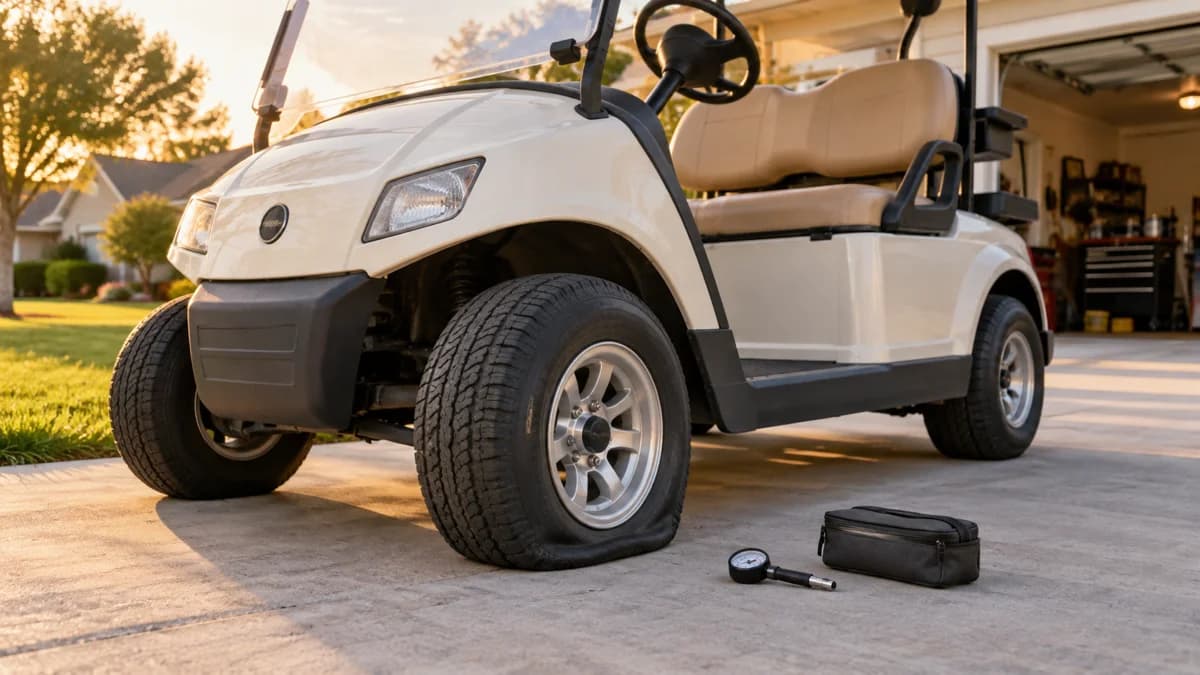
A golf cart flat tire needs a leak diagnosis and a repair decision before you continue driving. A small hole in the tread, a split sidewall and a leaking valve can all leave a cart leaning in the driveway. They do not call for the same fix. If the tire is visibly flat or damaged, stop the trip and arrange a suitable wheel change or recovery.
This guide is for an owner deciding what to do next, whether the cart is at home, on a course or in a neighborhood. It covers repair instructions, spare-wheel checks and useful equipment.
Golf cart flat tire: secure the cart first
If you notice a flat while driving, bring the cart to a controlled stop in a safe location. Get passengers away from traffic. Use the exact vehicle parking instructions and prevent unintended movement before inspecting the wheel. On a rental or course cart, contact the operator rather than starting an unauthorized repair.
If the tire has lost its supporting shape, do not drive another half mile: it needs attention where it is. Continuing the route also makes it harder to distinguish the original puncture from damage caused afterward.
Choose recovery when the site is unsafe, the cart cannot be secured, you lack approved lifting equipment, or the tire or wheel has substantial damage. Our repair directory can help find service; ask explicitly whether the shop offers a mobile visit or pickup.
What our October 2026 source comparison found
On October 12, 2026, we compared three published approaches: E-Z-GO's owner instructions, USTMA's passenger/light-truck tire repair guidance and Slime's off-highway sealant specification. We also cross-checked two RXV manuals and two manufacturer tire-size examples.
| Source and scope | Published repair rule | What an owner should check |
|---|---|---|
| E-Z-GO RXV ELiTE, manual 10036459-B, printed page 28 | Small tread holes can be plugged; large holes or sidewall holes/cuts require replacement | Match the vehicle and installed tire, then follow the repair product instructions |
| USTMA tire repair guidance, passenger and light-truck scope | Remove and inspect the tire; eligible tread injuries require a puncture stem and inner-liner patch | A plug-only repair does not meet this procedure; tire-maker restrictions still apply |
| Slime 10194 specification, off-highway tires and tubes | Manufacturer claims sealing of tread punctures up to 1/4 inch in tires, or 1/8 inch in tubes | Check the formula, tire type and permitted use; it does not repair sidewalls or approve road use |
The finding: “a golf cart tire” has no single repair standard. Vehicle instructions, the actual tire and its use must all match. An off-highway product claim does not approve a road-going LSV tire, and USTMA's passenger/light-truck procedure does not automatically cover every turf tire.
Before ordering parts, identify your cart and photograph the installed tire markings. Our serial-number lookup guide helps establish the model; the current E-Z-GO manual library provides matching documents. For Club Car and Yamaha, obtain the equivalent exact-model instructions from the manufacturer or dealer.
Two RXV manuals, two wheel-torque ranges
The comparison uncovered a practical reason to avoid a universal lug-nut setting:
| Documented example | Printed wheel-installation page | Published range |
|---|---|---|
| RXV EX1 EFI, 10036460-E | 30 | 65–85 ft-lb |
| RXV ELiTE, 10036459-B | 29 | 50–85 ft-lb |
Both specify a cross tightening pattern. Use the torque in the instructions for your actual vehicle and installed hardware; a shared E-Z-GO badge is not enough.
Golf cart flat tire diagnosis: tread, valve or bead?
Start with what you can observe without lifting the cart: tire shape, a visible cut or embedded object, wheel damage and the pressure reading if it can be taken safely. Do not pull out a nail just to see what happens. Record its position for the technician.
The RXV EX1 EFI manual describes soapy-water bubbles as a way to locate escaping air during its tire-repair procedure. That procedure includes wheel removal; do not crawl beneath a cart or inflate a visibly damaged tire to find a leak. Have the shop perform the test when safe access or tire condition is uncertain. Source: tire section, printed page 29.
| Observed leak location | What to report | Next decision |
|---|---|---|
| Central tread | Object, hole location and whether the cart was driven flat | Ask whether the injury and internal condition qualify for the applicable repair |
| Sidewall or shoulder | Cut, bulge, crack or damage near the tread edge | Take out of service and obtain tire-center assessment; do not assume a tread plug fixes it |
| Valve area | Escaping air around the valve opening or stem | Request valve/core/stem diagnosis instead of buying a tread repair blindly |
| Tire-to-rim edge, or bead | Leak at the sealing edge, visible rim condition | Request bead and wheel inspection; adding air does not identify the cause |
A tire can have more than one leak, and an exterior photograph cannot show the inner liner.
For an intact tire with pressure loss, check the operating specification in our model-based tire-pressure guide. The documented RXV EX1 EFI example allows 18–22 PSI, while the tire's sidewall limit serves a different purpose. Do not substitute a generic 20 PSI target or inflate to a maximum simply because it appears on the rubber.
If the cart also pulls, vibrates or wears a tire unevenly, report that separately. Our alignment guide covers another diagnostic path; a plug will not correct alignment.
Repair, replacement and recovery solve different problems
Repair is appropriate only when the installed tire's injury and condition meet the applicable instructions. USTMA limits its stated passenger/light-truck procedure to eligible tread injuries no greater than 1/4 inch, or 6 mm, requires internal inspection and rejects overlapping repairs. The tire maker can impose further limits, and a technician decides whether the tire qualifies. USTMA source.
Replacement addresses a tire that cannot be repaired within those limits. It still needs the correct size, construction and ratings for the cart. The RXV ELiTE manual directs tire replacement to a qualified tire center or dealer using mounting equipment. Breaking a bead and changing the tire on its rim is a different job from bolting on an already mounted wheel.
Recovery gets a disabled cart to a suitable repair location. Tell the operator that it has a flat, so they can plan loading and equipment. Do not assume that putting an electric cart in TOW makes it safe to drag on a damaged tire. Vehicle-specific brake release and transport procedures still apply. Our golf cart transport guide and cart weight guide cover the questions to ask.
If you have a policy, check whether it covers this particular cart, location and recovery service before expecting reimbursement. The golf cart insurance guide explains the coverage questions.
A spare tire must fit more than the diameter
We checked two manufacturer examples to test a common shortcut: shopping only for an “18-inch golf cart tire.”
| Published example, checked October 12 | Tire designation | Rim diameter | Published outside diameter |
|---|---|---|---|
| Yamaha Drive2 fleet | 18x8.5-8 | 8 inches | 18 inches in the nominal designation |
| Kenda K399 Pro Tour | 205/50-10 | 10 inches | 18.3 inches in the manufacturer table |
The outside diameters are similar, yet the rim diameters differ by 2 inches. Similar overall height does not make loose tires interchangeable on the same rim.
For a complete mounted spare, confirm all of these with the vehicle or wheel supplier:
- Approved tire size, construction, load and speed ratings for the application.
- Wheel width, diameter, bolt pattern, center opening and offset.
- Correct lug hardware and seating shape.
- Clearance around brakes, steering, fenders and any lift equipment.
- Compatibility with the tires already fitted and the permitted operating configuration.
Kenda's table even lists multiple constructions and load ratings under the same 205/50-10 designation. A size label alone does not select the exact replacement. Our tire and wheel buyer's guide covers shopping distinctions. If your cart has wheel spacers or speed-related tire changes, include those in the fitment discussion rather than assuming factory wheel instructions cover the modification.
Three useful tools
Carry equipment for tasks you can perform safely. You can keep a gauge and charged inflator without committing to roadside wheel removal. A jack, supports and torque wrench belong in the kit only when you also have a workable approved procedure and a suitable location. Our golf cart tool-kit guide separates those jobs.
A gauge for pressure checks
The AstroAI digital gauge, ASIN B01J8DLGU2, is a compact option for checking pressure at a compatible valve. Verify access at your installed wheel. Its 150 PSI headline is the measuring range, not a golf cart operating pressure.
Check Gauge Price on AmazonA cordless inflator for an appropriate top-up
The Fanttik X8 APEX Mechanical Gray, ASIN B0F191R1LZ, avoids reliance on a cart's accessory power socket. Check its manual, hose access and pressure-setting range before use. Remain with the tire during inflation and use the cart's required target. Do not reinflate a damaged tire. Manufacturer product information.
Check Inflator Price on AmazonOff-highway sealant only when approved
The Slime 10194 2-in-1 32-ounce bottle, ASIN B08TFGLRL1, is an option to discuss for compatible off-highway tires or tubes. Confirm both vehicle and tire-maker permission before using it. Follow Slime's dose and application instructions, and tell a repairer if sealant is already inside the tire.
Its stated 1/4-inch tire and 1/8-inch tube limits concern tread punctures. They do not turn a sidewall cut, damaged wheel or uncertain bead into a suitable repair. Manufacturer specification.
Check Slime 10194 Price on Amazon →For a planning exercise, set aside $15 for a gauge, $90 for a cordless inflator and $20 for a sealant bottle, totaling $125. These are hypothetical budget allocations; use the buttons to check the current offer before buying.
We verified the product identities on October 12, 2026.
Send the repair shop a useful request
Send five items before asking for a price: location, cart identity, tire markings, damage photos and whether it was driven flat. Include a wheel photograph, any aftermarket changes and any sealant or attempted repair.
Ask for a written breakdown of the call-out, diagnosis, eligible repair or replacement tire, mounting, valve work and recovery if needed. Confirm whether the shop can handle your tire and cart. A national flat-fee estimate would hide the most consequential part: whether the tire is repairable and whether the cart has to be collected.
After the work, keep the receipt, tire specification and wheel-installation instructions with your maintenance records. Add a tire condition and pressure check to your routine before trips. If a cart comes out of seasonal storage with a flat, resolve it before following the rest of the return-to-service checklist.
If the tire history is uncertain, use our tire-age and date-code guide to record each wheel before ordering replacements.
Frequently asked questions
Can I drive a golf cart with a flat tire?
No, not on a visibly flat or damaged tire. Secure the cart, get passengers clear of traffic and arrange a suitable wheel change or recovery.
Can a golf cart tire be plugged?
Sometimes. The RXV ELiTE manual allows plugs for small tread holes but requires replacement for large holes or sidewall cuts. Confirm the installed tire manufacturer and service restrictions too.
Is a tire plug a permanent repair for a road tire?
Not under USTMA passenger and light-truck guidance, which requires removal and inspection plus both a puncture stem and an inner-liner patch. Ask the tire maker which procedure applies to your tire.
Will tire sealant fix a sidewall cut?
No. Slime 10194 is an off-highway product for specified tread punctures, with stated limits of 1/4 inch in tires and 1/8 inch in tubes. Vehicle and tire approval still matter.
Why does my golf cart tire keep losing air?
A tread puncture, valve leak or tire-to-rim bead leak needs a different repair. Locate the leak rather than repeatedly adding air. A tire shop can inspect internal damage and distinguish the cause.
Should I inflate to the number on the tire sidewall?
No. Use the operating specification for the exact cart and installed tire; the sidewall figure is a pressure limit, not the operating target. The documented RXV EX1 EFI example specifies an 18–22 PSI range.
Will any 18-inch golf cart spare fit?
No. Yamaha lists an 18x8.5-8 fleet tire, while Kenda lists a 205/50-10 tire with an 18.3-inch outside diameter. Those use different rim diameters. Match tire, wheel, hub, hardware and clearance requirements.
What should I tell a mobile golf cart repair shop?
Send the location, cart model and serial number, tire-size photo, wheel photo, observed damage and whether the cart was driven flat. Ask whether the quote includes call-out, tire work, mounting and any recovery.
Golf Cart Search
Find the Best Golf Carts of 2026
Compare top-rated models, read expert reviews, and find the perfect cart for your needs.