
As an Amazon Associate, we earn from qualifying purchases. This helps support our site at no extra cost to you.
If you are shopping for the best golf cart turn signal kit, the first question is not brand. It is whether your cart already has headlights and taillights.
That is where buyers waste money. They buy a cheap "universal" turn signal kit, then discover their cart still needs a full light package, a voltage reducer, mirrors, seat belts, a windshield, and the paperwork covered in our street-legal guide and registration by state guide.
This guide is built to solve that exact problem. We will cover the best add-on turn signal kits for carts that already have lights, the best full kits for Club Car, EZGO, and Yamaha, the 9-pin harness confusion that trips people up, and how to avoid ordering the wrong kit the first time.
Quick Answer: Add-On Kit or Full Kit?
Here is the clean version:
- Buy an add-on turn signal kit if your cart already has working headlights, taillights, and a compatible harness.
- Buy a full street-legal lighting kit if your cart still needs front and rear lights, brake light wiring, horn, or steering-column controls.
- Buy neither yet if your cart still lacks the rest of the road-use package covered in our golf cart laws hub, insurance hub, and best street legal carts guide.
The biggest mistake is using a turn signal kit to solve a bigger compliance problem. Turn signals help, but they do not magically turn a golf-course cart into a road-ready one. In markets like Florida, South Carolina, Texas, and Arizona, the legal conversation moves quickly from "Can I add signals?" to "Do I also need mirrors, belts, a windshield, registration, and insurance?"
What a Golf Cart Turn Signal Kit Actually Includes
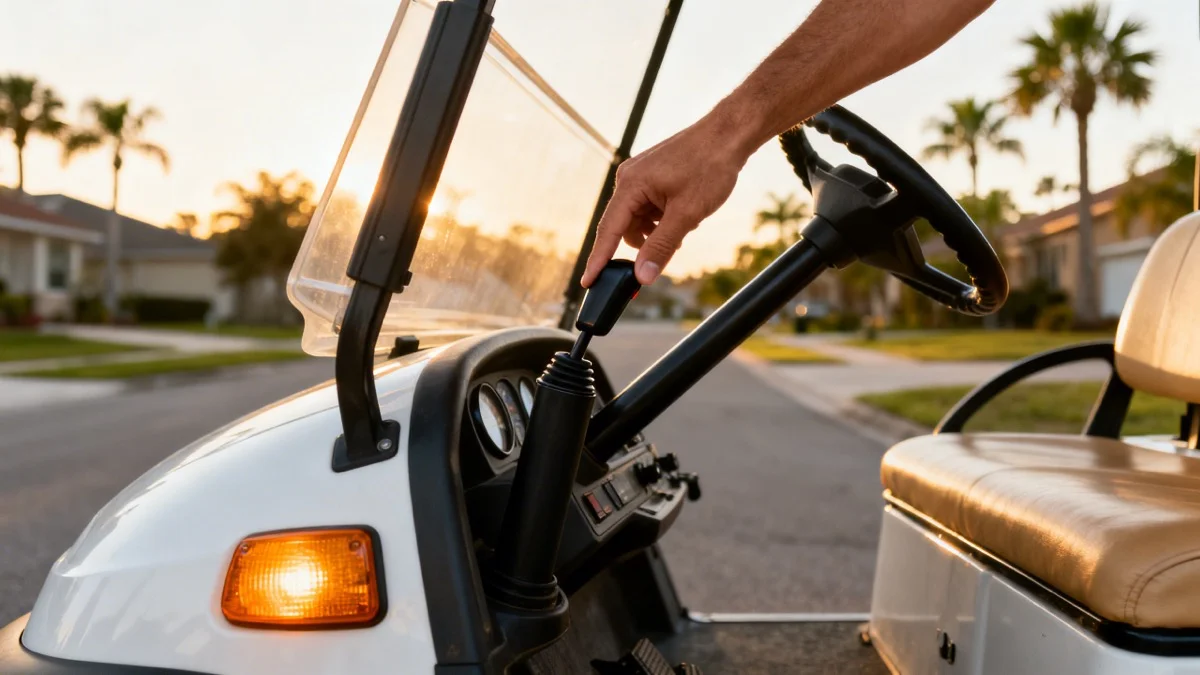
A real golf cart turn signal kit usually includes five things:
- Turn signal lever for the steering column
- Flasher module or controller
- Horn button or horn wiring
- Brake light switch so your rear lamps brighten when you stop
- Harness and connectors to tie into your current lighting setup
That last part is the one that matters most. The difference between a smooth install and an all-day wiring headache is often the harness.
Some kits are built around a 9-pin plug, which is common on aftermarket golf cart light kits. If your cart already has that style harness, an add-on kit can be cheap and easy. If your cart uses a different wiring layout, the word "universal" usually means "you are doing more wiring than the listing admits."
This is also why the best product for a Club Car Onward 4 Passenger is not always the best product for an EZGO Liberty LSV or a Yamaha Drive2 PTV. Fitment is not just about voltage. It is about body shape, steering column trim, brake linkage, and where the wiring can actually run cleanly.
Add-On Kit vs Full Street-Legal Kit
| What you have now | What you should buy | Typical price | Best fit |
|---|---|---|---|
| Headlights + taillights + compatible harness | Turn-signal-only add-on kit | $25 to $60 | Budget retrofit |
| No lights installed yet | Complete light + signal kit | $100 to $180 | Best value overall |
| Existing lights but poor wiring or random homemade setup | Usually a complete kit | $100 to $180 | Cleaner long-term fix |
| Factory LSV with broken signal hardware | OEM-style replacement parts | Varies | Brand-specific repair |
In practice, most owners are better off buying a full kit unless they already know they have a good harness. That is exactly why the current SERP is full of retailer product pages instead of solid buyer education. Most sites tell you what the kit costs, not whether the kit actually matches your cart.
If you are trying to build out the whole neighborhood package, pair this guide with our best golf carts for neighborhoods guide, golf cart safety guide, and best golf cart mirrors guide. Turn signals make the most sense as part of a complete visibility package, not a standalone gimmick.
Best Turn Signal Add-On Kit: 10L0L Universal 9-Pin Kit
If your cart already has basic headlights and taillights, the 10L0L Universal Turn Signal Kit is the smartest add-on buy.
It is built for the common real-world retrofit: you installed a light kit a year ago, then realized your city or HOA expects turn signals, brake lights, hazard flashers, and a horn for road crossings or neighborhood use. The 10L0L kit adds the turn signal lever, horn button, hazard switch, controller, brake pad switch, and steering-column cover without forcing you to replace the entire lighting system.
The reason it works is the 9-pin plug. On carts with compatible aftermarket light harnesses, installation is dramatically easier than cutting in a totally new kit. On carts without that harness, it is still possible, but this stops being the easy option.
What I like:
- usually about $40 to $60
- strong fit for carts that already have lights
- cheaper than replacing a full harness
- 10L0L has better golf-cart-specific fitment support than most generic Amazon sellers
What to watch:
- 12V input only
- not truly universal in the mechanical sense
- still needs clean brake-switch mounting
Best Full Kit for EZGO TXT and T48: PROFX Deluxe LED Kit
For EZGO TXT carts built between 1996 and 2013, the 10L0L Deluxe kit is the cleanest complete solution I found.
It is the right answer when your cart still needs the whole street-use package on the lighting side: headlights, taillights, brake function, turn signals, horn, and the steering-column hardware to control it. Instead of piecing together an add-on signal kit plus separate lights, you buy once and wire once.
That matters on EZGO carts because buyers often try to save money with partial upgrades, then end up paying twice. A full kit is easier to justify when you are already comparing the cart against a newer factory-ready model like the EZGO Liberty or EZGO Liberty LSV.
Expect to pay roughly $130 to $150 depending on seller. That is still cheaper than buying separate headlights, rear lamps, turn-signal controls, horn, and brake switch individually. Budget for a voltage reducer as well, since a 36V or 48V cart needs one to run the 12V lighting and the kit does not include it.
Best for:
- EZGO TXT owners starting from scratch
- 1996-2013 carts getting upgraded for neighborhood use
- owners who want a cleaner install than a patchwork add-on
Best Full Kit for Club Car Precedent, Tempo, and Onward: 10L0L Deluxe LED Kit
If you own a Club Car Precedent, and in many cases a related Tempo or Onward platform, the 10L0L Deluxe LED kit is the safest mainstream recommendation.
The aftermarket is simply strongest here. Club Car buyers have more kit choices than almost anyone else, which is helpful but also creates noise. The 10L0L kit stands out because it combines the full compliance hardware with better-known fitment support and a strong install reputation. You get the lights, turn signal lever, horn, brake pad switch, steering-column cover, and the 9-pin-style wiring setup that many retrofit buyers are specifically looking for.
This is the kit I would choose for a typical neighborhood Club Car owner who does not want to do the "buy an add-on now, fix the rest later" routine.
Typical street price is about $130 to $170.
If you are still deciding whether to retrofit your current Club Car or move up to a factory-ready option, compare the math against our Club Car review, best golf carts page, and the carts listed on our dealer directory.
Check Price on AmazonClub Car Precedent Alternative: 10L0L Complete Light Kit
This 10L0L complete light kit fits 2004-up Club Car Precedent carts and lists both gas and electric compatibility. It combines headlights, taillights, turn signals, a horn, and a brake-light switch in one package.
It is not the right choice if you only need turn signals added to a sound existing harness; for that job, the 10L0L 9-pin add-on above is simpler. Choose this full kit when the cart needs the lighting system as well as signal and horn hardware.
Confirm the input-voltage requirements and every included harness part against your exact cart before ordering.
Check Price on AmazonHow to Match a Kit to Your Cart Without Guessing
Compatibility is where most turn signal buyers get punished. Here is the simplest brand-by-brand filter.
Club Car DS, Precedent, Tempo, and Onward
Precedent has the strongest aftermarket support, which is why the 10L0L kits make sense there.
Tempo and Onward often overlap with Precedent hardware, but "often" is not the same as "always." If the listing does not explicitly mention your platform, do not assume.
DS carts are a separate animal. Plenty of sellers bury that detail in the compatibility notes. If you own a DS, use DS-specific fitment language and do not buy a Precedent kit because it was cheap.
Relevant references:
EZGO TXT, RXV, and Liberty
TXT is the easiest EZGO platform to buy for because the aftermarket assumes it first.
RXV is where "universal" starts to fall apart. The steering column and lighting layout differ enough that bargain listings become a gamble.
Liberty buyers should pause before retrofitting aggressively. Many Liberty carts are already closer to neighborhood-ready than older TXT carts, so it is worth comparing a retrofit budget against what a cleaner factory package gets you.
Relevant references:
Yamaha Drive, Drive2, and older G-series carts
Yamaha buyers usually have fewer slam-dunk kit options. That does not mean the retrofit is bad. It means the listings require more attention.
Older G-series carts can work well with model-specific full kits. Drive and Drive2 buyers should pay special attention to steering-column covers, brake switch mounting, and whether the kit is truly built around Yamaha hardware or just marketed that way.
Relevant references:
9-Pin Plug, Voltage Reducers, and Brake Switches Explained
These are the three details that matter more than the product title.
9-pin harness compatibility
When a listing says 9-pin, it usually means the kit is designed to connect to an existing aftermarket golf cart light harness. That is why add-on signal kits can be so efficient on carts that already have lights.
If your cart has random homemade wiring, factory-only wiring, or a mystery harness from a previous owner, a 9-pin add-on kit may not save you time at all. In that case, a complete kit is often cleaner.
Voltage reducer requirements
Most electric carts run 36V or 48V, but most turn signal kits want 12V. Gas carts already have a 12V system, so this is mostly an electric-cart problem.
If your cart does not already have a reducer, budget for one:
For the full wiring walkthrough, use our voltage reducer guide. That page covers wire gauge, fuse blocks, and the common Club Car charging issue people create when they wire reducers badly.
Brake switch fitment
Cheap listings make the brake switch sound trivial. It is not. Brake-light function usually depends on a clean mechanical or pad-mounted switch that actually matches your pedal or linkage layout. If that part of the install is sloppy, you get turn signals but weak or inconsistent brake lights, which defeats the point of the upgrade.
If the kit is already installed and only the brake lights are failing, troubleshoot the switch, timer relay, and rear lamp circuit with our golf cart brake lights fix guide.
When a Turn Signal Kit Will Not Fix the Real Problem
Do not buy a turn signal kit yet if any of these are true:
- your cart still has no front or rear lights
- your wiring is already unreliable
- your cart cannot support 12V accessories cleanly
- you still need mirrors, seat belts, or a DOT-style windshield
- your state registration path is still unclear
That last point matters. A lot of buyers spend money on hardware before confirming the paperwork side. If your goal is true public-road use, read the law page for your state first, then confirm whether you are building a simple local-use cart or something closer to a registered LSV.
If your cart still needs multiple road-use components and you would rather buy than build, start with our best street legal golf carts guide, best golf cart brands, or browse local dealers near you. If you already own the cart and want the work done cleanly, our repair directory is the better next stop than gambling on a half-fit universal kit.
Typical Installation Cost and DIY Difficulty
Here is the real-world cost picture:
| Job type | DIY parts cost | Typical shop install | Total |
|---|---|---|---|
| Turn-signal add-on only | $25 to $60 | $75 to $150 | $100 to $210 |
| Full light and signal kit | $100 to $180 | $100 to $200 | $200 to $380 |
| Full road-use package with mirrors, belts, windshield, and paperwork | $300 to $800+ | $200 to $400+ | $500 to $1,200+ |
DIY difficulty is usually moderate, not "easy." If you are comfortable removing the steering-column trim, identifying 12V power, mounting a brake switch, and testing circuits with a multimeter, you can do this. If not, pay for installation and save yourself the wasted weekend.
My Recommendation by Buyer Type
- Best choice if your cart already has lights: 10L0L Universal Turn Signal Kit
- Best full kit for EZGO TXT/T48: PROFX Deluxe LED Kit
- Best full kit for Club Car buyers: 10L0L Deluxe LED Kit
- Club Car Precedent alternative: 10L0L Complete Light Kit
- Best overall strategy if your cart still needs everything: buy a full kit, not an add-on
If you want the shortest version possible, here it is:
Only buy the add-on kit if you are sure your current harness is ready for it. Everyone else should buy a full kit or rethink the whole retrofit against a factory-ready neighborhood cart.
Frequently Asked Questions
Do turn signals alone make a golf cart street legal?
No. In most places they are only one item on the checklist. You still need the rest of the road-use equipment and, depending on your state, registration and insurance. Start with our street-legal guide, then confirm your local rules on the laws hub.
What is the difference between a turn-signal kit and a street-legal light kit?
A turn-signal kit assumes you already have working headlights and taillights. A street-legal light kit includes the lights plus the turn signal controls, brake wiring, and horn. If your cart has no lights yet, the full kit is almost always the smarter buy.
Are universal golf cart turn signal kits really universal?
Electrically, sometimes. Mechanically, rarely. The problem is usually not the flasher box. It is the steering-column cover, brake switch, light harness layout, and model-year fitment.
Do gas golf carts need a voltage reducer for turn signals?
Usually no. Gas carts typically already have a 12V electrical system. Electric carts are the ones that usually need a reducer.
What if my cart already has headlights but no brake lights?
That is exactly the gray area where buyers get stuck. If your cart has a compatible harness, an add-on kit can work. If the rear lamps are weak, improvised, or wired badly, a full kit is often cleaner and only slightly more expensive.
Is the 9-pin plug the most important compatibility detail?
It is one of them. It matters most on add-on kits. But brake-switch fitment and actual cart model compatibility matter just as much.
Which brands are easiest to retrofit?
Club Car Precedent-family carts and EZGO TXT carts usually have the best aftermarket depth. Yamaha carts can be done well, but buyers need to be more careful about listing details.
How much should I expect to spend all in?
If you do the work yourself and your cart already has lights, you may only spend about $40 to $60. If you need a full kit plus installation, a realistic number is $200 to $380. If you are trying to make the whole cart road-use ready, the total often lands between $500 and $1,200 once you add mirrors, belts, windshield, and paperwork costs.
Can I install a turn signal kit myself?
Yes, if you are comfortable with basic wiring and testing. If the cart has older or questionable wiring, paying a shop is often cheaper than diagnosing your own mistakes afterward.
What should I do before ordering?
Confirm your exact cart model and year, inspect whether you already have a 9-pin or similar light harness, verify whether your cart has 12V power or needs a reducer, and check your local road-use rules before you spend anything.
Golf Cart Search
Find the Best Golf Carts of 2026
Compare top-rated models, read expert reviews, and find the perfect cart for your needs.