As an Amazon Associate, we earn from qualifying purchases. This helps support our site at no extra cost to you.
Identify the element before cleaning it. A golf cart air filter may have a dry cartridge, a washable foam pre-filter, or a different manufacturer-specified arrangement. Washing every part, oiling every foam sleeve, or blowing everything out with compressed air can contradict the service instructions.
For a gas cart, start with the installed engine and airbox, then follow their applicable manual. A battery-electric cart does not have a gasoline-engine intake filter. This guide focuses on filter identification, cleaning decisions and sealing checks; use our gas-cart tune-up guide for the wider service appointment.
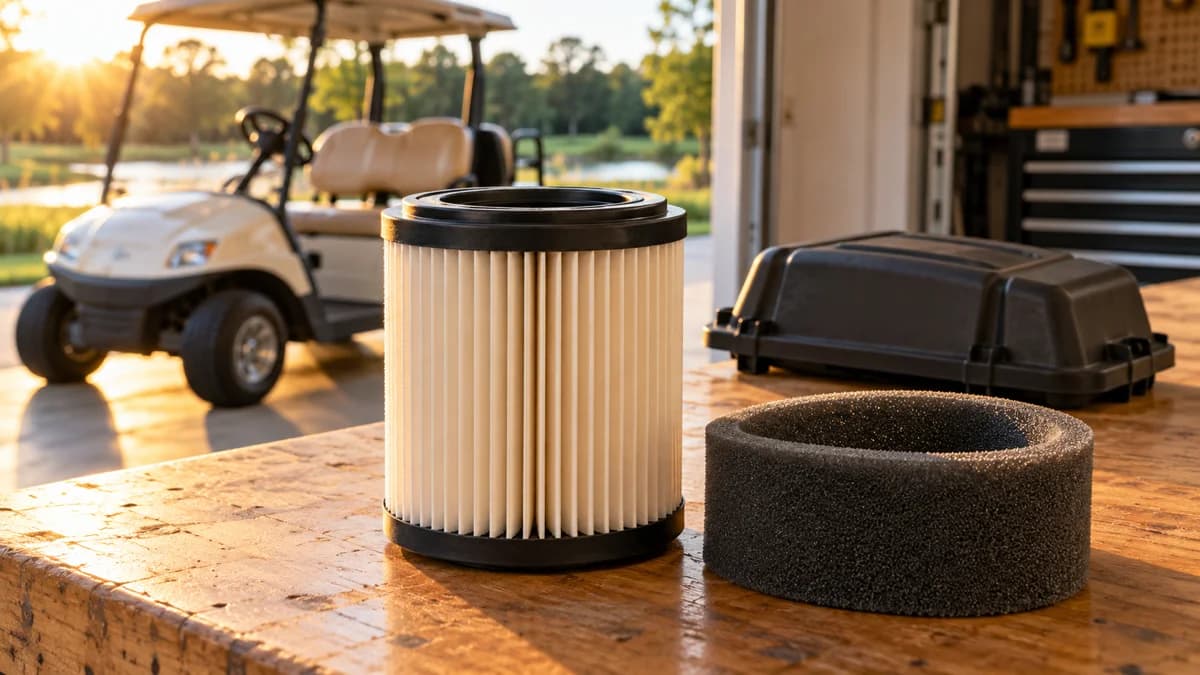
Hero: AI-generated editorial illustration, not a photograph of equipment we tested.
Golf cart air filter cleaning: four manuals compared
On October 21, 2026, we checked four manufacturer-hosted manuals and recorded their element-specific instructions. Our comparison includes two E-Z-GO generations, one Yamaha vehicle manual and one Kohler engine service manual. It is document research, not a physical filter test or a survey of all golf carts.
| Reference checked | Element and service decision |
|---|---|
| Yamaha 2026 DR2 EFI, J0K-F8199-37-E0, p. 36 | Wash and dry the foam pre-filter; replace a dirty or damaged main element |
| E-Z-GO RXV EX1 EFI, 10036460-A, pp. 39 and 41 | CVT filter: compressed air permitted. Engine-air cartridge: compressed air prohibited |
| E-Z-GO RXV CRX EFI, 10211507-A, model year 2027+, p. 39 | Dry engine-air cartridge: tap light dust out; no oil or compressed air; replace when heavily soiled |
| Kohler ECH440/ECH440LE, 17 690 14 Rev. E, p. 35 | Quad-Clean: wash, dry and lightly oil the precleaner; replace the paper element |
Read the exact Yamaha manual, RXV EX1 manual, RXV CRX manual and Kohler service manual before applying a row. Page numbers are the printed numbers, not necessarily your PDF viewer's counter.
The useful finding is that even one manual can contain opposite cleaning instructions for different filters. The EX1's CVT instruction is not permission to blast its engine cartridge. Likewise, a foam sleeve does not by itself establish whether oil belongs on it. Our deliberately small sample demonstrates those distinctions; it cannot rank brands by filtration or predict engine life.
The current E-Z-GO manual library links the CRX document. Its 2027+ cover matters: a current download is not automatically the correct document for an older EX1 vehicle. Retain the revision that matches the cart being serviced and confirm applicability with the manufacturer when identity is uncertain.
Match the cart, engine and airbox first
A body badge is a useful starting point, not the complete parts specification. Record the vehicle serial number, model, installed engine identification and any known engine or intake changes. A previous owner may have changed components. Use the serial-number guide and E-Z-GO model-year guide to establish the vehicle identity separately from the engine.
For a Club Car, do not assume that a Kohler engine necessarily uses the Quad-Clean assembly illustrated above. Kohler also depicts a low-profile cleaner and explicitly refers equipment-supplied air cleaners back to the equipment manufacturer's manual. Follow the actual assembly, not a procedure selected merely because the engine brand matches.
For an E-Z-GO, distinguish EX1, CRX and earlier installations before choosing a cartridge. For a Yamaha, identify the exact DR2/G29 or other model and engine. Our Yamaha G29 guide explains vehicle identity; it does not make a later DR2 filter universal.
Ask a parts supplier to confirm the approved replacement number against that information. A listing headed “fits Club Car, EZGO and Yamaha” is not adequate evidence. Keep the old part's marking and clear photographs, but do not assume the old part was correct simply because it was installed.
Separate paper, foam and the housing
Before removal, secure the cart according to its service instructions, switch off and remove the key, apply the parking brake, and allow hot parts to cool. Follow any additional isolation and access requirements in the applicable manual. If reaching the airbox requires lifting the vehicle or unfamiliar disassembly, arrange qualified service rather than improvising support.
Photograph the cover, clips, hoses and element orientation before disturbing them. Yamaha warns against dropping anything into the intake and identifies a notch that controls pre-filter orientation. A photograph is more useful than a vague memory of which way a sleeve faced.
Keep three items distinct:
- Main element: the component that performs the specified intake filtration. Do not assume a pleated element is washable.
- Pre-filter or precleaner: a separate stage with its own handling instructions, often serviced differently from the main element.
- Housing and intake path: the cover, sealing surfaces, clips, ducts and connections that must keep unfiltered air from bypassing the element.
Do not probe an open intake with a tool or leave loose cloth inside it. Keep dirt from the outside of the housing away from the clean side while following the manual's cleaning method. A clean-looking cartridge cannot compensate for a damaged cover or a poor seal.
Golf cart air filter service by element
Yamaha foam is not the main element
The cited 2026 DR2 EFI manual treats the removable foam pre-filter separately: wash it with soap and water, let it dry, and avoid wringing it because it can tear. Its main element receives a different instruction: replace it if dirty or damaged. The pre-filter's notch must align correctly during reassembly.
That page does not include an oiling step for the foam. Do not import Kohler's oiling instruction into Yamaha's procedure. If an aftermarket filter specifies different care, first establish that it is approved for your application and obtain the instructions for that exact product.
E-Z-GO dry cartridges stay dry
Both RXV manuals in our comparison describe a dry engine-air filter. Their procedure permits tapping out light dust and requires replacement for heavy soiling. It prohibits oil and warns against compressed air because cartridge damage can lead to engine damage.
This does not authorize washing, solvents, a pressure washer or a stronger air nozzle. It also does not turn a visibly damaged element into a serviceable one just because loose dust has been removed. Use the complete procedure and replace parts that fail its inspection criteria.
Kohler's assembly determines the foam procedure
For the Quad-Clean assembly in the cited Kohler manual, the precleaner may be replaced or washed, rinsed and air-dried, then lightly oiled with new engine oil with excess squeezed out. The paper element is replaced. The manual's separate low-profile foam arrangement also has its own service sequence.
Those instructions belong to the illustrated assemblies. They are not an instruction to add oil to the E-Z-GO dry cartridge or to every Club Car filter. Kohler warns that loose or damaged air-cleaner parts can cause premature wear and failure. If your installed housing differs, resolve the assembly identity before service.
Inspect the seal before closing the cover
Look for tears, distorted end caps, damaged sealing edges, cracked housing parts and clips that do not hold securely. Stop if the element will not seat as its instructions require. Forcing a cover shut is not proof that a replacement fits.
Compare approved part numbers first. Dimensions can help reject an obvious mismatch, but matching length and diameter cannot establish filter-media performance, seal compression or compatibility. Do not trim an element, add improvised foam or stack gaskets to make the cover close.
For an awkward view, use a phone photograph or an inspection mirror while the engine is stopped and the work area is safe. A small light can help inspect the accessible housing edge. Neither tool certifies that a hidden intake path is clean. If there is unexplained dirt beyond the seal, a damaged duct or uncertainty about contamination, have a technician assess it before running the engine.
Our general cleaning guide concerns vehicle surfaces. It is not permission to spray cleaning solution into the intake. Keep exterior washing and internal engine-air service separate.
Optional inspection aids, not a replacement-parts kit
Use tools you already own where they do the job. These are optional aids, not filters matched to your cart, and we have not physically tested them for this article. Choose a replacement cartridge through the applicable parts catalog or a supplier who confirms its fit.
- Ullman C-2 inspection mirror: an option for viewing an accessible cover edge without guessing from one angle. Keep its metal handle clear of electrical terminals and moving parts. See the Ullman C-2 on Amazon
- Streamlight 66118 Stylus Pro penlight: an option for illuminating accessible housing surfaces. Do not use a general-purpose light in a fuel-vapor hazard; a fuel leak is a reason to stop work. See the Streamlight penlight on Amazon
- STANLEY 33-425 measuring tape: useful for recording approximate external dimensions to send with a parts inquiry. It cannot verify an internal sealing fit or replace the approved part number. See the STANLEY tape on Amazon
Check current prices at the links and compare them with buying nothing. Do not buy all three automatically: a phone, existing light and existing ruler may be enough to document a parts question. Our owner tool-kit guide covers other inspection equipment without treating tool ownership as permission for every repair.
Record hours and calendar triggers separately
A scheduled six-month inspection does not replace pre-ride checks. The RXV EX1 chart includes pre-ride and weekly air-filter attention as well as a 125-hour or six-month inspection. It instructs owners to use the interval reached first. Read the whole schedule, including its conditions, rather than copying one later row.
Here is our illustrative scheduling calculation, not a manufacturer's universal interval. Assume the applicable task truly is due in 125 operating hours or six months, whichever comes first:
| Assumed use | Time to accumulate 125 hours | Which trigger comes first? |
|---|---|---|
| 5 engine hours per week | 25 weeks | Compare the actual dates with six calendar months |
| 15 engine hours per week | 8.33 weeks | Hour trigger, assuming steady use |
| 1 engine hour per week | 125 weeks | Six-month trigger |
The calculation is 125 ÷ weekly engine hours. Six calendar months is not a fixed number of weeks; enter the actual date instead of converting it to 24 or 26 weeks by habit. These examples exclude earlier required checks and any more-frequent service the manufacturer specifies for conditions such as dust.
Copy this service record into your maintenance notes:
| Record field | What to enter |
|---|---|
| Identity | Vehicle serial/model, installed engine and airbox |
| Parts | Approved main-element and pre-filter numbers |
| Instructions | Manual number, revision and printed page |
| Before service | Date, engine hours, condition, photographs |
| Work | Separate action for main element, pre-filter and housing |
| Completion | Seating, orientation, clips and connections checked |
| Next trigger | Next hour reading and actual calendar date |
Keep the record with your maintenance schedule. For seasonal work, fold it into the winter-storage plan or spring checklist without moving factory-due work to a more convenient season.
When filter service is not the diagnosis
A dirty element may be due for service, but rough running does not prove it is the cause. The CRX manual's spark-plug table includes intake restriction among possible contributors to fouling alongside other faults. Replacing the filter cannot establish which condition caused a persistent symptom.
Record when the fault occurs, whether it started after service, any warning-light pattern, and what parts were changed. Do not run the engine without the filter as a shortcut test. Use the troubleshooting guide to organize the complaint, and the spark-plug guide for plug identification and measurement limits.
Ask a golf cart repair provider to separate due maintenance from diagnosis. Request the engine and airbox identification, proposed filter number, reason for replacement, labor and any additional diagnostic charge. A documented repair is more useful than repeatedly purchasing a generic tune-up kit.
Air-filter questions
Can I wash a golf cart air filter?
Only if the instructions for that exact element permit it. The 2026 Yamaha DR2 EFI manual allows washing its foam pre-filter, but tells owners to replace a dirty or damaged main element.
Can I use compressed air to clean the filter?
The two E-Z-GO RXV manuals compared here prohibit compressed air on the engine-air cartridge. The older EX1 manual separately allows it for the CVT filter. Those are different components.
Should I oil the foam pre-filter?
Do not decide from appearance alone. Kohler’s Quad-Clean instructions specify lightly oiling its washed, dry precleaner. Yamaha’s cited DR2 EFI foam-pre-filter procedure specifies washing and drying without an oiling step.
How often should I inspect my golf cart air filter?
Use the installed vehicle and engine schedule. The cited RXV EX1 manual includes pre-ride and weekly air-filter checks as well as a 125-hour or six-month inspection; that later interval does not replace earlier checks.
Are all Club Car, E-Z-GO and Yamaha filters interchangeable?
No. Match the vehicle, installed engine, airbox and approved replacement number. Dimensions help reject a mismatch but do not establish sealing performance or compatibility.
Does a dirty filter explain every rough-running gas cart?
No. The E-Z-GO CRX manual lists air restriction among possible contributors to plug fouling, alongside other faults. Persistent symptoms need diagnosis rather than repeated filter purchases.
Does an electric golf cart need an engine air filter?
A battery-electric cart has no gasoline combustion-engine intake filter. It may have other cooling or ventilation components, which need their own vehicle-specific instructions.
What should I write on an air-filter service record?
Record the date, engine hours, cart and engine identity, filter number, manual revision, element and seal condition, work performed, and the next applicable hour and calendar triggers.
Golf Cart Search
Find the Best Golf Carts of 2026
Compare top-rated models, read expert reviews, and find the perfect cart for your needs.