

As an Amazon Associate, we earn from qualifying purchases. This helps support our site at no extra cost to you.
Golf cart charging cost equals electricity used at the wall, in kWh, multiplied by your electricity rate. If a session uses 6 kWh and your rate is $0.20/kWh, it costs $1.20. Those are example inputs, not a promise that every full charge costs $1.20.
For an owner budgeting neighborhood trips, a short measurement log is more useful than a universal cents-per-charge claim. For a buyer comparing carts, ask for the installed battery specification and evidence from a route similar to yours. Voltage, charger amps and advertised range cannot supply the electricity bill on their own.
Golf cart charging cost: start at the wall
There are two different quantities to keep separate:
- Battery energy: energy stored in or removed from the pack.
- Wall energy: electricity the charger takes from the outlet over the measurement period.
Your utility bills the second quantity. Charging losses and permitted maintenance charging can make it different from a battery-capacity calculation. If you already have a reliable wall-energy reading, do not add another loss percentage to it.
The calculation is simply:
Session cost = wall kWh × applicable dollars per kWh.
At an assumed $0.20/kWh, 2 kWh costs $0.40, 6 kWh costs $1.20 and 10 kWh costs $2.00. These examples show the arithmetic. They do not identify a typical golf cart's consumption.
Charging duration is a separate question. Our golf cart charging-time guide explains the charge deficit and current calculation. A charger that runs longer at lower power can use similar energy to one that finishes sooner at higher power.
Three battery examples with reproducible calculations
We checked three manufacturer specifications on October 11, 2026 and calculated the following examples. This is a comparison of published inputs, not a physical charging test or an owner survey.
| Published battery input | Example pack arrangement | Calculated nominal energy |
|---|---|---|
| Trojan T-105, 6V and 225Ah at the 20-hour rate | Six matched batteries in series: 36V/225Ah | 36 × 225 ÷ 1,000 = 8.10 kWh |
| Trojan T-875, 8V and 170Ah at the 20-hour rate | Six matched batteries in series: 48V/170Ah | 48 × 170 ÷ 1,000 = 8.16 kWh |
| Eco Battery Gen3 Skinny, 51.2V and 105Ah | One lithium pack | 51.2 × 10⁵ ÷ 1,000 = 5.376 kWh |
The useful finding: a higher voltage does not automatically mean a more expensive charge. The first two configurations have nearly equal calculated nominal energy because the 48V example has fewer amp-hours. For system differences, see 36V versus 48V carts.
These calculations use nominal voltage and the stated Ah rating. They are not measured usable energy. Trojan also publishes separate energy ratings; we have not substituted those for the selected 20-hour inputs. Eco rounds its product-table energy to 5.3 kWh; 5.376 is our multiplication of its voltage and capacity. Discharge rate, temperature, battery condition and operating limits affect what a cart can actually use.
Golf cart charging cost at two assumed efficiencies
To show how uncertainty changes the bill, assume each example needs to replenish 50% of its calculated nominal energy. Apply the same two hypothetical overall wall-to-stored-energy efficiencies, 80% and 90%, to every row. Neither percentage is a measured result or a manufacturer efficiency claim.
Estimated wall kWh = nominal kWh × fraction replenished ÷ assumed efficiency.
For the cost column, we use EIA's July 2026 U.S. residential average of 18.31 cents/kWh, published September 24, 2026. This is the latest monthly release available at our check, not an October tariff. Source: EIA Electric Power Monthly.
| Example pack | Wall kWh at 80% / 90% assumed efficiency | Calculated cost range |
|---|---|---|
| 36V/225Ah | 5.063 / 4.500 | $0.82–$0.93 |
| 48V/170Ah | 5.100 / 4.533 | $0.83–$0.93 |
| 51.2V/105Ah | 3.360 / 2.987 | $0.55–$0.62 |
Costs use unrounded calculations, then round to cents. The lithium row replenishes less calculated energy, so its lower cost is not proof of superior efficiency. We deliberately apply equal efficiency assumptions to avoid making that claim. Nor is this a recommendation to discharge any pack to a particular level.
Use the battery replacement guide to identify chemistry and configuration, and the lithium conversion guide for installation questions. Neither a voltage label nor a conversion quote establishes your actual energy use.
What the same 6 kWh costs in five states
The next comparison holds wall consumption at an illustrative 6 kWh per session. Only the rate changes. These five benchmarks come from EIA's July 2026 residential price table, checked October 11, 2026.
| State | Residential benchmark, cents/kWh | One 6 kWh session | Twelve such sessions |
|---|---|---|---|
| Florida | 15.03 | $0.90 | $10.82 |
| Arizona | 15.38 | $0.92 | $11.07 |
| South Carolina | 15.47 | $0.93 | $11.14 |
| Texas | 15.88 | $0.95 | $11.43 |
| California | 33.61 | $2.02 | $24.20 |
EIA reports preliminary statewide averages, not quotes from your utility. We selected five states for a comparison, not a representative sample of owners. Twelve sessions is an assumed monthly schedule. Your bill may use tiers or time-of-use prices; relevant variable delivery charges and taxes may also affect the incremental cost. Fixed charges you pay regardless of the cart are a separate budgeting item.
Measure your cart without changing its charging setup
First check the exact vehicle, battery and charger instructions. A measurement accessory must be permitted for that setup and rated for its AC input, location and connected load. The charger's 15A or 25A output label describes the battery side; it does not mean the charger draws that current from a household outlet.
If the instructions require a direct outlet connection, or a plug-in accessory's suitability is uncertain, ask a qualified electrician about an appropriate metering arrangement. Do not improvise adapters, defeat grounding or use an indoor device in a damp area. Our garage setup guide and charger extension-cord guide cover related planning checks.
For an approved measurement arrangement:
- Record the cart, battery and charger model, starting charge indication and date.
- Record the meter's starting cumulative kWh reading.
- Complete charging according to the manufacturer's instructions, noting interruptions.
- Record the ending kWh reading. Subtract the starting value.
- Multiply that difference by the applicable rate for that period.
- Repeat after different normal days and keep distance, passengers and route notes.
Do not deliberately run a pack flat to obtain a supposedly definitive full-charge number. Measure normal use. If your tariff changes during a session, use energy recorded within each price window or label a blended-rate estimate accordingly.
| Log field | Example entry, all hypothetical |
|---|---|
| Route and load | 8 miles, two adults, mostly level |
| Meter start / finish | 12.4 / 15.2 kWh |
| Session energy | 2.8 kWh |
| Applicable rate | $0.20/kWh |
| Energy charge | $0.56 |
| Energy per mile | 2.8 ÷ 8 = 0.35 wall kWh/mile |
One session cannot establish seasonal consumption. The log gives you comparable observations for later trips. Our range guide explains why the exact route and load matter when comparing advertised distances.
Three measurement products to compare
These are feature comparisons, not products we tested on a cart. Check suitability before purchasing. We verified the ASIN identities and Amazon listings on October 11, 2026; seller price and delivery depend on the offer and destination. Our localized Amazon check did not establish U.S. dollar prices for the two P3 meters, so we do not present a guessed U.S. price.
P3 P4400 Kill A Watt: an on-device cumulative kWh display is useful if you want to record sessions manually without an app. The manufacturer's specification sheet gives 115V operation, 125V maximum and 15A maximum. Amazon showed seller offers rather than a featured offer at our check. Compare the actual delivered quote before choosing it over the EZ model.
Check P4400 seller offersP3 P4460 Kill A Watt EZ: choose this feature set if on-device cost estimates and retained readings matter. P3 lists cost forecasts and battery backup, with the same 115V operating, 125V maximum and 15A maximum ratings. Source: P3 P4460 specifications. Its Amazon listing had an in-stock offer at our check; enter your own tariff rather than accepting a default cost estimate.
Check P4460 price and deliveryTapo P115, four-pack: this offers app-based energy tracking. TP-Link's U.S. store listed the four-pack at $32.99 at our check, before applicable tax and shipping. That is a manufacturer-store reference price, not a promised Amazon price. The U.S. datasheet specifies 100–125V, 15A/1,800W for general or resistive loads and prohibits damp or outdoor use. Those ratings do not by themselves confirm suitability for your charger. Its timers and low-power auto-off features should not interrupt a charging or maintenance cycle required by the equipment instructions.
Compare the Tapo P115 four-pack on AmazonIf you need one measurement point, four devices may be unnecessary. Buying a meter also does not save energy by itself. At a hypothetical $30 purchase cost and $0.20 of verified savings per session, recovering that purchase would require 150 sessions. Do not buy an accessory based on an unmeasured savings claim.
Turn charging cost into a monthly ownership budget
Use your own log to total a representative month. For a simple planning example, 12 sessions × 6 wall kWh × $0.20/kWh = $14.40 per month. Repeating those same assumed inputs for 12 months gives $172.80. Seasonal driving or a changing tariff will change the result.
Keep electricity separate from battery replacement, maintenance, insurance and purchase costs. Our gas-versus-electric comparison uses a transparent ownership scenario; a cheap individual charge cannot prove which vehicle is cheaper over five years.
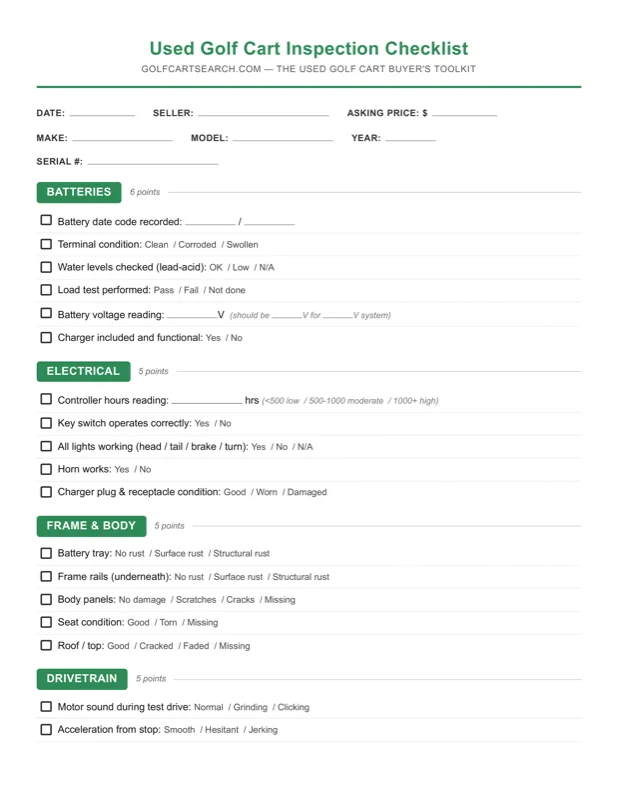
For used carts, ask the seller for battery identification, age, charger documentation and any actual energy log. A charger included in the sale may need a compatibility check. Match the demonstrated route to yours before treating an electricity estimate as a purchase advantage. The used-cart inspection guide covers the wider inspection.
If consumption changes sharply under similar conditions, check for interruptions and compare the next session before diagnosing a fault. Lost range, abnormal heat or error indicators warrant attention through the charging troubleshooting guide or a local repair provider. One high kWh reading does not identify a failed battery.
Before choosing a replacement cart from a local dealer, get a complete written purchase quote and a route-specific demonstration. A small charging bill is useful information, but it is only one line in that decision.
Frequently asked questions
How much does it cost to charge a golf cart?
Multiply wall kWh by your rate. A hypothetical 6 kWh session at $0.20/kWh is $1.20. Measure your own normal use rather than applying that example to every full charge.
Is 36V cheaper to charge than 48V?
Not automatically. Our two Trojan configurations calculate to 8.10 and 8.16 nominal kWh. Pack capacity and the amount replenished matter alongside voltage.
How do I work out battery kWh?
Multiply nominal volts by Ah and divide by 1,000. In series, voltage adds while Ah stays the same. The result is a capacity calculation, not the wall-energy reading on your bill.
Does a faster charger increase the bill?
Charging hours alone cannot answer that. Compare accumulated kWh over complete sessions with comparable starting conditions and the correct approved charger profile.
What would twelve monthly charges cost?
With assumed inputs of 6 wall kWh and $0.20/kWh, twelve sessions cost $14.40. Replace both inputs and the session count with your own records.
Can any smart plug measure a charger?
No. Confirm energy monitoring and suitable AC ratings, location and manufacturer permission. Do not confuse battery-side output amps with AC input current.
Is lithium always cheaper to recharge?
Compare equivalent use and measured wall energy. A smaller pack that costs less to replenish is not evidence of greater efficiency or a lower total ownership cost.
Which electricity rate belongs in the calculation?
Use the applicable variable tariff and relevant per-kWh charges, with time-of-use periods where needed. State averages are comparison benchmarks.
Is standby charging free?
Do not assume zero use. Measure the permitted connected period if it matters to your budget, and follow the exact charging and storage instructions.
Golf Cart Search
Find the Best Golf Carts of 2026
Compare top-rated models, read expert reviews, and find the perfect cart for your needs.