As an Amazon Associate, we earn from qualifying purchases. This helps support our site at no extra cost to you.
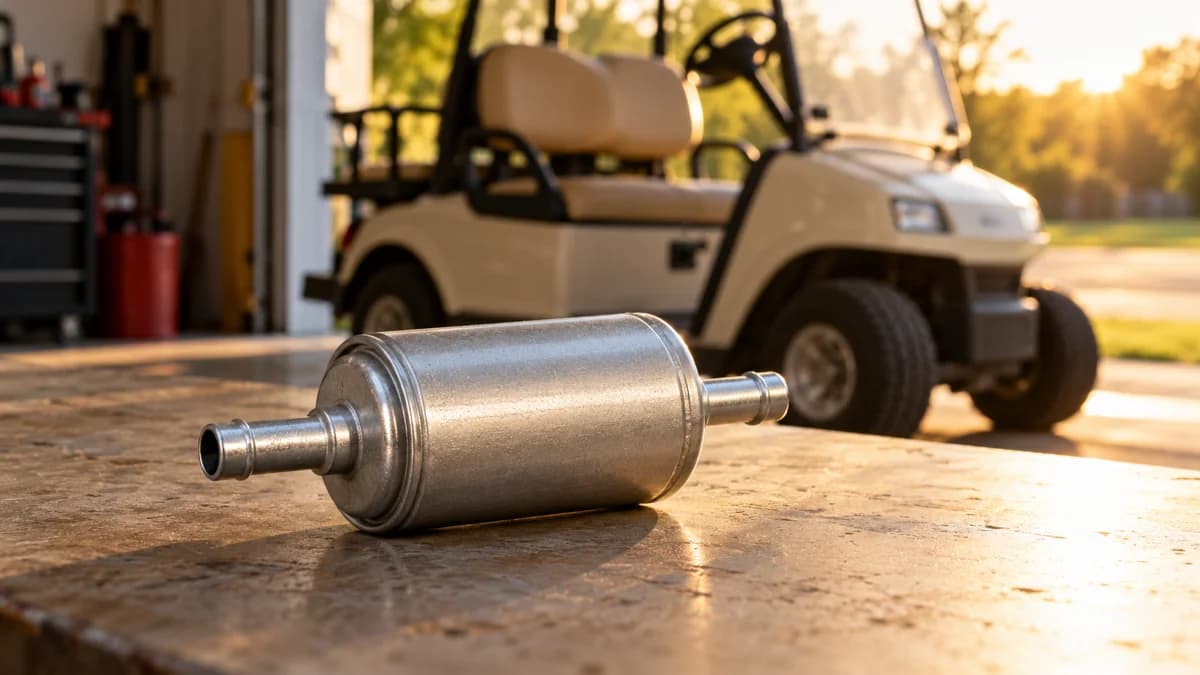
Match a golf cart fuel filter to the installed engine before buying or disconnecting anything. A scheduled fuel-system inspection does not automatically mean the filter needs replacing. Starting trouble, hesitation or a clear housing that looks partly empty also cannot identify the failed part on their own.
For owners, the useful first job is to identify the equipment, record the complaint and find the applicable service instructions. Our October 27, 2026 comparison of three manufacturer manuals found a distinction that generic replacement guides often miss: the E-Z-GO entries specify leak checks, while Yamaha's filter-contamination troubleshooting entry directs the reader to a dealer.
Golf cart fuel filter: identify the system first
Record the vehicle serial number, model and installed engine. Include an engine swap or fuel-system conversion. An older body with a replacement engine needs the parts information for the equipment actually present, not a kit selected only by the year on the body.
Use our serial number and VIN guide to collect the vehicle identity. For an E-Z-GO, the model-year identification guide helps separate families before you open the manufacturer's parts catalog. A TXT and an RXV are not interchangeable parts descriptions.
The next question is whether the engine uses a carburetor or electronic fuel injection, usually abbreviated EFI. That affects the applicable service procedure. Do not infer the answer from a clear filter housing, a hose barb or an online listing that names several brands.
Find the filter in the correct diagram and record its item number and part number. If the diagram shows a strainer or filter within a larger assembly, ask whether it is separately serviceable. Do not buy an external inline part to replace something the catalog identifies differently.
Our Club Car, E-Z-GO and Yamaha pages provide model context. The actual serial range, engine identification and current parts information settle fitment.
Three manuals: inspection and replacement are separate
On October 27, 2026, we downloaded the following manufacturer-hosted PDFs and read their actual maintenance or troubleshooting tables. We recorded the task, interval and recommended next action rather than treating every mention of a filter as a replacement instruction.
| Document checked | What the relevant entry says |
|---|---|
| E-Z-GO RXV EX1 EFI, 10036460-E, labeled 2024-current, printed p. 24 | Check the fuel system for leaks at 50 hours or three months, whichever comes first. Filters are among the listed inspection points. |
| E-Z-GO RXV CRX EFI, 10211507-A, labeled 2027+, printed p. 28 | The same 50-hour/three-month fuel-system leakage check. The entry does not order a filter change. |
| Yamaha 2026 DR2 EFI, J0K-F8199-37-E0, printed p. 31 | In the engine-will-not-start chart, foreign matter in the fuel filter is a dealer referral. |
The result is a service-scope distinction, not a universal filter-life estimate. Two scheduled inspection entries and one troubleshooting entry do not establish how long every golf cart filter lasts. They also do not prove that the two E-Z-GO engine generations use the same replacement part.
This is original document analysis of three deliberately selected references. We did not remove filters, measure fuel pressure, test flow, inspect a fleet or establish failure rates. The sample does not cover all Club Car engines, older carbureted carts or every Yamaha generation.
E-Z-GO: keep the task wording with the interval
The RXV EX1 EFI manual, revision E and 2027+ RXV CRX EFI manual both include the tank, cap, lines, filters, pump and fuel rail in their leakage-check entry. Both charts also have a pre-ride whole-vehicle leak inspection.
Copying only “50 hours” onto a maintenance list loses two pieces of information: the three-month limit and the actual task. Keep all three together. Writing “replace filter every 50 hours” would change what these entries say.
For a cart covered by one of these entries, track operating hours and elapsed time, using the first limit reached. Follow the rest of the applicable manual too. An inspection interval is not permission to keep using a newly leaking cart until the next appointment.
Check document coverage in the official E-Z-GO owner-manual library. Its current and older model sections help avoid transferring an EX1 reference to a CRX installation solely because both carts have RXV bodywork.
Yamaha: the no-start chart sends filter contamination to a dealer
The 2026 Yamaha DR2 EFI manual, printed page 31, lists an inoperable fuel pump, a clogged fuel line, foreign matter in the fuel filter and a dirty injector separately. Each of those rows directs the reader to a Yamaha dealer.
That table is useful for preparing a service request. It is not a disconnected-hose test or a set of owner filter-replacement steps. It also shows why replacing the filter simply because the engine will not start can miss another cause.
For the wider diagnosis, see our fuel-pump symptoms guide. Keep the distinction between a reported symptom, an identified restriction and a measured pump fault on the repair record.
What a filter symptom can tell you
Write down what happened before choosing a component: whether the engine cranks normally, whether it fires, whether the problem appears cold or hot, and whether it began after refueling, storage or recent work. Record the circumstances you already observed; do not repeatedly drive a failing cart to recreate them.
A cart that does not crank normally needs a different initial investigation from one that cranks but will not fire. Our starter-generator guide covers that distinction. A cart whose engine runs but does not move also needs the clutch and drive-system checks, rather than an automatic fuel-filter purchase.
Keep these observations separate from conclusions:
- “The visible filter was partly empty.” This records appearance. It does not measure delivery pressure or flow.
- “The cart stopped after ten minutes.” This records timing. It does not prove a filter restriction.
- “It ran differently after a new filter.” This records a change. The service report still needs to establish correct installation and whether the original complaint is resolved.
- “There is fresh fuel wetness or a strong new fuel odor.” Stop operating the cart and arrange inspection. Do not start it to locate a leak.
Avoid opening a line to see whether fuel comes out, cranking into a bottle, or blowing through a removed filter as a general diagnostic method. Those improvised checks lack the exact setup and acceptance criteria for the installed system. A qualified technician should use its service information to distinguish a restriction from pump, line, injector, ignition or other faults.
If the engine is carbureted, use the carburetor guide for the separate identification and repair questions. An EFI cart does not acquire a carburetor simply because a troubleshooting article mentions one.
Golf cart fuel filter replacement: confirm these details
Before authorizing replacement, have the supplier or shop confirm:
- Application: cart serial range, engine identity and any modifications.
- Part: the approved filter or documented replacement, including whether a larger assembly is required.
- Connections: the specified hoses, fittings, seals and clamps, with their applicable requirements.
- Direction and routing: the filter's instructions and the system diagram.
- Procedure: safe isolation, any pressure-relief requirements, access and installation steps for this exact system.
- Completion checks: required leak inspection and confirmation of the original complaint after service.
A matching hose diameter proves only one dimension. It does not establish the correct filter, fuel-system suitability or connection requirements. Likewise, “fits Club Car, E-Z-GO and Yamaha” in a product title is not a substitute for documented application.
For general small-engine context, Briggs & Stratton's fuel-filter guidance says some filters have a flow arrow and that leaks must be corrected before operation. It also tells readers to consult both engine and equipment manuals. That page does not establish a Briggs procedure or filter as compatible with your golf cart.
Use the approved part's arrow or inlet/outlet markings and its instructions. Do not orient a filter by the tapered end, the printed label or “toward the front of the vehicle.” If markings are absent or routing conflicts with the diagram, resolve that question before installation.
For pressurized EFI work, the correct pressure-relief and service procedure matters even if the filter looks easy to reach. Do not adapt a carbureted-cart video. If the manufacturer directs the job to a dealer, or the required service information and equipment are unavailable, use qualified service.
Keep a fuel-filter service record
The following six-field record comes from our comparison: it preserves the task wording, the equipment identity and the outcome instead of reducing everything to “filter done.” Copy it into your maintenance notes or ask the shop to include it on the invoice.
| Field | What to record |
|---|---|
| Equipment | Vehicle serial/model, engine identity and fuel-system configuration |
| Reference | Manual number, revision, page and applicable serial coverage |
| Reason | Scheduled leak inspection, reported fault or confirmed replacement requirement |
| Timing | Date, operating hours and the applicable next interval |
| Work | Findings, approved part number and related components actually replaced |
| Outcome | Required leak checks completed and original complaint assessed |
For example, a receipt saying “fuel filter replaced” leaves unanswered whether the old filter was restricted, whether a damaged hose was also repaired and whether the hot-restart complaint returned. Those are useful questions for the next technician, even when the new part was correct.
Keep fuel service alongside the maintenance checklist, but distinguish it from the air-filter procedure and spark-plug specification. A tune-up package can contain several unrelated tasks with different schedules.
Inspection aids you may already own
For a parked, secured cart with no suspected fuel leak or vapor present, a small light and mirror can help read an accessible label without moving hoses. Do not reach past hot or moving parts or lift the cart merely to identify a filter.
An optional Ullman C-2 inspection mirror can help view an awkwardly positioned marking. It is a viewing aid, not a tool for disconnecting fuel fittings.
Check the Ullman C-2 mirror on AmazonThe Streamlight 66118 Stylus Pro is a compact inspection light. Do not treat an ordinary penlight as equipment approved for a flammable atmosphere; stop if you suspect a fuel leak.
Check the Streamlight 66118 on AmazonMaxxHaul 70472 wheel chocks are an optional restraint aid when suitable for the cart, tires and surface. Follow the vehicle's parking and securing instructions. Chocks do not make a slope suitable for service or replace lifting supports.
Check MaxxHaul 70472 chocks on AmazonUse what you already have when it is suitable. Check current seller pricing through the links; no copied Amazon price or availability is promised here. Our owner's tool-kit guide covers broader tool selection.
Compare the repair scope before the bill
Ask a local repair provider for a dated estimate separating diagnosis, the exact filter or assembly, required related parts, labor, completion checks, tax and transport. Ask what evidence supports replacement and whether diagnostic charges are credited toward the work.
An external filter change and a larger fuel-system assembly job are different scopes. A low part price cannot establish the installed total. Keep the written estimate beside the gas-cart tune-up plan so a maintenance package does not silently become open-ended diagnosis.
Before collection, request the part number used, findings about contamination or damaged components, and the result of the required leak checks. If the original fault was intermittent, have the shop describe what conditions it checked and what remains unconfirmed. Keep any unresolved complaint visible on the service record.
Fuel-filter questions owners ask
How often should a golf cart fuel filter be replaced?
Use the replacement requirement for the exact cart and installed engine. RXV EX1 EFI manual 10036460-E and RXV CRX EFI manual 10211507-A list a fuel-system leak check at 50 hours or three months, whichever comes first. That row does not specify filter replacement.
Where is the fuel filter on a golf cart?
Locate it in the parts diagram for the installed engine and serial range. Do not assume every cart uses an exposed inline filter under the seat. A body badge, clear plastic housing or similar-looking hose does not identify the assembly.
What are the symptoms of a clogged golf cart fuel filter?
A starting or running complaint can justify fuel-system diagnosis, but it does not identify a restricted filter by itself. The 2026 Yamaha DR2 EFI no-start chart lists filter contamination, an inoperable pump, a clogged line and a dirty injector as separate possibilities requiring dealer attention.
Can I replace a Yamaha Drive2 EFI fuel filter myself?
The 2026 DR2 EFI manual J0K-F8199-37-E0 directs foreign matter in the fuel filter to a Yamaha dealer. Its troubleshooting row is not an owner replacement procedure. Obtain the applicable service instructions and qualified help before opening the system.
Which direction does a golf cart fuel filter face?
Follow the specified fuel-flow direction and any arrow or inlet/outlet markings for the approved filter. Do not use the tapered end, housing color or front of the cart as a universal rule. Confirm the part and routing before installation.
Does a partly empty clear filter prove that the pump is bad?
No. A visible fuel level alone does not establish the specified pressure, delivery volume or cause of a running fault. Record what you observed without opening the line, then use the exact service procedure for diagnosis.
Will a universal inline fuel filter fit my cart?
The word universal does not establish compatibility. Confirm the approved part or documented replacement, engine and serial application, fuel-system requirements, connections and installation instructions. Matching hose diameter alone is insufficient.
How much does golf cart fuel-filter replacement cost?
Request a dated quote for the identified assembly. Separate diagnosis, filter or module, required seals and hoses, labor, leak checks, tax and transport. This guide does not establish a national installed price or a current Amazon price.
Golf Cart Search
Find the Best Golf Carts of 2026
Compare top-rated models, read expert reviews, and find the perfect cart for your needs.