As an Amazon Associate, we earn from qualifying purchases. This helps support our site at no extra cost to you.
A golf cart throttle cable should be identified before it is adjusted or replaced. A sticking pedal, delayed return or unexpected acceleration calls for taking the cart out of service. Tightening a cable until the cart feels faster can change a control system without fixing the fault.
This guide is for owners deciding what to record, which manual to use and what to ask a repair shop. It separates a simple pedal observation from cable adjustment and governed-speed work. It does not provide a universal free-play setting or a governor modification.
Golf cart throttle cable: identify the actual mechanism
Start with the vehicle serial number, engine identity and a parts diagram for that configuration. Our serial number and VIN guide helps gather the first piece. Record an engine replacement or modified pedal assembly as well; a body badge cannot establish what now sits underneath it.
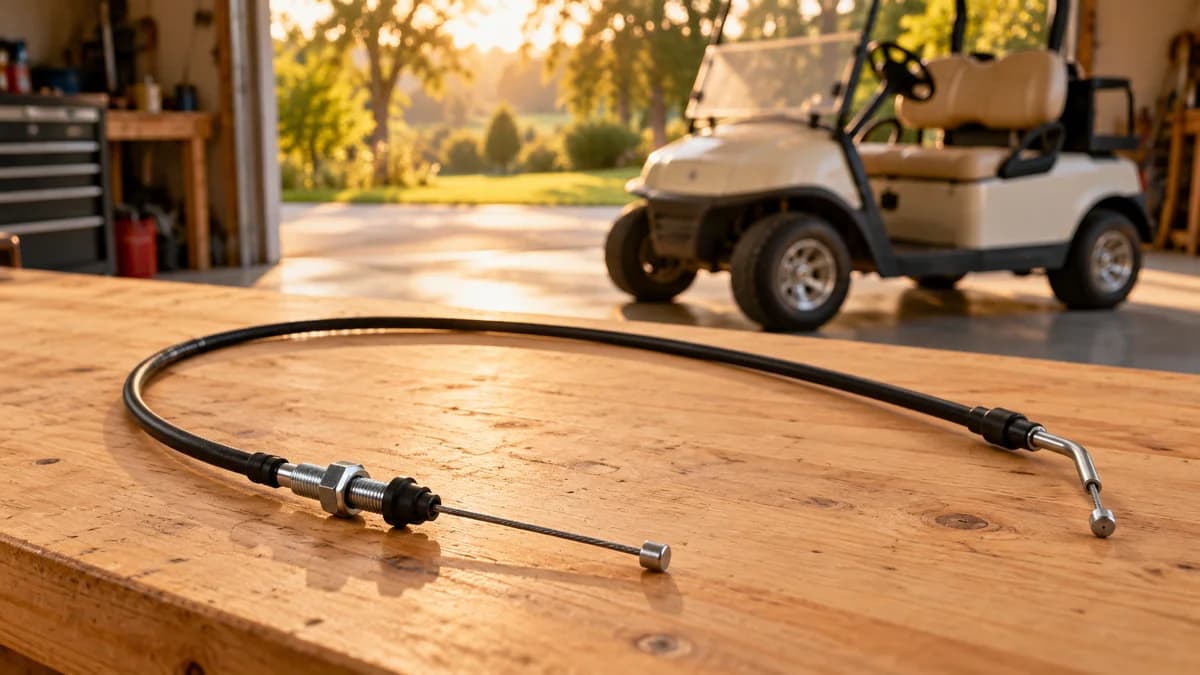
A mechanical cable uses an inner wire moving within an outer housing to transfer a control movement. The housing, its supports and both end fittings matter. A cable that looks similar on a store page can still have the wrong working length, mounting arrangement or end connection.
Do not rely on the words “throttle cable” and “accelerator cable” alone. A parts diagram may distinguish the pedal-side connection from an engine-side connection through a governor or other linkage. Record where each end connects and the diagram's part number, rather than treating every black cable under the seat as the same part.
Fuel injection does not settle the question. The Yamaha DR2 EFI example below explicitly includes throttle cables in its service chart. Conversely, an electrical accelerator input fault needs its own diagnostic path. On applicable Club Car systems, our MCOR identification guide explains why that component is not a substitute name for a cable.
Use the E-Z-GO, Yamaha and Club Car pages for model context, then confirm the installed equipment from the manufacturer information. Those overview pages do not establish parts interchangeability.
What our three-manual comparison found
On October 26, 2026, we downloaded three manufacturer owner manuals and compared their accelerator checks, linkage-service entries, intervals and procedure references. We read the actual chart layouts, including footnotes, rather than treating a search excerpt as a service instruction.
| Document reviewed | Separate checks we found |
|---|---|
| E-Z-GO RXV EX1 EFI, 10036460-E, labeled 2024-current | Pre-ride accelerator smoothness; throttle/governor linkage operation and governed speed at 50 hours or three months. |
| E-Z-GO RXV CRX EFI, 10211507-A, labeled 2027+ | Pre-ride accelerator smoothness; the same 50-hour/three-month linkage-check entry. |
| Yamaha DR2 EFI, J0K-F8199-37-E0, 2026 | A pre-operation pedal check with the main switch off; a separate cable-adjustment and EFI throttle-shaft wear entry in the annual service column. |
Our practical finding: pedal feel and scheduled linkage service are two separate jobs. A low-use cart still needs the pre-use check. A pedal that feels normal does not cancel the next scheduled linkage task, and a scheduled date does not justify driving with a newly sticking pedal.
There is also a useful reference trap in the EX1 document: the accelerator row points to printed page 37, but that page is headed Brakes. It is not a cable-adjustment recipe. We checked both the row and the referenced page. If a chart reference sends you to an unrelated procedure, obtain the correct service information instead of adapting the nearby instructions.
This is a deliberate three-document comparison, not physical testing or a representative sample of all carts. It does not establish cable failure rates, universal replacement intervals or compatibility across model years. The EX1 and CRX documents concern different engine configurations; matching schedule entries do not prove that their cables interchange.
E-Z-GO: retain both the ride check and the linkage interval
The RXV EX1 EFI manual, revision E, printed page 24, and 2027+ RXV CRX EFI manual, printed page 28, both use the maintenance interval reached first. Their linkage entry includes checking governed speed; it does not tell owners to increase it.
For a cart covered by those entries, put both 50 operating hours and three calendar months on the record. A neighborhood cart used for short trips can reach the calendar limit long before accumulating another 50 hours. Apply the manual's other applicable conditions as well.
Find serial coverage and current documents through the official E-Z-GO owner-manual library. A PDF's “current” label is the document's wording, not a guarantee that it covers a swapped engine or every cart sold today.
Yamaha: EFI still has a cable-service entry
The 2026 DR2 EFI manual, printed page 24, calls for smooth accelerator operation with the main switch in the OFF position and dealer attention when a pedal does not work properly.
Printed page 28 places the throttle-cable adjustment and EFI throttle-shaft wear entry in the annual column, whose header also gives 250 hours, 1,200 miles and 500 rounds. The introductory maintenance guidance says calendar maintenance still applies even when mileage or hours are low. Do not reduce this to “wait until 250 hours.”
That row's service reference is an asterisk. Yamaha explains that these procedures are in the service manual and belong with a dealer or other qualified mechanic. The chart names work to schedule; it does not supply an owner adjustment method. This is the DR2 EFI document, not permission to transfer its settings to every Drive2 or G-series cart.
Golf cart throttle cable symptoms: record, then diagnose
A symptom narrows the repair request. It does not prove which part failed.
| What you notice | What to record for the shop |
|---|---|
| Pedal feels stiff, catches or returns slowly | When it began, whether it follows storage or recent work, and any visible obstruction or damage. |
| Engine response continues after releasing the pedal | Take the cart out of service; describe the event without repeating it for a video. |
| Pedal moves normally but the cart hesitates | Record warning indications and whether the engine response or vehicle movement was delayed. Do not assume a cable. |
| Problem began after a mat, cable or pedal change | Identify the exact change, installer and part, and provide earlier photos if available. |
Engine hesitation can send diagnosis toward the fuel system and carburetor. A different situation, where engine speed changes but the cart does not move as expected, may require clutch diagnosis or drive-belt identification. Those are diagnostic possibilities, not a parts-shopping list.
For an electric cart with normal pedal movement and no drive, use the no-start diagnostic guide and exact controller information. Replacing a gas-cart cable will not resolve an unidentified electrical input fault.
Check the footwell without creating a movement hazard
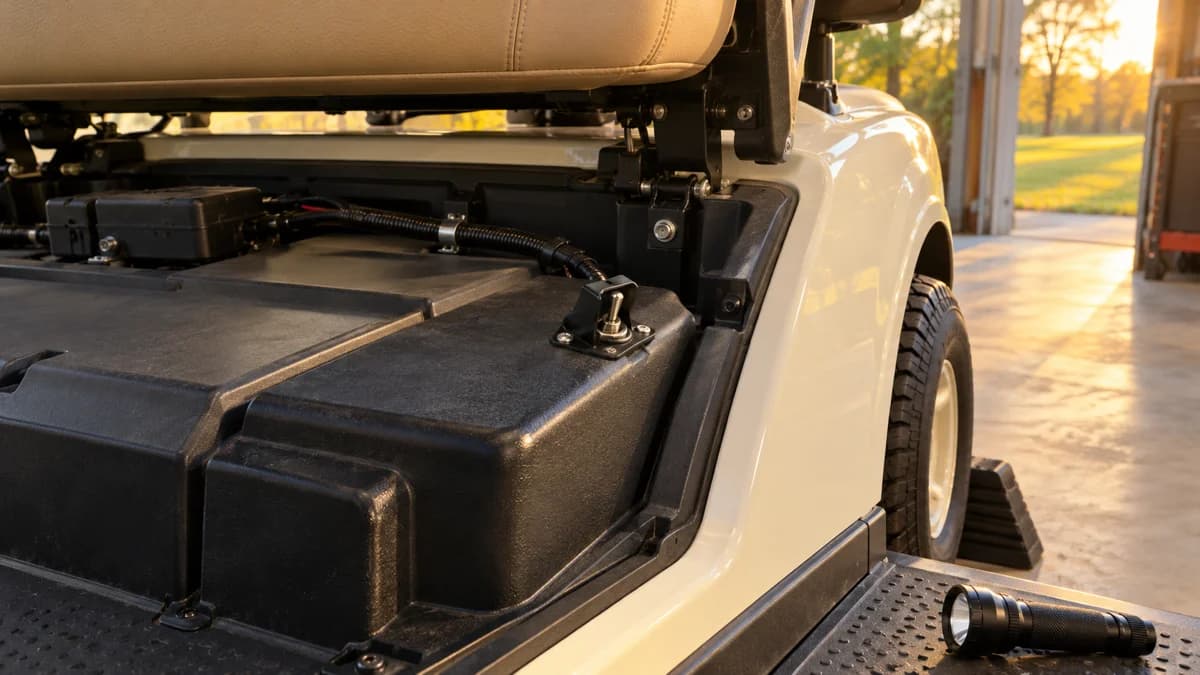
Do the stationary check only after securing the cart using its own manual. Use level ground, switch off, remove the key when the procedure permits, keep bystanders clear and use suitable wheel restraint. Follow any required isolation procedure before touching or opening components.
A parking brake alone is not sufficient protection for pressing the accelerator. The EX1 manual, printed page 13, says pressing the accelerator releases an engaged parking brake. The Yamaha manual describes the same interaction. Switching off prevents normal starting; it does not mean pedal movement cannot release that mechanical restraint.
For wheel restraint, the MaxxHaul 70472 rubber chock pair is an option to assess against your tire size and ground surface. Follow the chock instructions and vehicle procedure. Chocks do not authorize working underneath a cart or replace its required support equipment. Check the current listing for price and delivery details.
View MaxxHaul 70472 wheel chocks on AmazonLook for a loose object, displaced mat edge or added accessory intruding into the pedal's travel. Do not force the pedal through resistance, cut a return spring or hold a linkage open. If covers must come off or hands must reach moving components, stop at the limit of the owner procedure.
A Streamlight 66118 Stylus Pro penlight can help illuminate an accessible footwell or bracket. Use it for observation with the cart secured and switched off. The listing carries the current price; this recommendation does not imply electrical insulation or approval for a fuel-vapor hazardous area.
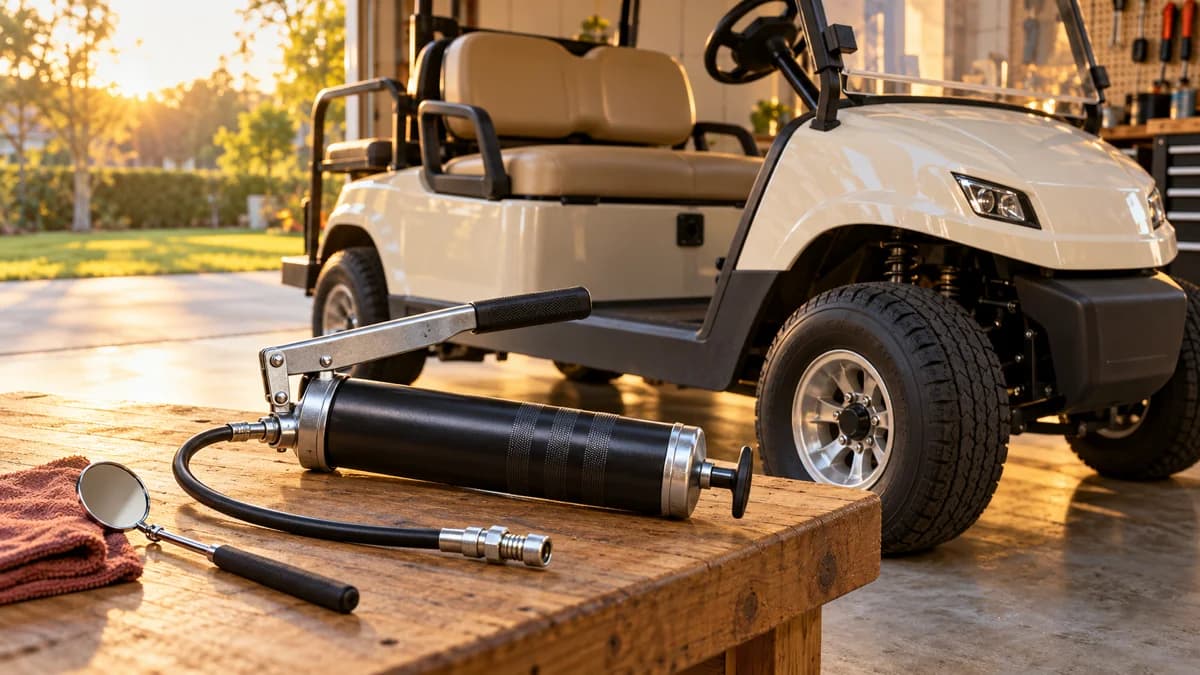
Check Streamlight penlight price on AmazonAn Ullman C-2 inspection mirror can help photograph an otherwise obscured, accessible cable connection without moving it. Keep the mirror out of electrical terminals and moving mechanisms; it is a viewing aid, not an insulated service tool. Confirm current price and size on the product page.
View Ullman C-2 inspection mirror on AmazonYou do not need to buy these tools if you already have suitable inspection aids. Our golf cart tool-kit guide separates observation tools from equipment needed for actual service.
Why a universal adjustment or spray can make matters worse
An adjuster changes the relationship between components. Removing every bit of visible slack is not a substitute for the specified adjustment sequence. Pedal travel, switch actuation, throttle closure and the governor mechanism need to remain correct together.
Cable manufacturer Motion Pro's cable-maintenance guidance emphasizes inspecting housings and fittings and using the applicable factory service manual for adjustment. Its examples concern motorcycles. They support checking cable condition and the correct procedure, not importing motorcycle free-play or torque numbers into a golf cart.
Likewise, the EX1 chart's general-lubrication entry is qualified by where lubrication is required. It does not identify every aftermarket cable's liner, compatible lubricant or application method. Ask for instructions for the installed cable. A damaged housing, frayed wire, displaced support or wrong routing needs proper assessment even if a spray temporarily changes the feel.
Keep the task separate from a gas-cart tune-up. Replacing an air filter or checking a spark-plug gap cannot demonstrate that a binding accelerator has been repaired. Do not alter governor springs or defeat switches while pursuing a smoother pedal.
Match the cable and prepare a useful repair request
Before ordering, collect these six items:
- Vehicle identity: model, serial number, engine and any known conversions.
- Cable identity: both endpoints, diagram item and confirmed part number or supersession.
- Observed fault: binding, delayed return, damaged housing or response problem; include when it started.
- Applicable instruction: document number, revision, serial coverage and the service procedure the shop will use.
- Work scope: diagnosis, cable or bracket replacement if needed, adjustment, and checks of the affected control functions.
- Release record: who completed the work, date, and confirmation that the applicable functional checks passed before use.
Photograph the installed routing before disassembly if it is safely accessible. A photo helps identify what was present; it does not prove that the previous installation was correct. Ask the supplier to confirm the exact application rather than choosing solely by an advertised overall length.
Request a quote separating diagnosis, parts, labor and transport. There is no verified national repair-price dataset behind this guide, so a single “typical replacement cost” would overstate the evidence. Tell the shop if the cart cannot safely be driven and ask about collection or mobile service through our repair directory.
Add the resulting record to your maintenance schedule. If the cause remains uncertain, keep the cart out of service and use the broader troubleshooting guide to organize the next diagnostic request.
Frequently asked questions
What does a golf cart throttle cable do?
A mechanical control cable transfers movement between control components. Its exact endpoints depend on the cart. Identify the pedal, governor and engine-side linkage in the correct parts diagram before ordering a cable described as throttle or accelerator.
Can I drive a golf cart with a sticking accelerator?
Do not continue driving a cart whose pedal binds, fails to return or produces uncontrolled acceleration. Park it, keep it out of service and arrange qualified inspection. A lubricant spray is not proof that the fault is repaired.
How often should an E-Z-GO throttle linkage be checked?
RXV EX1 EFI manual 10036460-E and 2027+ RXV CRX EFI manual 10211507-A both list throttle/governor linkage checks at 50 hours or three months, whichever comes first. Both also require a separate pre-ride accelerator check.
Does Yamaha specify annual throttle cable service?
The 2026 DR2 EFI manual J0K-F8199-37-E0 places its throttle-cable adjustment entry in the annual column: 250 hours, 1,200 miles or 500 rounds. Calendar maintenance still applies with low use. The procedure belongs to the service manual and a dealer or qualified mechanic.
How much slack should a golf cart throttle cable have?
Use the exact service specification for the installed linkage. There is no single free-play measurement in this guide that applies to every E-Z-GO, Club Car and Yamaha. Cable identity, pedal geometry and the adjustment sequence must match the vehicle.
Can I lubricate every golf cart throttle cable the same way?
Confirm the instructions for the installed cable and linkage first. A scheduled lubrication entry is not permission to apply any spray through any cable housing. Damage, wrong routing or a loose bracket still needs repair even if lubrication changes the feel.
Does fuel injection mean a cart has no throttle cable?
No. The 2026 Yamaha DR2 EFI maintenance chart explicitly lists throttle-cable adjustment and an EFI throttle-shaft wear check. Identify the actual mechanism instead of inferring cable presence from EFI branding.
Is a Club Car MCOR the same as a throttle cable?
No. MCOR refers to an electrical accelerator input component on applicable Club Car systems. A mechanical cable and an electrical input device need different identification and diagnostic procedures. Do not order either solely because the cart hesitates.
Golf Cart Search
Find the Best Golf Carts of 2026
Compare top-rated models, read expert reviews, and find the perfect cart for your needs.