As an Amazon Associate, we earn from qualifying purchases. This helps support our site at no extra cost to you.
Golf Cart vs Side-by-Side: Cost, Towing & Use Cases
Quick Answer: Golf Cart or UTV?
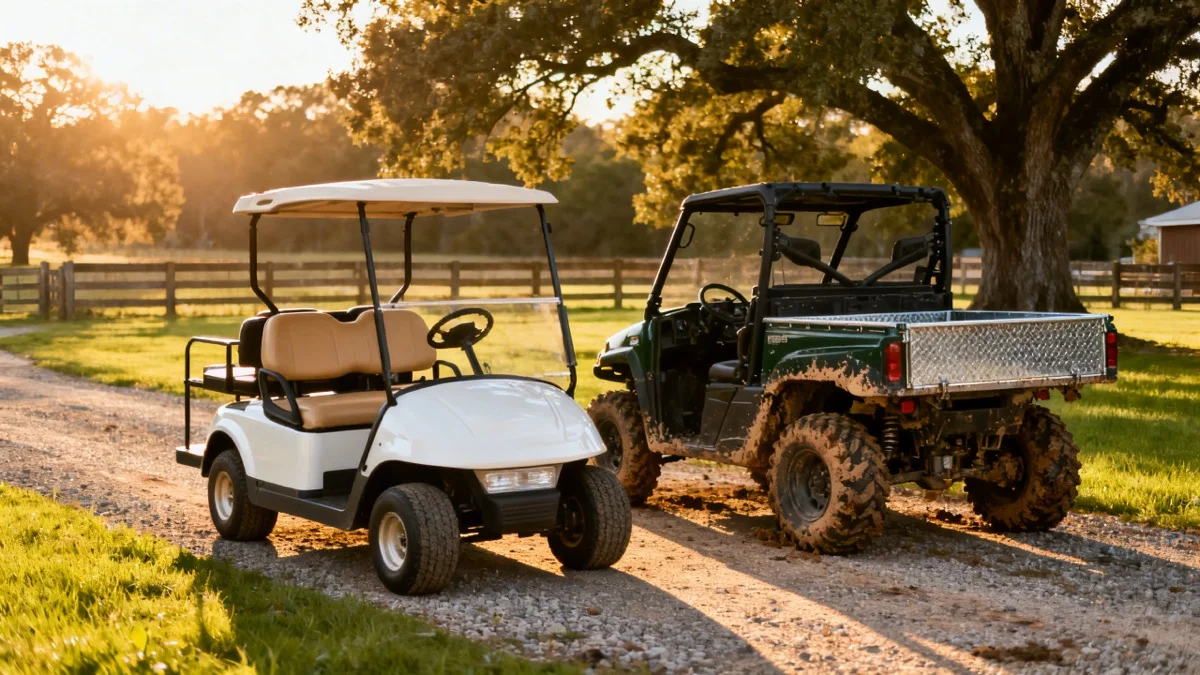
Choose a golf cart for neighborhoods, campgrounds, beach towns, smooth property roads, quiet operation, and lower ownership cost. Choose a UTV or side-by-side for rough land, 4WD, farm work, hunting trails, a rated dump bed, and heavier towing. A John Deere Gator is a UTV, not a golf cart. If you are still debating, a golf cart probably covers your use case unless the terrain or workload clearly requires a side-by-side.
You have 10 acres of property, a neighborhood that allows low-speed vehicles, or a campground you visit every summer. You need something with wheels, a seat, and enough utility to haul your gear. The question is: golf cart or UTV?
Both have loyal followings, and both can do things the other cannot. This guide compares their intended use, model-specific capability, legal classification, safety equipment, and cost so you can choose the right vehicle for your property.
Golf Cart vs UTV at a Glance
Golf Cart Strength Quiet local transport
UTV Strength Rough-ground utility
Golf Cart Top Speed 12 - 25 mph
UTV Top Speed 25 - 60+ mph
Road Status Vehicle + local-law specific
Towing Use exact model rating
Golf Cart vs Side-by-Side Quick Decision
Use this quick filter before getting lost in specs:
| Your main use | Better choice | Why |
|---|---|---|
| Neighborhood, campground, beach town, or short paved trips | Golf cart | Quiet, cheaper, easier to park, and more accepted by HOAs and communities |
| Farm chores, mud, steep hills, or rough trails | UTV / side-by-side | 4WD, ground clearance, stronger suspension, and higher towing |
| Property checks on gravel or mowed paths | Golf cart | Lower cost covers the job if the surface is improved |
| Towing over 1,000 lbs or hauling heavy feed, tools, or firewood | UTV / side-by-side | Higher payload and towing ratings |
| Comparing a golf cart vs John Deere Gator | Gator for work, cart for local transport | A Gator is a UTV with a work bed and off-road capability |
| Quiet hunting access on maintained trails | Electric golf cart | Less noise and scent disruption than a gas side-by-side |
The simplest rule: if you need transportation, buy the golf cart. If you need a small work truck for rough ground, buy the UTV.
What Exactly Is a Golf Cart vs a UTV?
Before comparing specs, it helps to understand what each vehicle actually is.
A golf cart is built primarily for low-speed transport. Modern carts come in electric and gas versions, multiple seating layouts, and configurations intended for courses, private property, or local-road use. A cart is not automatically a federal low-speed vehicle just because an owner adds lights or increases its speed.
A UTV or side-by-side is designed for off-highway utility or recreation. CPSC distinguishes recreational off-highway vehicles by features such as a steering wheel, side-by-side seating, foot controls, occupant restraints, and a rollover protective structure. Utility models commonly add a cargo box, more ground clearance, and selectable four-wheel or all-wheel drive. Popular families include the Polaris Ranger, Can-Am Defender, Kawasaki Mule, Honda Pioneer, John Deere Gator, and Yamaha Viking.
The key distinction: golf carts are built for comfort and convenience on paved or smooth surfaces. UTVs are built for capability and durability on rough ground.
Purchase Price Comparison
This is where golf carts pull ahead immediately.
New Golf Cart Prices
| Brand | Starting Price | Loaded Price |
|---|---|---|
| EZGO | $6,500 | $12,500 |
| Club Car | $6,500 | $14,000 |
| Yamaha | $7,000 | $12,000 |
| ICON | $9,999 | $15,999 |
| Star EV | $8,000 | $14,000 |
| Custom/Lifted | $14,000 | $25,000 |
A solid new 4-passenger golf cart from a major brand runs $8,000 to $12,000. Used carts in good condition start around $2,000 to $5,000.
Current UTV Price Anchors
As of this update, Polaris lists the 2026 Ranger 500 from $9,999, Ranger 1000 from $14,299, and Ranger XP 1000 from $21,499 before destination, setup, tax, registration, and accessories. That spread shows why "a UTV costs X" is not a useful buying rule. Compare a work-focused base trim, crew model, and cab-equipped version separately, then get an out-the-door dealer quote.
Performance: Speed, Range, and Towing
Speed
Golf carts are not fast, and that is by design. Standard models cruise at 12 to 15 mph. Street-legal LSVs reach 19 to 25 mph. Even modified carts rarely exceed 30 mph.
UTVs cover a wider range. Utility-focused models like the Kawasaki Mule SX top out around 25 mph. Mid-range models like the Polaris Ranger 1000 and Honda Pioneer 700 hit 40 to 50 mph. Performance UTVs like the Ranger XP 1000 exceed 60 mph.
If you need to cover ground quickly on a large property or reach a distant hunting stand, the UTV wins this category.
Range
Electric golf carts get 15 to 25 miles per charge on lead-acid batteries and 25 to 40 miles on lithium. Gas golf carts run 100 to 180 miles per tank.
Gas UTVs get 10 to 20 mpg depending on the model and terrain. With fuel tanks of 9 to 11 gallons, that translates to 90 to 225 miles per tank.
For short daily trips under 20 miles, an electric golf cart covers your needs at a fraction of the fuel cost. For all-day property work or long trail rides, the UTV's larger fuel capacity and gas engine have the advantage.
Towing and Payload
This is the UTV's strongest category.
| Capability | Golf Cart | UTV |
|---|---|---|
| Towing capacity | Use exact manufacturer rating; some carts have no published trailer rating | Model-specific; current examples range from 1,500 to 4,000 lbs |
| Bed/payload capacity | Model-specific; personal carts may not have a rated cargo bed | Model-specific; work UTVs commonly publish bed and total payload ratings |
| Passenger capacity | Model and seat configuration specific | Model and seat configuration specific |
A golf cart may handle a small yard trailer only when the manufacturer approves the hitch and load. If no towing rating is published, do not invent one from a similar-looking cart. For current comparison points, the 2026 Polaris Ranger 1000 publishes a 2,500-pound towing capacity, while John Deere lists up to 4,000 pounds on several full-size Gator XUV models. Ratings can change by trim and seating layout.
That said, most neighborhood and campground use never requires more than what a golf cart can tow.
Street Legality: Classification and Local Law Decide
This is where golf carts hold a major advantage for anyone who wants to drive on public roads.
Federal rules define an LSV (low-speed vehicle) as a qualifying on-road motor vehicle capable of more than 20 mph but not more than 25 mph and compliant with applicable federal safety requirements. NHTSA also makes clear that states decide registration and road-use rules. Adding a windshield, lights, or seat belts to an ordinary golf cart does not by itself establish LSV certification.
UTV and golf-cart road rules both vary by state and locality. Some jurisdictions allow certain off-highway vehicles on designated roads; others limit or prohibit them. Check the vehicle title or certificate, state law, local ordinance, road ownership, posted speed, required equipment, registration, and insurance before buying. Start with our state golf cart laws directory, then confirm the rule with the relevant DMV or local authority.
Noise: Test the Exact Vehicle
An electric golf cart is generally quieter in low-speed use than a gas UTV because it has no combustion engine. Tire tread, speed, road surface, motor whine, wind, enclosure panels, and measurement distance still affect the result. We did not find comparable manufacturer sound tests that justify one universal decibel table across all carts and UTVs.
If noise matters, test-drive the exact model on a surface similar to your property and check any campground, HOA, or municipal noise rule before buying.
Maintenance and Operating Costs
An electric golf cart usually has fewer routine powertrain service items than a gas UTV, but ownership cost varies too much for one annual number. Build the comparison from the manuals and your actual use.
Annual Operating Costs
| Cost Category | Electric Golf Cart | Gas Golf Cart | Gas UTV |
|---|---|---|---|
| Energy | Electricity rate, charger losses, and miles used | Fuel price and consumption | Fuel price, engine size, terrain, and load |
| Scheduled service | Battery and charger requirements, brakes, tires | Engine service plus brakes and tires | Engine, driveline, suspension, brakes, and tires per model schedule |
| Large replacements | Battery pack when capacity no longer meets the use case | Engine/drivetrain repairs as the cart ages | Tires and drivetrain or suspension repairs from workload and terrain |
| Insurance/registration | Depends on classification and use | Depends on classification and use | Depends on road access, use, and jurisdiction |
Golf cart maintenance is also simpler. Electric carts need battery watering (for lead-acid), tire checks, and occasional brake adjustments. Gas carts add oil changes and spark plug replacements. UTVs require all of that plus differential fluid changes, transmission service, CV joint maintenance, and more frequent suspension work from off-road use.
For a deep dive on golf cart insurance costs and coverage, see our dedicated guide.
5-Year Total Cost of Ownership
Use this five-year worksheet with quotes for the exact vehicles:
| Cost | What to enter |
|---|---|
| Purchase | Out-the-door price including destination, setup, tax, required accessories, and delivery |
| Energy | Expected miles or hours multiplied by local electricity or fuel cost |
| Scheduled maintenance | The owner's-manual schedule priced by a local dealer or shop |
| Tires and wear | Tire type, terrain, expected replacement frequency, brakes, and belts where applicable |
| Battery or major repair reserve | Pack age and warranty for an electric cart; drivetrain reserve for gas vehicles |
| Insurance and registration | Written quotes based on the exact classification and intended use |
| Resale | Conservative local comparable value, not a generic percentage |
This comparison often favors a simple electric cart for short, smooth, low-load trips. It can favor the UTV when the alternative is modifying a cart beyond its rated purpose or paying for a second work vehicle.
Business-use tax treatment depends on eligibility, documented use, placed-in-service timing, and current tax rules. Read our Section 179 overview, then confirm the exact purchase with a qualified tax professional. Financing options are available for both vehicle types.
Best Use Cases: Where Each Vehicle Wins
Neighborhoods and Communities
Winner: Golf cart. This is not a contest. Golf carts are quieter, cheaper, street-legal in more places, and purpose-built for neighborhood driving. Many planned communities, retirement villages, and golf cart-friendly towns have infrastructure designed specifically for golf carts: dedicated paths, cart parking at stores, and charging stations.
UTVs are banned in most neighborhoods by HOA rules, local noise ordinances, or state law.
Farm and Ranch Work
Winner: It depends on the work. For heavy-duty tasks like hauling feed, pulling equipment through muddy fields, and working in all weather conditions, a UTV's 4WD, higher towing capacity, and rugged build are worth the extra cost. A Polaris Ranger or John Deere Gator can handle jobs a golf cart simply cannot.
But many farm and ranch owners use golf carts for daily property checks, moving between buildings, and light hauling. A farm-ready golf cart with a rear cargo bed costs a fraction of a UTV and handles 80% of daily tasks.
The sweet spot? Many property owners end up with both: a UTV for heavy work days and a golf cart for everything else.
Hunting and Trail Riding
Winner: UTV. If you are navigating wooded trails, creek crossings, steep grades, or thick mud, you need a UTV. The ground clearance, 4WD, and suspension travel make UTVs capable in terrain that would strand a golf cart.
That said, golf carts work well for hunting on managed properties with established trails and food plots. Electric carts are especially popular for hunters because they are nearly silent, which avoids spooking game.
Campgrounds and RV Parks
Winner: Golf cart. Most campgrounds and RV parks either require or strongly prefer electric golf carts. Many have outright bans on gas-powered vehicles including UTVs. An electric golf cart is quiet, clean, and fits the relaxed campground atmosphere.
The Kandi Collapsible Mini is worth researching for RV owners because it folds down for transport. Its former Amazon listings are currently unavailable, so confirm current inventory through Kandi or a dealer.
Beach Towns and Coastal Communities
Winner: Golf cart. Beach towns from Bald Head Island, NC to Anna Maria Island, FL run on golf carts. They are street-legal, easy to park, and perfect for short trips to the beach, restaurants, and shops. Saltwater environments are hard on any vehicle, but a golf cart's simpler mechanics mean less that can corrode.
Large Rural Properties (10+ Acres)
Winner: UTV for rough terrain, golf cart for improved surfaces. If your property has gravel roads, mowed paths, and relatively flat ground, a golf cart handles it. If you are dealing with hills, unimproved trails, or dense brush, a UTV earns its higher price.
For properties with a mix of both, a lifted golf cart with off-road tires splits the difference. You will not match a UTV's capability, but you will handle most terrain at a lower cost.
Can You Split the Difference?
Two trends are blurring the line between golf carts and UTVs.
Lifted and Modified Golf Carts
A standard golf cart with a 3 to 6 inch lift kit ($200 to $1,500), off-road tires ($400 to $800 for a set), and upgraded shocks can handle gravel roads, light trails, and uneven ground that would stop a stock cart. For $2,000 to $3,000 in upgrades on top of a standard cart, you get something that covers 80% of what a UTV does at 40% of the cost.
The AODES Trailcross is positioned for rougher terrain than a standard cart. Its former Amazon product page now describes a different 250cc vehicle and is unavailable, so do not use that listing as a current buying path.
For buyers who want off-road capability in a golf cart package, the Kandi GOAT 2P combines a 5,000W motor, published 40-mile range, and yoke steering. Its former Amazon listing is currently unavailable, so check Kandi or dealer inventory instead.
Electric UTVs
On the UTV side, electric models like the John Deere Gator GX ($17,499) and Polaris Ranger XP Kinetic bring quiet operation and lower maintenance to the UTV category. They are significantly more expensive than electric golf carts, but they close the noise and operating cost gap.
If noise and operating costs are your main objections to a UTV but you truly need the capability, electric UTVs are worth researching.
Safety Comparison
Both vehicle types have safety considerations worth understanding.
Golf carts have a lower center of gravity, which makes rollovers less likely on flat ground. But they lack the roll cages, seat belts (unless LSV-equipped), and structural protection that UTVs provide. Our golf cart safety guide covers the essentials for families.
UTVs come standard with roll cages, seat belts, and doors or nets. They are built to handle rough terrain safely. However, their higher speeds (40 to 60+ mph) and off-road use create risks that golf carts rarely face.
For seniors and families with young children using the vehicle in a neighborhood setting, golf carts' lower speeds are a safety advantage.
Which One Should You Buy?
Here is a straightforward decision framework.
Buy a golf cart if:
- You are driving in a neighborhood, community, or campground
- Street legality on public roads matters to you
- Noise is a concern (neighbors, wildlife, early mornings)
- Your budget is under $15,000
- You need something for short trips under 20 miles
- Low operating and maintenance costs are a priority
- The terrain is mostly paved, gravel, or mowed grass
Buy a UTV if:
- You need to haul more than 1,000 lbs or tow more than 1,000 lbs
- You are working on rough, hilly, or unimproved terrain daily
- You need speeds above 25 mph on your property
- 4WD or AWD is essential for your conditions
- You plan to use it primarily on private land, not public roads
- You are farming, ranching, or doing serious trail work
Consider a lifted golf cart if:
- You have a large property with mostly improved surfaces
- You want more capability than a stock cart without UTV costs
- You occasionally encounter rough patches but do not need 4WD
- Your budget is $8,000 to $15,000 total
For most buyers who asked "golf cart or UTV?", the honest answer is: if you are debating between the two, a golf cart probably covers your needs. The people who truly need a UTV usually already know it because their terrain or workload demands it.
Ready to find a golf cart? Browse our dealer directory to find shops near you, or explore the best golf cart brands to narrow down your options.
Frequently Asked Questions
Golf cart vs side-by-side: which is better?
A golf cart is better for neighborhoods, campgrounds, beach towns, short paved trips, quiet operation, and lower ownership cost. A side-by-side or UTV is better for rough land, 4WD work, towing over 1,000 lbs, farm chores, hunting trails, and higher-speed private-property use.
Golf cart vs Gator: what is the difference?
A John Deere Gator is a UTV, not a golf cart. Gators are built for utility work with cargo beds, more ground clearance, stronger suspension, and higher towing and payload ratings. Golf carts are cheaper, quieter, simpler, and better suited to neighborhoods, campgrounds, and smooth property roads.
Should I buy a golf cart or side-by-side for property use?
Buy a golf cart if your property has paved roads, gravel paths, mowed trails, light hauling needs, and short daily trips. Buy a side-by-side if the land is muddy, hilly, wooded, or unimproved, or if you need 4WD, a dump bed, and heavy towing capacity.
Is a golf cart considered a UTV?
No. Golf carts and UTVs are distinct vehicle categories with different regulations, capabilities, and intended uses. Golf carts are classified as low-speed vehicles or personal transportation vehicles. UTVs are classified as off-highway vehicles or recreational off-highway vehicles. This distinction matters for registration, insurance, and where you can legally drive each one.
Can I register a UTV as a street-legal vehicle?
It depends on the state, county or municipality, road, vehicle equipment, and registration path. Some jurisdictions designate routes for off-highway vehicles, while others prohibit them. Do not rely on a national state count or assume that adding equipment changes the vehicle classification. Check the relevant DMV and local road authority before using a UTV on public streets.
What about electric UTVs vs electric golf carts?
Electric UTVs like the John Deere Gator GX ($17,499) and Polaris Ranger XP Kinetic solve the noise and fuel cost problems, but they cost 2 to 3 times more than an electric golf cart. If you need UTV capability and want electric benefits, they are excellent. If you do not need the extra capability, an electric golf cart delivers the same quiet, low-cost experience for far less money.
How long does each vehicle last?
Golf carts last 15 to 20+ years with proper maintenance. They have fewer moving parts, simpler drivetrains, and lower stress from normal use. UTVs last 10 to 15 years, but their more complex systems and off-road use mean more wear on suspension, drivetrain, and chassis components.
Which holds its value better?
Both hold value reasonably well. Golf carts from Club Car, EZGO, and Yamaha retain 50 to 70% of their value after 5 years. UTVs from Polaris, Honda, and John Deere hold similar percentages but start at higher prices, so the dollar depreciation is larger.
Golf Cart Search
Find the Best Golf Carts of 2026
Compare top-rated models, read expert reviews, and find the perfect cart for your needs.