As an Amazon Associate, we earn from qualifying purchases. This helps support our site at no extra cost to you.
Choose golf cart differential oil by the installed axle and its approved service specification. A bottle recommended for another cart, even another RXV or Drive2, is not enough. Confirm the cavity, lubricant, quantity and final level before removing a plug.
Our October 22, 2026 manual comparison found different Yamaha gas/electric quantities and a material disagreement between two E-Z-GO EX1 revisions. Those differences make a universal “use this oil and fill to the hole” answer unreliable. This guide helps you identify the right instructions, plan fluid measurement and describe the job to a repairer. It does not replace the cart's service procedure.
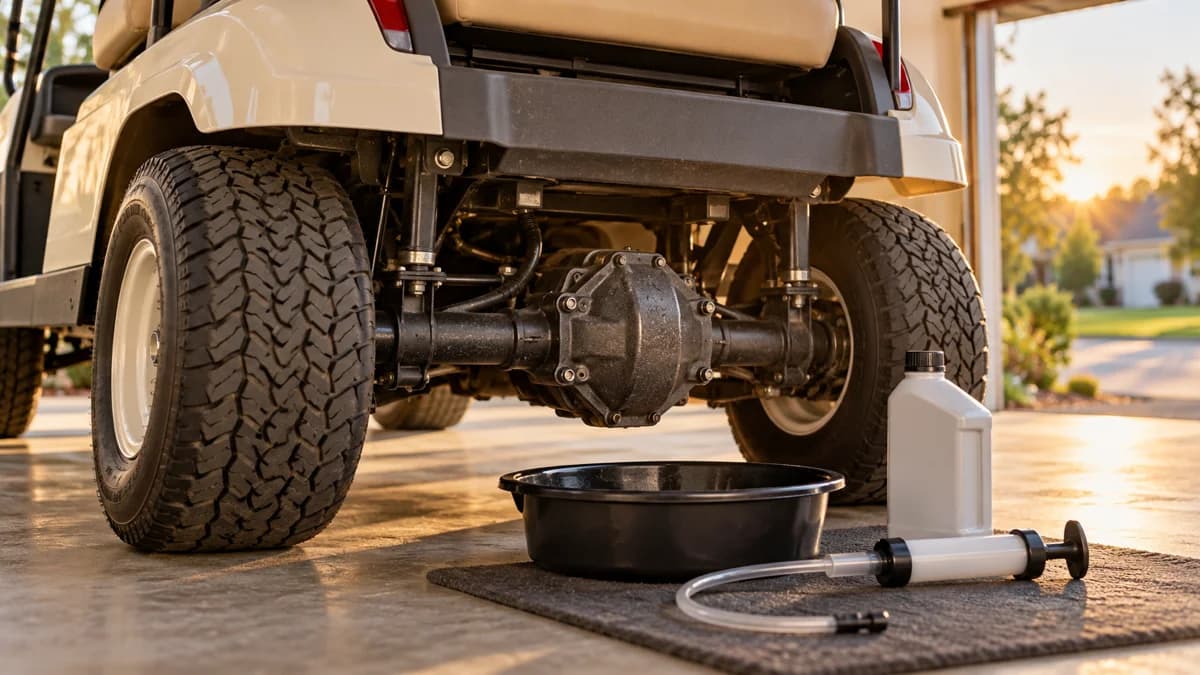
Hero: AI-generated editorial illustration, not a photograph of a vehicle we serviced.
Golf cart differential oil: five manuals compared
We downloaded five manufacturer-hosted documents on October 22 and compared their lubricant tables, level instructions and revision identities. The sample deliberately includes two revisions for one engine family. It is a desk comparison, not hands-on oil testing, a representative fleet sample or a finding that one brand lasts longer.
| Identified document | What its fluid entry says |
|---|---|
| Yamaha 2026 DR2 EFI, J0K-F8199-37-E0, p. 41 | SAE 80W-90 or SAE 90; 475 mL change quantity |
| Yamaha 2027 DR2 AC, J0J-F8199-38-E0, p. 41 | SAE 80W-90 or SAE 90; 355 mL change quantity |
| E-Z-GO RXV ELiTE, 10193239-B, model year 2027+, p. 25 | 25 oz / 740 mL Mobil 424; separate 2 oz / 60 mL Sturaco modifier |
| E-Z-GO RXV EX1 EFI, 10036460-A, p. 32 | Transaxle: 1 L Mobil 424. Differential: 100 mL 80W-90 |
| E-Z-GO RXV EX1 EFI, 10036460-E, p. 26 | Differential: 1 L Mobil 424. Transaxle: 150 mL 80W-90 |
Sources: Yamaha EFI, Yamaha AC, RXV ELiTE revision B, EX1 revision A, and EX1 revision E. Page numbers are printed page numbers. Save the cover and relevant pages together.
The EX1 rows are a discrepancy to resolve, not two recipes to choose between. We have not established whether hardware changes, terminology or a documentation correction explains the difference. Neither our table nor an older search result establishes which physical cavity gets which fluid on your particular cart.
The current E-Z-GO library links revision E under RXV EX1 and separately lists newer RXV manuals. The Yamaha manual directory also needs a cover check: the AC download we retrieved is marked 2027. A live download URL is not proof of a matching model year.
Identify the axle before shopping for oil
Start with the vehicle serial number, model, powertrain and any replacement-axle history. Use our serial-number guide and E-Z-GO model-year guide to organize those details. Then have the supplier or technician identify the actual installed assembly.
For a Yamaha, “Drive2” alone does not select the gas or electric document above. For an E-Z-GO, “RXV” does not distinguish the ELiTE axle from an EX1 arrangement. The TXT versus RXV comparison covers vehicle differences, but it is not a lubricant cross-reference.
For a Club Car, obtain its own applicable manual and axle identification. We did not include a Club Car service specification in this sample, so none of the quantities above should be transferred to it. The same applies to replacement axles, modified drivetrains and other brands.
Ask for a written specification that identifies the cavity and exact lubricant requirement. A product marketed as “golf cart oil” or “universal gear oil” is not the missing approval. Keep engine oil, axle lubricant and grease as separate entries on your maintenance checklist.
Resolve the RXV EX1 document conflict first
The older A and currently linked E documents both describe two separate oil cavities. Their fluid tables, however, reverse the transaxle/differential names and change the smaller 80W-90 entry by 50 mL. That is large enough to matter when the smaller published figure is only 100 or 150 mL.
Do not average those numbers, pick the newer quantity by appearance or use a photograph to decide the cavity. Send the dealer your serial number, axle identification and both document numbers. Ask it to provide the applicable service-manual diagram, approved lubricant and level procedure for each opening. Keep that answer with the service record.
If the shop gives a single “rear-end oil change” quote, ask whether it includes every applicable cavity and which specification it will use. This is a scope question, not a reason to assume wrongdoing. Our repair directory can help find a provider; bring the document discrepancy to the appointment.
An engine-service kit does not settle this issue. Our gas-cart tune-up guide covers a different service scope. Likewise, the drive-belt guide addresses belt identification rather than axle-fluid selection.
Golf cart differential oil level is model-specific
The cited Yamaha EFI and AC level procedures allow oil 0 to 25 mm below the bottom edge of the level opening. The EX1 E checking procedure instead describes the level just below its threaded opening and slow addition until seepage begins. Yamaha's AC manual directs oil replacement to a Yamaha dealer or other qualified mechanic.
Those are specific instructions, not permission to use an improvised dipstick, add a whole bottle or tilt a cart to accept more oil. Follow the applicable level-check setup, vehicle position and access procedure. A drain/refill quantity and the amount needed for a top-up answer different questions.
Before opening anything, make sure you can identify the correct plug from the matching diagram. Do not loosen housing fasteners to search for a drain, drill a hole or assume a rubber cover plug matches a threaded one. Stop if the assembly does not match the document.
Secure and isolate the cart as its service instructions require. Work on a firm, level surface, allow hot parts to cool and use the specified protective equipment. Never get underneath a cart supported only by a jack. If access requires lifting, use the exact vehicle's approved points and support method; our jack-point guide explains why those details need confirmation. Arrange qualified service if you cannot meet them.
Our capacity and measuring calculations
We used the published metric quantities for the following arithmetic. These are planning calculations, not measured fill results or instructions to override a final level check.
- The two Yamaha quantities differ by 475 − 355 = 120 mL. Using the gas quantity for the electric example would add 120 ÷ 355 × 100 = 33.8% of its stated change quantity unnecessarily.
- The EX1 smaller entry changes from 100 to 150 mL, a 50% difference relative to the older entry. That describes the document change, not a recommended adjustment to an existing cart.
- A nominal 5 mL hand pump would require 475 ÷ 5 = 95 strokes to deliver 475 mL, or 355 ÷ 5 = 71 strokes for 355 mL, if every stroke delivered its nominal amount.
The pump example assumes a fully primed pump, complete strokes and no losses. Real delivery can differ because fluid remains in the hose or strokes are incomplete. Counting strokes is therefore not an accuracy certificate. Use a suitable clean measuring method and the manufacturer's final-level procedure.
A practical shopping check follows from this: consider the measuring increments and access clearance before buying a large dispenser. A container marked only in broad fractions of a quart may be a poor choice for distinguishing 100 from 150 mL. Keep separate clean equipment for different fluids so you do not introduce an unidentified mixture.
Inspection intervals and replacement are separate
The cited 2027+ RXV ELiTE chart lists axle-fluid replacement at 500 hours or five years, whichever comes first, alongside earlier leakage checks. Its nearby prose emphasizes the five-year period. Use the full chart rather than reading that paragraph as a five-year exemption from hour-based service.
For that one chart, a hypothetical cart accumulating 20 hours a month reaches 500 hours in 25 months. At five hours a month it would take 100 months, so the 60-month calendar trigger arrives first. Method: 500 ÷ assumed monthly hours, compared with five × 12 months. These inputs are examples, not observed fleet records.
For your own log, record both next-due hours and the date. Keep inspection results separate from completed replacement: “no external leak seen” does not mean “oil changed.” A battery-electric cart still has mechanical drive components; our gas versus electric comparison should not be read as maintenance-free ownership.
Before seasonal storage, check the exact cart's requirements rather than adding an automatic annual axle drain. Use the winter-storage guide for the wider battery, charger and parking plan. Axle service cannot substitute for battery storage instructions.
Leaks and noise need a cause, not a thicker bottle
Record where the wet area appears, whether a fresh drip forms while parked and when a new noise occurs. Photographs taken from a safe position and dated notes give a technician useful history. Do not keep driving to reproduce grinding, an unsafe handling change or a suspected low-lubricant condition.
A leak can require repair as well as correcting the level. Adding oil without knowing the fluid already present, or repeatedly topping up without finding the loss, leaves important questions unanswered. If drained oil is unexpectedly milky or contains obvious metal fragments, preserve the observation for the technician rather than inventing a flush recipe.
Do not pour solvent, automatic transmission fluid, a friction modifier or a “quiet differential” additive into an unidentified axle. The separate modifier entry in the ELiTE example is not permission to add it to every cart. Ask for a diagnosis and approved corrective procedure.
A rear-area noise is also not automatically a differential fault. Use our troubleshooting guide to record symptoms, and include recent wheel, tire, suspension or drivetrain changes. The tire-pressure guide and wheel-hardware torque guide address separate checks; fresh oil cannot confirm either is correct.
Three optional service aids
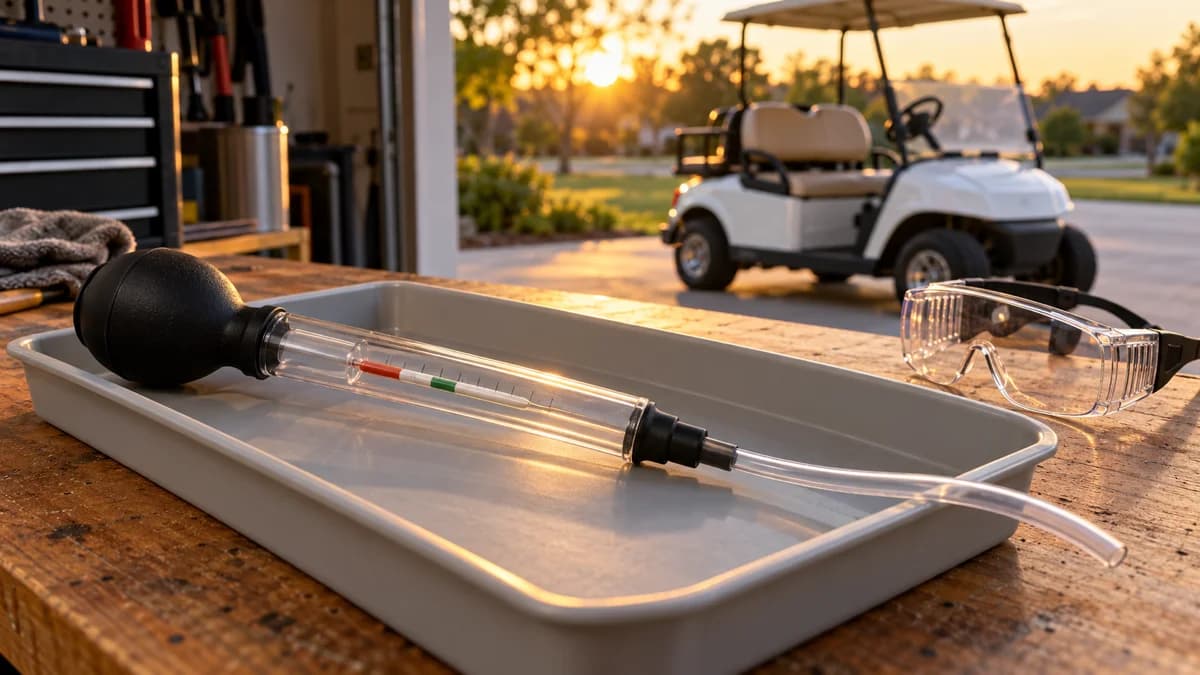
Use tools already owned if they meet the actual procedure. These are selection examples, not products we physically tested or a required bundle. Follow each tool's instructions, and check its current price at the linked listing. None establishes lubricant compatibility.
Slippery Pete quart-bottle fluid pump
The manufacturer identifies this pump as a nominal 5 cc model for quart bottles with a 28 mm opening. Check the actual bottle neck, hose access and fluid compatibility. It is a transfer aid, not a calibrated dosing instrument; do not assume a marine threaded adapter belongs in a golf-cart opening.
Check current pump price on AmazonNEIKO 20762A oil catch pan
A purpose-made catch pan can contain fluid during a permitted level check or service. For this 2-gallon/8-liter model, check its physical height and pouring arrangement against your safe access setup. It is oversized relative to the sample quantities, which does not make its contents a useful volume measurement. Use a separate approved waste container for transport and disposal.
Check NEIKO pan price on Amazon →MaxxHaul 70472 wheel-chock pair
These rubber chocks are one option to evaluate against the tires, surface and vehicle procedure. Read the manufacturer's product information and placement instructions. Chocks help prevent rolling; they do not support a raised cart or replace jack stands. Do not buy a pair as a substitute for establishing the complete support arrangement.
Check MaxxHaul chock price on Amazon →Save a cavity-by-cavity service record
Write one line for each cavity. A useful record includes:
| Record | What to enter |
|---|---|
| Vehicle and assembly | Serial, model, powertrain, axle identification and known changes |
| Approved source | Manual number/revision, page and any serial-specific clarification |
| Fluid | Exact approved product/specification, cavity and separately required additive |
| Work performed | Inspection, top-up, replacement or leak repair; measured amount and final check |
| Timing | Date, operating hours and next applicable hour/calendar triggers |
| Findings | Leak location, contamination observation, repaired parts and technician comments |
For a quote, separate diagnosis, each fluid, any modifier, seals or plugs, labor, disposal and collection. There is no current local labor-price sample behind this article, so it does not assign a universal service price. A written complete quote is more useful than a guessed average. Our ownership-cost calculator can organize an estimate once you have real local inputs.
Keep the record after service and check for any follow-up the technician requires. Treat the unresolved EX1 table difference as a question to close in writing, not an invitation to experiment with oil types.
Differential oil questions owners ask
What oil goes in a golf cart differential?
Use the lubricant approved for the installed axle, not a brand-wide rule. The cited Yamaha manuals specify SAE 80W-90 or SAE 90; the cited RXV ELiTE manual lists Mobil 424 and a separate Sturaco friction modifier.
How much differential oil does a Yamaha Drive2 take?
The identified 2026 DR2 EFI manual lists 475 mL, while the identified 2027 DR2 AC manual lists 355 mL. These are document-specific change quantities, not universal Drive2 top-up amounts.
Does an electric golf cart have differential oil?
Yes, the electric Yamaha DR2 AC and E-Z-GO RXV ELiTE examples here both specify rear-drive lubricant. Having no gasoline engine does not eliminate axle maintenance.
Can I use the same oil in both RXV EX1 cavities?
Do not assume so. The two EX1 revisions compared here list different lubricants for the two cavities, and their labels and smaller quantity disagree. Obtain serial-specific confirmation before servicing.
Should differential oil always reach the fill-hole edge?
Use the exact level procedure. The Yamaha examples allow a level 0 to 25 mm below the bottom edge; the cited EX1 procedure describes a level just below the threaded hole and adding slowly until seepage begins.
How often should I change golf cart rear-axle oil?
Follow the full hour and calendar schedule. The cited RXV ELiTE chart lists replacement at 500 hours or five years, whichever comes first. Leakage checks occur earlier; that interval is not universal.
Will fresh oil fix a noisy golf cart differential?
A noise does not establish the cause. Record when it occurs and arrange inspection for new grinding, leakage or unsafe operation. Do not use thicker oil or an additive as an unverified repair.
Is a pump stroke count accurate enough for filling?
Treat it only as a planning calculation. A nominal 5 mL stroke gives 95 strokes for 475 mL, but priming, incomplete strokes and retained fluid change actual delivery. Use approved measurement and the specified final level.
Golf Cart Search
Find the Best Golf Carts of 2026
Compare top-rated models, read expert reviews, and find the perfect cart for your needs.