As an Amazon Associate, we earn from qualifying purchases. This helps support our site at no extra cost to you.
Advanced EV Golf Cart Reviews: Price, Problems & Where Made
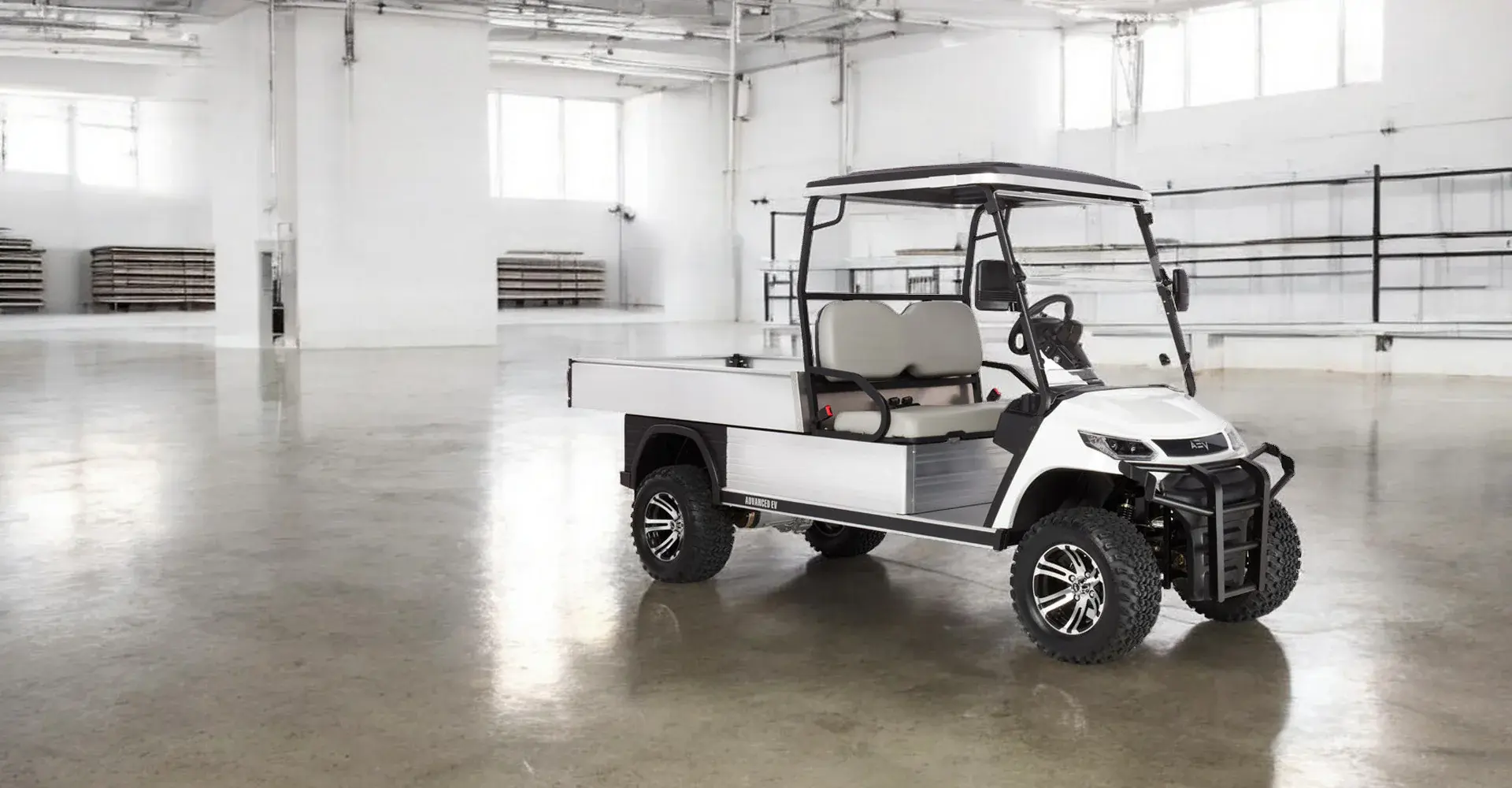
Advanced EV is a value-focused golf cart brand sold through a dealer network, with Texas-based operations and a simple pitch: give buyers a feature-loaded, street-legal electric golf cart at a price that undercuts the legacy brands.
Starting at $8,299 for the Advent 2, Advanced EV offers lithium batteries, four-wheel hydraulic disc brakes, Bluetooth touchscreens, and a full LSV package as standard equipment. That is a lot of cart for the money, and it is why the brand keeps showing up in golf cart communities across Florida, Texas, and the Carolinas.
But a lower price always raises the question: what are you giving up? These Advanced EV golf cart reviews cover current models, real-world pricing, common problems, warranty details, where Advanced EV carts are made, and honest comparisons to ICON, Evolution, Club Car, and the rest of the Big 3. By the end, you will know whether an Advanced EV belongs in your garage.
If you are comparing Advanced EV against other value brands, our golf cart brands to avoid guide walks through the service-depth, warranty, and resale checks that matter before buying.
Quick Answer: Are Advanced EV Golf Carts Good?
Advanced EV is a good short-list brand if you want a lithium, street-legal cart under roughly $10,000 and have an authorized dealer nearby. The best fit is usually the Advent 4L for families and neighborhood drivers. The main cautions are dealer coverage, steel-frame corrosion in humid or coastal areas, warranty length versus ICON, the 2023 Advent seat recall, and model-specific country-of-origin claims.
Founded By Dealers, 35+ Years Experience
Headquarters Dallas, TX
Origin Verify by Model
Price Range $8,299 - $13,900
Warranty 2-5 Years / 5-Year Battery
Who Is Advanced EV?
Advanced EV was founded by golf cart dealers who got tired of selling other people's products. With over 35 years of combined industry experience behind the brand story, the company built its lineup from the dealer side of the business, meaning the carts are positioned around the things that matter to buyers and the shops that service them.
The country-of-origin answer needs more nuance than many reviews give it. Advanced EV has Texas operations and dealer support, and the CPSC identifies LvTong USA Golf Cars LLC, dba Advanced EV, of Dallas, Texas as the importer for the recalled 2020-2022 Advent 4F, 4FL, 6, and 6L carts. That same official CPSC recall lists those recalled units as manufactured in China.
So if you are asking, "where are Advanced EV golf carts made?", the honest answer is: verify the exact model, year, and VIN/serial plate with the dealer before buying. Do not assume every Advanced EV cart is fully made in Texas just because the brand has Texas operations.
Advanced EV offers two main product lines:
- Advent Series covers the full range of personal golf carts, from the 2-passenger Advent 2 through the 8-passenger Advent 8, with standard and lifted versions
- Horizon is the premium line with upgraded motors, WetSound marine speakers, and RFID keyless start
- Advent Click mirrors the Advent lineup but targets commercial and fleet buyers (rental operations, apartment complexes, resort maintenance)
Today, Advanced EV sells through a growing dealer network primarily concentrated in Texas, Florida, California, and the Southeast. They have also expanded into buses and utility vehicles, though personal golf carts remain their core product.
Every Advanced EV Model Reviewed
Advanced EV runs on the ECO 51.2V lithium battery platform across its personal lineup. Every model uses a Toyota-programmed AC controller, four-wheel hydraulic disc brakes, and comes street-legal ready with LED lights, turn signals, mirrors, seat belts, and a DOT-approved windshield. Here is what each model offers and who it is best for.
Advent 2: Best Budget Entry ($8,299)
The Advent 2 is Advanced EV's starting point and one of the most affordable lithium-battery golf carts from any brand with U.S. dealer support. At $8,299 MSRP, you get a 2-passenger cart with a 4kW AC motor, 350-amp Toyota controller, ECO 51.2V 105Ah lithium battery, and an estimated range of 30 to 40 miles per charge.
Standard features include a molded instrument panel with LCD Bluetooth touchscreen, LED speedometer, reverse backup camera, dual USB and Type-C charging ports, and a 12V power supply. The suspension uses double A-arm independent front with coil-over hydraulic shocks and a rear sway bar.
Best for: Solo riders, golfers, and couples in golf cart communities who want a compact, affordable cart with modern features. At $8,299, it undercuts the ICON i40-ECO ($9,999) by $1,700 while offering comparable equipment.
Advent 4 and 4F: Standard 4-Passenger
The Advent 4 adds rear-facing seating for four passengers, while the 4F puts all four passengers facing forward. Both use the same 4kW motor and 350-amp controller as the Advent 2, with the same lithium battery and feature set.
The forward-facing 4F is the better choice if you regularly carry passengers on public roads. Rear-facing seats work fine on golf courses and private communities, but most passengers prefer facing forward on longer drives. Expect pricing around $8,500 to $9,000 MSRP depending on configuration.
Best for: Families and neighborhood drivers who need four seats without the lifted look. The Advent 4 is the practical daily driver in the lineup.
Advent 4L and 4FL: Lifted 4-Passenger ($9,399)
The Advent 4L takes the standard 4-passenger platform and adds a lifted chassis, 12-inch custom alloy wheels, all-terrain tires, brush guard, and fender flares. The 4FL adds forward-facing seating to the lifted package.
At $9,399 MSRP, the lift adds about $900 to $1,000 over the standard Advent 4. The enhanced ground clearance handles unpaved roads, gravel paths, and uneven terrain that would scrape a standard cart's undercarriage. The aggressive stance also happens to be the look most buyers in the hunting and off-road segment want.
Best for: Buyers on rural properties, hunting land, or communities with unpaved roads. Also popular with anyone who simply prefers the lifted aesthetic. For flat, paved neighborhoods, save the money and get the standard Advent 4.
Advent 6 and 6L: 6-Passenger ($10,300)
The Advent 6 carries six passengers (two front, four rear) and the 6L adds the lifted suspension package. At $10,300 MSRP for the 6L, this is one of the cheaper 6-passenger lithium golf carts from a brand with U.S. dealer support.
With six passengers and gear, the 4kW motor works harder than it does on the lighter 2 and 4-passenger models. Expect range to drop from the advertised 30 to 40 miles down to 25 to 30 miles with a full load on hilly terrain. The four-wheel disc brakes handle the extra weight well, which is important when your passenger count doubles.
Best for: Large families, retirement communities, resort shuttles, and anyone who regularly carries more than four people. If you rarely fill all six seats, the Advent 4 is lighter, more efficient, and $1,000 to $2,000 cheaper.
Advent 8: Maximum Capacity
The Advent 8 stretches the platform to seat eight passengers, making it the largest personal cart in the Advanced EV lineup. It uses the same drivetrain as the smaller models, which means the 4kW motor is pushing a lot more weight.
Pricing varies by dealer but expect $11,000 to $12,000 for the Advent 8. At this size, you are competing with shuttle-style carts from Club Car and EZGO that cost significantly more.
Best for: A narrow audience. Large properties, campgrounds, resort transportation, and buyers who genuinely need to carry eight people. For most personal use, the 6-passenger model makes more sense.
Advent Click: Built for Fleets
The Click series mirrors the Advent lineup but is designed for commercial applications. Rental operations, apartment complexes, hotel maintenance teams, and golf courses are the target buyers. Click models often step up to the larger 5kW AC motor with a 450-amp controller, providing extra power for the constant start-stop-start cycles that fleet use demands.
Pricing starts around $8,499 MSRP. The Click line extends into HD utility variants with cargo beds and specialized configurations.
Best for: Business owners and property managers who need reliable fleet vehicles. The commercial focus means these carts are built to handle higher usage cycles than the personal Advent line.
Horizon 4: The Premium Flagship ($9,400-$13,900)
The Horizon is Advanced EV's answer to buyers who want more refinement than the Advent offers. Currently available as a 4-passenger model, the Horizon upgrades to a 5kW AC motor with a 450-amp controller, providing noticeably stronger acceleration and hill-climbing ability compared to the 4kW Advent models.
The feature list goes beyond the Advent: WetSound marine-grade speakers, RFID keyless start, optional power steering, redesigned premium seats with armrests, a removable storage box, and a painted center pod for a more polished look. The suspension and brake hardware carry over from the Advent platform.
Base MSRP starts around $9,400, but the fully equipped lithium version runs approximately $13,900 at most dealers. That puts it in the same territory as the ICON i40 ($12,999) and just below the Evolution D5 Ranger 4 Plus ($9,595 MSRP).
Best for: Buyers who like Advanced EV's dealer-first approach but want the upgraded motor, better speakers, and premium touches. If the Advent feels utilitarian, the Horizon adds the refinement that makes a cart feel like more than a golf cart.
Advanced EV Pricing: MSRP vs What You Actually Pay
Advanced EV publishes MSRP, but dealer pricing varies by region and configuration. Here is what we found across listings in early 2026:
| Model | MSRP | Typical Dealer Price | Notes |
|---|---|---|---|
| Advent 2 | $8,299 | $8,000 - $9,000 | Best value entry point |
| Advent 4 | ~$8,500 | $8,200 - $9,500 | Standard 4-passenger |
| Advent 4L | $9,399 | $9,000 - $12,500 | Widest price range by region |
| Advent 6L | $10,300 | $10,000 - $12,000 | Cheapest 6-passenger lithium |
| Advent 8 | ~$11,500 | $11,000 - $13,000 | Limited availability |
| Advent Click | $8,499 | $8,000 - $9,000 | Fleet/commercial pricing available |
| Horizon 4 (lithium) | $9,400+ | $10,000 - $13,900 | Premium model, dealer markup common |
Geography matters. Dealers in high-demand markets like Florida and Texas tend to price at or above MSRP, while dealers in less saturated areas may offer modest discounts. Delivery and setup fees typically add $300 to $800 depending on distance.
For context, a comparable new golf cart from the Big 3 with lithium battery, touchscreen, and disc brakes runs $13,000 to $16,000. That is where Advanced EV's $8,299 to $9,399 price range becomes a serious value proposition.
5 Common Advanced EV Problems
No golf cart brand is perfect, and Advanced EV owners report a handful of recurring issues. These are the five most common problems based on forum posts, dealer feedback, and owner reviews. Knowing these upfront helps you make an informed purchase and catch issues early.
For general electric cart diagnostics, our troubleshooting guide covers step-by-step fixes for most issues.
1. Battery and Charging Failures
The most frequently reported issue across Advanced EV models. Symptoms include the charger failing to initiate a charge cycle, batteries losing capacity faster than expected, and the cart showing a full charge but losing power quickly during use.
Root causes: Faulty charger connections, issues with the battery management system (BMS), or electrical connection problems between the battery pack and the controller. Some early models shipped with lead-acid batteries that degraded faster than the current lithium standard.
Fix: Check all battery terminal connections for corrosion or looseness. Test the charger output with a multimeter. If the BMS throws errors, a dealer reset often resolves the issue. Charger replacements under warranty are straightforward. For a deep dive into battery health, see our complete battery guide.
2. Direction Switch Malfunctions
Some owners report the forward/neutral/reverse switch failing to register inputs correctly. The cart may not respond to direction changes, get stuck in one direction, or intermittently lose the ability to shift between forward and reverse.
Fix: The switch itself is an inexpensive part but requires proper diagnosis to rule out wiring issues. A dealer can test the switch with a continuity meter. If the switch tests fine, the problem often traces back to a loose wiring harness connector under the dash.
3. Speed Controller Errors
The Toyota-programmed 350-amp controller manages power delivery from battery to motor. Under heavy load (steep hills, full passenger load, hot weather), the controller can overheat and trigger a thermal shutdown. Some owners also report erratic speed behavior where the cart surges or hesitates during acceleration.
Fix: Keep the controller cooling fins clear of dirt and debris. Avoid sustained steep climbs with a full load in extreme heat. If shutdowns happen on flat ground, the controller may need reprogramming or replacement under warranty. Surge issues are typically resolved with a firmware update at the dealer. For more on how controllers work, see our AC vs DC motor guide.
4. Motor Wear and Whining Sounds
After extended use, some owners report a whining or grinding noise from the motor. Leading causes include worn bearings, damaged wiring to the motor, or a faulty ignition switch. The 4kW motor in the Advent line handles most personal use well, but fleet-duty carts and those frequently carrying heavy loads see accelerated wear.
Fix: Do not ignore unusual motor sounds. A whining noise caught early is often just a bearing replacement ($100 to $200 at a shop). Left untreated, it can lead to full motor failure, which is far more expensive. Regular maintenance and keeping the motor area clean extends motor life significantly.
5. CPSC Seat Recall (2020-2022 Models)
In 2023, Advanced EV issued a voluntary recall through the Consumer Product Safety Commission (CPSC) for Advent 4F, 4FL, 6, and 6L models sold between May 2020 and June 2022 (serial numbers LTA0050000 through LTA0145000). The front seat could become loose due to missing rubber grommets, creating fall and injury hazards.
Action required: If you own an affected model, stop using the cart and contact the dealer where it was purchased for a free inspection and repair. Advanced EV customer service is available at 855-300-1364, Monday through Friday, 8 a.m. to 5 p.m. CT.
Context: Recalls happen across the industry. Club Car, EZGO, and Yamaha have all issued CPSC recalls over the years. What matters is how the company handles it, and Advanced EV addressed this recall promptly with free dealer repairs. If you are buying a used Advanced EV, check the serial number against the recall range before purchasing. See our used buying guide for more pre-purchase checks.
What Advanced EV Does Well
The problems above are real, but they affect a minority of owners. Here is where Advanced EV genuinely delivers.
Dealer-First Design Philosophy
Advanced EV was literally built by dealers. That shows up in practical ways: standardized parts across models, easier serviceability, responsive warranty support, and carts designed around what dealers know buyers actually care about. Compare this to brands where dealers struggle to get warranty parts for months. Several Evolution dealers have publicly complained about 30 to 90+ day warranty wait times. Advanced EV's smaller dealer network can be a disadvantage, but the dealers they do have tend to report a smoother support experience.
Texas-Based Dealer Support
Advanced EV's practical advantage is not a blanket "made in Texas" claim; it is the dealer-support model. If your local dealer stocks parts, handles warranty work cleanly, and has experience with Advent and Horizon carts, Advanced EV ownership is much easier. Before buying, ask the dealer where your specific cart was manufactured or assembled, where replacement parts ship from, and who handles warranty approval if a controller, charger, battery, or seat component fails.
Standard Lithium Batteries
Every current Advanced EV personal model ships with ECO 51.2V lithium batteries. Many competitors still charge $2,000 to $3,000 extra for a lithium upgrade. Lithium batteries last 2,000 to 5,000 charge cycles vs 300 to 500 for lead-acid, weigh roughly half as much, charge in 2 to 4 hours instead of 8 to 12, and require zero maintenance. This single feature makes the price comparison with older lead-acid models misleading. Once you factor in battery replacement costs, lithium saves money over the cart's lifetime.
Four-Wheel Hydraulic Disc Brakes
Every Advanced EV model includes four-wheel hydraulic disc brakes plus an electromagnetic motor brake. That is better stopping hardware than what most Big 3 brands offer at base price (Club Car, EZGO, and Yamaha still use rear drum brakes on many models). Disc brakes provide firmer, more consistent stopping power, especially in wet conditions and on slopes. For a safety-conscious buyer, this is a meaningful advantage.
Aggressive Pricing
The Advent 2 at $8,299 and the Advent 4L at $9,399 represent some of the lowest MSRPs for a lithium-battery, street-legal golf cart from any manufacturer with a U.S. presence. For buyers shopping under $10,000, Advanced EV delivers more standard features than anything else at the price. See our best golf carts under $10,000 guide for how Advanced EV stacks up against every budget option.
Advanced EV vs ICON vs Evolution vs Club Car
Here is how Advanced EV compares to the brands it most directly competes with:
| Factor | Advanced EV Advent 4L | ICON i40 | Evolution Classic 4 Plus | Club Car Onward |
|---|---|---|---|---|
| Starting Price (lithium) | $9,399 | $12,999 | $6,795 | $14,000+ |
| Motor | 4kW AC | 5kW AC | 4kW AC | 3.3kW AC |
| Controller | Toyota 350A | 450A | 400A Curtis | Club Car |
| Range | 30-40 miles | 40+ miles | 35-50 miles | 35 miles |
| Top Speed | 25 mph | 25 mph | 25 mph | 19 mph (25 LSV) |
| Touchscreen | LCD Bluetooth | 10.1" waterproof | 7" touchscreen | Optional |
| Disc Brakes | 4-wheel hydraulic | 4-wheel standard | 4-wheel standard | Rear drum |
| Frame Material | Steel (powder-coated) | Steel (powder-coated) | Steel | Aluminum |
| Battery Warranty | 5 years | 10 years | 5-8 years | 2 years |
| Parts Warranty | 2-5 years | 3 years | 2 years | 2 years |
| Origin / support | Texas-based support; verify model origin | Multiple U.S. facilities | Chino, CA (HDK components) | Augusta, GA |
| Dealer Network | Growing (regional) | 200+ nationwide | 250+ nationwide | 1,000+ nationwide |
| Resale (3-year est.) | 50-65% | 60-70% | 50-60% | 70-80% |
| Years in Business | 10+ | 8 | 10 (HDK: 20) | 60+ |
Key takeaways:
Advanced EV wins on price and dealer-backed value. At $9,399 for a lifted, lithium-equipped 4-seater, it is $3,600 cheaper than the ICON i40 and $4,600+ cheaper than a comparable Club Car. The value case is strongest when a nearby dealer can support the cart after the sale.
ICON wins on motor power and warranty. The 5kW motor and 10-year battery warranty are hard to beat. ICON also has a much larger dealer footprint, which matters if parts access concerns you. Read our complete ICON review and the Advanced EV vs ICON comparison for the full breakdown.
Evolution wins on rock-bottom pricing. The Classic 4 Plus starts at $6,795, nearly $2,600 less than the cheapest Advanced EV. But Evolution's warranty service has documented problems, and the non-transferable warranty hurts resale value. See our Advanced EV vs Evolution comparison and Evolution review.
Club Car wins on build quality and resale. The rust-proof aluminum frame, 60+ year track record, and massive dealer network make Club Car the safe long-term investment. But you pay 40 to 60% more for a comparably equipped cart. Read our complete Club Car review.
Tomberlin wins on premium LSV feel. If you like the idea of a road-ready cart with more power steering, telematics, luxury seating, and stronger premium positioning than Advanced EV, read our Tomberlin golf cart review. The catch is that Tomberlin costs substantially more and carries more resale risk.
EZGO and Yamaha are also worth considering if parts availability and proven long-term reliability rank highest on your list. For a full cross-brand breakdown, see our best golf cart brands page and top-ranked golf carts.
Advanced EV Resale Value
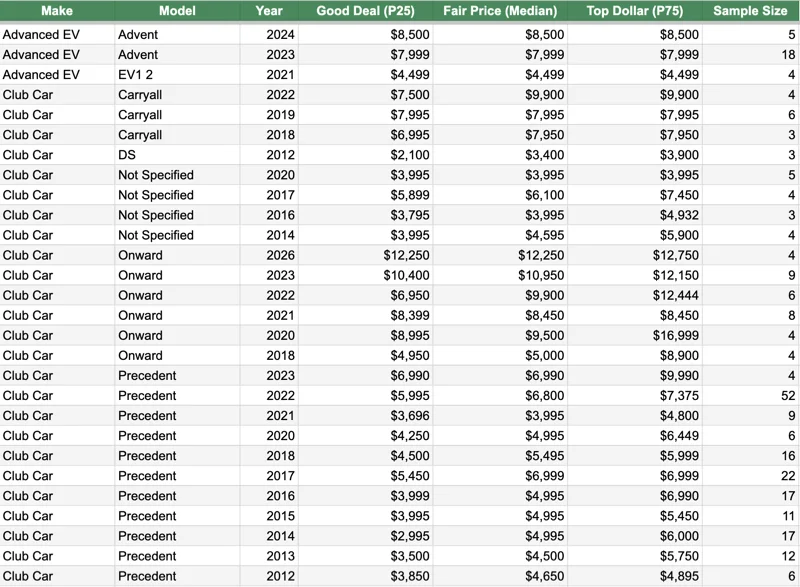
Advanced EV carts are still new enough that long-term resale data is limited. Based on current used listings and dealer trade-in reports, here is what to expect:
A $9,400 Advanced EV purchased new will likely resell for $5,000 to $6,500 after 3 years with proper maintenance. That is roughly 50 to 65% value retention, which is below Club Car (70-80%) and slightly below ICON (60-70%), but roughly in line with Evolution and other value brands.
Several factors affect Advanced EV resale:
- Brand recognition: Buyers are more cautious about lesser-known brands when shopping used
- Dealer availability: Limited dealer presence in some regions means fewer local buyers
- Steel frame: In coastal or humid areas, visible rust drops the value faster than aluminum frames
- Lithium advantage: Current lithium models hold value better than older lead-acid versions, and battery health is the single biggest factor in used cart pricing
If resale value is your top priority, Club Car's aluminum frame is the clear winner. If you plan to drive your cart for 8+ years and care less about selling it later, Advanced EV's lower purchase price means you come out ahead financially even with steeper depreciation.
For help determining what any golf cart is worth, check our golf cart value guide.
Who Should Buy an Advanced EV Golf Cart
Buy an Advanced EV if:
- You want a lithium-battery, street-legal cart under $10,000
- You value a Texas-based support network and can verify origin for the exact model
- There is an Advanced EV dealer within reasonable driving distance of your home
- You live in a golf cart community where carts are daily transportation
- Four-wheel disc brakes are important to you (especially for hilly areas)
- You plan to keep the cart for 5+ years and are less concerned about resale
- You need a fleet of carts for a business at competitive per-unit pricing
Skip Advanced EV and consider another brand if:
- You live in a coastal or humid area where steel frame corrosion is a concern (go Club Car aluminum)
- There is no Advanced EV dealer near you (parts and warranty will be difficult)
- Battery warranty length is a top priority (ICON offers 10 years vs 5 for Advanced EV)
- You want the absolute lowest price regardless of brand or dealer support (Evolution starts at $6,795)
- You need a gas-powered option (Advanced EV is electric-only; see our electric vs gas comparison)
- Proven long-term reliability data matters more than features per dollar (go with the Big 3)
- Maximum resale value is a priority (Club Car retains 70-80% after 3 years)
Accessories Worth Adding to Your Advanced EV
Advanced EV carts come well-equipped, but a few additions make daily driving better.
A quality phone mount keeps your phone secure for GPS and music without blocking the touchscreen. The A2C magnetic alloy mount (about $27) is an option only if your cart has a square iron roof strut that passes a magnet test; it will not attach to aluminum, plastic, or round supports.
Check Price on AmazonIf you ever need to replace or upgrade your lithium battery, the DC HOUSE 48V 100Ah kit is a current 100Ah-class option to compare. It is not an Advanced EV factory replacement: confirm the exact tray dimensions, voltage, controller limits, charger profile, cable layout, mounting, and warranty implications before buying.
Check Price on AmazonFor model-specific floor mats, covers, enclosures, storage, hitches, and electrical fitment, use our Advanced EV Advent and Horizon accessories guide. For broader upgrade ideas, see the complete accessories guide and customization guide.
Advanced EV Alternatives on Amazon
If there is no Advanced EV dealer near you, several electric golf carts ship directly from Amazon with free delivery:
The Kandi GOAT 2P (about $7,999 when last listed) is a 2-passenger cart with a 5,000W motor and 40-mile range. Stronger motor than the Advent 2 at a slightly lower price, but no local dealer support, and it is currently unavailable on Amazon.
See our full Kandi GOAT 2P breakdown
The AODES Trailcross (about $7,249 when last listed) is a 4-passenger 48V cart with rugged styling and a full street-legal package. At roughly $2,000 less than the Advent 4L, it is worth comparing if price is your primary concern, though its Amazon listing is no longer active, so treat that figure as a reference rather than a live offer.
See our full AODES Trailcross breakdown
These Amazon-sold carts carry standard manufacturer warranties. Read reviews carefully and confirm your state's registration requirements before ordering. Also check whether your state requires golf cart insurance for street-legal operation.
The Bottom Line on Advanced EV
Advanced EV fills a real gap in the market. It delivers a lithium-battery, street-legal, feature-loaded golf cart at prices that undercut ICON, Club Car, and EZGO by a significant margin. Responsive dealer support and four-wheel disc brakes standard are genuine advantages at this price point.
The trade-offs are a smaller dealer network, a shorter battery warranty than ICON's 10-year coverage, a steel frame that can rust, and limited long-term reliability data. The 2023 CPSC seat recall was handled appropriately, but it is a reminder that newer brands are still working through quality control.
If you can find a dealer near you, test drive an Advent 4L and compare it side-by-side with an ICON i40 or Evolution D5. The $3,000 to $4,000 price gap is real, and so is the equipment you get for the money. Whether that gap matters more than a longer warranty and a bigger dealer network is a personal call.
For most budget-conscious buyers in golf cart communities who want a daily driver with modern features, Advanced EV deserves a spot on your short list. Browse Advanced EV and all other brands in our dealer directory, or compare head-to-head on our comparison pages.
Frequently Asked Questions
Are Advanced EV carts reliable for daily use?
Advanced EV carts are reasonably reliable for a brand at this price point. Most owners report trouble-free daily operation, and the AC motor and lithium battery platform are proven technologies. The brand does not yet have 20+ years of reliability data like Club Car, EZGO, and Yamaha. Sticking to a regular maintenance schedule and addressing issues early will maximize the lifespan of any Advanced EV cart.
How fast does an Advanced EV golf cart go?
Most Advanced EV models have a top speed of 25 mph, which qualifies them as Low-Speed Vehicles for street-legal use. The Toyota-programmed controller manages the speed curve for smooth acceleration. Exceeding 25 mph through modification would change your cart's legal classification in most states. For more context, see our golf cart speed guide.
How far can an Advanced EV go on a single charge?
Advanced EV advertises 30 to 40 miles per charge on the ECO 51.2V 105Ah lithium battery. Real-world range depends on terrain, passenger count, temperature, and driving style. On flat ground with 1 to 2 passengers, expect 30 to 40 miles. With a full 6-passenger load on hilly terrain, the Advent 6 may drop to 20 to 25 miles. See our range guide for tips on extending battery life.
Should I buy a new or used Advanced EV?
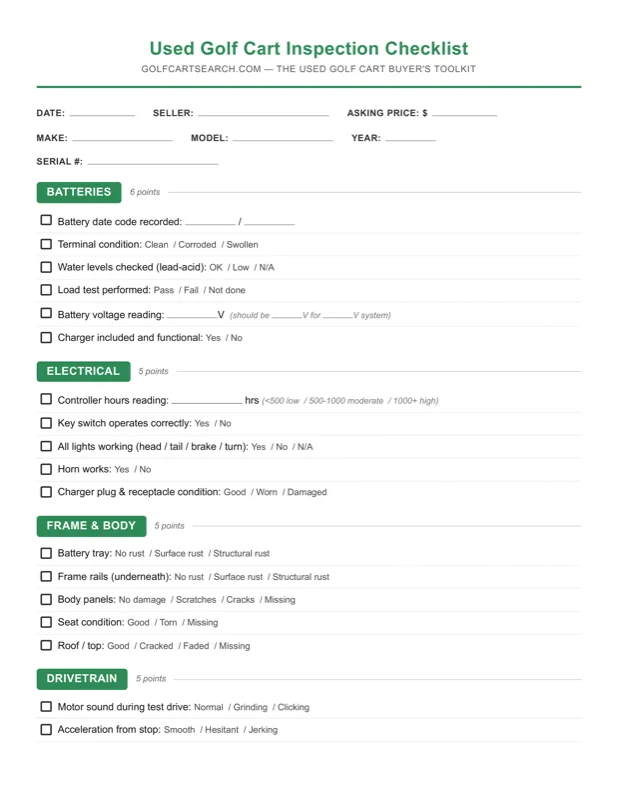
New carts come with the full manufacturer warranty (2 to 5 years depending on model). Used carts from 2022 to 2024 sell for $5,000 to $8,000. If buying used, inspect battery health, check the serial number against the CPSC recall range, test all electronics, and look for frame rust. Confirm warranty transferability with Advanced EV directly before purchasing.
Where can I find an Advanced EV dealer?
Advanced EV dealers are concentrated in Texas, Florida, California, and the Southeast. Visit advancedev.com for their official dealer locator, or search for dealers near you in our golf cart dealer directory. Always buy from an authorized dealer to ensure warranty coverage and proper setup.
How does the Advanced EV warranty compare to competitors?
Advanced EV offers 2 years on most components and up to 5 years on Advent models, with a separate 5-year lithium battery warranty. ICON offers 3-year parts and 10-year battery. Yamaha offers 4-year parts. Club Car offers 2-year parts with a lifetime aluminum frame warranty. Advanced EV's warranty is competitive for the price point but falls short of ICON's battery coverage.
What motor does Advanced EV use?
The Advent line uses a brushless 4kW AC motor with a Toyota-programmed 350-amp controller. The Horizon and Click series upgrade to a 5kW AC motor with a 450-amp controller. Both are permanent magnet AC motors with regenerative braking. For a deeper understanding of golf cart motor technology, see our AC vs DC motor guide and motor draw guide.
Can I finance an Advanced EV golf cart?
Most Advanced EV dealers offer financing options, and several third-party lenders specialize in golf cart loans. Typical terms run 24 to 72 months at 6 to 12% APR depending on credit score. For a complete breakdown of financing options, rates, and what to watch for, see our golf cart financing guide.
Golf Cart Search
Find the Best Golf Carts of 2026
Compare top-rated models, read expert reviews, and find the perfect cart for your needs.