As an Amazon Associate, we earn from qualifying purchases. This helps support our site at no extra cost to you.
How Long Do Golf Carts Last? Gas vs Electric Lifespan
Golf carts are a serious investment. Whether you are spending $5,000 on a used E-Z-GO or $15,000 on a new Club Car, you want to know how long that cart will actually last before you hand over the money.
Quick Answer: How Long Does a Golf Cart Last?
The short answer: electric golf carts last 20-40 years and gas golf carts last 15-30 years with proper maintenance. If you are asking "how long does a golf cart last?" the useful answer is not one number. The frame can last decades, batteries may last 4-15 years, tires often last 3-7 years, and gas engines are usually judged by hours instead of age.
| Search question | Short answer | What usually decides it |
|---|---|---|
| How long do golf carts last? | Usually 15-40 years | Frame material, battery care, storage, and maintenance |
| How long does a golf cart last? | Often 20+ years for a cared-for major-brand cart | Whether the frame is solid and major systems are still worth repairing |
| How long do gas golf carts last? | Usually 15-30 years | Oil/filter service, belt and clutch care, engine hours, and parts availability |
| How long do electric golf carts last? | Usually 20-40 years | Battery replacements, charger health, controller condition, and corrosion control |
| How long do carts last? | If you mean golf carts, use the same 15-40 year range | Neglect and rust shorten the range fastest |
| Club Car serial number identification year | The serial number helps verify age before judging lifespan | On many Club Cars, the two digits after the model prefix show the model year |
Those ranges are huge, and the difference between a cart that dies at 10 years and one that runs for 35 comes down to a few specific factors.
This guide breaks down the lifespan of every major component, compares durability by brand, and gives you practical steps to get the most years out of your cart. If you are shopping for a golf cart or trying to decide whether to repair or replace the one you have, this is everything you need to know.
Electric vs Gas Golf Carts: Which Lasts Longer?
Electric golf carts generally outlast gas carts because they have far fewer moving parts. An electric drivetrain consists of a motor, controller, and batteries. A gas drivetrain has a combustion engine with pistons, valves, a carburetor or fuel injection, exhaust system, and dozens of additional components that wear over time.
That said, both types can last decades when maintained properly. The real question is not which type lasts longer, but which type fits your maintenance habits. For a deeper comparison beyond just lifespan, see our full electric vs gas golf cart breakdown.
| Factor | Electric | Gas |
|---|---|---|
| Overall lifespan | 20-40 years | 15-30 years |
| Moving parts | Fewer (motor, controller) | Many (engine, transmission, exhaust) |
| Biggest maintenance item | Batteries ($600-$4,500) | Engine rebuilds ($800-$1,500) |
| Annual maintenance cost | $200-$400 | $300-$600 |
| Maintenance complexity | Simpler (DIY-friendly) | More complex (some tasks need a mechanic) |
| Frame lifespan | Same (depends on material) | Same (depends on material) |
| Motor/engine lifespan | 15-20+ years | 1,500-2,500 engine hours |
Why Electric Carts Last Longer
Electric motors have one moving part: the rotor. No oil to change, no air filters to replace, no spark plugs to foul. The motor itself rarely fails. What wears out on electric carts are the batteries, which are replaceable.
Why Gas Carts Still Have a Place
Gas carts offer longer range per tank and do not lose performance in cold weather the way lead-acid batteries do. For owners who drive long distances daily or operate in remote areas without convenient charging, gas carts remain practical. Their engines can be rebuilt or replaced when they eventually wear out, keeping the cart on the road for decades.
How Long Do Gas Golf Carts Last?
Gas golf carts usually last 15 to 30 years when the engine, belt system, fuel system, and frame are maintained. The gas engine itself is often discussed in hours, not miles. A cart used lightly in a neighborhood may age out cosmetically before the engine is worn out; a course, resort, campground, or farm cart can rack up hours much faster.
Use this quick rule:
- Light personal use: 20-30 years is realistic with regular oil changes and storage.
- Daily community use: 15-25 years is realistic if belts, fuel parts, brakes, and tires are kept up.
- Fleet/commercial use: lifespan depends heavily on service records and engine hours.
If a gas cart revs high, smells like fuel, slips on hills, or has rough starts, diagnose those issues before assuming the whole cart is worn out. Our gas clutch problems guide, carburetor guide, and starter generator guide cover the common aging points.
Component-by-Component Lifespan Breakdown
A golf cart is only as durable as its weakest component. Here is how long each major part lasts, what replacement costs, and what you can do to extend its life.
Frame: 15-30+ Years
The frame is the backbone of your golf cart, and its lifespan depends almost entirely on what it is made of.
Aluminum frames (used by Club Car) resist rust completely and can last 30-40+ years with zero structural maintenance. This is why Club Cars dominate in coastal areas and beach communities.
Steel frames (used by E-Z-GO, Yamaha, and most Chinese manufacturers) are strong but vulnerable to rust. In dry climates, a protected steel frame can last 20-30 years. In humid or coastal areas, rust can compromise the frame sooner without proper rust prevention.
What kills frames early: Salt air, standing water, road salt, and storing the cart outdoors without protection.
Replacement cost: You do not replace a frame. If it is rusted through, the cart is totaled.
Motor: 15-20+ Years
Electric golf cart motors are among the longest-lasting components on the vehicle. Under normal use, expect 15-20+ years before replacement is needed.
AC motors last longer than DC motors because they are brushless. No brushes means less friction, less heat, and less wear. AC motors also feature regenerative braking, which reduces brake wear.
DC motors have carbon brushes that gradually wear down. Plan on replacing brushes every 3-5 years ($50-$150 in parts). The motor itself lasts 15-20 years if you keep up with brush maintenance.
Gas engines are measured in hours rather than years. Most golf cart engines run 1,500-2,500 hours before needing a rebuild. At 5 hours per week, that is roughly 6-10 years. An engine rebuild costs $800-$1,500. For more on how motors affect performance, see our guide on golf cart motor draw.
| Motor Type | Lifespan | Replacement Cost | Maintenance |
|---|---|---|---|
| AC electric | 20+ years | $800-$2,000 | Nearly zero |
| DC electric | 15-20 years | $300-$1,000 | Brush replacement every 3-5 years |
| Gas engine | 1,500-2,500 hours | $800-$1,500 (rebuild) | Oil, filters, spark plugs |
Batteries: 4-15 Years (The #1 Wear Item)
Batteries are the component you will replace most often on an electric golf cart, and the type of battery you use dramatically affects both lifespan and total cost of ownership. For a deep dive, read our complete golf cart battery guide.
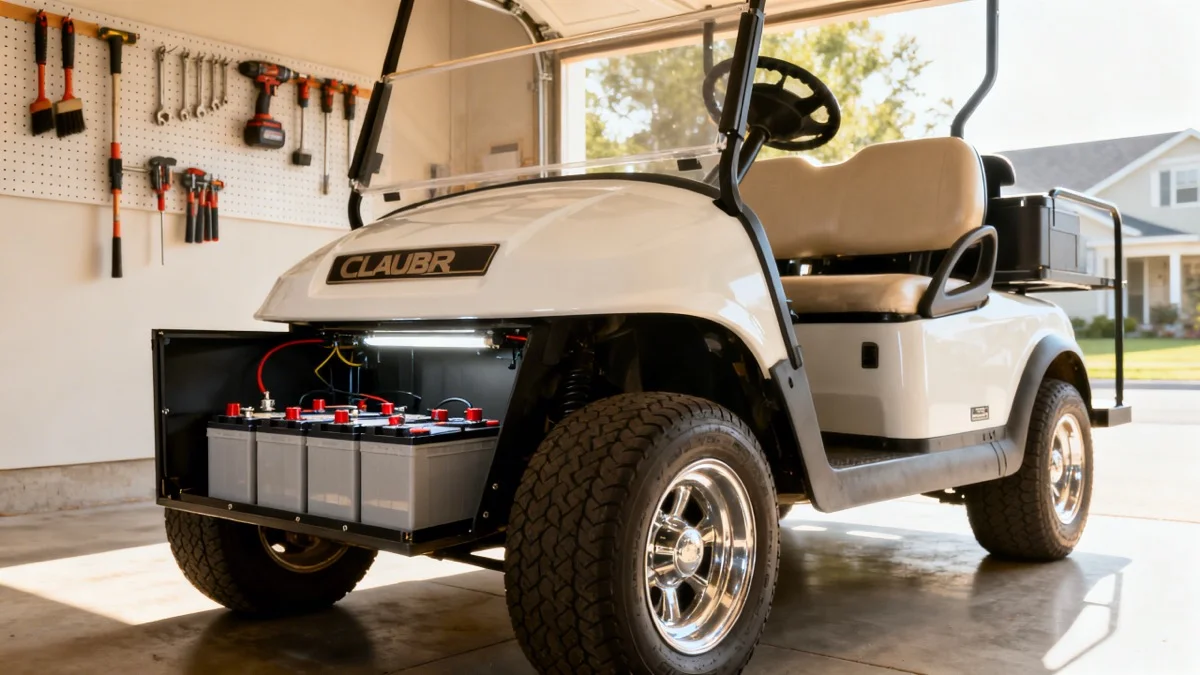
Lead-acid batteries last 4-6 years with proper maintenance (500-1,000 charge cycles). A full replacement set of six 8V or eight 6V batteries costs $600-$1,200. They require weekly water checks, terminal cleaning, and careful charging habits.
Lithium (LiFePO4) batteries last 8-15 years (3,000-5,000 cycles). A 48V lithium pack costs $2,000-$4,500. They require zero water maintenance, weigh 60-70% less, and deliver consistent power until the end of their life.
Over a 15-year period, you would buy roughly three sets of lead-acid batteries ($1,800-$3,600 total) versus one lithium pack ($2,000-$4,500). The math often favors lithium, especially when you factor in zero maintenance and better performance. If you are considering the switch, our lithium battery conversion guide walks through the full process.
Check Price: DC HOUSE 48V 100Ah Lithium BatteryWhat kills batteries early: Deep discharging below 20%, infrequent charging, low water levels (lead-acid), extreme heat, and leaving batteries uncharged during storage. See our winterization guide for seasonal storage tips.
Charger: 7-10 Years
A quality charger lasts 7-10 years. Budget chargers can fail in 3-5 years, and a failing charger is one of the most common reasons batteries die early. Modern smart chargers with automatic shutoff protect your batteries from overcharging and help them last longer.
If your charger is older than your current battery set, consider replacing it when you install new batteries. A mismatched or degraded charger can cut battery life by 30-40%.
Check Price: EPOWREY 48V Charger (Club Car) Check Price: FORM 36V Charger (EZGO TXT)Tires: 3-7 Years
Golf cart tires wear based on surface type and driving habits more than mileage. Expect 3-4 years on pavement and hard surfaces, or 5-7 years on turf and softer terrain. Our tire and wheel guide covers choosing the right type for your use case.
Replacement cost: $40-$80 per tire for standard sizes, $80-$150 for off-road or low-profile tires.
What kills tires early: Incorrect tire pressure (check every 2-4 weeks), UV exposure from outdoor storage, and aggressive driving on pavement.
Brakes: 4-7 Years
Most golf carts use mechanical drum brakes that last 4-7 years with periodic adjustment. Some newer models use hydraulic disc brakes that last longer and perform better, especially on hilly terrain.
Replacement cost: $100-$300 for a complete brake kit. Adjustments are free if you DIY.
Warning signs: Spongy brake pedal, grinding noises, or the cart rolling on slopes. Our brake maintenance guide covers DIY inspection, adjustment, and replacement step by step.
Controller: 8-15 Years
The controller manages power delivery from the batteries to the motor. They typically last 8-15 years, though power surges, water intrusion, or overheating can shorten that lifespan.
Replacement cost: $200-$600 for most models. Upgrading to a higher-amp controller is a common speed modification.
Body, Seats, and Roof: 10-20+ Years
The plastic body panels, seat cushions, and roof are cosmetic components that affect appearance more than function.
- Body panels: 15-20+ years (UV damage causes fading and brittleness over time)
- Seat cushions: 5-10 years before cracking and fading; seat covers extend their life
- Roof/canopy: 10-15 years; may need replacement if cracked or yellowed
These components are all replaceable and relatively affordable. A full customization makeover can make a 20-year-old cart look brand new.
How Long Golf Carts Last by Brand
Not all golf carts are built equal. Frame material, build quality, and parts availability vary significantly between brands. Here is what to expect from the major manufacturers. For full brand comparisons, see our brand rankings and top golf cart picks.
| Brand | Expected Lifespan | Frame Material | Key Strength | Key Weakness |
|---|---|---|---|---|
| Club Car | 25-40+ years | Aluminum | Rust-proof frame, best resale value | Higher purchase price |
| E-Z-GO | 20-30 years | Steel | Broad parts support, practical repairs | Steel frame needs rust prevention in coastal areas |
| Yamaha | 20-30+ years | Steel (powder-coated) | Excellent gas engine reliability | Parts harder to find |
| Star EV | 15-25 years | Steel | Good value, standard lithium options | Newer brand, less track record |
| Icon | 15-25 years | Steel | Feature-rich, competitive pricing | Dealer network still growing |
| Evolution | 15-25 years | Steel/Aluminum | Modern features, touchscreen | Limited long-term reliability data |
Club Car: The Longevity Champion
Club Car's aluminum frame is the single biggest reason they outlast the competition. Aluminum does not rust. Period. In Florida retirement communities, The Villages, and coastal neighborhoods, you will find 25-30 year old Club Cars still running daily. The Club Car Onward and Precedent models are particularly well-regarded for durability. Read our full Club Car review.
Club Car Serial Number Identification Year
If you are judging how much life a used Club Car has left, verify the year before trusting the seller's estimate. For many 1981 and newer Club Car carts, the serial number sticker is under the passenger-side glove box or cup-holder area. The first letters identify the model family, and the next two digits identify the model year.
Example: PH0901-123456
PH= Precedent i2 Excel model prefix09= 2009 model year01= first production week
Club Car maintains an official model serial prefix directory, and our golf cart serial number lookup guide explains the full Club Car, EZGO, and Yamaha year-identification process.
This matters for lifespan because a clean 2016 Club Car and a clean 2006 Club Car can look similar in photos. The serial number tells you the true age before you compare batteries, frame condition, resale value, and repair risk.
E-Z-GO: Repair-Friendly Legacy Brand
E-Z-GO carts are among the more repair-friendly legacy brands. Parts are widely available and well-documented, especially for TXT and RXV-family carts. The main long-term tradeoff is the steel frame, which needs rust prevention in humid and coastal markets. If you live in a dry climate and keep up with maintenance, an E-Z-GO TXT or RXV can run for decades. Check our E-Z-GO review for model-by-model details.
Yamaha: Best Gas Engine Reliability
Yamaha brings decades of engine manufacturing experience from their motorcycle and marine divisions. Their gas golf cart engines are widely considered the most reliable in the industry. The Yamaha Drive2 is their current flagship. See our Yamaha review.
Newer Brands: Star EV, Icon, Evolution
Brands like Star EV, Icon, and Evolution have been gaining market share by offering more features at lower prices. Many come standard with lithium batteries, touchscreens, and street-legal packages. The trade-off is less long-term reliability data, fewer independent repair shops, and potentially harder-to-source parts in 10-15 years. Read our reviews of Star EV, Icon, and Evolution for full details.
If you are comparing specific brands head to head, our Club Car vs E-Z-GO and Yamaha vs Club Car comparisons break down the differences.
10 Ways to Extend Your Golf Cart's Lifespan
The difference between a cart that lasts 10 years and one that lasts 30 is almost entirely about maintenance. Follow our complete maintenance guide for detailed schedules, but here are the 10 most impactful habits.
1. Charge After Every Use (Electric)
Plug in your cart after every outing, even short ones. Deep discharge cycles are the number one battery killer. Modern smart chargers prevent overcharging, so leaving it plugged in overnight is safe.
2. Check Battery Water Weekly (Lead-Acid Only)
Low water levels expose the lead plates, causing permanent damage. Use only distilled water and fill to 1/4" above the plates after charging. This single habit can double your battery life.
3. Keep Battery Terminals Clean
Corrosion on terminals creates resistance, which generates heat and reduces charging efficiency. Clean terminals monthly with a wire brush and apply anti-corrosion spray.
4. Store Indoors or Under Cover
UV exposure degrades tires, seats, body panels, and battery casings. Rain and humidity accelerate rust on steel frames. A garage, carport, or quality golf cart cover adds years to every component.
5. Maintain Correct Tire Pressure
Underinflated tires cause uneven wear, reduce range, and strain the motor. Check pressure every 2-4 weeks. Most golf cart tires run at 18-22 PSI.
6. Follow the Maintenance Schedule
Annual professional service (or every 100-125 hours) catches small problems before they become expensive failures. Between services, follow the spring maintenance checklist and seasonal care routines.
7. Change Oil on Schedule (Gas Carts)
Change oil every 125 hours or every 6 months. Use 10W-30 as recommended by most manufacturers. New carts need their first oil change at 8-10 hours.
8. Winterize for Off-Season Storage
Cold weather and months of sitting idle damage batteries, tires, and seals. Proper winterization prevents costly spring surprises.
9. Address Problems Immediately
A squeaky brake, slow acceleration, or clicking sound might seem minor, but small issues compound. A failing charger silently kills your batteries. A loose connection overheats your controller. Fix problems when they are cheap.
10. Upgrade to Lithium Batteries
Switching from lead-acid to lithium is the single most impactful upgrade for longevity. Lithium batteries last 2-3 times longer, weigh 60-70% less (reducing strain on the motor, controller, and frame), and deliver consistent power. See our lithium conversion guide for the full walkthrough.
When to Repair vs Replace Your Golf Cart
Every cart owner eventually faces this decision. Here is a practical framework.
Repair When:
- Single component failure: Replacing batteries ($600-$4,500), a motor ($300-$2,000), or brakes ($100-$300) is almost always worth it if the frame and other components are solid
- Total repair cost is under 50% of cart value: A $1,200 battery replacement on a cart worth $4,000 is a good investment
- The frame is structurally sound: Everything else can be replaced
Replace When:
- Frame has significant rust or structural damage: This is not repairable. A rusted-through frame means the cart is done
- Multiple major systems failing at once: Needing a motor, controller, and batteries simultaneously on an older cart can exceed the cart's value
- Total repair cost exceeds 50% of cart value: If your cart is worth $3,000 and needs $2,000 in work, you are better off putting that money toward a newer model
- Parts are unavailable: Some older or discontinued brands have limited parts supply
What Is Your Cart Worth?
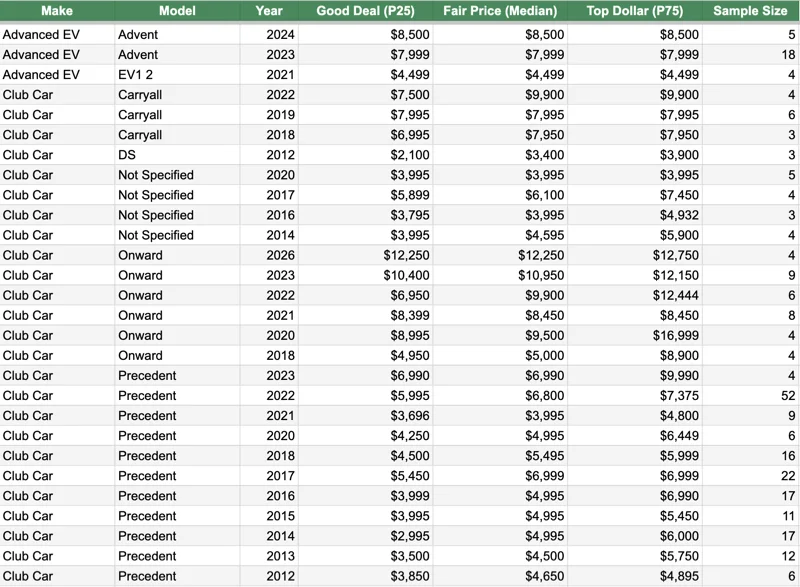
Before deciding, check your cart's current market value. Our golf cart value guide and value calculator can help you estimate. For used cart pricing benchmarks, see our pricing guide.
How Lifespan Affects Resale Value
Golf carts depreciate differently than cars. They hold value well because demand stays strong and the basic design rarely changes dramatically year to year.
Typical depreciation:
- Year 1: 15-20% drop from purchase price
- Years 2-5: 5-10% per year
- Years 5-10: 3-5% per year (depreciation slows significantly)
- 10+ years: Bottoms out around 30-40% of original price if well-maintained
For the brand-specific version of that curve, see our golf cart depreciation by brand guide.
What boosts resale value:
- Club Car brand (aluminum frame commands a premium)
- Lithium battery upgrade (buyers pay more knowing they will not need batteries for years)
- Recent maintenance records
- Covered storage history
- Street-legal features (headlights, turn signals, mirrors)
What kills resale value:
- Visible rust (especially on the frame)
- Old or dead batteries
- Cosmetic damage (torn seats, cracked windshield, faded body)
- No maintenance history
- Brands with limited dealer support
If you are planning to sell your cart eventually, check our guide on how to sell your golf cart for tips on maximizing your return.
The Bottom Line on Golf Cart Longevity
A golf cart is not a disposable purchase. With basic maintenance, you can expect 20+ years of reliable use from any major brand. Electric carts have the edge in longevity thanks to simpler drivetrains, and choosing an aluminum-frame model (like a Club Car) eliminates the biggest structural risk.
The components that matter most are your batteries and frame. Invest in quality batteries, maintain them properly, and protect the frame from corrosion. Do that, and you will be the person in the neighborhood still driving the same cart decades from now.
Ready to find your next golf cart? Browse dealers near you or check our repair directory if your current cart needs some attention.
Frequently Asked Questions
How long do golf carts typically last?
Electric golf carts last 20-40 years and gas carts last 15-30 years with proper maintenance. The biggest factors are frame material, battery care, and whether the cart is stored indoors. A well-maintained Club Car with an aluminum frame can easily run 30+ years.
How long does a golf cart last?
A golf cart usually lasts 20+ years if it is a major-brand cart with a sound frame, healthy batteries or engine, and regular maintenance. Electric carts often last longer because they have fewer moving parts. Gas carts can also last decades if oil changes, filters, belts, fuel parts, and engine service are kept up.
How long do gas golf carts last?
Gas golf carts usually last 15 to 30 years. The engine may need major service or a rebuild around 1,500 to 2,500 hours, but the cart can keep going if the frame, drivetrain, and parts support are still good.
How long do carts last?
If you mean golf carts, use the same 15 to 40 year range. The short version is 20-40 years for electric carts, 15-30 years for gas carts, and 25-40+ years for well-kept Club Cars with aluminum frames.
How do I identify a Club Car year from the serial number?
For many 1981 and newer Club Cars, find the serial sticker under the passenger-side glove box or cup-holder area. The model prefix comes first, then the next two digits identify the model year. For example, PH0901-123456 is a 2009 Precedent. Use our serial number lookup guide for prefix details and older cart locations.
How do I know if my golf cart is near the end of its life?
Look for these signs: significant frame rust (especially structural rust you can push a screwdriver through), repeated electrical failures, a motor that overheats frequently, or multiple major components failing in the same year. A single expensive repair does not mean the cart is done, but stacking problems usually means it is time to start shopping.
Is it worth buying a 10-year-old golf cart?
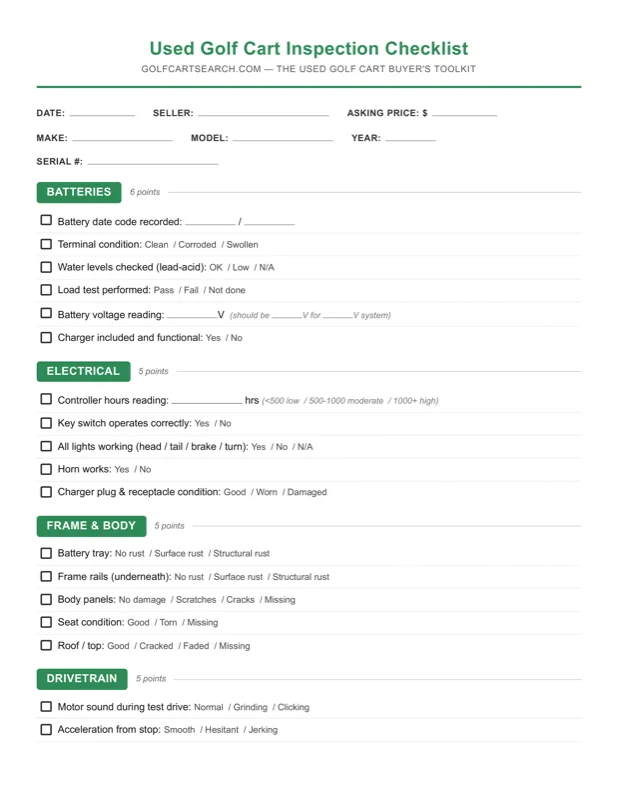
A 10-year-old cart from a major brand (Club Car, E-Z-GO, Yamaha) can still have 10-20+ years of life left if it was maintained. Check the frame for rust, test the batteries under load, and verify the motor runs smoothly. Our used golf cart buying guide covers exactly what to inspect.
How long do golf cart tires last?
Golf cart tires last 3-7 years depending on surface type and maintenance. Tires driven on pavement wear faster (3-4 years) than those used on turf (5-7 years). Replace tires when tread depth is below 1/16" or when they are over 5-7 years old, regardless of visible wear. Read our tire guide for recommendations.
Does driving terrain affect how long a golf cart lasts?
Yes. Carts driven on hilly terrain, rough gravel, or off-road trails experience more stress on the motor, brakes, suspension, and tires. A cart used primarily on flat paved surfaces in a retirement community will last significantly longer than one driven on hunting trails. Terrain also impacts range and battery wear.
How long does a golf cart frame last?
Aluminum frames last 30-40+ years and essentially never need structural maintenance. Steel frames last 15-25 years in dry climates but can develop rust problems in 8-15 years in coastal or humid environments. The frame is the one component you cannot replace, so it effectively determines the maximum lifespan of the cart.
Golf Cart Search
Find the Best Golf Carts of 2026
Compare top-rated models, read expert reviews, and find the perfect cart for your needs.