
Best Golf Cart GPS Trackers & Anti-Theft Security Guide (2026)
30,000+ golf carts are stolen every year. Compare the best GPS trackers, locks, and alarms to protect your cart. Prices, reviews, and setup tips.
Golf cart seats hit 150F in summer sun. Compare the best fans, misting systems, sun shades, and coolers to stay cool on your cart. Prices from $28.

As an Amazon Associate, we earn from qualifying purchases. This helps support our site at no extra cost to you.
Golf cart seats can hit 150F in direct summer sunlight. Steering wheels reach 127F. At 118F, exposed skin starts to burn. And here is the part that matters most: the largest golf cart communities in America, places like The Villages in Florida, Sun City in Arizona, and Peachtree City in Georgia, are all in states with brutal summer heat. The primary residents are adults over 55, the age group most vulnerable to heat-related illness.
No major golf cart manufacturer sells carts with air conditioning, fans, or any cooling system. Not Club Car, not EZGO, not Yamaha. Cooling is entirely up to you.
The good news is that a $30 clip-on fan and a $40 sun shade can make summer riding genuinely comfortable. This guide covers every cooling option available in 2026, from budget fans to full misting systems, with real temperature data and climate-specific recommendations so you pick the right solution for where you live.
Golf carts are more exposed to heat than regular vehicles. No cabin, no tinted windows, and the standard vinyl seats absorb and hold heat. Here is what the research shows:
An Arizona State University study measured surface temperatures after vehicles sat in direct sun for one hour. Dashboards averaged 157F. Steering wheels hit 127F. Seats reached 123F. Those numbers are for enclosed vehicles with some shade from the roof and windshield. Open golf carts are worse because seats, steering wheels, and floorboards get direct, unobstructed sun exposure.
The pain threshold for human skin is 111F. First-degree burns start at 118F. Second-degree burns begin at 130F. A dark vinyl golf cart seat in Phoenix or Tampa can exceed all of those numbers by lunchtime.
For golf cart owners in The Villages (Florida), Sun City (Arizona), or other Sun Belt communities, this is not a once-in-a-while problem. It is a daily reality from May through September. And because the average resident in these communities is over 65, the health stakes are real. The CDC reports that adults aged 65 and older account for more heat-related hospitalizations than any other age group, partly because common medications like diuretics and blood pressure drugs impair the body's ability to cool itself.
A portable fan is the simplest, most affordable cooling upgrade you can make. Modern rechargeable fans clip onto your cart's roof struts or frame bars, run for hours on a single charge, and move enough air to make a real difference.
| Fan | Price | Battery | Runtime | Mount Type | Best For |
|---|---|---|---|---|---|
| KOONIE 10000mAh | ~$30 | 10,000mAh | Up to 24 hrs | Spring clamp | Best value |
| KORBOT 24000mAh | ~$50 | 24,000mAh | Up to 150 hrs | Clip + tie-wrap | Longest battery |
| MAGOLFIN 2-Pack | ~$60 | 12,000mAh each | 7-30 hrs each | Magnetic | Best for two riders |
| KOONIE Misting Fan | ~$40 | 10,000mAh | Up to 48 hrs | Clip + straps | Best fan + mist combo |
With over 15,000 Amazon reviews and a 4.5-star rating, the KOONIE is the most popular golf cart fan for a reason. It delivers strong airflow from 8-inch blades, runs up to 24 hours on a charge, and costs around $30.
Key specs:
The clamp is strong enough to hold on rough cart paths without slipping. Charge it overnight, clip it on in the morning, and you have a full day of cooling. At this price point, some owners buy two: one for the driver and one for the passenger.
Check Price on AmazonIf you hate recharging, the KORBOT is the answer. Its 24,000mAh battery lasts up to 150 hours on low speed, which means you could ride for weeks between charges.
Key specs:
The wireless remote is a genuine convenience. Instead of reaching up to the roof to change fan speed, you tap a button on the remote sitting in your cup holder. The LED lights are a nice bonus for evening rides.
Price: Around $50.
Check Price on AmazonMost golf cart fan reviews focus on single units. The MAGOLFIN solves the two-rider problem by shipping as a set with a fan for each seat.
Key specs:
The magnetic mount is the standout feature. Just stick it to any metal part of your golf cart frame. No fussing with clips, no worrying about compatibility with different frame sizes. Works on Club Car, EZGO, Yamaha, and just about every other brand.
Price: Around $55-$70 for the pair.
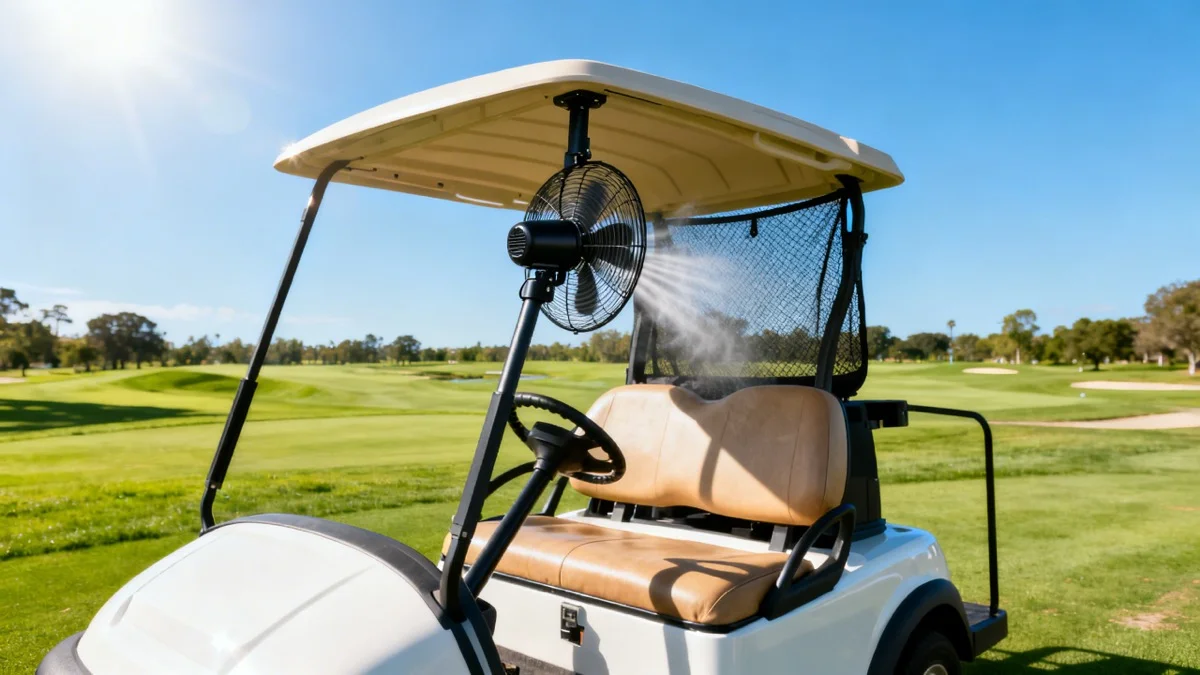
This is the same trusted KOONIE brand, but with a built-in 200ml water tank that sprays a fine mist while the fan blows. The combination of moving air and evaporating water drops the temperature noticeably, especially in dry climates.
Key specs:
How it works: The mist nozzle sprays a fine water vapor in front of the fan blades. The fan pushes the mist toward you, creating an evaporative cooling effect. In dry climates (Arizona, Nevada, West Texas), this can feel 15-25F cooler than the ambient temperature. In humid climates (Florida, the Carolinas), the effect is smaller but still noticeable.
Price: Around $35-$45.
Check Price on AmazonIf a misting fan is not enough, a dedicated misting system provides coverage for the entire cart. These systems run a mist line along your cart's roof frame with multiple nozzles creating a curtain of fine mist around the seating area.
The ExtremeMist is the gold standard for portable golf cart misting. Its 170 PSI pump produces an ultra-fine mist that cools without soaking you, your seats, or your dashboard accessories.
Key specs:
Installation on a golf cart: Run the 16-foot mist line along the edge of your roof frame using the included rubber ties and clips. The pump draws from any water container you provide (a water bottle, jug, or cooler). Setup takes about 10 minutes.
Cooling performance: ExtremeMist claims up to 30F of cooling in dry conditions. Real-world results depend on humidity. In Arizona, expect the full 25-30F drop. In Florida, closer to 10-15F. Either way, the difference is significant.
Price: $189-$239 depending on the configuration. The "Essential" kit at $189 includes everything you need.
Shade is your most effective passive cooling strategy. Quality sun shades block 80-90% of UV rays and can reduce temperatures under the canopy by 15-25F with zero electricity and zero maintenance.
The KEMIMOTO mesh sun shade attaches to your cart's rear frame and provides UV-blocking coverage for the entire seating area while still allowing airflow. Unlike a full enclosure, mesh lets breezes through so you get shade without trapping heat.
Key specs:
Price: Around $35-$50. One of the best dollar-for-degree cooling investments you can make.
Check Price on AmazonThe Formosa is a step up in quality. Made by a US company with 35+ years of design experience, it uses durable polyester with vinyl-coated breathable mesh and snap-button adjustable panels.
Key specs:
Price: Around $75-$85. Worth the premium if you want a shade that will last multiple seasons without fading or stretching.
For additional UV protection from the front, consider pairing a sun shade with a tinted windshield, which can reduce solar heat gain through the front of the cart.
Staying hydrated is the most important thing you can do in summer heat. The CDC recommends drinking at least 8 ounces of water every 15-20 minutes during outdoor activity in hot weather. A good cooler keeps drinks cold for the entire ride.
This is the most popular golf cart cooler on Amazon for good reason. It pops open to full size in one second, collapses to 3.5 inches flat for storage, holds 13 cans, and costs under $30.
Key specs:
Price: Around $25-$30.
Check Price on AmazonIf you need serious insulation (48-hour ice retention) and a secure mount that will not bounce around on cart paths, the 10L0L is the upgrade. It comes with a universal no-drill mounting bracket that fits EZGO, Club Car, and Yamaha carts.
Key specs:
Price: Around $50-$70.
Even with a fan and sun shade, the seat itself can be miserably hot if it has been baking in the sun. A cooling seat cover addresses the problem directly.
This seat cover has 8 built-in turbo fans that blow air upward through the seat surface, keeping your back and legs cool while you ride. It connects to your golf cart's electrical system via an included DC converter that works with any voltage from 12V to 48V, or you can run it from a USB power bank.
Key specs:
Price: Around $50-$70.
Check Price on AmazonBudget alternative: If a powered seat cover feels like overkill, a simple light-colored breathable seat cover (around $30-$60) makes a big difference by itself. Mesh and neoprene materials absorb less heat than stock vinyl and allow airflow behind your back. Our seat covers guide covers the best options for hot climates.
Not all cooling solutions work equally in every climate. Here is a quick guide based on where you live:
| Solution | Dry Heat (AZ, NV, West TX) | Humid Heat (FL, SC, GA) |
|---|---|---|
| Clip-on fans | Good | Great (best choice) |
| Misting fans | Excellent | Good |
| Full misting systems | Excellent (up to 30F drop) | Fair (10-15F drop) |
| Sun shades | Great | Great |
| Evaporative coolers | Excellent | Poor (humidity blocks evaporation) |
| Cooling seat covers | Great | Great |
If you live in Florida, South Carolina, or coastal Georgia: Focus on airflow. A good clip-on fan and a breathable sun shade are your best combination. Skip the full misting system and consider a misting fan combo instead.
If you live in Arizona, Nevada, or inland Texas: Misting systems shine here. The dry air lets water evaporate quickly, which is what creates the cooling effect. A misting system plus a sun shade can make 110F weather feel almost tolerable.
If you live somewhere with variable humidity: A misting fan combo gives you both options. Use the mist in dry conditions, fan-only when it is humid.
Not everything requires a purchase. Golf cart owners in communities like The Villages and Sun City have years of experience beating the heat. Here are the most practical tips from forums and community discussions:
Timing is everything. The simplest free cooling strategy is avoiding peak heat. Ride before 10 AM or after 4 PM. Surface temperatures drop dramatically once the sun angle lowers.
Wet bandana on your neck. Your neck has major blood vessels close to the skin surface. A wet bandana or cooling towel on the back of your neck cools your blood as it circulates, lowering your overall body temperature. Cost: a few dollars.
Frozen water bottles as portable AC. Fill water bottles 3/4 full, freeze overnight, and bring them in your cooler. As they melt, you have ice-cold water to drink. In the meantime, hold one against your wrist or neck for instant relief.
Light-colored towel on the seats. Before you park, drape a light-colored towel over the seats. It blocks direct sun and prevents the vinyl from superheating. When you come back, remove the towel and sit on a seat that is 30-40F cooler than it would have been.
Remove enclosure panels in summer. If your cart has a full enclosure for winter, take off the side panels in summer. Enclosures trap heat and block airflow. Keep the roof for shade but let the sides breathe.
Park strategically. This sounds obvious, but many cart owners default to the closest spot rather than the shadiest one. A cart that has been in shade stays 30-40F cooler than one in direct sun. Your future self will thank you for the extra 30-second walk.
This is one of the most common concerns, and the answer is reassuring.
Portable battery-powered fans use their own internal batteries. They draw zero power from your golf cart. Charge them at home from a wall outlet, and they run independently all day. This is why we recommend rechargeable fans as the default choice.
Hardwired fans draw minimal power. A typical 12V golf cart fan uses 5-15 watts. On a 48V electric cart with a standard battery pack, that translates to roughly 0.1-0.3 amps. Over a full day of riding, a hardwired fan reduces your range by less than 1 mile. The impact is negligible.
Powered seat covers are similarly efficient. The 10L0L cooling seat cover draws about 5-10 watts through its DC converter. Running it all day reduces range by under half a mile.
Where power draw matters: Full AC systems (1,000-2,000 watts) and high-powered evaporative coolers (200-500 watts) can significantly reduce your range, cutting it by 20-40% on some carts. This is one reason most golf cart owners choose fans and passive cooling over powered AC. The cooling-to-power trade-off is much better.
For tips on maintaining your batteries through hot weather, see our complete battery guide. Heat accelerates chemical reactions in batteries and speeds up fluid evaporation in lead-acid systems, so summer maintenance is especially important.
Get your cart ready for hot weather with this quick checklist:
The best approach combines multiple strategies. A fan handles airflow. A sun shade handles UV and radiant heat. A cooler handles hydration. Smart timing handles the worst of the afternoon sun. None of these are expensive, and together they transform a miserable summer ride into a comfortable one.
For a cart worth $8,000 to $15,000, spending $60-$150 on cooling accessories is a small investment that pays off every single ride from May through September. Start with a fan and a sun shade. If that is not enough, add a misting option. And if you need winter comfort too, our golf cart heaters guide covers the opposite end of the thermometer.
Browse our complete accessories guide for more ways to upgrade your ride, or find a dealer near you for professional installation help.
No. As of 2026, no major golf cart manufacturer (Club Car, EZGO, Yamaha, Icon, Star EV) offers factory-installed air conditioning. All cooling solutions are aftermarket. Full AC installations run $3,000-$5,000 and require an enclosed cart. Most owners find that a quality fan ($30-$50) and sun shade ($35-$85) provide adequate comfort at a fraction of the cost.
Clip-on fans with spring-loaded metal clamps work on most carts by attaching to roof struts and frame bars. Magnetic-mount fans (like the MAGOLFIN) are the easiest to install because they snap onto any metal surface. Bracket-mount fans provide the most permanent installation but require specific frame tube sizes. For most owners, a clip-on or magnetic fan is the simplest and most versatile choice.
Misting fan combos cost $35-$45 and combine a fan and mister in one portable unit. Dedicated misting systems like the ExtremeMist Quad Kit cost $189-$239 and provide coverage for the entire seating area with 4 nozzles. Professional-grade misting setups for commercial fleets can run $300-$500. Most individual golf cart owners are well served by a misting fan combo in the $35-$45 range.
You can, but it is not ideal. Household fans need AC power (wall outlet), so you would need an inverter connected to your cart's battery system. Rechargeable portable fans designed for outdoor use are a better choice because they are waterproof, vibration-resistant, and have their own batteries. They also mount more securely with clips or magnets designed for moving vehicles.
A KOONIE clip-on fan ($30) plus a KEMIMOTO mesh sun shade ($40) plus an InTheZone collapsible cooler (~$28) gives you airflow, shade, and hydration for about $98 total. This combination addresses the three biggest heat problems: radiant sun, still air, and dehydration. Add a wet bandana on your neck and you have a surprisingly effective cooling system with zero monthly costs and zero battery drain on your cart.
Heat risk is higher for adults over 65 because the body's cooling mechanisms become less efficient with age, and many common medications (diuretics, beta-blockers, antihistamines) further impair temperature regulation. The CDC recommends that older adults in extreme heat stay hydrated, avoid peak sun hours (10 AM to 4 PM), wear lightweight clothing, and take breaks in air-conditioned spaces. Cooling accessories like fans and sun shades reduce exposure, but if temperatures exceed 105F, consider postponing non-essential rides. For more safety tips, see our golf cart safety guide.
Golf Cart Search
Compare top-rated models, read expert reviews, and find the perfect cart for your needs.
Browse Top-Rated Carts30,000+ golf carts are stolen every year. Compare the best GPS trackers, locks, and alarms to protect your cart. Prices, reviews, and setup tips.

Best golf cart floor mats for EZGO, Club Car, Yamaha & ICON. Compare rubber, TPE, and silica gel liners with prices, fitment charts, and top picks for 2026.

Find the best golf cart heater for your setup. Compare propane vs electric by brand, voltage, and price with BTU ratings and compatibility charts.
Get the latest updates on golf cart services, tips, and exclusive offers delivered to your inbox.