As an Amazon Associate, we earn from qualifying purchases. This helps support our site at no extra cost to you.
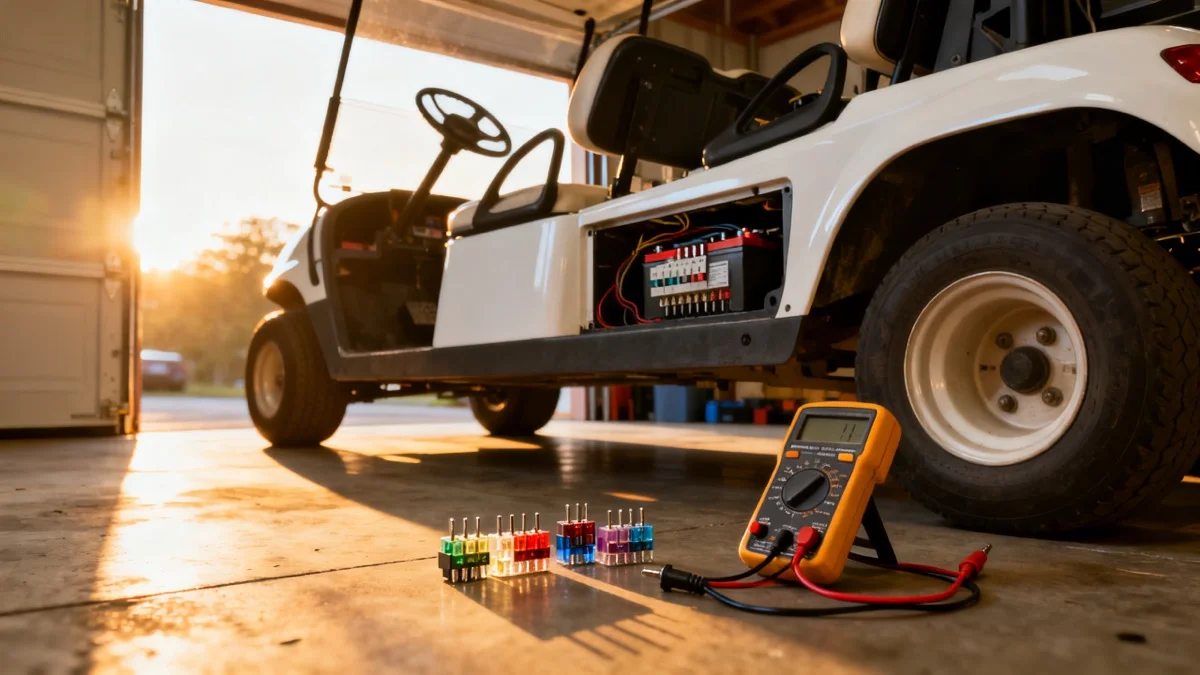
Most golf cart fuse boxes are under the seat, behind the dash, on a rear fender liner, or in an inline holder near the battery pack. If your lights, horn, turn signals, USB port, charger, or whole cart suddenly stopped working, check the fuse box before replacing larger electrical parts.
On a 48V Club Car, start under the seat, in front of the batteries, behind the dash, and near the controller or voltage reducer. For a Club Car Onward, check the driver-side under-dash area, the accessory harness, and under the seat near the voltage reducer or accessory wiring.
This guide shows where to find the fuse box on Club Car, EZGO, and Yamaha carts, how to test a fuse, which fuse sizes are common, and what to do when the same fuse keeps blowing. If your cart is completely dead, use this with our golf cart won't start guide. If the problem started after installing accessories, read the golf cart wiring and voltage reducer guide next.
Golf Cart Fuse Box Location: Fast Chart
Start with the places below. If your cart has been customized, accessories may have their own inline fuse holders under the dash, under the seat, or near a voltage reducer.
| Cart or system | Where to look first | What you may find |
|---|---|---|
| EZGO TXT 48V with factory lights | Under the seat, driver-side rear fender liner | Blade fuse block for lighting circuits |
| Older EZGO TXT gas | Near key switch, solenoid, or charge receptacle wiring | Inline fuse holder |
| EZGO Marathon and older models | Behind dash, steering column area, or passenger-side inner body | Older fuse panel or inline glass fuse |
| Club Car DS gas and electric | Behind dash or black electrical box near batteries | Inline holders, blade fuses, or glass fuses |
| Club Car Precedent | Under seat, in front of battery, or near controller harness | ATM blade fuse holder and possible glass fuse |
| Club Car Onward and Tempo | Driver-side under dash, accessory harness, and under seat near voltage reducer | Blade fuse block or inline accessory fuses |
| 48V Club Car carts | Under seat near battery pack, in front of batteries, behind dash, or near controller harness | Blade or glass fuse, depending on model/year |
| Yamaha Drive2 | Battery compartment | Inline fuse box with blade fuses |
| Yamaha G29 | Below cup holder area or near controller | Blue fuse block or inline holders |
| Yamaha G2 and older G-series | Rear inner fender near driver side or controller area | Glass or blade fuses depending on year |
| Evolution golf carts | Under dash, under seat, near DC-DC converter, or accessory fuse block | Blade fuse block or inline accessory fuses |
| Aftermarket accessories | Near voltage reducer, switch panel, light kit, or battery feed | Inline blade fuse holder |
The owner manual still wins. Golf carts get modified constantly, especially used carts with lights, sound bars, fans, backup cameras, and turn signal kits. A dealer-installed accessory harness may not match the factory fuse location.
Before You Touch the Fuse Box
Golf cart electrical work is usually DIY-friendly, but the battery pack can deliver serious current. Treat it with respect.
- Park on level ground.
- Turn the key off and remove it.
- Put the forward/reverse switch in neutral.
- Set the parking brake.
- Put the tow/run switch in tow or maintenance mode if your cart has one.
- Remove rings, watches, bracelets, and loose metal tools from your hands.
- Disconnect the main negative battery cable before opening wiring covers.
- Take a photo before removing any fuse or wire.
If you are not comfortable around a 36V, 48V, or 72V battery pack, use our electric golf cart repair directory. Electrical diagnosis is usually cheaper than replacing parts by guesswork.
Tools and Parts Worth Having
You do not need a shop full of tools. For fuse work, keep it simple.
| Tool or part | Typical cost | Why it matters |
|---|---|---|
| Digital multimeter | $12 to $30 | Confirms voltage and continuity instead of guessing |
| Blade fuse assortment | $10 to $20 | Gives you 5A, 10A, 15A, 20A, 25A, and 30A spares |
| Inline fuse holders | $7 to $15 | Replaces cracked or corroded holders on accessory circuits |
| Fuse puller or needle-nose pliers | $0 to $8 | Removes blade fuses without twisting them |
| Dielectric grease | $5 to $10 | Helps protect low-voltage connectors from moisture |
| Heat-shrink connectors | $8 to $20 | Better than electrical tape for repairs |
A basic multimeter is the first buy for fuses, battery voltage, chargers, solenoids, and accessory wiring.
Check Price: AstroAI Digital MultimeterFor replacement fuses, buy an assortment with standard, mini, and low-profile mini blade fuses. Body size matters.
Nilight 272-piece blade fuse assortmentIf you find a cracked inline holder or a fuse that keeps corroding from splash exposure, replace the holder instead of forcing another fuse into a bad socket.
MCIGICM inline ATC/ATO fuse holdersHow to Tell If a Golf Cart Fuse Is Blown
There are two ways to check a fuse: visual inspection and a meter test. Use both when possible.
Visual Fuse Check
Pull the fuse straight out. Look through the plastic body at the metal bridge between the two blades.
- Good fuse: the metal bridge is continuous.
- Blown fuse: the bridge is broken, burnt, melted, or blackened.
- Questionable fuse: plastic looks cloudy, blades look burnt, or the bridge is hard to see.
Visual checks are fast, but not perfect. Some fuses fail where you cannot see the break.
Multimeter Fuse Test
Set your multimeter to continuity mode. If it does not have that setting, use ohms.
- Remove the fuse from the holder.
- Touch one probe to each blade.
- A good fuse beeps or reads near 0 ohms.
- A blown fuse reads open, OL, or no beep.
- If the reading jumps around, clean the fuse blades and test again.
Testing the fuse out of the holder avoids false readings from other circuits. If the fuse is good but the circuit is dead, test voltage at the holder next.
How to Test Power at the Fuse Holder
This step tells you whether power reaches the fuse box.
- Reconnect the battery only if you are comfortable testing live low-voltage circuits.
- Set the meter to DC volts.
- Connect the black probe to pack negative, chassis ground if applicable, or the accessory negative bus.
- Touch the red probe to the input side of the fuse holder.
- Touch the red probe to the output side of the fuse holder.
On a 12V accessory circuit, you should see roughly 12 to 14 volts on both sides of a good fuse when the circuit is powered. If voltage appears on the input side but not the output side, the fuse or holder is bad. If there is no voltage on either side, the issue is upstream: battery feed, voltage reducer, switch, ground, or a main fuse.
For 36V, 48V, and 72V traction circuits, be more cautious. The voltage is still DC, but the current available from the pack is high. If the main fuse, controller feed, or battery cable side is suspect, stop and decide whether a shop should diagnose it.
Which Fuse Size Should You Use?
Use the exact same fuse style and amperage rating that came out of the holder. If the cover or manual says 15A, use 15A. If the fuse body says 10, use 10A.
| Fuse rating | Common golf cart use |
|---|---|
| 5A | Small gauges, indicator lights, low-draw electronics |
| 7.5A | USB ports, small accessory circuits |
| 10A | DC outlet, control circuit, light accessory branch |
| 15A | Headlights, taillights, horn, turn signals on many kits |
| 20A | Larger lighting circuit or moderate accessory bundle |
| 25A | Main accessory feed on some Yamaha Drive2 carts |
| 30A | Voltage reducer feed, fuse block feed, larger add-on harness |
Yamaha Drive2 owner literature lists a 10A DC outlet fuse, 15A light fuse, 10A blade fuse, and 25A main blade fuse in the battery-compartment inline fuse box. EZGO TXT 48V owner literature places the equipped fuse block under the seat on the driver-side fender liner. Club Car Precedent service literature warns to fix the cause before installing a new fuse.
Those three points matter more than brand folklore:
- Match the manual.
- Match the old fuse.
- Do not upsize the fuse.
Fuse Box Locations by Brand
The exact location changes by year, trim, and accessory package. Use these notes as a search path, then confirm against your serial number.
Club Car Fuse Box Locations
On older Club Car DS carts, check behind the dash first. Also check the black electrical component box near the batteries.
On Club Car Precedent, check under the seat and near the main battery area. Service literature for 2016 Precedent models notes ATM-style blade fuses on the main harness in front of the battery and a glass fuse nearby. Some accessory harnesses use inline holders under the seat. Later Precedent carts may also have a fuse near the controller harness.
Club Car Onward Fuse Box Location
On Club Car Onward and Tempo, check the driver-side under-dash area first, then the accessory harness, and then under the seat near any voltage reducer. If the dead item is an add-on light kit, USB charger, radio, sound bar, or turn signal kit, follow that accessory's positive wire back toward the reducer or battery feed because it may use its own inline fuse holder instead of the main harness.
For 48 volt Club Car carts, do not assume every fuse is in one box. A 48V traction system can have one fuse path for the control circuit and a separate 12V accessory fuse path after the voltage reducer.
If your Club Car will not charge after electrical work, the problem may be the OBC, charger circuit, or reducer wiring rather than a simple fuse. Start with our Club Car charger guide, charger light codes guide, and charging port problems guide.
EZGO Fuse Box Locations
On EZGO TXT 48V carts with factory lighting, the owner manual says to raise the seat bottom and find the fuse block on the driver-side fender liner.
Older EZGO TXT gas models may use an inline fuse near the key switch wiring or near the solenoid. Look for a small plastic holder in the wire connected to the key switch or accessory feed. If the cart has aftermarket lights, the fuse may be near the voltage reducer instead of the factory location.
Older EZGO Marathon carts can be less tidy. Check behind the dash, around the steering column, and inside the passenger-side inner body area. If you are not sure which model you own, use the golf cart VIN and serial number decoder.
If the fuse issue is part of a broader no-move condition, compare symptoms with our EZGO golf cart review, EZGO TXT vs RXV guide, and solenoid replacement guide.
Yamaha Fuse Box Locations
Yamaha Drive2 owner literature places the inline fuse box in the battery compartment and lists blade-style fuses for the DC outlet, lights, main fuse, and another 10A circuit.
On Yamaha G29, check below the cup holder area and near the controller. On older G2 electric carts, check the rear inner fender near the front of the driver side. Some older Yamaha carts use glass fuses rather than blade fuses.
Yamaha fuse access is usually better than older Club Car or EZGO carts, but gas Yamaha symptoms can overlap with fuel pump, starter generator, ignition, and carburetor issues. If the fuse is good and the gas cart still will not run, use our Yamaha golf cart review, carburetor cleaning guide, and starter generator guide.
Evolution Golf Cart Fuse Box Location
Evolution fuse box location depends on the model, year, and whether the accessories were factory-installed or dealer-installed. Start under the dash, then check under the seat, near the DC-DC converter or voltage reducer, and near any accessory fuse block. If only one add-on is dead, trace that accessory's wire because it may have a small inline blade-fuse holder outside the main panel.
The same rule applies to many newer imported LSV-style carts: the drive system, lights, horn, USB, stereo, and turn signals may not all share one obvious fuse box.
What Each Fuse Usually Protects
Factory carts and add-on kits vary, but most fuses fall into one of these buckets.
| Fuse | What it protects | Common symptom when blown |
|---|---|---|
| Main accessory fuse | 12V accessory feed from reducer or battery | All lights, horn, USB, and radio dead |
| Light fuse | Headlights, taillights, marker lights | Cart drives, lights do not work |
| Turn signal fuse | Flasher, turn switch, signal lights | Signals dead or flashing oddly |
| Horn fuse | Horn button and horn | Horn silent, other accessories work |
| DC outlet or USB fuse | 12V socket or USB charger | Phone will not charge |
| Key switch fuse | Key or control circuit | Cart may be completely dead |
| Solenoid/control fuse | Low-current control side | No click, no movement |
| Charger or receptacle fuse | Charge interlock or charger circuit | Charger will not start or shows fault |
| Radio/stereo fuse | Head unit or amplifier remote lead | Stereo dead, cart runs |
A blown accessory fuse does not automatically mean your main golf cart drive system has failed. The cart may still drive because the motor and controller use the high-voltage traction pack, while the lights and horn use a separate 12V circuit through a voltage reducer.
That is why "cart drives but lights do not work" is usually a 12V accessory problem. "Cart is completely dead" deserves a broader diagnostic path.
Why a Golf Cart Fuse Keeps Blowing
If a fuse blows once and the replacement holds, you may have had a one-time surge or an old fuse. If the replacement blows immediately, stop.
Short to Ground
This is the most common repeat-blown-fuse cause. A positive wire rubs through insulation and touches metal, frame, battery bracket, steering column, or another ground path. The fuse opens to prevent the wire from melting.
Places to inspect:
- under the floor mat near pedal movement
- behind the dash where accessory switches were drilled
- roof struts where light wires run upward
- under the seat near battery hold-downs
- rear seat footrest area after a seat kit install
- places where zip ties cut into insulation
- any wire passing through metal without a grommet
Wrong Fuse Rating
If the holder needs a 15A fuse and someone installed a 5A fuse, it may blow during normal use. If someone installed a 30A fuse where a 10A fuse belongs, the circuit may not blow soon enough. Both are wrong.
Find the rating from the holder cover, manual, or accessory instructions. Do not copy the old fuse blindly if you bought the cart used.
Overloaded Accessory Circuit
One light kit circuit might have been fine. Then someone added a sound bar, USB charger, fan, and underglow to the same feed. Now a 15A fuse blows because the circuit is overloaded, not because the fuse is bad.
If your cart has more than two or three add-ons, clean it up with a fuse block and separate circuits. A 6-way or 12-way 12V fuse block is usually a better setup than a pile of inline holders.
Check Price: Kohree 6-Way Fuse BlockFor wiring layout, wire gauge, and voltage reducer sizing, use the golf cart voltage reducer guide.
Wet or Corroded Connectors
Golf carts live in garages, carports, beach towns, golf courses, and retirement communities. Moisture gets everywhere. Corrosion inside a fuse holder, light plug, turn signal connector, or charger receptacle can increase resistance and heat.
If the fuse blades are green, white, blackened, loose, or pitted, replace the holder or connector. A fresh fuse in a weak holder is not a real repair.
This is especially important for coastal carts. Salt air accelerates corrosion. Our rust and corrosion prevention guide, rain driving guide, and garage storage guide cover the bigger prevention habits.
Failed Accessory
A failed horn, light bar, radio amplifier, USB charger, windshield wiper motor, or heater can pull too much current. Disconnect the accessory, install the correct fuse, and test again. If the fuse holds, the accessory or its short lead is suspect.
Voltage Reducer Wiring Mistake
Golf cart accessories need 12V. A 36V or 48V battery pack will destroy normal automotive accessories if wired directly. If a fuse blows after installing lights, a horn, USB port, or radio, confirm the circuit is receiving 12V from a reducer.
Common mistakes include:
- tapping one battery instead of using a reducer
- connecting 12V accessories to full pack voltage
- sharing one small ground wire across too many loads
- running a reducer output without a fuse block
- using wire that is too thin for the fuse size
- leaving the reducer powered through the wrong Club Car OBC path
If the cart was recently converted to lithium, review the lithium conversion guide and lithium not charging guide. Battery changes often expose old accessory wiring problems.
Symptom-Based Fuse Troubleshooting
Use the symptom first, then chase the fuse. That is faster than pulling every fuse on the cart.
Cart Is Completely Dead
Check these in order:
- Main battery pack voltage
- Main negative cable and pack positive cable
- Tow/run switch position
- Key switch fuse or control fuse
- Solenoid control fuse
- Charger interlock or receptacle wiring
- Key switch continuity
- Solenoid input and output voltage
If the cart is electric and you hear no click, no lights, and no charger response, a fuse is possible, but dead batteries or a disconnected pack cable are more common. Use the battery voltage chart before blaming the fuse.
Lights and Horn Are Dead, But Cart Drives
This is the classic accessory-fuse problem.
- Check the light or accessory fuse.
- Check voltage reducer output.
- Check ground at the accessory bus.
- Check the light switch.
- Inspect under-dash wiring.
- Look for a separate inline fuse near the battery or reducer.
If the cart has been made street legal, the lights, horn, mirrors, and turn signals may be on a dealer-installed harness. Compare your setup with our street legal golf cart guide, LSV vs golf cart guide, and golf cart laws page.
Charger Will Not Start
Do not assume the charger died. Check:
- wall outlet and GFCI
- charger plug and receptacle
- battery pack voltage
- charger receptacle fuse if equipped
- charge interlock wiring
- Club Car OBC circuit on older carts
- lithium BMS wake-up or shutdown state
If the charger shows a light pattern, use the charger light code guide. If the plug is loose or hot, use the charging port problems guide. If the charger itself is missing or wrong, compare options in the best golf cart chargers guide, EZGO TXT charger guide, or Club Car charger guide.
Fuse Blows When You Press the Pedal
That points toward a control circuit, solenoid circuit, pedal switch, key switch path, or wire that moves with the pedal linkage. Inspect the pedal box and wiring harness before replacing the solenoid. If the cart clicks but does not move, use the solenoid symptoms guide.
Fuse Blows When You Turn on Lights
Start at the last light or accessory installed.
- Disconnect the headlights and test.
- Disconnect the taillights and test.
- Disconnect turn signal switch and flasher.
- Check for rubbed wires at roof struts and under the body.
- Check whether the fuse rating matches the kit instructions.
LED lights draw less than halogen, but bad wiring still blows fuses. If you are upgrading lights, compare options in the LED light guide and turn signal kit guide.
If the fuse only blows when the brake pedal is pressed, narrow the diagnosis with the golf cart brake lights not working guide.
Repair Cost Guide
| Repair | DIY parts cost | Shop cost |
|---|---|---|
| Replace one blade fuse | $1 to $5 | $25 to $75 minimum labor |
| Buy fuse assortment | $10 to $20 | Not usually needed |
| Replace inline fuse holder | $7 to $15 | $75 to $150 |
| Replace 12V fuse block | $15 to $35 | $100 to $250 |
| Trace short in light circuit | $0 to $20 supplies | $100 to $300 |
| Replace voltage reducer | $25 to $80 | $125 to $300 |
| Repair melted accessory harness | $20 to $100 | $150 to $500 |
If the repair estimate is getting expensive, compare the cart's condition and value before approving major wiring work. The golf cart value guide, used golf cart prices by brand, and troubleshooting guide can help.
For local help, find golf cart repair shops near you or browse golf cart dealers if the cart needs broader service.
How to Prevent Blown Fuses
The best fuse repair is the one you do not repeat.
- Keep a labeled fuse map under the seat.
- Use a fuse block for multiple accessories.
- Give each accessory its own fused circuit.
- Match wire gauge to fuse size.
- Use heat-shrink connectors, not twisted wire and tape.
- Add grommets where wires pass through metal or plastic.
- Zip-tie wires away from pedal movement, steering, belts, and hot engine parts.
- Keep battery terminals clean.
- Check under-seat wiring after battery replacement.
- Inspect light, horn, and turn signal wiring before rainy season.
- Never bypass a fuse.
A clean electrical setup also protects upgrades like sound bars, GPS trackers, phone mounts, and dashboard tech.
Helpful Source Links
For exact model locations, use your owner or service manual:
- EZGO TXT 48V owner manual, notes the fuse block location under the seat on the driver-side fender liner when equipped.
- Yamaha Drive2 PTV EFI owner manual, shows the inline fuse box in the battery compartment with 10A, 15A, and 25A blade fuses.
- Club Car Precedent 2016 service manual excerpt, notes ATM-style blade fuses on the main harness and warns to repair the cause before replacing a fuse.
Golf Cart Fuse Box FAQs
Where is the fuse box on a golf cart?
Most modern golf cart fuse boxes are under the seat, behind the dash, inside the driver-side glove box, near the controller, or in an inline holder near the battery pack. EZGO TXT 48V manuals place the fuse block on the driver-side rear fender liner. Yamaha Drive2 owner literature places the inline fuse box in the battery compartment.
How do I know if my golf cart fuse is blown?
Pull the fuse and inspect the metal bridge inside the plastic body. If the bridge is broken or burnt, the fuse is blown. A multimeter test is better: a good fuse beeps in continuity mode or reads near zero ohms, while a blown fuse reads open.
Can a blown fuse stop a golf cart from running?
Yes. A blown key switch, solenoid, controller logic, main feed, or charger interlock fuse can keep the cart from running or charging. A blown accessory fuse usually only affects lights, horn, turn signals, radio, USB ports, or other 12V add-ons.
What size fuse does a golf cart use?
Common golf cart fuses include 5A, 7.5A, 10A, 15A, 20A, 25A, and 30A blade fuses. Match the fuse holder, manual, or accessory instructions exactly. Never install a higher amp fuse because the lower one keeps blowing.
Can I use a car fuse in a golf cart?
Yes, if it is the same body style and amperage. Most modern carts use standard automotive blade fuses. The amp rating matters more than the store where you bought it.
Why does my golf cart fuse keep blowing?
The circuit likely has a short, overload, wet connector, failed accessory, wrong fuse rating, pinched wire, or voltage reducer wiring problem. If the new fuse blows immediately, stop replacing fuses and find the fault.
How much does it cost to fix a blown golf cart fuse?
One fuse costs about $1 to $5. A fuse assortment costs about $10 to $20. If a shop traces a repeat short, expect $100 to $300 for normal diagnosis, plus parts if the harness, voltage reducer, switch, or accessory is damaged.
Should I disconnect the batteries before replacing a golf cart fuse?
Yes. Turn the cart off, use tow or maintenance mode if equipped, remove jewelry, and disconnect the main negative battery cable before opening fuse holders or working around wiring.
Why do my golf cart lights not work but the cart drives?
The motor circuit and accessory circuit are usually separate. The cart can drive on the 36V, 48V, or 72V pack while the lights and horn depend on a 12V reducer, fuse, switch, and ground. Check the 12V fuse first.
What should I do if I cannot find the fuse box?
Trace the wire from the dead accessory back toward the battery pack or voltage reducer. Look for a small plastic inline holder, a covered fuse block, or a dealer-installed accessory panel. If the wiring is messy or unlabeled, a repair shop can usually locate it faster than guessing.
Golf Cart Search
Find the Best Golf Carts of 2026
Compare top-rated models, read expert reviews, and find the perfect cart for your needs.