As an Amazon Associate, we earn from qualifying purchases. This helps support our site at no extra cost to you.
Golf Cart Towing Capacity & Trailer Hitches
Quick Answer: Golf Cart Towing Capacity
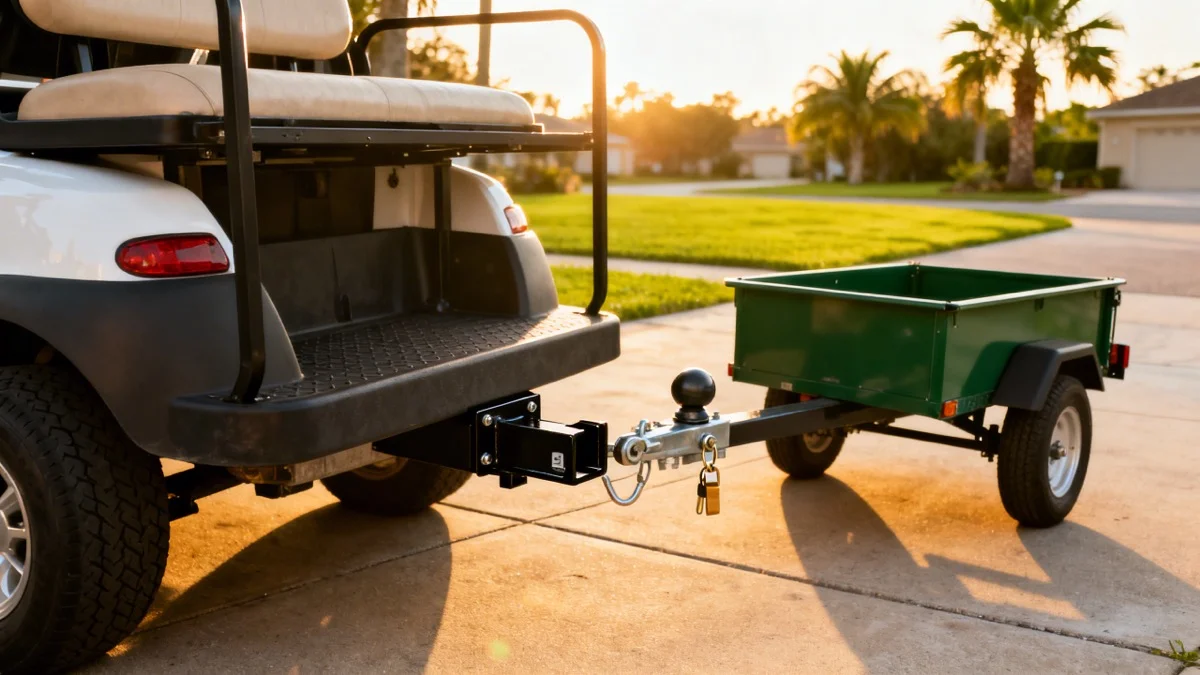
Most standard golf carts can tow about 300 to 800 lbs safely, while many gas carts and utility models can tow more when the manual allows it. For a normal electric neighborhood cart, keep trailer-plus-cargo weight around 300 to 500 lbs unless the owner manual gives a higher rating. A golf cart trailer hitch helps with light utility trailers, garden carts, kayaks, and campground gear, but braking and stability are usually the real limits.
If you use your golf cart on a large property, at a campground, or around a farm, you've probably wished you could haul more than what fits on the back seat. A trailer hitch solves that for $35 to $100, and installation takes under 30 minutes with basic tools.
The problem? No major brand ships a hitch from the factory, competitor articles only cover capacity OR hitches (never both), and nobody publishes a complete towing capacity table across brands. This guide fixes all of that.
Newer platforms often need a dedicated receiver instead of a Big 3 universal kit. Denago owners should check the Denago accessories guide before ordering because Rover XL and Nomad XL or XL6 receivers are sold as different products.
Golf Cart Towing Capacity Quick Chart
Use this as a starting point before hooking up a golf cart towing trailer.
| Cart type | Practical towing range | Best use |
|---|---|---|
| Standard electric golf cart | 300 to 600 lbs | Garden cart, small utility trailer, campground gear |
| Standard gas golf cart | 500 to 800 lbs | Yard work, light property hauling, small trailers |
| Lithium neighborhood cart | 300 to 600 lbs | Short flat routes where range loss is acceptable |
| Utility golf cart | 800 to 1,200+ lbs | Work properties, course maintenance, farms, large campuses |
| Golf cart with weak brakes or old batteries | Avoid towing | Fix the cart before adding trailer load |
The important phrase is total trailer weight. A 200 lb trailer carrying 400 lbs of mulch is a 600 lb towing load before passengers, cargo on the cart, hills, or wet grass enter the picture.
Golf Cart Towing Capacity by Brand
The first question every owner asks: how much can my cart actually pull? Here's a brand-by-brand breakdown based on manufacturer specs and real-world testing.
| Brand | Model | Electric | Gas |
|---|---|---|---|
| Club Car | Onward / Precedent | ~500 lbs | ~800 lbs |
| Club Car | Villager 2-passenger | 975 lbs | 675 lbs |
| Club Car | Carryall 500 (utility) | up to 1,200 lbs | up to 1,200 lbs |
| EZGO | TXT / RXV | ~500 lbs | ~800 lbs |
| EZGO | Liberty (ELiTE Lithium) | 500 lbs | n/a |
| Yamaha | Drive2 PTV | ~500 lbs | ~800 lbs |
| Yamaha | UMAX One/Two (utility) | 1,200 lbs | 1,500 lbs |
| ICON | i40 / i60 | ~500 lbs | n/a |
| Star EV | Sirius / Capella | ~500 lbs | n/a |
Most standard personal golf carts, regardless of brand, can safely tow 500 to 800 lbs. Utility models from Club Car and Yamaha are purpose-built for work and may rate around 1,200 to 1,500 lbs depending on the exact model. Current Club Car Carryall 500 materials list up to 1,200 lbs towing capacity, while Yamaha's UMAX One lists 1,200 lbs and UMAX Rally 2 lists 1,500 lbs.
Golf carts weigh 900 to 1,100 lbs on average. As a general rule, avoid towing more than the cart itself weighs, and stay well under that limit if you're on hills or rough terrain.
Factors That Affect Towing Capacity
The numbers above are maximums. Your real-world towing ability depends on:
- Motor type and power: A 48V system with a 5kW motor tows more confidently than a 36V with a 3kW motor. AC motors handle sustained loads better than DC motors.
- Terrain: Flat pavement is easy. Gravel, sand, grass, and hills all reduce effective capacity. Cut the rated capacity by 25 to 30 percent on rough ground.
- Tire condition: Worn or under-inflated tires reduce traction and stability under load.
- Passenger count: Two passengers add 350 to 400 lbs, leaving less capacity for the trailer.
- Battery condition: Old lead-acid batteries sag under heavy electrical loads. Fresh or lithium batteries maintain voltage and power better when towing.
Electric vs Gas: Which Tows Better?
Both can tow, but they handle loads differently.
Gas carts are the stronger towers. A gas EZGO or Yamaha puts out sustained power regardless of load, and refueling takes seconds. If you tow daily on a property, gas is the practical choice. Most gas carts handle 800 to 1,000+ lbs without straining.
Electric carts deliver strong initial torque, which helps get a loaded trailer rolling. But pulling a heavy load drains batteries much faster. Expect 20 to 40 percent less range when towing. A cart that normally gets 30 miles per charge might only manage 18 to 24 miles with a 500 lb trailer behind it. Lithium batteries hold up better under towing loads than lead-acid, both for range and longevity.
For light, short-distance towing under 500 lbs, electric works fine. For sustained hauling, gas or a UTV is a better fit.
For a full breakdown, see our electric vs gas comparison guide.
Best Golf Cart Trailer Hitches
No major golf cart manufacturer includes a trailer hitch from the factory. You need an aftermarket kit. Here are the four best options for 2026, tested across Club Car, EZGO, and Yamaha carts.
Best Overall: OMEIPMEO Universal Hitch Kit
The OMEIPMEO kit fits Club Car, EZGO, and Yamaha carts with a rear footrest. Heavy-duty steel construction with corrosion-resistant coating, a 2-inch receiver, and precision-aligned bolt holes for drill-free installation on most carts. The embedded locking mechanism prevents accidental trailer disengagement, a safety feature that cheaper options skip.
The kit ships complete: hitch, receiver, mounting brackets, dowel pin, steel clip, and all screws. About $35 to $50 and installs in 20 minutes.
Check Price on AmazonMost Popular: ELITEWILL Heavy-Duty Hitch
With over 600 reviews and a 4.5-star rating, the ELITEWILL is the most battle-tested option on Amazon. Slotted bracket holes accommodate footrest spacing from 10-5/8 inches to 11 inches, giving it the widest compatibility of any universal hitch. High-strength steel with rust-preventing primer.
One note: it sits slightly lower than some competitors, which reduces rear ground clearance by an inch or two. If you run off-road tires or have a lift kit, this won't matter. For stock carts on rough terrain, measure your clearance first.
About $80 to $100.
Check Price on AmazonBudget Pick: 10L0L Universal Hitch
10L0L makes affordable golf cart accessories and their universal hitch delivers at around $35 to $45. Standard 2-inch receiver, black powder coating, and universal fit for Club Car, EZGO, and Yamaha. They also offer model-specific versions for a more precise fit.
The trade-off at this price: some buyers report needing to slightly enlarge bolt holes for alignment. A step drill bit handles this in two minutes, but it's worth knowing before you start.
10L0L Universal Hitch on Amazon →Best Combo: ECOTRIC Hitch with Grab Bar
If your cart lacks a rear grab bar and you want a hitch, this combo kit solves both problems. The ECOTRIC pairs a 2-inch receiver hitch with a sturdy safety grab bar for rear-seat passengers. Reviewers describe it as "way over-built," which is exactly what you want in a towing setup.
About $50 to $70. The integrated grab bar adds structural rigidity to the hitch mount, making this the sturdiest universal option at its price.
ECOTRIC Hitch + Grab Bar Combo on Amazon →Quick Comparison
| Feature | OMEIPMEO | ELITEWILL | 10L0L | ECOTRIC Combo |
|---|---|---|---|---|
| Price | $35-50 | $80-100 | $35-45 | $50-70 |
| Receiver | 2" | 2" | 2" | 2" |
| Reviews | Newer | 600+ (4.5★) | Mixed | Strong |
| Grab Bar | No | No | No | Yes |
| Drill-Free | Yes (most carts) | Yes (most carts) | Sometimes | Yes |
| Best For | Value + quality | Proven reliability | Budget builds | Safety-first owners |
How to Install a Golf Cart Trailer Hitch
Most universal hitches bolt directly to the rear footrest or step plate. No welding, no fabrication. The job takes 20 to 30 minutes.
Tools required:
- Socket wrench set (1/2" and 9/16" are most common)
- Adjustable wrench
- Step drill bit (only if bolt holes need slight enlargement)
- Tape measure
- Thread-locking compound (recommended to prevent vibration loosening)
For a complete rundown of tools every golf cart owner should have, see our tool kit guide.
Step-by-step process:
- Measure your footrest bolt spacing. Most universal hitches fit 10 to 11 inches center-to-center. Measure yours before you start wrenching.
- Remove or flip the rear seat if it blocks access to the footrest bolts. On carts with flip seats, just fold the seat forward.
- Position the hitch brackets under the footrest, aligning the bolt holes.
- Insert bolts through the footrest and brackets using the included hardware.
- Slide the receiver tube into the brackets and secure with the provided pin and clip.
- Tighten all bolts to manufacturer specs. Apply thread-locking compound to prevent loosening from road vibration.
- Test the connection by pulling firmly on the receiver. There should be zero play or wobble.
What Can You Tow with a Golf Cart?
This table shows what golf cart owners actually tow, with realistic weight estimates and feasibility ratings:
| Item | Typical Weight | Feasibility |
|---|---|---|
| Small utility trailer (empty) | 100-200 lbs | Easy for any cart |
| Utility trailer + mulch or soil | 400-800 lbs | Gas or utility carts |
| Kayak on trailer | 80-150 lbs | Easy for any cart |
| Garden cart with tools | 150-300 lbs | Easy for any cart |
| Camping gear (RV park) | 200-400 lbs | Easy for any cart |
| Firewood load | 300-600 lbs | Moderate, flat ground |
| Small Jon boat on trailer | 400-700 lbs | Gas carts only |
| Riding mower on trailer | 500-800 lbs | Gas or utility carts only |
Popular use cases:
- Property and farm work: Hauling mulch, feed, fencing supplies, firewood, and tools. This is where a trailer hitch pays for itself in a single weekend. For dedicated farm setups, see our best golf carts for farms guide.
- Campgrounds and RV parks: Moving gear between sites, hauling supplies from the camp store, towing kayaks to the waterfront. See our portable golf carts for camping guide. If the load is one lightweight kayak or bulky soft gear, compare a small trailer against a golf cart roof rack for kayak and cargo use.
- Hunting: Hauling tree stands, decoys, game, and gear into the field. Our hunting golf carts guide covers full setups.
- Neighborhood hauling: Moving yard waste, landscaping materials, or supplies from the hardware store.
If you only need to carry smaller loads, a cargo box or basket mounted directly to the cart might be enough without adding a trailer.
What NOT to tow:
- Full-size boats or pontoons (too heavy, brakes cannot handle it)
- Vehicles or other golf carts (use a proper tow vehicle or tow bar system)
- Anything over your rated towing capacity
- Heavy loads on steep hills
Towing Safety: The Rules That Matter
Here's the thing experienced owners learn quickly: braking is the real limit, not pulling power. A 48V electric motor has plenty of torque to drag 1,500 lbs across flat ground, but your rear-drum brakes will struggle to stop that load on a downhill slope.
Golf carts only have rear-wheel brakes. No ABS, no engine braking (on most models), no four-wheel stopping power. A loaded trailer pushing from behind on a hill can overwhelm your brakes fast.
Speed: Stay under 10 mph with a loaded trailer. Under 5 mph on hills or loose surfaces. Your cart can go much faster unloaded, but speed plus a heavy trailer is a dangerous combination.
Weight distribution: About 10 to 15 percent of the total trailer weight should sit on the hitch ball (tongue weight). Too little tongue weight causes the trailer to sway side to side. Too much lifts the front wheels and reduces steering control.
Tire pressure: Check your tires before every towing session. Under-inflated tires reduce stability and increase blowout risk under load. Keep tires at the manufacturer's recommended PSI.
Pre-tow checklist:
- Hitch pin and clip are secure
- Trailer lights work (if equipped)
- Load is centered and tied down
- Total weight is under rated capacity
- Brakes are in good condition
- Tire pressure is correct on cart AND trailer
How Towing Affects Electric Cart Range
For electric cart owners, towing means fewer miles per charge. Here's what to expect based on battery type and load:
| Towing Weight | Range Reduction | 30-Mile Cart Gets |
|---|---|---|
| 100-200 lbs | 10-15% | ~25-27 miles |
| 300-500 lbs | 20-30% | ~21-24 miles |
| 500-800 lbs | 30-40% | ~18-21 miles |
Hills, headwind, and battery age make these numbers worse. Older lead-acid batteries lose voltage faster under heavy loads, compounding the range loss.
Tips to maximize range while towing:
- Keep speeds low (slower draws less power)
- Stick to flat routes when possible
- Charge to 100% before a towing run
- Consider a lithium battery upgrade if you tow regularly. Lithium packs maintain voltage under load much better than lead-acid and last 3 to 5 times longer.
Legal Considerations for Golf Cart Towing
Golf cart towing laws vary by state and are often vague. The general picture:
- Private property: No restrictions anywhere. Tow whatever you want on your own land.
- Public roads: If your cart is street-legal, most jurisdictions allow towing small trailers. Some states require the trailer to have taillights, reflectors, and a slow-moving-vehicle triangle.
- Golf cart communities: Communities like The Villages and Peachtree City often have their own rules about towing on cart paths. Check with your HOA or community management before hooking up a trailer.
For state-specific rules, check our golf cart laws page. If you're towing on public roads, consider adding golf cart insurance to cover liability.
When a UTV Makes More Sense
A golf cart with a hitch handles light to moderate towing well. But there's a point where a UTV is the smarter choice:
- You tow over 1,000 lbs regularly. UTVs handle 1,500 to 4,000+ lbs with proper brakes and suspension.
- You work on steep or rough terrain. UTVs have four-wheel brakes, higher ground clearance, and stronger engines.
- You need sustained high-speed towing. Golf carts should tow under 10 mph. UTVs handle faster speeds safely.
For light hauling under 500 lbs on relatively flat ground, a $50 hitch on your existing golf cart is far more practical than buying a $10,000+ UTV. If you do need a cart with more towing muscle, browse utility models on our dealer directory.
Maintenance Tips for Carts That Tow
Regular towing adds wear to specific components. Add these checks to your maintenance routine:
- Brakes: Inspect every 3 months if you tow weekly. Look for worn brake shoes, low fluid, and any pulling to one side. Details in our brake maintenance guide.
- Tires: Check pressure before each towing session. Rotate tires every 6 months. Replace tires showing uneven wear on the inside edges.
- Hitch hardware: Tighten all bolts monthly. Vibration from towing loosens hardware over time, and a loose hitch is a safety hazard.
- Suspension: Listen for new squeaks or clunks when loaded. Springs and shocks wear faster with regular towing.
- Batteries: For lead-acid systems, monitor water levels more frequently. Heavy electrical loads from towing cause faster water consumption through electrolysis.
Frequently Asked Questions
How much weight can a standard golf cart pull?
Most standard golf carts tow 500 to 1,000 lbs depending on whether they run electric or gas. Electric carts typically handle 300 to 600 lbs, while gas models manage 800 to 1,000 lbs. Utility models from Club Car and Yamaha reach up to 1,500 lbs. Always check your specific model's owner manual for the official rating.
Can I tow a jet ski with my golf cart?
It depends on the total weight. A lightweight jet ski and trailer together weigh 600 to 1,000 lbs. A gas-powered utility cart might handle a small jet ski for short distances on flat ground, but most standard carts cannot manage that weight safely. The bigger concern is braking: stopping 900+ lbs on a downhill boat ramp with rear-only brakes is risky.
How fast should I drive while towing?
Stay under 10 mph with a loaded trailer. On hills, uneven terrain, or loose surfaces, slow to 5 mph or less. The faster you go, the harder it is to stop, and golf cart brakes are not built for heavy towing at speed.
Does adding a trailer hitch void my golf cart warranty?
In most cases, no. Aftermarket hitches bolt on without modifying the frame or drivetrain. But if towing causes damage to the cart (burned-out motor, broken axle, stripped gears), the manufacturer may not cover the repair. Stay within the stated towing capacity and you should be fine.
What's the difference between a ball mount and a receiver hitch?
The receiver is the square tube that bolts to your cart. It's the permanent part. The ball mount slides into the receiver and holds the trailer ball. Most golf cart hitch kits include the receiver and mounting brackets. You may need to buy a ball mount and trailer ball separately, depending on the kit and your trailer's coupler size.
Should I get a universal or model-specific hitch?
Universal hitches fit most carts and cost less, but may need minor adjustments during installation. Model-specific hitches (available for the Club Car Precedent, EZGO TXT, and others) bolt on with zero modification and align perfectly. For the easiest install, go model-specific. For the best value, universal works well with a few extra minutes of fitting.
Golf Cart Search
Find the Best Golf Carts of 2026
Compare top-rated models, read expert reviews, and find the perfect cart for your needs.