As an Amazon Associate, we earn from qualifying purchases. This helps support our site at no extra cost to you.
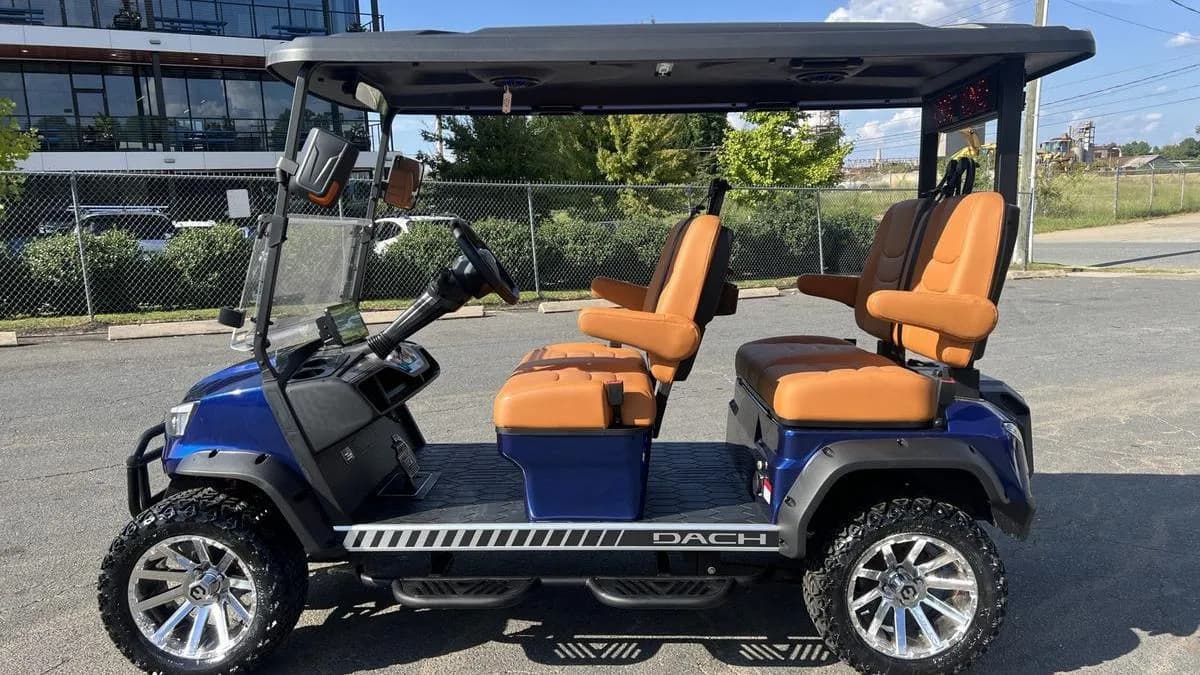
DACH golf cart reviews are getting more common because the brand is doing what newer cart makers have to do: show up with a lot of visible value right away. The Apollo and Falcon models bring 72V lithium power, 25 mph capability, automotive styling, big screens, cruise control, disc brakes, and modern lighting into a price range that sits below many premium legacy-brand carts.
The short verdict: DACH looks like a serious newer value brand, but it is not a blind buy yet. The specs are strong. The warranty is more specific than many buyers expect. The pricing is competitive. The open question is whether your local DACH dealer can support the cart as well as the brochure sells it.
This review covers DACH pricing, Apollo and Falcon specs, what the warranty actually says, the real DACH golf cart problems to watch for, and when DACH makes more sense than Denago, Evolution, ICON, Atlas, or a used Club Car, EZGO, or Yamaha.
Price Signal $9,995 to $14,580
Apollo Battery 73.6V 105Ah LiFePO4
Apollo Motor 72V 6.3KW AC
Top Speed 25 mph
Range Claim 50 miles at 19 mph
Biggest Risk Dealer depth
DACH Golf Cart Reviews: Quick Verdict
DACH is worth a test drive if you want a modern lithium neighborhood cart and your local dealer can prove they will service it. It is especially interesting if you like the Apollo's forward-facing 4-seat layout or the Falcon's 2+2 flip-seat setup.
The best reasons to consider DACH:
- 72V lithium system instead of a lower-voltage budget setup
- 25 mph speed class
- 12.3-inch screen with camera, media, CarPlay, and Android Auto functions listed in DACH materials
- front and rear disc brakes plus electronic parking brake on Apollo documentation
- cruise control, which is unusual in this category
- modern molded seats, soundbar, lighting, and wireless charging features
- pricing that undercuts many premium dealer-sold carts
The best reasons to slow down:
- DACH is still newer in the U.S. market than the Big 3 brands
- service and parts support are dealer-dependent
- resale value is still unproven
- some dealers describe warranty details more vaguely than the owner manual does
- street-legal use still depends on paperwork, not just equipment
My verdict: DACH is a strong local-dealer buy, not a brand I would order casually without a support plan. If there is a good DACH dealer nearby, the value is real. If support is thin in your area, compare it against a used Club Car, EZGO, Yamaha, or one of the more established newer brands first.
Who Makes DACH Golf Carts?
DACH is a newer electric golf cart and low-speed personal transportation brand. Its public brand deck describes DACH as operating manufacturing and design centers in Orlando, Florida and Rizhao, China. The same deck says the Orlando center handles styling and color research, production details tailored to North American preferences, transportation, dealer center operations, and after-sales service, while the China base focuses on technical research and chassis manufacturing.
CartFinder's 2026 DACH overview describes the U.S. side as Orlando-based assembly, quality control, customization, headquarters, R&D, and distribution, with key frames, chassis, and structural parts tied to Shanghai Dachi Auto Power Co., Ltd.
That puts DACH in the same general category as several newer golf cart brands: it has more structure than a random marketplace cart, but it does not yet have the decades of dealer density that make Club Car, EZGO, and Yamaha easier to own almost anywhere.
The practical takeaway is simple. Do not judge DACH only by where parts are sourced or where final work happens. Judge the dealer in front of you. Ask who handles warranty claims, how fast common parts arrive, whether their technicians have DACH training, and how many DACH carts they have already serviced.
DACH Golf Cart Prices and 2026 Models
DACH's current buyer-facing lineup is centered around the Apollo and Falcon families. Dealer naming can vary, so use the layout and equipment more than the exact trim label.
The DACH golf cart price range in 2026 runs from about $9,995 to $14,580 based on current dealer and marketplace signals.
| Model | Layout | 2026 Price Signal | Best Fit |
|---|---|---|---|
| DACH Falcon 2+2 | 2 forward, 2 rear-facing flip seat | about $9,995 | Value buyers who want cargo flexibility |
| DACH Falcon Ultra | 2+2 with higher-end equipment and solar canopy claims | about $11,880 | Buyers who want the Falcon layout with more tech |
| DACH Apollo Rider | 4 forward-facing seats | about $11,995 MSRP at Hartville | Families who do not want rear-facing passengers |
| DACH Apollo / Gen2 | 4 forward-facing seats, upgraded power-output feature on some trims | about $12,995 | Neighborhood buyers wanting the core Apollo package |
| DACH Apollo Elite | upgraded Apollo trim | about $13,980 | Buyers who want the premium Apollo setup |
| DACH Apollo 4+2 | 6 passenger | about $14,580 | Larger families and community shuttling |
Those price signals come from current dealer and marketplace research, including CartFinder's January 2026 pricing roundup and Hartville Golf Carts' Apollo Rider page, which shows a $11,995 suggested MSRP. Always ask for the full out-the-door number because freight, setup, documentation, tax, title, registration, accessories, and delivery can move the real bill.
If you are comparing DACH against the broader market, use our 2026 golf cart pricing guide, dealer fees guide, and best time to buy a golf cart before signing.
DACH Apollo Specs That Matter
The Apollo is the cleanest DACH model to analyze because the DACH Apollo owner's manual includes detailed specs.
| Spec | DACH Apollo |
|---|---|
| Battery | 73.6V 105Ah LiFePO4, 7.728 kWh |
| Controller | 72V 350A AC controller |
| Motor | 72V AC 6.3KW motor |
| Charger | 110V-240V / 20A onboard charger |
| Passenger capacity | 4 |
| Listed range | 50 miles at 19 mph constant speed |
| Max speed | 25 mph |
| Max load capacity | 758 lbs |
| Net weight | 1,420 / 1,389 / 1,378 lbs depending on configuration |
| Dimensions | 120 x 55.1 x 79.9 inches, with height varying by configuration |
| Wheelbase | 85 inches |
| Turning radius | 14.8 feet |
| Grade claim | 30 percent |
| Tires | 22x10-14 on aluminum alloy rims |
| Brakes | Front and rear disc brakes plus electronic parking brake |
| Suspension | Front independent double-arm, rear axle with trailing arm and spring shock absorber |
That is a strong spec sheet for the price class. The 72V system is the headliner, but the details that matter in daily use are the brakes, electronic parking brake, screen, rear camera, lighting, cruise control, wireless charging, and passenger layout.
If you are cross-shopping 48V and 72V carts, read our 48V vs 72V golf cart guide. The short version is that 72V usually gives stronger high-load performance and more headroom, but it can also make parts, chargers, and diagnosis more brand-specific.
What DACH Does Better Than Many Budget Carts
DACH's strongest argument is not one single feature. It is the combination of several things that make the cart feel less like a stripped golf-course platform.
72V Lithium Power
Many value carts sell themselves on lithium, but not all lithium carts feel equally strong under load. The DACH Apollo's 73.6V 105Ah battery and 6.3KW AC motor give it a more serious electrical foundation than a basic 48V lead-acid or entry lithium cart.
This does not mean it will outrun everything. It does mean the cart has the right kind of hardware for neighborhood hills, four passengers, and 25 mph road-use expectations. For the battery basics behind those numbers, read our golf cart batteries guide, battery voltage chart, and lithium conversion guide.
Forward-Facing Apollo Layout
The Apollo's four forward-facing seats are a real selling point for families. Rear-facing flip seats are useful, but they are not always ideal for kids, older passengers, or public-road use. If you want everyone facing forward, the Apollo is easier to defend than many 2+2 carts.
If you are still deciding on passenger capacity, start with our 2 vs 4 vs 6 seater guide.
Better Daily-Use Tech
DACH's Apollo brochure lists a 12.3-inch TFT LCD touch display with battery level, current, voltage, mileage, speed, error codes, reverse camera, media, light control, radio, CarPlay, and Android Auto functions. That is exactly the kind of feature list that makes the cart feel modern during a test drive.
The warning is that screens are not the same as support. A big display is great until it fails. Before buying, ask whether your dealer stocks screens, controllers, chargers, and body trim, or whether those parts require a long special order.
Cruise Control
DACH highlights cruise control as an unusual Apollo feature. That sounds minor until you use a cart for long neighborhood loops, large communities, resorts, or campground roads. It can reduce foot fatigue and make steady-speed driving easier.
I would not buy a cart only for cruise control. I would treat it as a nice differentiator if the dealer, warranty, ride quality, and price already make sense.
DACH Golf Cart Problems and Risks
Most DACH golf cart problems are not confirmed universal defects. They are ownership risks that come with buying a newer brand.
Dealer Network Depth
This is the biggest one. A new cart with a thin service network can become frustrating even if the vehicle itself is good. DACH is expanding, but it is not yet as easy to service nationwide as a Club Car, EZGO, or Yamaha.
Before you buy, ask:
- How long has this dealer carried DACH?
- Do they perform warranty work in-house?
- Which DACH parts do they stock?
- How long do controllers, screens, chargers, brake parts, body panels, and batteries usually take to arrive?
- Will they service the cart if you move or sell it?
If those answers are weak, shop the dealer directory and compare alternatives nearby before committing.
Warranty Is Parts-Focused
The DACH Apollo owner manual says the limited warranty covers parts only and applies to the original purchaser. It lists lifetime coverage for the frame, 5 years full replacement for the LiFePO4 battery on personal-use vehicles, 3 years on the controller, electric motor, and rear axle, 2 years on solar panels and most other parts, and 1 year on the windshield.
That is not bad. It is also not the same as saying every inconvenience is covered. The manual excludes routine maintenance, wear items, electrical damage from current fluctuations, unauthorized parts or accessories, non-approved electrical modifications, transportation to and from service locations, and several cosmetic or exposure-related items.
Commercial, rental, taxi, and excessive-use applications are treated differently. The manual says rental, taxi, or excessive-use battery warranty is six months and must be registered as such.
Resale Is Still Unknown
DACH does not yet have the used-market trust of Club Car, EZGO, or Yamaha. It also has less resale history than brands like ICON and Evolution. That does not mean resale will be terrible. It means you should not assume it will be strong.
If you might sell within three years, use our golf cart depreciation guide, trade-in vs private sale guide, and value calculator before you overpay for a new DACH.
LSV Paperwork Can Be the Deal Breaker
The Apollo spec sheet lists 25 mph, lights, turn signals, mirrors, windshield, seat belts, disc brakes, and electronic parking brake. Those are helpful road-use signals. They do not automatically make a DACH street legal in your state.
Under the federal low-speed vehicle standard, an LSV must meet specific equipment and speed rules. States and cities then add their own title, VIN, registration, inspection, insurance, and road-access requirements.
Before buying a DACH for public roads, verify:
- 17-digit VIN or other accepted title path
- MCO or MSO paperwork
- state registration path
- insurance availability
- local road speed-limit rules
- required mirrors, reflectors, windshield, wiper, horn, seat belts, and lighting
Use our street legal guide, LSV vs golf cart guide, golf cart registration by state guide, and state golf cart laws page before assuming any dealer's "street legal" label is enough.
DACH vs Denago, Evolution, ICON, and Atlas
DACH is not entering an empty market. It is fighting for the same buyer who is already looking at Denago, Evolution, ICON, Atlas, Advanced EV, Tomberlin, and cheaper direct-buy carts.
| Brand | Why It Might Beat DACH | Why DACH Might Beat It |
|---|---|---|
| Denago | Stronger current warranty story on core models and growing dealer visibility | DACH Apollo gives a compelling forward-facing 4-seat 72V option |
| Evolution | More established value-brand footprint and lots of owner discussion | DACH may feel fresher and more automotive inside |
| ICON | Broader known dealer network in many markets | DACH's 72V package and Apollo layout may appeal more |
| Atlas | Stronger premium safety and warranty claims on current models | DACH usually comes in cheaper and still feels tech-heavy |
| Advanced EV | More familiar in some dealer markets | DACH looks more modern and feature-dense in the Apollo/Falcon class |
The right answer is local. If the DACH dealer is strong and the price is right, DACH belongs on the short list. If the local Denago, Evolution, or ICON dealer is clearly stronger, the safer buy may not be the cart with the flashiest test drive.
Should You Buy a DACH or a Used Big 3 Cart?
This is the hard comparison. A new DACH can look like a better deal than a used legacy cart because the screen, seats, lights, lithium battery, and speed all feel more modern.
A used Big 3 cart can still be smarter if you care about:
- parts availability
- independent shop familiarity
- resale value
- simpler electrical diagnosis
- proven frame and drivetrain history
- a larger used-buyer pool
A clean used Club Car Onward, EZGO RXV, or Yamaha Drive2 may feel less flashy, but it can be easier to own for ten years. That is especially true if your local DACH support is new or thin.
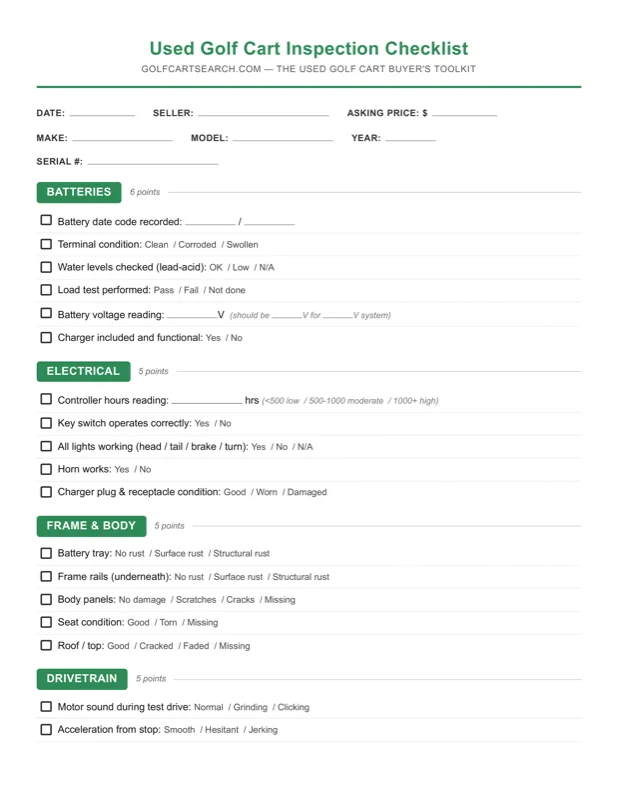
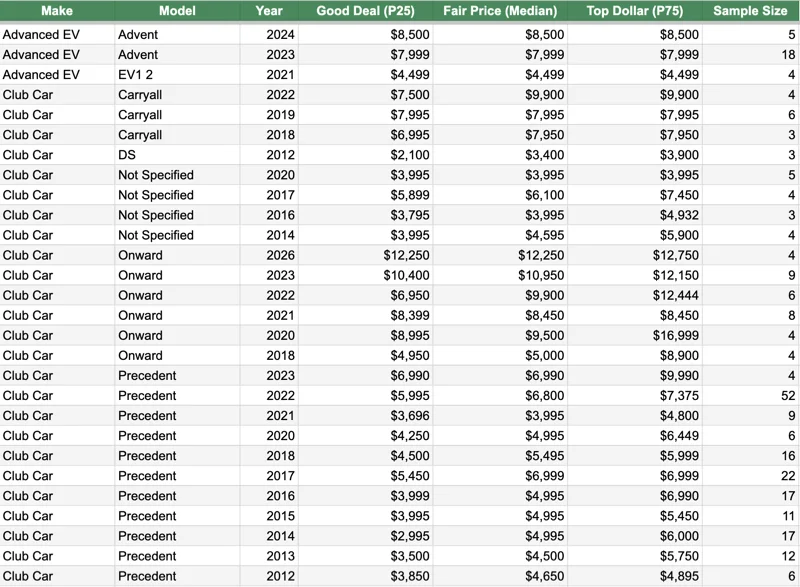
If you are shopping used, read our used golf cart buying checklist, used prices by brand, and used golf carts for sale by owner guide. You can also browse used golf carts for sale to compare real local alternatives.
Amazon and Direct-Buy Alternatives
DACH is dealer-focused, but many DACH shoppers are really asking a bigger question: should I buy a newer value cart instead of a used legacy cart?
If you want a direct-buy benchmark, the Kandi GOAT 2P is a useful comparison because it is a known direct-buy cart with a 48V 150Ah lithium pack and 40-mile range claim, though it is currently unavailable on Amazon. It is a 2-passenger choice, not a DACH Apollo replacement, but it gives you a direct-buy price anchor.
See our full Kandi GOAT 2P breakdown
If portability matters more than passenger space, the Kandi Collapsible Mini is the opposite kind of answer: smaller, cheaper, and easier to store, but not a full-size neighborhood family cart.
See our full Kandi Collapsible Mini breakdown
If you want another full-size online model to research, compare the SDLANCH SDLGC80 before deciding whether local dealer support is worth paying more for. Its Amazon listing showed an in-stock offer around $9,800 on August 18, 2026.
Check SDLANCH SDLGC80 availabilityFor the broader risks of ordering a full-size cart online, use our Amazon golf carts guide. Delivery, inspection, paperwork, and service support matter more than the checkout button.
Best DACH Accessories to Add First
DACH already loads the Apollo and Falcon with more tech than a basic cart, so do not rush into a pile of add-ons. Start with the boring items that protect the cart and make it easier to live with.
Best first upgrades:
- fitted floor mats for your exact model
- a quality cover if the cart sits outside
- insurance and registration documents stored in a waterproof pouch
- a tire pressure gauge
- wheel chocks for garage charging and maintenance
- a magnetic or clamp phone mount if you use maps around a community
The A2C magnetic alloy phone holder solves a daily-use problem without touching the cart's electrical system, but its base requires a square iron roof strut that passes a magnet test. Use a clamp or strap mount if the DACH support is aluminum, plastic, or round.
Check Phone Mount Price on AmazonFor bigger upgrades, use our golf cart accessories guide, floor mats guide, covers guide, and GPS tracker guide.
Who Should Buy a DACH Golf Cart?
Buy a DACH if most of these are true:
- you have a real DACH dealer nearby
- the dealer can handle warranty and parts in-house
- you want a 72V lithium cart
- you like the Apollo forward-facing seating or Falcon flip-seat layout
- you plan to keep the cart long enough that resale is not the main concern
- the out-the-door price beats comparable Denago, Evolution, ICON, Atlas, and Big 3 options by a meaningful amount
Skip DACH, or at least slow down, if:
- no local shop will service it
- the dealer cannot explain warranty terms clearly
- you need the safest resale value
- you plan to drive on public roads but paperwork is unclear
- you are buying used and cannot verify battery health
- you mainly want a proven, easy-to-repair cart
For public-road buyers, I would also compare DACH against our best street legal golf carts and check golf cart insurance requirements. A good test drive does not replace a clean title, VIN, registration, and insurance path.
DACH Golf Cart Buying Checklist
Before you buy a new or used DACH, get clear answers to these questions:
- What exact model and trim is on the quote?
- Is the battery the 73.6V 105Ah pack or a different configuration?
- Is the cart delivered as a golf cart, LSV, or neighborhood vehicle?
- Is a VIN, MCO, MSO, or title document included?
- What is the full out-the-door price?
- Who handles warranty labor?
- Are transportation costs to the dealer covered?
- Which parts does the dealer stock?
- How long do screens, controllers, chargers, brake parts, and body panels take to arrive?
- Is the battery warranty still valid if you add accessories?
- What happens if you move out of the dealer's service area?
- For used carts, can the seller document battery health and service history?
If the dealer answers those clearly, DACH becomes much easier to consider. If the answers are vague, the cart might still be good, but the ownership risk is higher.
FAQ: Are DACH golf carts any good?
DACH golf carts look good for buyers who want a modern, tech-heavy 72V lithium cart at a lower price than many premium alternatives. The Apollo spec sheet is strong, with a 73.6V 105Ah LiFePO4 battery, 72V 6.3KW AC motor, 25 mph speed, disc brakes, electronic parking brake, and a 50-mile range claim at 19 mph. The real question is local service support.
FAQ: Who makes DACH golf carts?
DACH markets itself as a newer low-speed personal transportation brand with Orlando, Florida operations and Chinese engineering and chassis manufacturing support. CartFinder describes DACH carts as assembled in Orlando with key structural components supplied by Shanghai Dachi Auto Power Co., Ltd. The practical ownership question is still local dealer support.
FAQ: How much does a DACH golf cart cost in 2026?
Expect current 2026 DACH price signals from about $9,995 for the Falcon 2+2 to about $14,580 for the Apollo 4+2. Hartville Golf Carts lists the Apollo Rider at $11,995 suggested MSRP. Ask for the final out-the-door price because freight, setup, tax, title, registration, delivery, and options can change the total.
FAQ: What DACH golf cart models are available?
The core 2026 DACH lineup includes the Apollo, Apollo 4+2, Falcon 2+2, and upgraded trims such as Apollo Elite or Gen2 and Falcon Ultra. The Apollo is the forward-facing 4-seat platform, the Apollo 4+2 adds rear-facing seats, and the Falcon uses a 2+2 rear flip-seat layout.
FAQ: What is the DACH Apollo battery and motor?
The DACH Apollo owner manual lists a 73.6V 105Ah LiFePO4 battery rated at 7.728 kWh, a 72V 350A AC controller, and a 72V 6.3KW AC motor. It also lists a 110V-240V 20A onboard charger.
FAQ: How fast does a DACH golf cart go?
The DACH Apollo owner manual lists a 25 mph maximum speed. That puts it in the same speed class as many neighborhood LSV-style carts, but street legality still depends on title, VIN, insurance, equipment, and local rules.
FAQ: How far can a DACH golf cart go?
DACH lists a 50-mile Apollo range claim at 19 mph constant speed. Real-world range will be lower with hills, full passenger load, aggressive tires, cold weather, high speed, accessories, and stop-and-go neighborhood use.
FAQ: What is the DACH golf cart warranty?
The DACH Apollo owner manual lists a lifetime frame warranty, 5-year full replacement warranty on the LiFePO4 battery for personal-use vehicles, 3 years on the controller, electric motor and rear axle, 2 years on solar panels and most other parts, and 1 year on the windshield. Commercial, rental, taxi, and excessive-use applications are treated differently.
FAQ: What are the biggest DACH golf cart problems?
The biggest DACH concerns are dealer support, parts access, warranty exclusions, resale value, and paperwork clarity for road use. There is not enough long-term owner data yet to point to one universal mechanical failure across every DACH cart.
FAQ: Is DACH better than Denago, Evolution, or ICON?
DACH may be more appealing if you want 72V power, automotive styling, cruise control, and an Apollo forward-facing layout. Denago, Evolution, and ICON are usually safer if your local dealer network, resale confidence, and parts availability are stronger for those brands.
FAQ: Is a DACH golf cart street legal?
It depends on configuration and paperwork. A 25 mph cart with lights, mirrors, windshield, turn signals, seat belts, and parking brake may have the equipment profile buyers expect, but you still need the right VIN or title path, registration, insurance, and local approval.
FAQ: Should you buy a used DACH golf cart?
Be cautious. A used DACH can make sense if the discount is meaningful, the battery health is documented, the warranty status is clear, and a nearby dealer will support it. If not, a used Club Car, EZGO, Yamaha, ICON, Denago, or Evolution may be easier to own.
Golf Cart Search
Find the Best Golf Carts of 2026
Compare top-rated models, read expert reviews, and find the perfect cart for your needs.